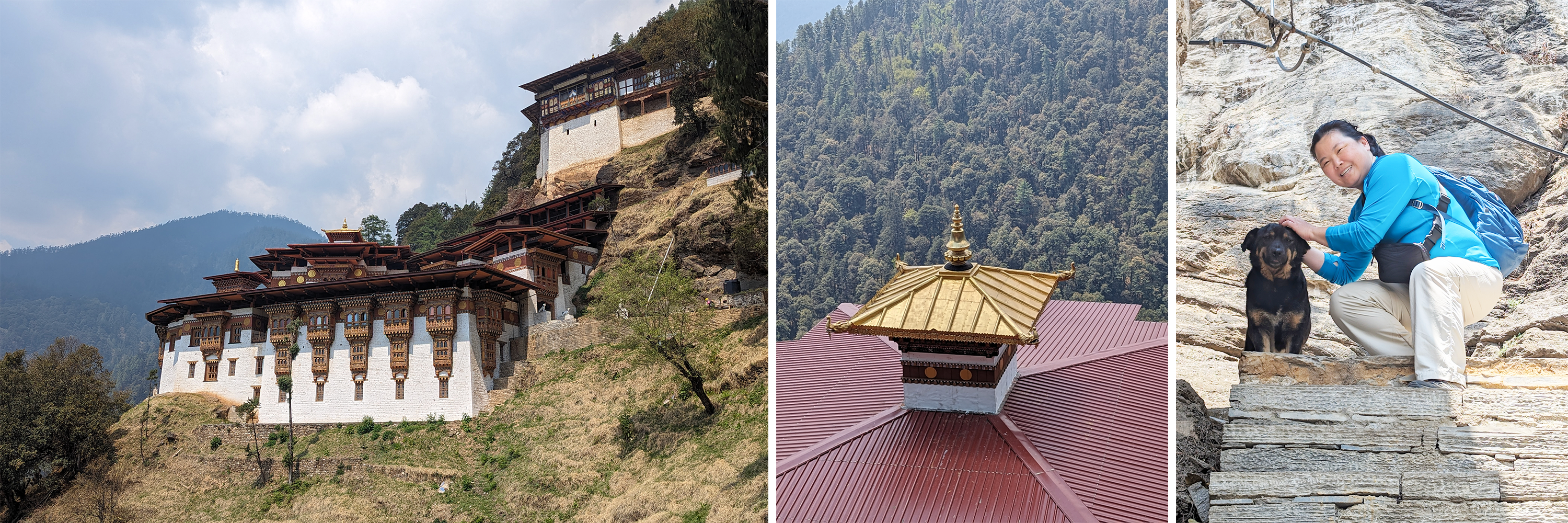
Punakha Valley

Punakha

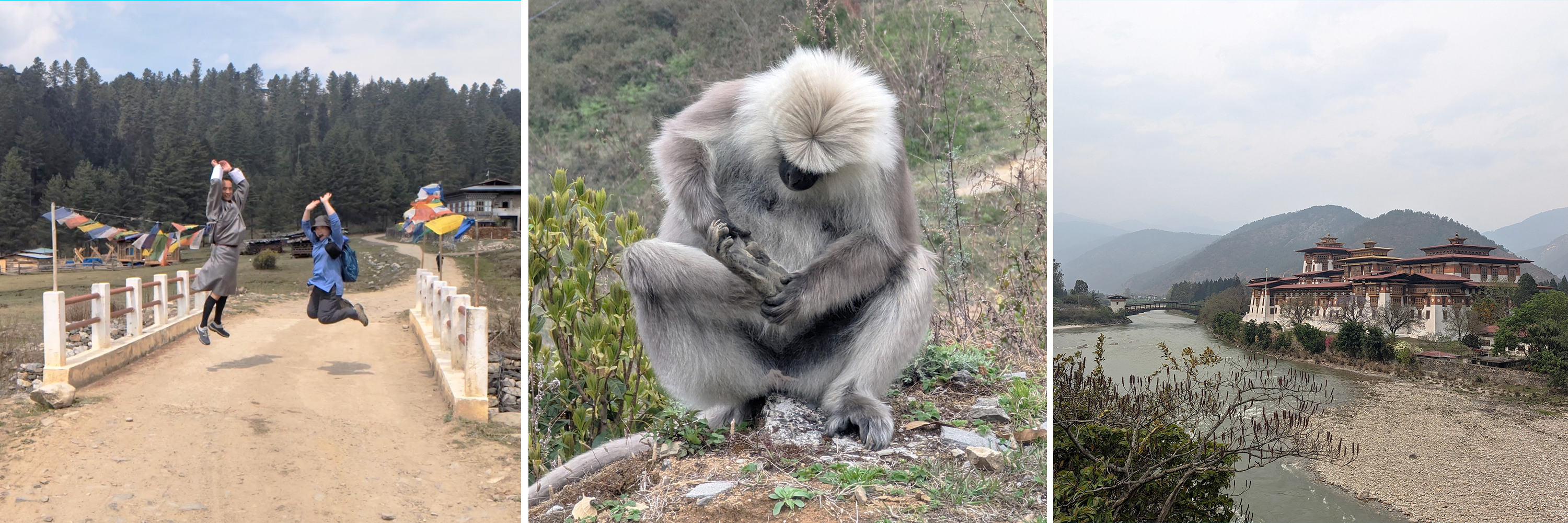
The last time I wrote, we were in Phobjikha Valley. After a lovely nature walk, we started our drive and our guides spotted a lively bunch of langur monkeys hanging out on the side of the road. They didn’t hang out for long, but one of them stopped to examine something stuck in its toes. It pulled out whatever was bothering it and put this toe treasure in its mouth. Apparently, tasty morsels can be found everywhere, if you’re a monkey. Eventually, we arrived in Punakha and we stopped to see the dzong, which was built on the scenic convergence of two rivers: Pho Chu (Male River) and Mo Chu (Female River).

Angela and Tenzin jumping in Phobjikha, en route we ran into some langur monkeys picking things out of their feet and eating them, the stunning Punakha Dzong

Although I think the Trongsa Dzong might actually still be more beautiful on the inside, the riverside setting of the Punakha Dzong makes its exterior more photogenic. The main temple inside the Punakha Dzong is quite large. This temple is where many ceremonies involving the royal family take place since it’s the only one large enough to accommodate all the invited guests. The outside of the temple is filled with intricate carvings and the inside is covered in paintings depicting Buddha’s life. Photography is prohibited inside all religious buildings.

beautiful wooden carvings on the main temple inside the dzong that is used for official purposes, Punakha Dzong lit up at night

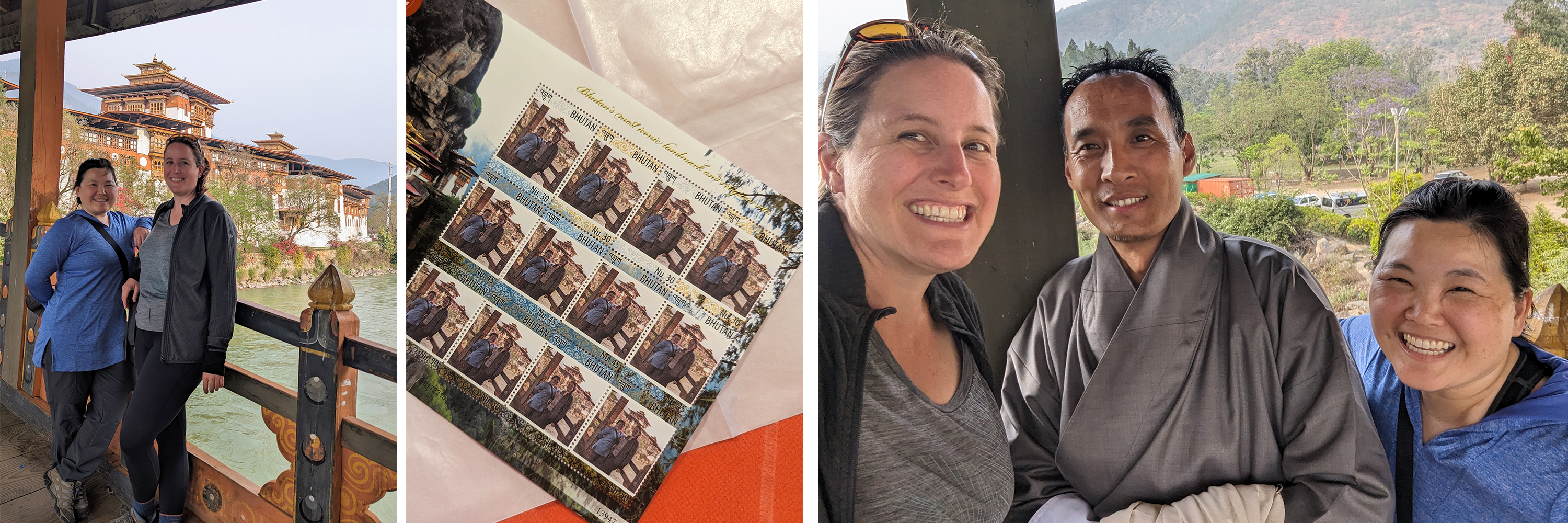
In order to get to the dzong, everyone crosses over a very scenic bridge over the river. Although we contemplated jumping on the bridge, there were a lot of people around and we didn’t want to seem disrespectful. Instead, we all posed for very tasteful photos with the dzong in the background. In the capital city of Thimphu, it is possible to have stamps made with a photo of your choice. We thought they just took a photo, but instead, we were asked to transfer a photo over from a phone. This was one of the most recent and cutest photos we had taken, so we purchased a couple sheets of stamps and a pile of postcards to send to family and friends. If you got one, consider yourself lucky, because those stamps had an extremely limited run of only 24.

outside of Punakha dzong; same photo made into stamps we sent home with our faces on them; me, Tenzin & Angela on the bridge

Divine Madman

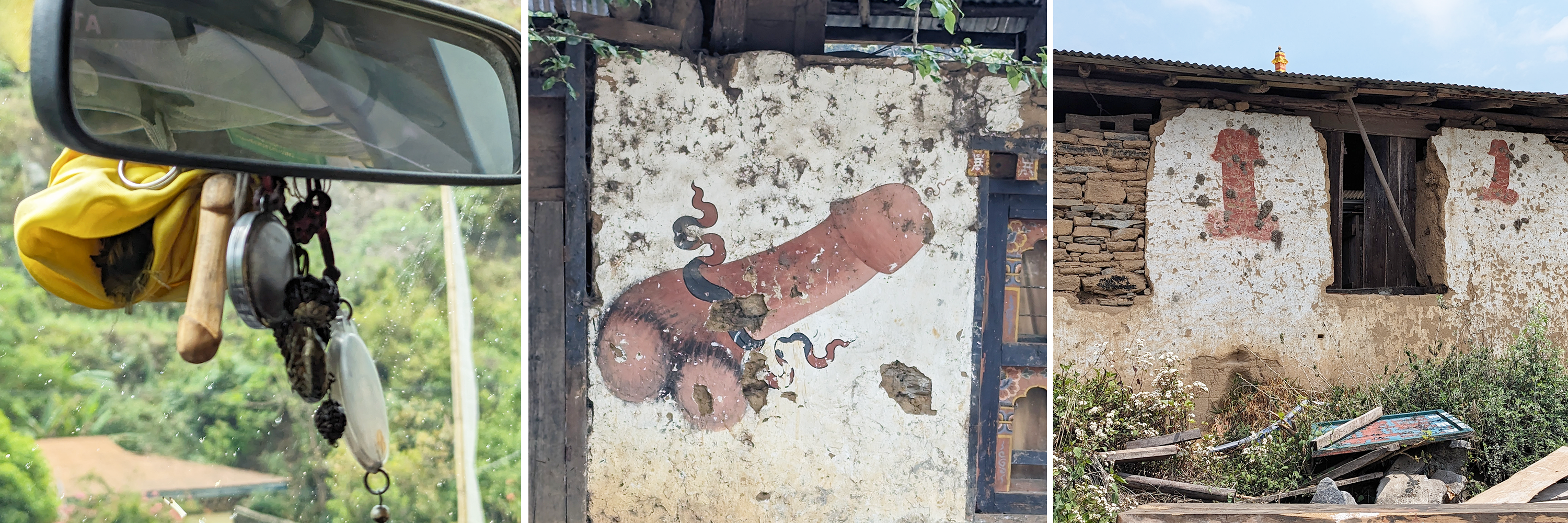
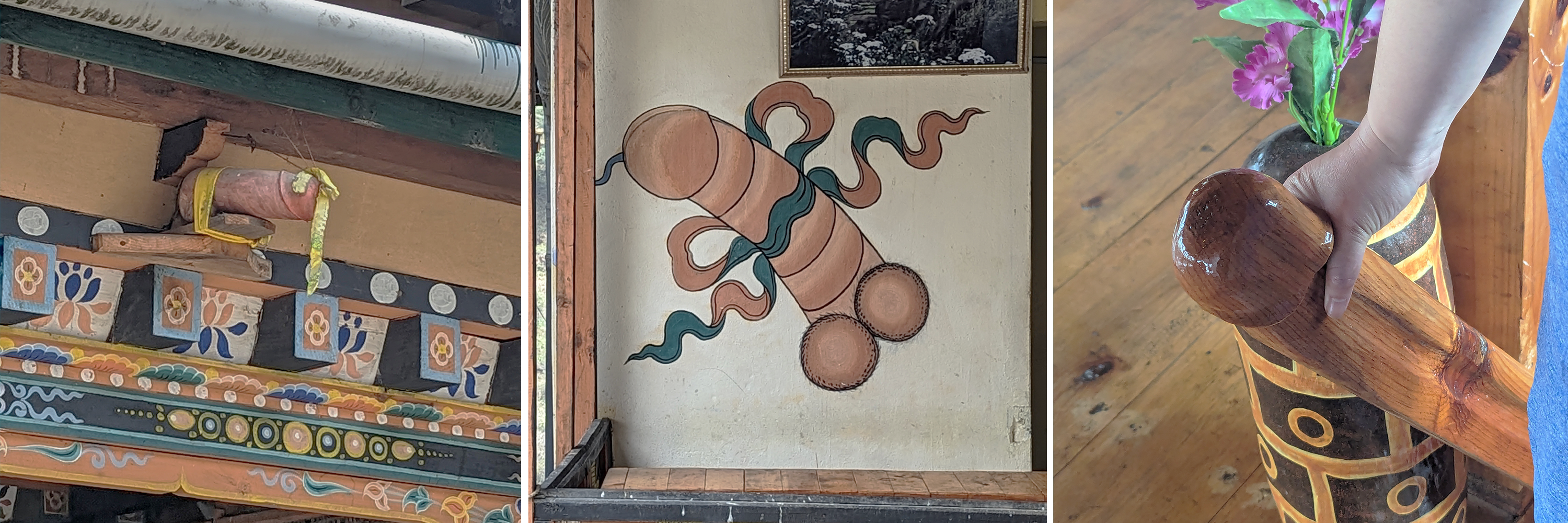
It doesn’t take long to notice that there are a lot of phalluses in Bhutan. They’re hanging from rooftops, painted on buildings, and used to bless tourists at festivals. Of course, there’s a story behind this, and it features a notorious monk named Drukpa Kunley, also known as the Divine Madman. He is usually depicted in paintings as having long hair, a bow and arrow, huge rings in his ears, and a hunting dog nearby. He was born in 1455 int Tibet and trained in a monastery before he later renounced his vows and took a wife.

The Divine Madman was a wandering Buddhist teacher, who started lecturing about different ways to reach enlightenment that included a lot of alcohol and sex. He used his Thunderbolt of Flaming Wisdom (a.k.a. his phallus) to subdue demons, in some cases by sticking it in their mouths. There are many stories about him seducing married women, and then their jealous husbands are converted to his ways and become an ardent follower of his teachings.

There are also stories of a Buddhist nun getting pregnant and having his child. However, the other nuns are jealous, but about a year later, there are a bunch of babies in the monastery, presumably from a very busy Drukpa Kunley. It’s easy to see why he’s associated with fertility in today’s Bhutan. Many people flock to Punakha to visit his temple, known as Chimi Lhakhang, to receive blessings and pray to have a child. There is an entire album of photographs inside the temple of people with their children they conceived after they visited. Those children are often given the name Kunley (after the monk) or Chimi (after the monastery).

good luck phallus in the car, intricate phallus painting on a storefront, double phallus decorations in a village

Today, the phalluses all over the county are meant to ward off evil spirits and malicious gossip. They are often hung from the eaves of the roof once a home is built. The paintings often depict phalluses with a string wrapped around the middle. Apparently, someone gave the Divine Madman a sacred thread to wear around his neck. However, he instead tied it around his phallus and said he hoped it would bring him luck with the ladies.

two crossed phalluses hanging from the corner of a house, painted phallus, handrail phallus carving

Although this phallic obsession is attributed to the Divine Madman, there’s been some research that shows that phalluses played a central role in the Bon religion, the animistic religion practiced in Bhutan before Buddhism became so widespread. Regardless of their origin, they continue to be a vital part of Bhutan’s cultural traditions today.

Bhutanese Food

Eezay

The most important part of every Bhutanese meal is a small dish of chilies, known as eezay. There are many different varieties of eezay. Some are nothing more than piles of red chilies; others are mixed with cilantro and other herbs. Often, the restaurant food caters to Western tourists that prefer their food on the blander side. I, however, prefer my food with a little more spice and by the last week of the trip, I just asked for a dish of eezay at every meal.

bag of chillies at the Paro market, old school giant mortar and pestle used for crushing chilies, side dish of eezay

Food in Eastern Bhutan

The food from our homestay in Merak was delicious. Every morning, we got thueb, red rice porridge with little cubes of paneer (homemade cheese). We also got a pile of fried red rice, a hard-boiled egg, and a cup of butter tea.

On our day-long Merak-Sakteng trek, our porters carried lunch for us and I got my first taste of my favorite Bhutanese food, nakay datshi. This is a dish made of fiddleheads, the fronds of the fern before they unravel in the spring. I’ve definitely eaten fiddleheads in the United States, but they’re pretty rare and often just sauteed in a simple butter sauce. These were cooked in a cheese sauce with chilies; something about this flavor combination is extremely satisfying. Datshi means cheese in Dzongkha and is featured in many dishes in Bhutan. For example, kewa datshi is potatoes with cheese (kewa means potato) and shamu datshi is mushrooms with cheese (shamu means mushroom). The amount of chillies in each dish depends on the preference of the chef.

Merak trek food (clockwise from left): eggs, mixed vegetables, eezay (chillies), rice, and nakay datsay; Angela getting her daily portion of thueb; drinking butter tea

Food in Central Bhutan

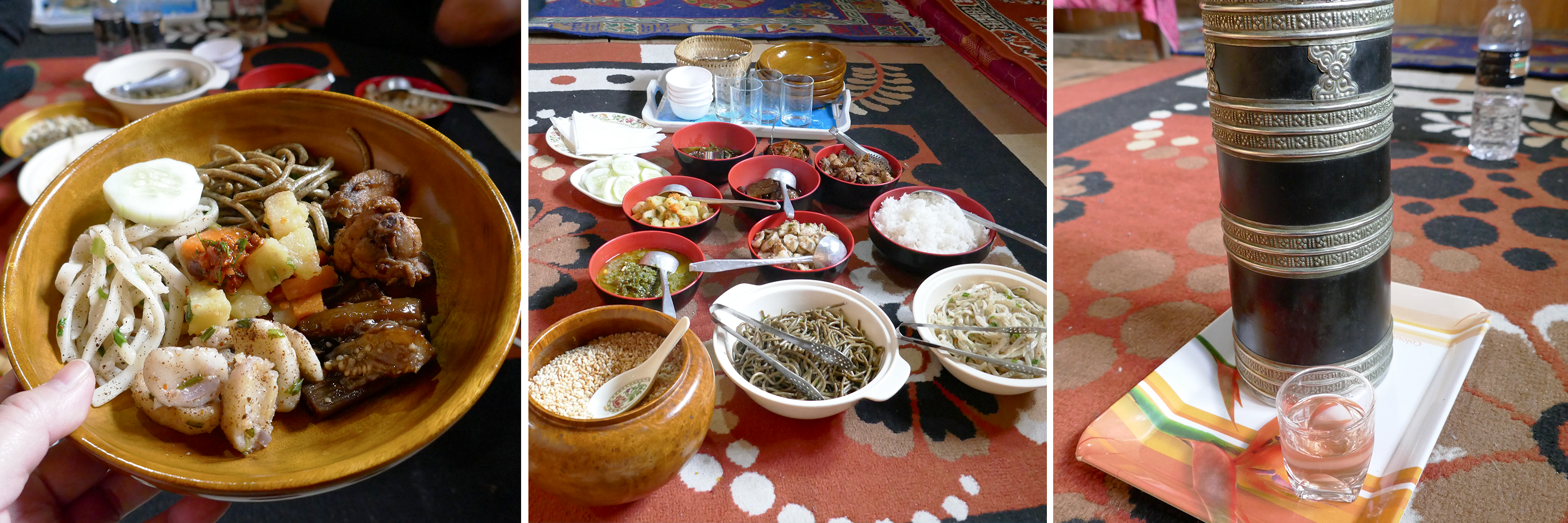
For lunch on our temple tour day, Tenzin took us to a local homestay that served a huge spread of food. We started with milk tea and then we tossed in some puffed rice (think Rice Krispies) for some added texture. Bumthang is known for buckwheat, so we got to sample long, skinny buckwheat noodles as well as two kind of wheat noodles: long, flat ones and short, fat pinched ones. We also drank some ara, the local moonshine which in this area had been brewed with sandalwood, giving it a slight pinkish tint.

Angela’s lunch plate full of noodles, the whole spread, and a traditional ara serving vessel with a glass of ara in front

In Bumthang, we also ate some delicious buckwheat pancakes for breakfast, smothered in local honey. Somewhere along the way, Tenzin figured out that Angela loves dumplings, so for a few dinners we ate a bunch of vegetable and potato dumplings. While we were in Phobjikha Valley, we ate kapchi, roasted wheat flour egg drop soup. Apparently this is a common soup to eat when you’re feeling sick and it was a surprisingly satisfying first course.

delicious buckwheat pancake, momo (dumplings), kapchi (toasted wheat soup)

Olo Choto

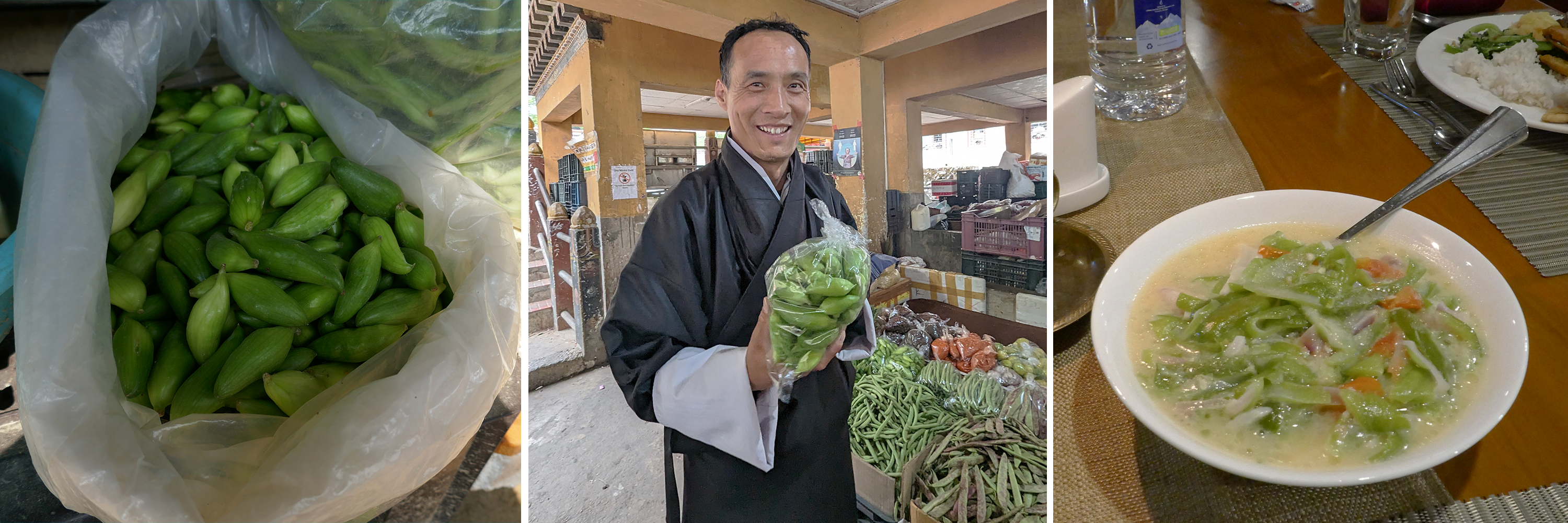
I had never seen this vegetable before in my life. Locally, it’s known as crow’s beak due to its shape. Tenzin showed it to us when we started our trip in Paro and both Angela and I had lots of questions about how people prepare it. She went down an internet rabbit hole and found out that there is a related variety that grows in Peru and Bolivia known as achocha.

We were walking through the Trongsa market and when we saw it again and we both started talking about how we wanted to try it, but it had to be cooked. Tenzin overheard us and was like, I’ll buy you some olo choto and I’ll have the hotel make it for dinner. In the car, we started discussing having an olo choto party and we were all laughing so hard. The hotel staff were kind enough to prepare the olo choto with cheese and chili. It was a delicious dinner and our guide and driver got to share in the olo choto fun as well.

pile of olo choto, Tenzin proudly showing off his purchase, prepared olo choto datshi

Best Meal of the Trip

For me, one of the best meals we had on our trip was on our way out of Thimphu. I kept asking Tenzin to find a place with some nakay datshi and he totally hooked us up. We started with a cup of milk tea (butter tea was also an option) with puffed rice (zao in Dzongkha). Then we were served a simple pumpkin soup before a bunch of different dishes arrived.

First up was ema datshi, which is practically the national dish of Bhutan. Ema means chilli in Dzongkha and this is a dish made of chilies and cheese, with different amounts of soupiness depending on the part of the country (I personally think the less soupy version is a bit better). This time of year, green chillies are the main ingredient. Next came my favorite nakay datshi, made with the seasonal fiddleheads mentioned earlier. There were also scrambled eggs, kewa datshi (potatoes and cheese), and the ever-present dish of eezay. We also were served Bhutanese red rice, which still has part of the bran left on the outside of each kernel. It has a slight nutty flavor and has quite a bit more nutrients than white rice. Interestingly, red rice is the only food item that the United States imports from Bhutan.
fiddleheads (nakay) at the market, one of the best meals we had in Thimphu (clockwise): red rice, eezay, nakay datshi, kewa datshi, eggs, ema datshi

Special thanks to Angela for providing most of the photos in this post!

Trongsa & Phobjikha Valley

Trongsa Dzong

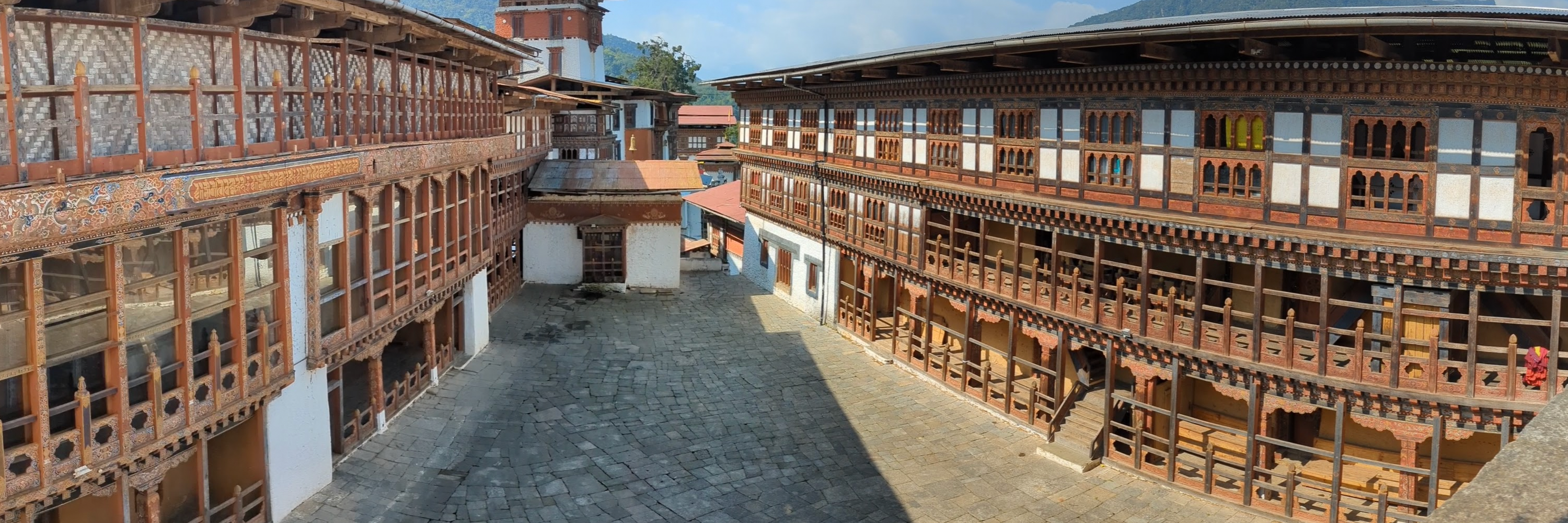
When I started reading about traveling to Bhutan, the word dzong kept showing up over and over again in the guidebooks. The most commonly used English translation is fortress, but it’s a bit more than that. Although they originally served as fortifications, they also hold both the administrative offices for the government as well as separate sections for monasteries. In other words, dzongs run both the secular and non-secular aspects of the region. The Trongsa Dzong became one of the most important ones due to its location near the middle of hte country. Whoever ruled Trongsa (called the Penlop), controlled the taxation of goods from one part of the country to another. The role of Penlop of Trongsa is traditionally given to the heir apparent and was last held by the current king of Bhutan before he assumed the throne.

outside of Trongsa Dzong, inside of Trongsa Dzong, view from top of Trongsa Dzong

The inside courtyard is expansive. We briefly got to meet Tenzin’s uncle, who has been a monk at the monastery here for many years.

panoramic view of Trongsa Dzong courtyard

One of the aspects of Bhutan that is so extraordinary is the amount of art that is incorporated into both public and private construction. This artistry is supported and promoted by the government. Dragons often adorn the pillars of temples. Prayer bells line the outside of temple walls. The four mythical creatures are carved and painted into various motifs. The art is everywhere, and it is exquisitely executed.

details inside Trongsa Dzong: dragon, prayer bells, garuda

wood carving over a door showing the four mythical Bhutanese animals: tiger, snow lion, dragon, and garuda

Tshangkha Village

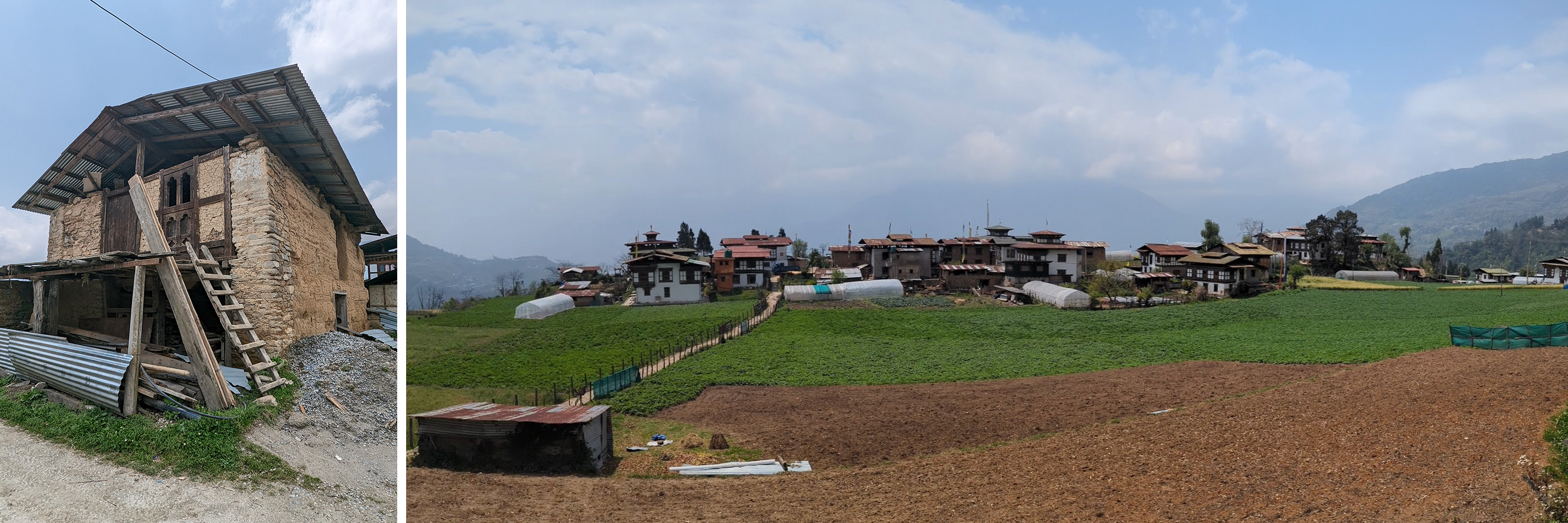
The same day, Tenzin took us to Tshangkha, the small village where he grew up. We got to meet his brother, his mother, and a bunch of other extended relatives. From the photo below, you can see it is a rather small village, with lots of fields filled with crops. Most people who grew up in the village have moved to Thimphu, the capital, which has more job opportunities. They make money in the city and then build nicer houses for the relatives that remain in the village, so there’s a lot of new construction going on in Tshangkha.

old mud house, view of village from the local temple

Phobjikha Valley

I had picked up a book of Bhutanese folktales and was reading them during our travels. One of the stories was about the fastest messenger who used to run messages from Trongsa to Wangdue for the king. He was so tired from running all the time that one day as he was running, he wished that he would die. Afterwards, as he passed by a river, he saw a woman washing the entrails of an ox in the water, but he didn’t understand how that was possible since there was no villages nearby. He completed his delivery to the king, and then promptly went to his room and fell asleep, never to wake up again. The woman was actually a demoness named Nyala who was actually washing his entrails (he was the sign of an ox). Eventually, the Nyala demon was subdued and the Chendebji Chorten was built upon its remains. I happened to read this story and then the very next day, we ended up visiting the chorten. It’s built in the Nepalese style, with eyes painted on the top of the stupa.

Tenzin also bought us to some fermented yak cheese to try, which honestly has just a faint taste of cheese to it. I mostly noticed how rock hard it was and how long it took to break down. I chewed on my cube for almost an hour and I think it took Angela at least two hours to get through hers. Good for exercising your jaw muscles, but maybe not my new favorite snack.

We took a brief stop at a black-necked crane center, which cares for two cranes that can’t be released into the wild. The migrating cranes stop here in the autumn months and fill up the entire Phobjikha Valley. There’s an entire festival for the cranes, and one of the dances involves people dressing up in crane costumes. Currently these cranes are vulnerable, but not endangered. I also learned there are only 15 different species of cranes around the world (I think I’ve seen at least 3 in the wild).

Chendebji Chorten (where Nyala was subdued), fermented yak cheese, black-necked crane

Gangtey Goemba

Most Buddhist temples in Bhutan are overseen by the government-supported Commision for Monastic Affairs headed by the Je Khenpo, basically the chief monk. However, there are still a few that are privately operated and this is one of them. Pema Lingpa (the chainmail-making, treasure hunting guy from the last blog post) visited this area and prophesied that his descendants would build a monastery here. His grandson actually built the first monastery, but is has been expanded several times over the generations. Fun fact: the current royal family actually traces their ancestry back to Pema Lingpa.

This monastery is located quite close to the nesting cranes of the aforementioned black-necked cranes. People say that they circle the monastery three times when they arrive and then repeat these three circles when they return to Tibet to breed in the summer. It gets quite a few visitors and went through a long renovation, where the paintings inside were redone and the outside decorations spruced up. Photo taking is only allowed outside of temples, out of respect for religious practices. Click on the photo to enlarge it to see all the fantastic details.

beautiful prayer wheels and temple decorations

Central Bhutan

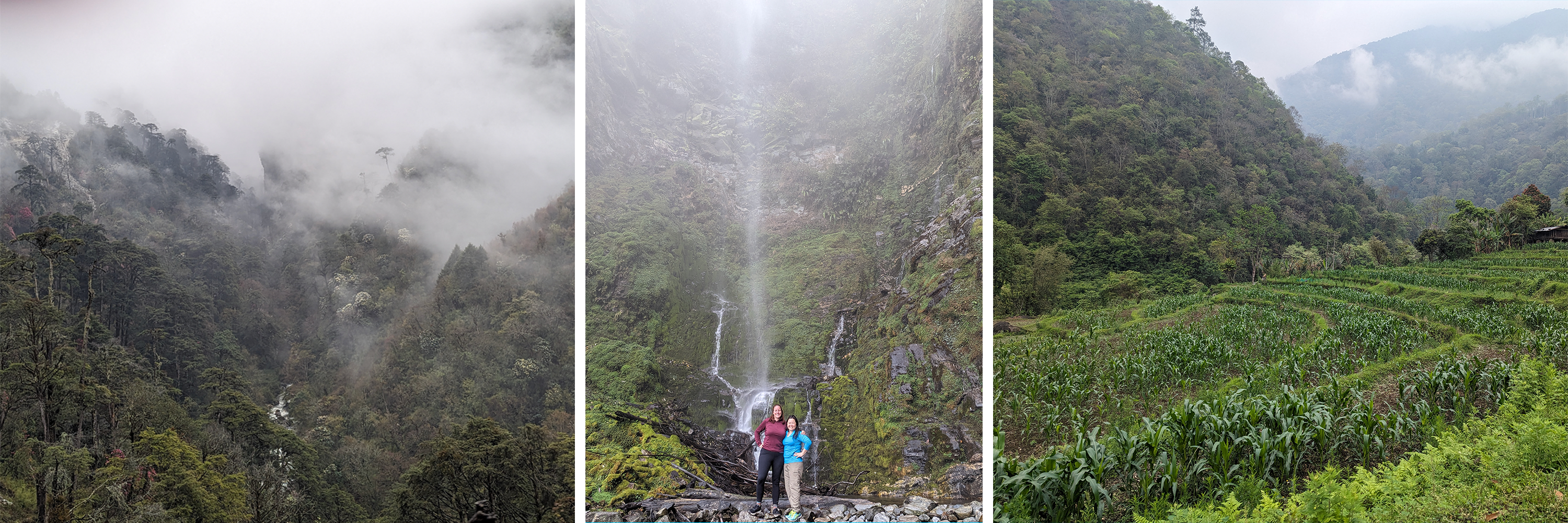
After our trekking in eastern Bhutan, we embarked on some long, long, windy roads to get to the center of the country. Although there were a few stops along the way, it was basically two straight days of driving. Nonetheless, we finally made it to the province of Bumthang (pronounced boom-tawng).

drive from Sakteng to Bumthang: foggy landscapes perfect for a fantasy novel, tall waterfalls, farming terraces

BUMTHANG

The weather had been hit or miss the previous few days and we were a bit worried we were going to be soaked by the end of our walking tour. Fortunately, clouds stayed away and we had a wonderful time as Tenzin took us to three different monasteries and a community weaving center.

The weaving in this part of the country is called yathra. Although different types of looms are used now, they still take an incredibly long time to make. Angela took one home that was at least four meters long! This particular center uses only natural dyes for their yak wool.

woman preparing the loom for weaving, natural dyes, yathra weaving in process

Before discussing any temples, it’s probably wise to talk about Guru Rinpoche. He was born in what is today known as Pakistan but due to some internal family disputes decided to leave. He lived in Tibet before entering Bhutan and in Bhutanese stories, he is foretold by the original Buddha as the next Buddha. One of his major talents was subduing local spirits and demons, which greatly abetted the spread of Buddhism throughout Bhutan. He also left behind treasures for believers to reveal in future years which could take the form of texts, objects, visions, or dances.

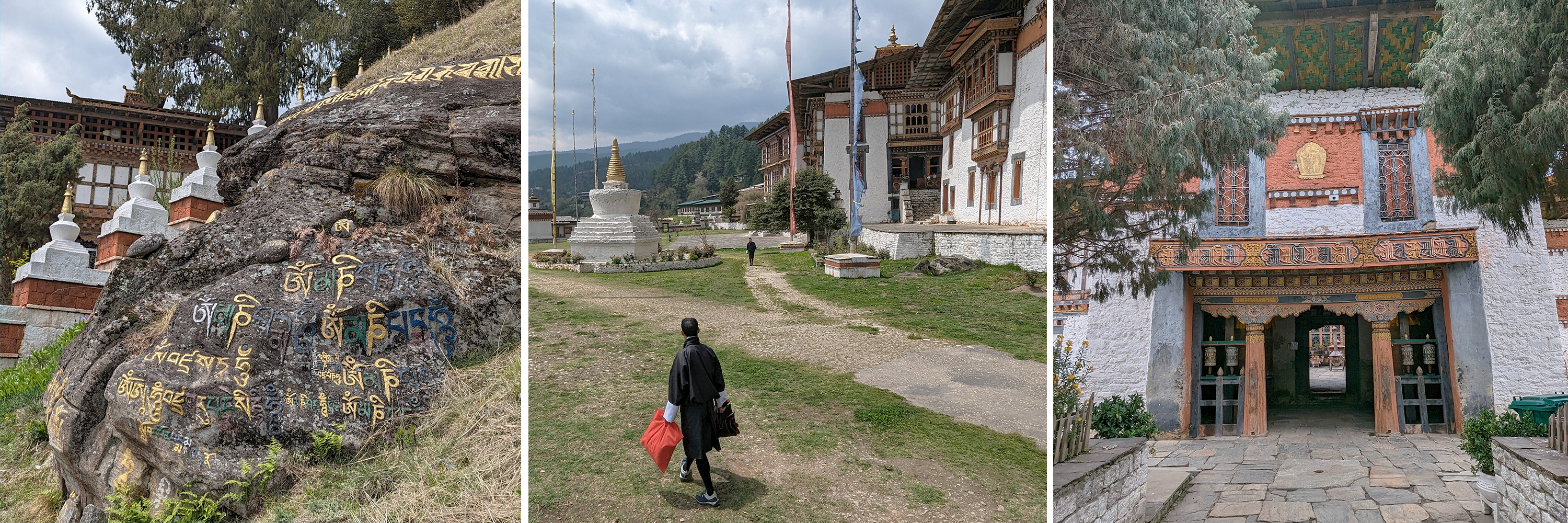
The biggest temple we visited in Bumthang was Kurjey Lhakhang, which now has three separate buildings. The oldest building is famous because Guru Rinpoche meditated here for three months and left an outline of his body print (in a seated posture) in the cave. He also, apparently planted his walking stick which became the giant cyprus tree outside the temple. The other two buildings were built by the first King and the Queen Mother.

outside of Kurjey Lhakhang, Tenzin entering the grounds of Kurjey Lhakhang, outside of Jambay Lhakhang

Jambay Lhakhang was the oldest temple we visited, having been built in the 7th century. One notable difference in earlier temples is that the sculpture inside depicts future Buddha and not current Buddha, which means that the hands are in a different position (mudra).

In 1501, Tamshing Lhakhang was established by Pema Lingpa. He is revered in Bhutan as a treasure hunter. Guru Rinpoche appeared to him in a dream and told him about the treasures he would find. Eventually, a monk wandered by a couple years later and gave him a scroll which outlined where he could find his first treasure as well as a key for decoding its message. He successfully dove into a lake, retrieved another scroll, and deciphered this first treasure text. Although he was met with skepticism even in his time, Pema Lingpa won over his critics with stunning feats like retrieving treasures underwater while keeping a butter lamp burning even while he was submerged.

Tamshing Lhakhang (even monks have to do laundry), outside wall of monastery, Bumthang River

Apparently, he was a very precocious youngster and his grandfather taught him how to be a blacksmith. Inside of this temple is chain mail he made when he was still a child. Devotees sometimes wear this chain mail as they make three tours of the temple as an act of purification. Today, this temple serves as a place of learning for young monks.

DOMKHAR TSECHU

Tsechus (festivals) are a major part of Bhutanese life and when we were planning our trip, we wanted to make sure we got to see at least one. There are much bigger festivals in the large cities, but we made it to a rather tiny tsechu outside of Bumthang. Tsechus are generally celebrated on the tenth day of a month of the lunar calendar, but the month varies from temple to temple. This symbolically corresponds to the birth day of Guru Rinpoche.

About one-third of the attendees were probably tourists, but the rest were locals decked out in their finest kiras and ghos. The male fashonistas in the crowd also were wearing elaborate, fancy, fabric boots. In case you are wondering, those will set you back about US$100.

fancy boats, cute kid in kira & her grownup’s fancy boots, cute kid in gho & his fancy boots

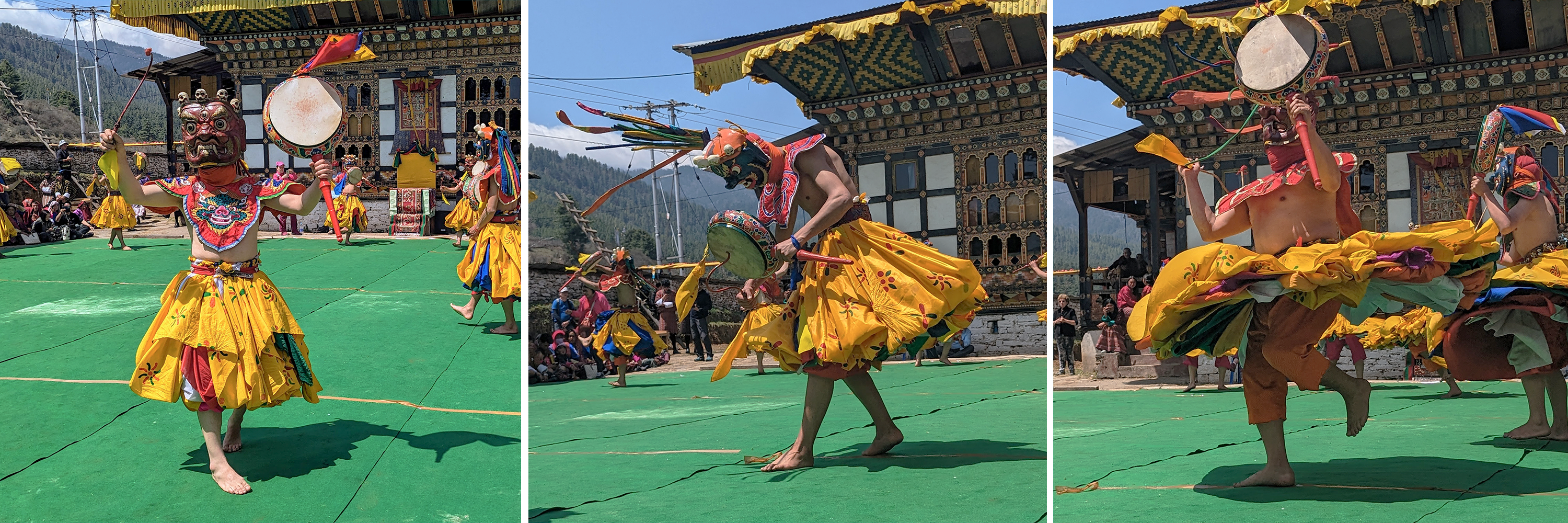
Every tsechu has slightly different dances and events. We came on the third day of the festival, and the opening dance was a set of dancers in Garuda masks. There are four important mythical creatures in Bhutanese Buddhism: Tiger (tak), Snow Lion (seng), Garuda (chung) and Dragon (druk). These appear all over the country, especially painted on the sides of houses and temples.

Garuda is a bird-like character, with clear horns coming out of its head. There are often four of them decorating each corner of a temple’s roof. The Garuda is particularly important in Bhutan, because of its association with Guru Rinpoche. One of the ways he subdued demons was by transforming into Garuda.

Garuda dancers, another Garuda dancer, Raksha dancer with an amazing headpiece (this was actually the last dance we saw)

After the Garuda dance, a clown came around to bless guests with his giant wooden phallus. There’s a longer story here about why the phallus plays such an important role in Bhutan, but that will have to wait for a later blog post. Regardless, the clown bonked everyone on top of the head with the phallus (Angela and I both had to remove our hats to be blessed) and then he came back around and people gave small bills which he shoved into his wooden phallus in exchange for the blessing. Although tourists were his first target, he eventually walked around and blessed many of the locals as well.

clown collecting tips for blessings in his oversized phallus, tourist being blessed by phallus, ladies in beautiful kiras singing

The longest dance we watched was what I think is called the Ngaging Dance. Remember the chain mail treasure-hunting guy Pema Lingpa? One of his ongoing legacies in Bhutan is the collection of dances that were revealed to him. Remember, dances can be treasures too. This one lasted the longest and was definitely an exercise in endurance for all the dancers involved.

dancers performing the Ngaging Dance

This video is only a short clip of the dance that went on for over thirty minutes and maybe closer to an hour.

Eastern Bhutan

This trip to Bhutan has definitely been on my to-do list for more than a few years. My college friend Angela and I started talking about this probably a decade ago, were seriously talking about going in 2020 (which of course didn’t work out), and finally the stars aligned for both of us to be available this spring.

Merak-Sakteng

After a brief stopover in Paro, we flew to the eastern edge of Bhutan. This is an area of Bhutan that travelers often don’t go to because it’s logistically challenging and requires a lot of time and in Bhutan, time is money. Travel here works very differently than other countries because the only way to visit as an American is on a guided tour. There is a sustainable development fee of $100 every day plus a set cost that is paid for lodging and meals, entry fees, guides, and travel. Souvenirs and tips are extra. The goal is to open Bhutan up to tourism, but not in a way that has a large negative effect on the community and the environment.
Our guide Tenzin flew with us and we met our driver Pema at the airport since he had been diligently driving all the way across the country the last couple days. We drove past the first university started in Bhutan, near several stupas commemorating different parts of Buddha’s life, monasteries, and through beautiful hillsides of red and pink rhododendrons that had recently bloomed. Eventually, we met our first yak and I stuck my head out the window and mooed at it. It just looked at me strangely and continued to munch grass.

stupas, Rangjung monastery, my first yak

Eventually, we arrived our destination of Merak, which is home to the Brokpa people. This used to be a semi-nomadic yak-herding tribe, but most people have a house in one of the villages nearby now. Originally, they lived on the Tibetan plateau, but eventually relocated to what is now Bhutan. There are additional Brokpa villages scattered throughout Arunachal Pradesh, India.

Our guide in Merak, Gelzen, told us the story they tell about how they ended up in Bhutan:

Once upon a time there was a Tibetan village where the wood was dry, wet, and rotten and not very useful. The people lived in the valley below the peak of a mountain, which kept the valley entirely in shade, which caused very little to grow and the people to suffer. The queen wanted to bathe in the river and it was too cold, so the king told the villagers to remove the peak of the mountain so the river would be warmer from the light of the sun.

They were running out of time to finish removing the top of the mountain when along came a small girl carrying a baby. No one knew the girl, but she told them, “It is better to chop off the head of a man than to chop off the head of the mountain.” She then kept walking on her way.

When the villagers convened that evening, everyone had seen the little girl but no one knew who she was or where she had come from. After much discussion, they decided the girl must be a deity and they should follow her advice. They hatched a plan to chop off the head of the king.

They petitioned the king to have a party to celebrate finishing their task of removing the top of the mountain. He eventually approved the plan to drink wine and dance. In those days, wine came in a large wooden container and they decided to hide an ax at the bottom of the container.

On the day of the party, the king and his entourage arrived and the party began. The dancers danced and the wine flowed freely among his soldiers and additional guests. However, the villagers did not partake in the wine because they knew about the plan. Eventually, most of the wine was finished and the last bit of wine was offered up to the king. As the villagers reached in to serve the wine, they pulled out the ax and chopped off his head. All of the villagers rejoiced in their newfound freedom.
They then discussed whether to stay in the shadow land and fight the king’s soldiers or to run away to another location. The girl arrived again and introduced herself as the deity Jomo and offered to guide them to a new land. She spotted the top of a mountain far away from where they were standing and led the villagers to that new location.

Those villagers that were stronger and were able to keep walking, continued over the mountain pass and settled the town of Merak. The less strong, weaker villagers turned around when they couldn’t make it over the pass and returned to the valley to set up the town of Sakteng. There is still a marker between the two villages that denotes where they turned back. Today the Brokpas revere Ama Jomo (Mother Jomo) as a principal deity that protects their villages.

Angela and I had decided to hike from Merak to Sakteng, which was supposed to be about 20 km, with a 1500 m elevation gain. When we checked in for our permits with the local forestry staff, they suggested it would take about 8 hours. Because we had just come to Bhutan a few days before, our guides had us spend another day in Merak to acclimatize to the elevation.

We had a lovely day walking around Merak and taking in the local culture. We visited the elementary school and as soon as we entered a classroom, all of the students stood up to say hello. Instruction in schools here is conducted in English from a very early age, so the grade 4 students answered a few of our questions, before we continued exploring. We wandered through herds of yaks, a few dzo / dzomo (the offspring of a cow and a yak), more rhododendron trees, before heading back to our homestay. While there, we ate lots of thueb (red rice porridge), fried rice, chili cheese, vegetables, and suja (butter tea). Butter tea is basically tea, milk, butter, and salt and tastes more like soup than tea. I was a bit skeptical at first, but decided I liked it for breakfast.

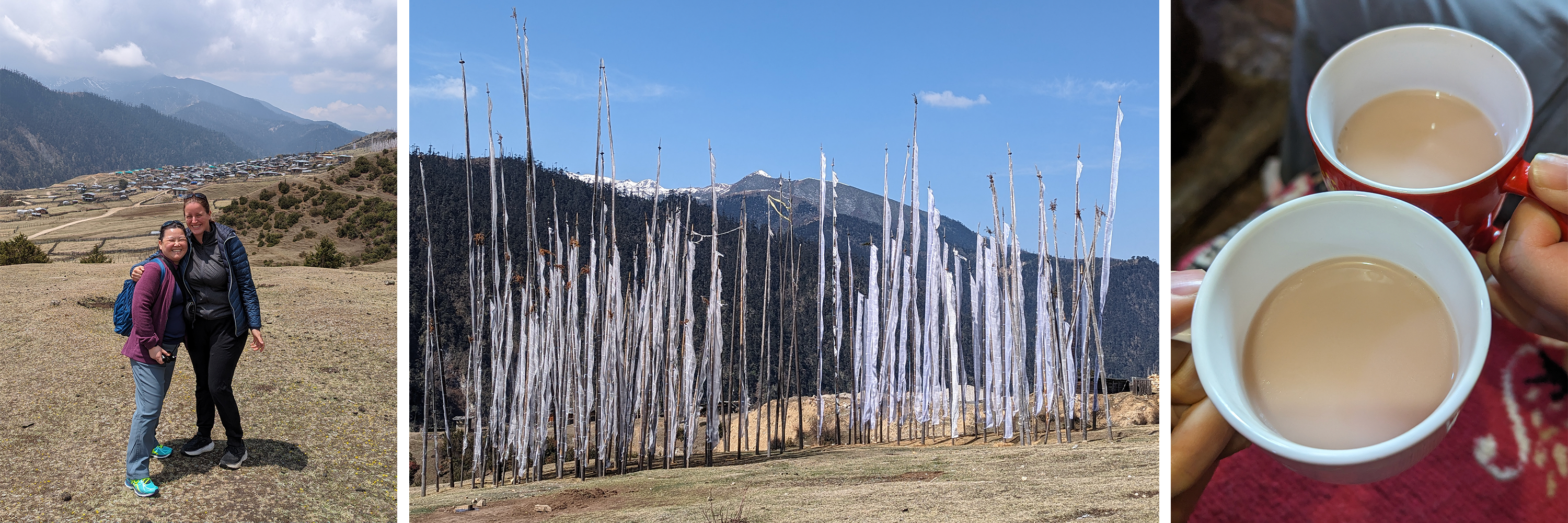
Angela and I with the town of Merak behind us, prayer flags, butter tea (suja in Dzongka)

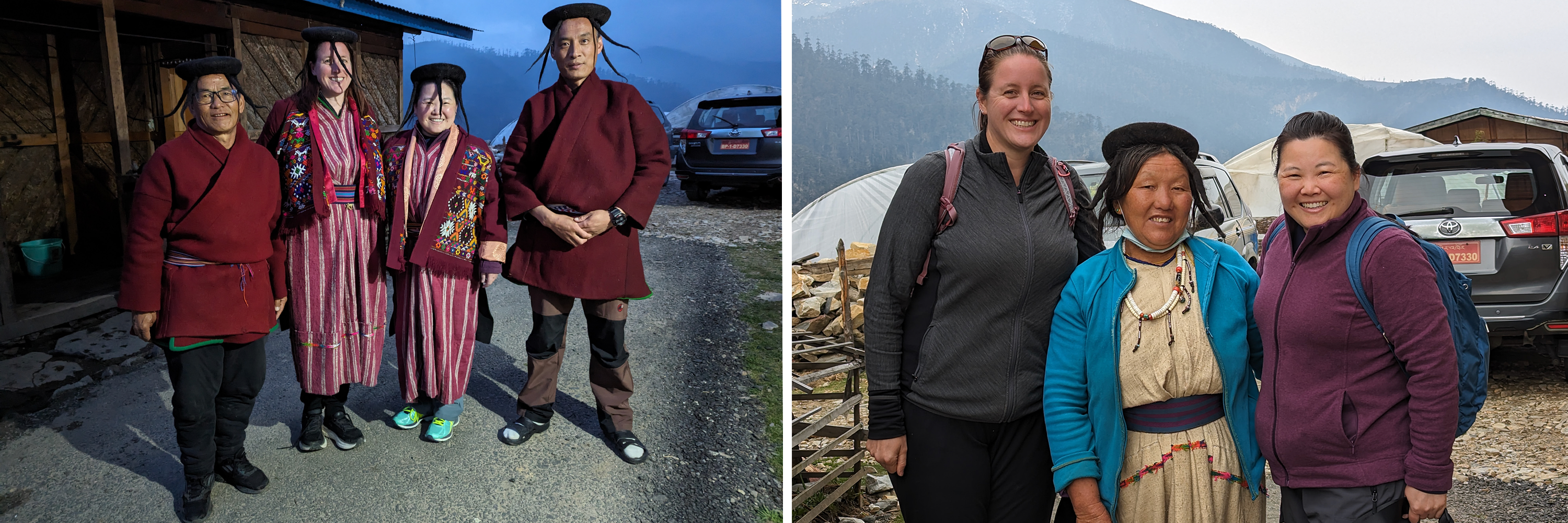
We also got to try on traditional Brokpa clothes and a couple of women sang traditional songs for us, while the home-brewed alcohol known as ara was passed around. The ara in Merak is mostly made from potatoes, corn, and buckwheat.

Pema, me, Angela, and Tenzin dressed up in traditional Brokpa clothing; Angela and I with our homestay Ama

The next day, we took off on our trek onwards and upwards over the Nachungla Pass which tops out at 4150 m (13,615 ft). There’s snow near the top, so, of course, I got in a snowball fight with our guide. Angela was struggling with the altitude and was having none of it. The whole trek is lined with rhododendron trees, even though they’re not quite in bloom yet because it’s too cold. At the pass, Gelzen gave us prayer flags and helped us to tie them on poles on the pass. Our porters also started a fire to appease the local deities.

Tenzin, a porter, and Angela hiking through the snow; our prayer flags at Nachungla Pass

Along the way, we found some interesting high elevation creatures including this intricately patterned beetle that Gelzen said was called a juniper bug because if you sniff it, it smells like juniper. Well, I caught one and tried to smell it and it didn’t smell like much of anything to me. Our guide Tenzin was a bit confused what we were doing and we realized that there are different kind of trekkers. Some just want to get from place to place, and some stop to smell the bugs. We definitely belong to the latter category.

juniper beetle, Himalayan tailless pika, sumo mite

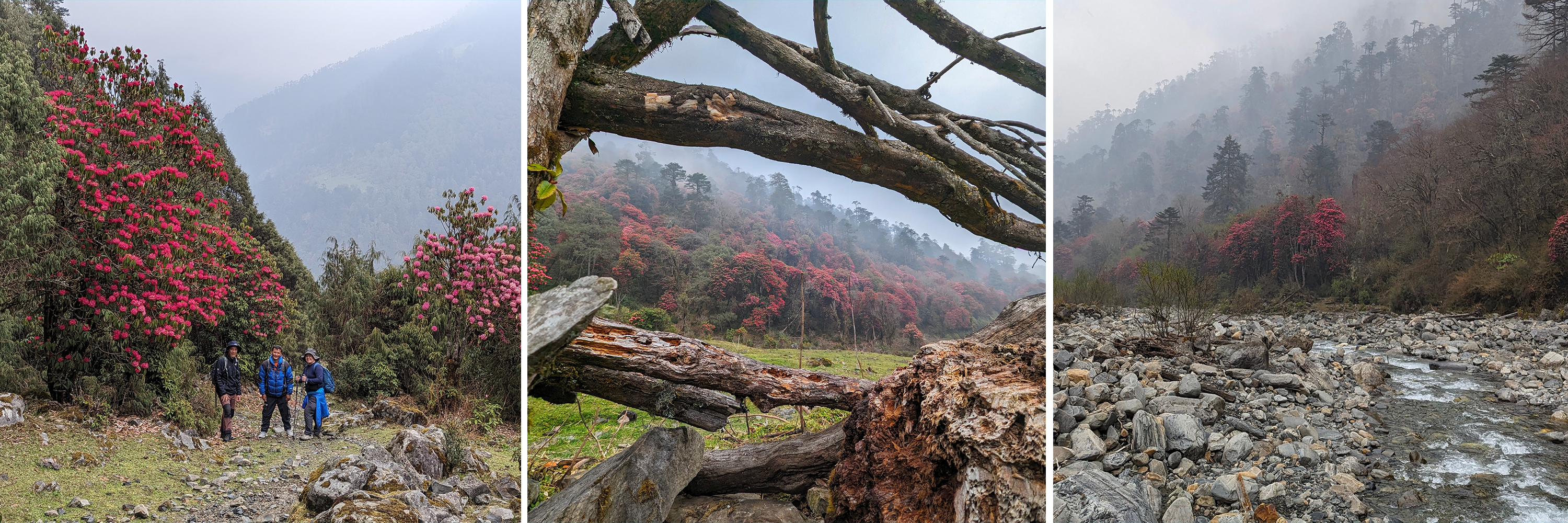
Once we got down off the pass, we descended into beautiful scenery filled with mostly red and pink rhododendrons. It’s hard to describe what it feels like to hike through entire hillsides covered in brightly colored flowers, but the whole experience was magical.

Tenzin, Gelzen, and Angela; rhododendron hillside through a yak fence; river & rhododendrons

different colored rhododendrons from our trek

Due to some slow climbing and lots of photography stops to look at flowers and beetles, we actually ended up getting into Sakteng after dark. Pema met us at the top of the hill with cups of tea and we slowly made our way down a hill and crossed two rivers on wet logs in the dark. We finally made it to our homestay, where we ate dinner and collapsed onto the mattresses on the floor.

looking back up the mountain into the fog

Valladolid & Campeche

Valladolid

This town gets overlooked as a destination because most folks see it as the place to stay before and after a trip to Chichén Itzá. However, I thought it was a nice town to hang out in for a couple days even without the allure of the big Mayan ruins close by. In fact, I ended up visiting twice, once on my way to Mérida and once after my three weeks of Spanish school. The town is super walkable, there’s quite a bit of art in town, a cenote to jump in right in the center of town, and the food options were fantastic.

One of the local attractions is the Casa de los Venados, a private house owned by an American couple full of their personal collection of Mexican art. The wife passed away a few years ago, but the husband still lives there. They don’t charge anything for the tour, but take donations that are given to local organizations. There’s a wide variety of art, including a fancy dining room set complete with portraits of famous Mexicans on the back of the chairs and a shaman costume and mask that apparently decorated with real animal blood.

artwork from the Casa de los Venados

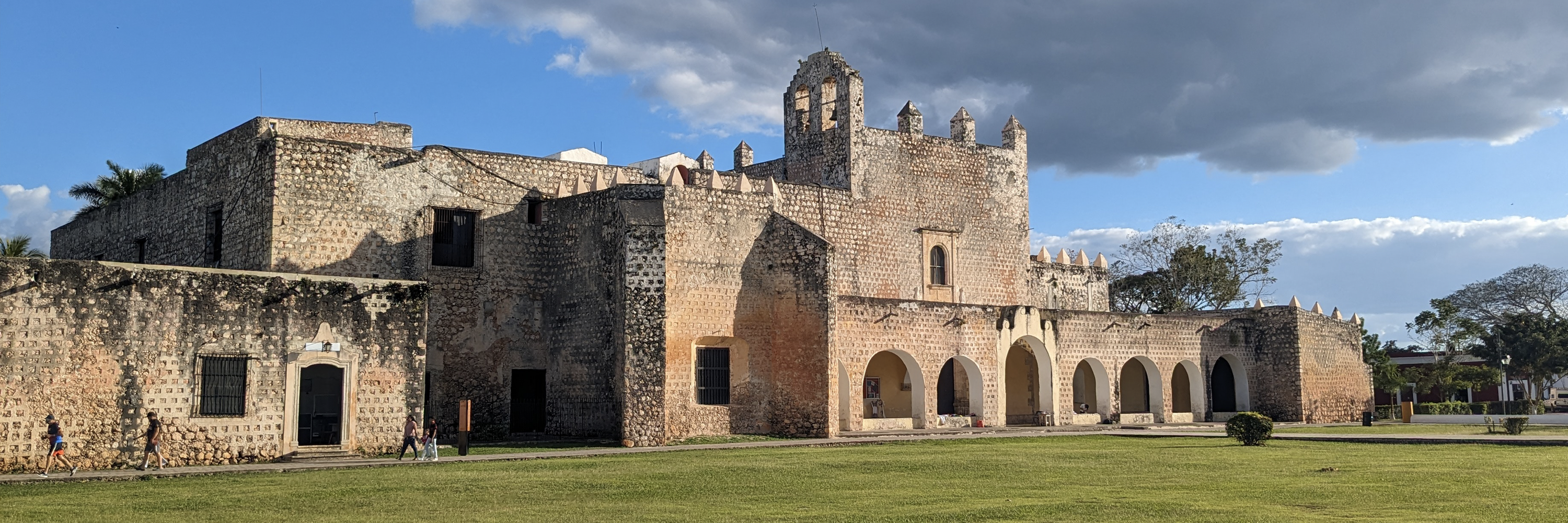
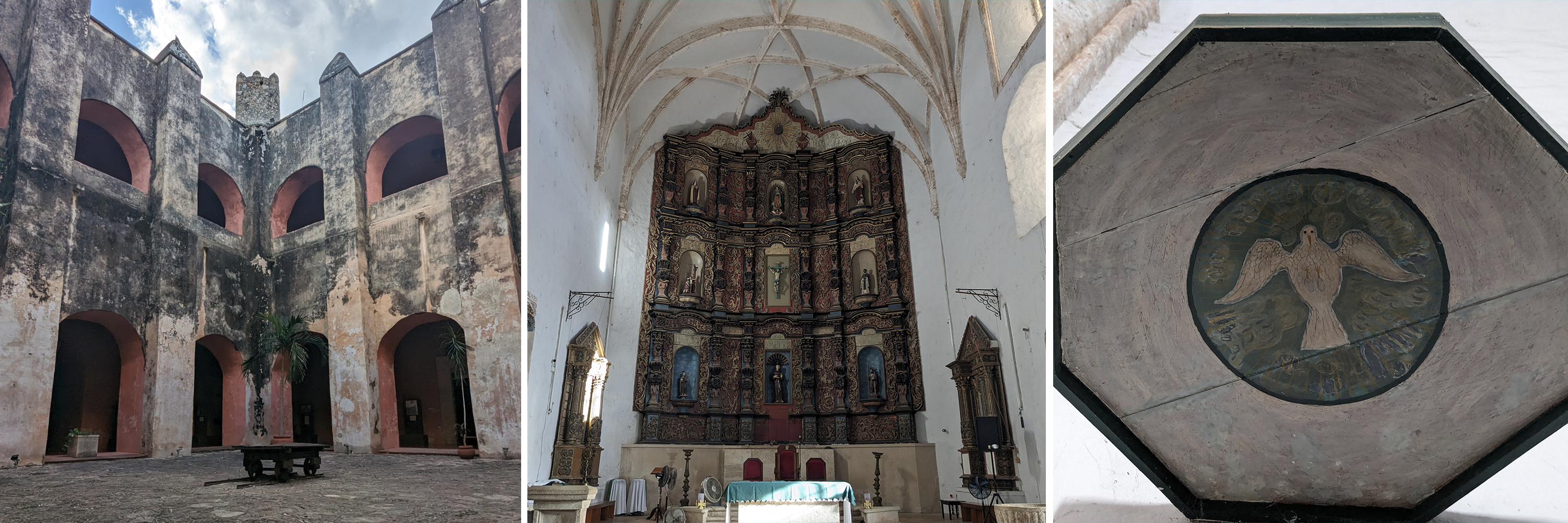
Valladolid is home to the former Convent of San Bernardino de Siena, which was home to a Franciscan order of friars. This confused me for a bit, because in contemporary English, convents generally are for nuns. However, apparently back in the day, the word convent was less gender-specific.

The outside of this building has a fun light show that tells the history of Valladolid every night, which includes the city’s role in the Caste War. In New Spain, there was a clear caste system with white Spanish (criollos) at the top, mixed indigenous and European ancestry (mestizo), the descendants of indigenous people who had helped the Spanish to conquer the Yucatan, and then other native groups and African slaves at the bottom. In an earlier post about Mérida, I discussed how the city became super rich from growing henequen. There were henequen haciendas all over the peninsula and the mostly white and mestizo Mexicans were getting rich, while indigenous Mayans were forced off their lands and then made pennies growing and harvesting the henequen for the owners of the estates.

As land continued to be privatized, Mayans organized to prevent their communal land from being taken by outsiders. One of the first events of the war, in 1847, occurred when Mayan soldiers in Valladolid rebelled by sacking and destroying the city. Inside the well located within the convent’s walls, archaeologists have pulled out rifles, bayonets, spears, and a cannon, all dating from the conflict from this time period.

The resistance was actually mostly centralized on the eastern coast of the Yucatan, south of Tulum. They declared themselves as a free state and, for a while, had extensive support of arms and trade from the United Kingdom. Also important to the war effort was the emergence of a Mayan religion that incorporated elements of Christianity and was inspired by a Talking Cross at a cenote. This church (sometimes known as the Cult of the Talking Cross) played a critical role in supporting the resistance. The uprising officially ended in 1901 when the last group of Mayan rebels were defeated.

former Convent of San Bernardino de Siena

courtyard, main church, view upwards of a peace dove from the pulpit (which I found incredibly ironic given the Catholic Church’s involvement in wars and genocides around the world)

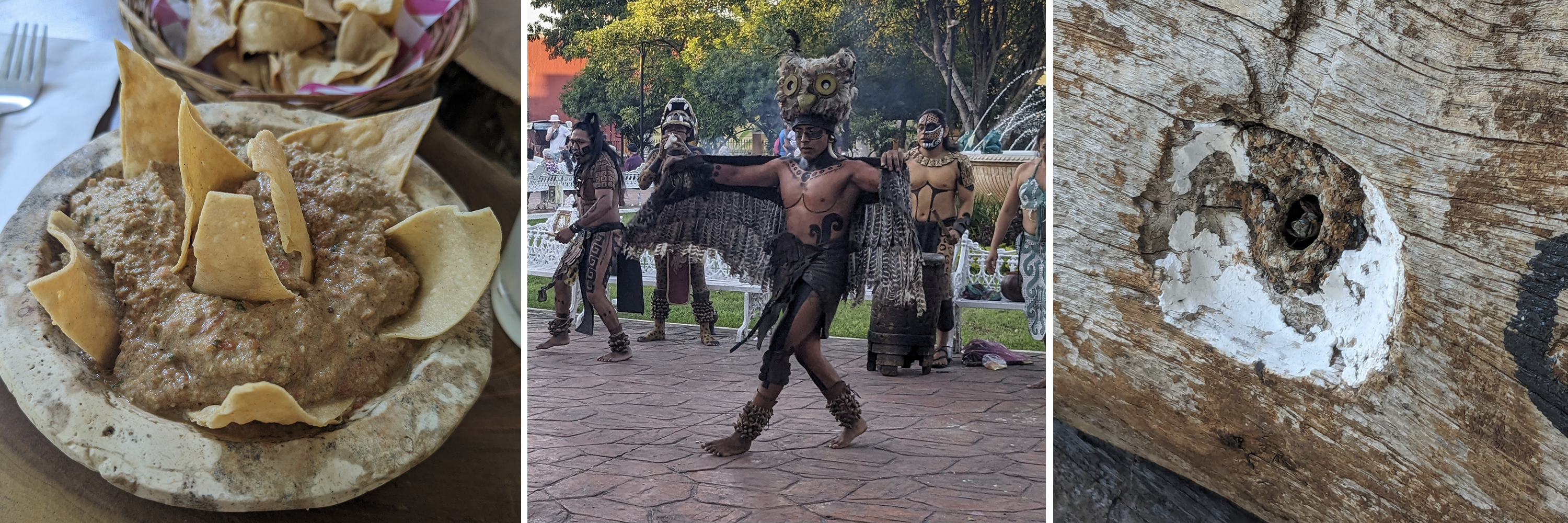
One of my favorite places in Valladolid was Xpokek, a small local apiary that gave bee tours. Mayans have always had a close relationship with bees and pre-European contact, native bees were kept inside logs where they built elaborate hives. To harvest the honey, the logs were split open and the bees were moved into a new log. Bees were central to Mayan life and the Mayan god of bees and honey was Ah Muzen Cab (maybe the same upside down god on the Tulum ruins). The native melipona bee is stingless and makes a relatively small amount of honey, only about three pounds of honey per year. In contrast, European honeybees make twenty times as much honey. Melipona honey is rarely eaten and instead is used as a treatment for cataracts and to prevent bacterial treatments in wounds. I also got to eat sikil pak for the first time there, which is a Mayan dip made of pepitas (pumpkin seeds), charred tomatoes, and spices. I’ll definitely be making this after I leave Mexico.

sikil pak, Mayan dancers in the central park in Valladolid, Melipona bee guarding the entrance to their log hive

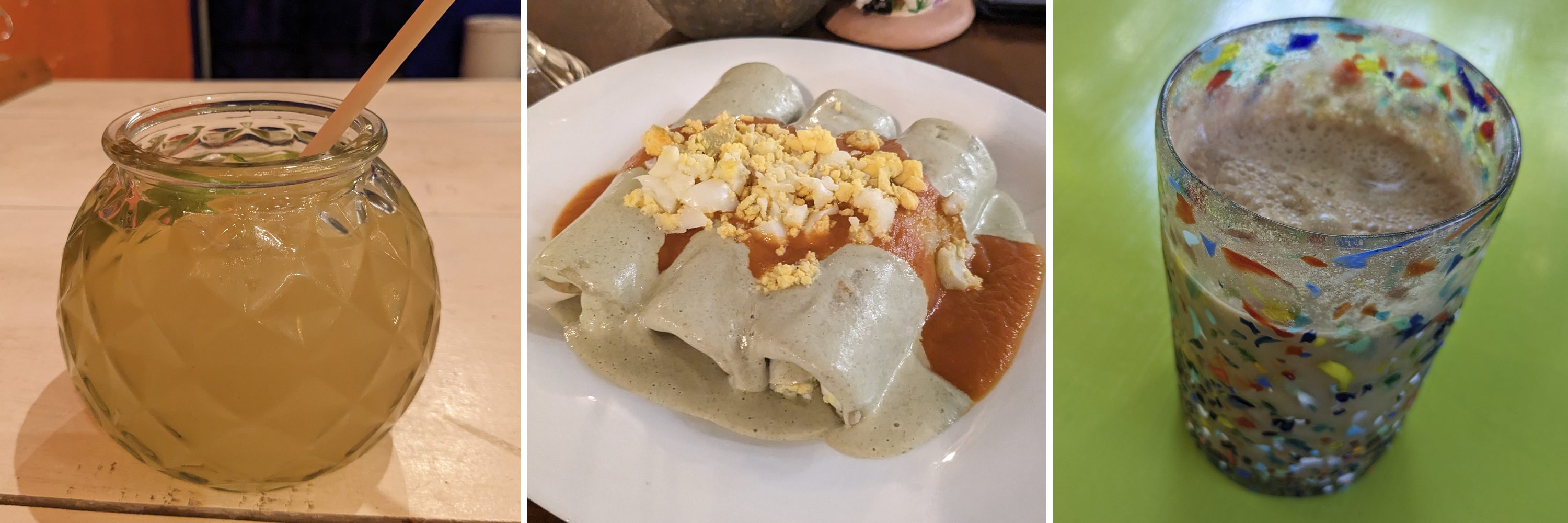
I did mention the great food, right? Tepache is a kombucha-like fermented drink made out of the rind of pineapples, probably first made by the Nahua of central Mexico. Papadzules are egg stuffed enchiladas covered in a sauce made of ground up pumpkin seeds and a well-loved Yucatecan dish. Tejate is Oaxacan in origin and made from maize, cacao, and the pits of the mamey fruit.

tepache, papadzules, tejate

Campeche

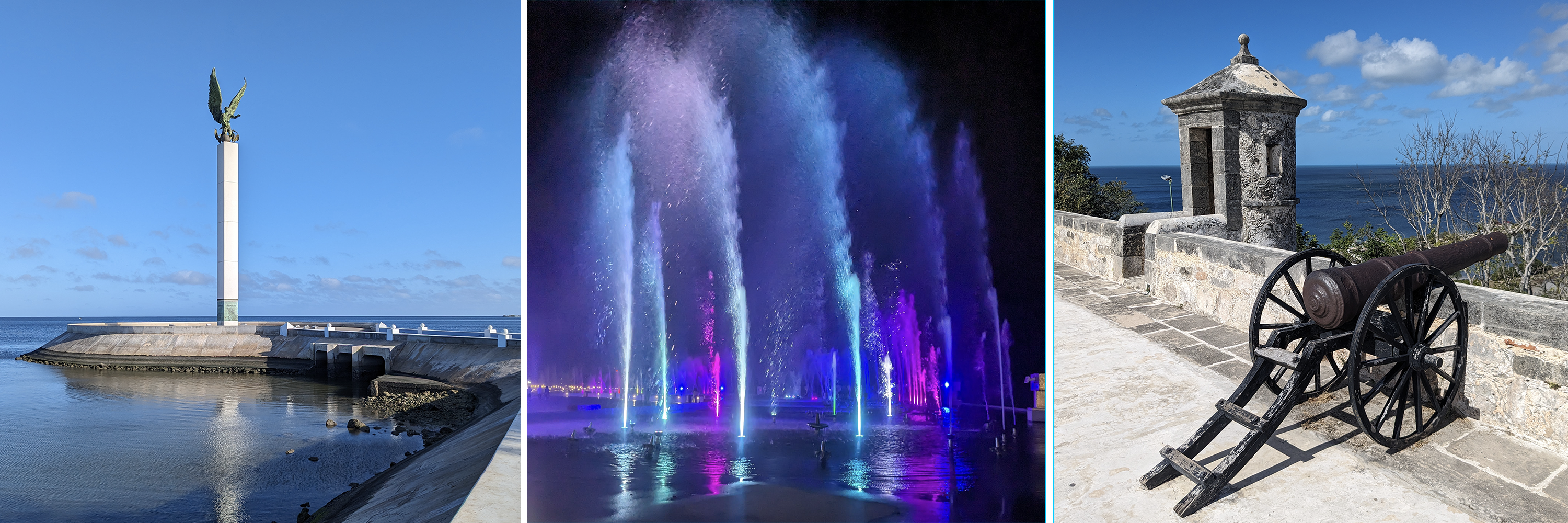
I was struggling in the heat of Mérida, so I took a journey to the western side of the Yucatan peninsula. Mostly I went because I wanted to see the jade mask from Calakmul, but ended up having a lovely weekend in this heavily fortified old city. The walls built by the Spanish still surround the old city, and even though it is located on the Gulf of Mexico, there are no beaches or places for locals to enter the water. However, the malécon along the water’s edge makes for a lovely stroll. Today, Campeche is known for its streets full of colorful houses, which are a joy to wander through.

Back in the day, Campeche was well-known for a type of wood called palo de Campeche, which was used to dye cloth a variety of colors, including brown, purple and orange. This is because it changes color based on its pH. This wood was one of prizes pirates would take from cargo holds when they commandeered ships in the area. Campeche was known as one of the cities where pirates would hang out in between their raids.

view along the malécon, nighttime fountain show, view from the old fort

The old fort is home to a regional museum holding lots of Mayan treasures. Many of the pyramids and ruins in Campeche state have been excavated and brought to this museum. In addition to all of the fancy jade masks, I thought this burial outfit and funeral carpet were exquisitely constructed. The amount of work required to make and sew all of the shells and seeds is unfathomable to me.

collar made of snail shells covered in cinnabar to give the red color, close ups of a funeral carpet made of shells and seeds

When I was in Chile a few years ago I ate a brazo de reina (queen’s arm) which was a sweet dulce de leche filled roll. However, here in the Yucatan, a brazo de reina is a hard boiled egg-filled tamale. The other really fun food speciality in Campeche was a machacado. The bottom of a cup is filled with mashed up fruit of your choice, covered in shaved ice, and then topped with condensed milk, more ice, and a bit of cinnamon. It’s a lot of sugar, but definitely a regional treat adapted for the heat.

Yucatecan brazo de reina, cute llama stamp on napkins, mango machacado

Chichén Itzá & Ek Balam

Chichén Itzá

Chichén Itzá is probably the most famous of all the Mayan ruins in Mexico. It has been extensively rebuilt since its heyday in roughly 700-900 CE. Early in the morning, when I visited, the site is still relatively quiet. There are a few bus loads of tour groups, but the site is large and people disperse rapidly once they’re though the gates. However, by mid-day, this site is busy, busy, busy. Vendors are selling souvenirs on every path and tourists are huddled in circles around guides listening to stories.

Even with all the commotion, Chichén Itzá is stunning. The work they have done to restore the ruins gives a clear impression of the power that this city-state used to possess. From the menacing platform of skulls to the giant pok-ta-pok playing field to the pyramid centerpiece, the elites of this city used strength and authority to control their subjects.

Pok-ta-pok features prominently at almost every Mayan ruin I visited. On signs, it’s often just called el juego de pelota, the ball game, in modern Spanish. The goal is to score points by getting a rubber ball (between 5-10 lbs) through a hoop positioned higher up on the sides of the playing court. There were two teams and players were not allowed to touch the ball with their hands or feet. They wore extensive gear to protect themselves and there are frequent mentions of bruised and injured players.

feathered serpent (kukulkan) head decorating the pok-ta-pok field, El Castillo also known as the Temple of Kukulkan, pok-ta-pok goal high up on the side of the wall

In Mérida, there’s a contemporary pok-ta-pok match every weekend across from the catherdral. I didn’t get there early enough to get good videos, but you can watch various YouTube videos of the sport. It looks a lot like hacky sack with a lot of sliding. The reason this sport is so important to Mayan culture is because it is a part of the Popol Vuh, the Mayan text that includes the story of creation. There are three sets of twins in the story, and the second set, Hun-Hunahpú and Vucub-Hanahpú, are invited to Xibalba to play in a pok-ta-pok match. They are defeated by the lords of the underworld and sentenced to death. Hun-Hunahpú’s skull is placed in a tree that produces gourds.

A woman named Xquic notices one of the gourds is in the shape of a skull, and when she goes to touch it, the skull spits on her hand and she become pregnant with Hun-Hunahpú’s twin sons. She leaves Xibalba to visit her mother-in-law who does not believe her since her sons are dead. However, she passes a test involving maize and then everyone believes her that she indeed is pregnant with this dead guy’s kids. Eventually the twin sons are born, they grow up, and return to the underworld to avenge the death of their father and uncle. They then become the sun and the moon and humans are then created from maize.

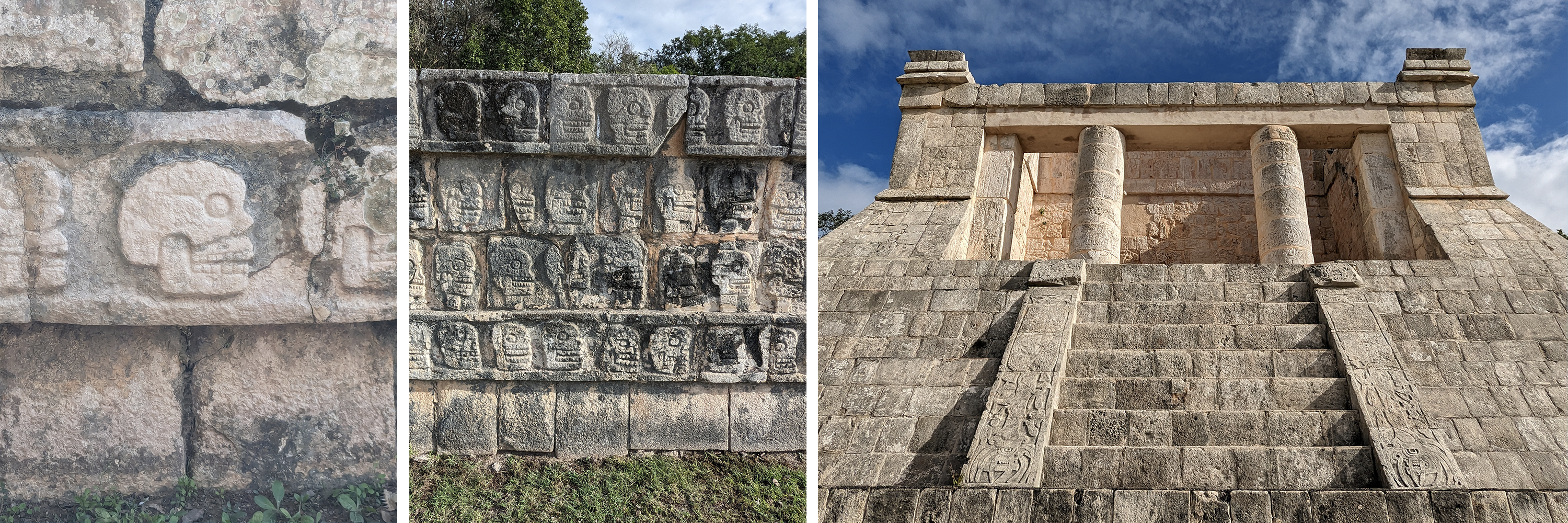
The Tzompantli was a large platform used for displaying skulls, most likely of sacrificed victims and prisoners of war. This one is located next to the pok-ta-pok field and some think that the losers of the game would be beheaded and their skulls would have been placed there. According to those interpretations, if you died during a game of pok-ta-pok, you skipped going to the underworld of Xibalba and headed straight to heaven. Because of this, others think that the winners were decapitated as a reward.

close-up of skull carving, side view of Tzompantli, Temple of the Bearded Man (named because of the carving of a bearded man)

This archeological site is huge and there are buildings still being uncovered. The Group of the Thousand Columns is a bunch of columns lined up in a grid like manner. On some of these columns, it’s easy to see carvings of warriors that would have been painted in striking colors. The whole area would’ve been covered with a roof and would’ve formed a type of passageway out of the heat of the sun. There are also at least two cenotes. The Sacred Cenote was used to dump bodies after human sacrifices and the other one was probably used as a water source for the city.

tiered building corner, Sacred Cenote, Group of the Thousand Columns

My other favorite buildings were at the end of the tour. The House of the Nuns was probably a house for Mayan royalty and its carvings are still easily visible today. El Caracol was a Mayan observatory used for tracking astronomical events. All observatories seem to be called el caracol, the Spanish word for snail, because of how the top of the building resembles a snail shell. (The tiny observatory I saw on Cozumel was also called El Caracol.)

close-up of carvings, House of the Nuns, El Caracol

Ek Balam

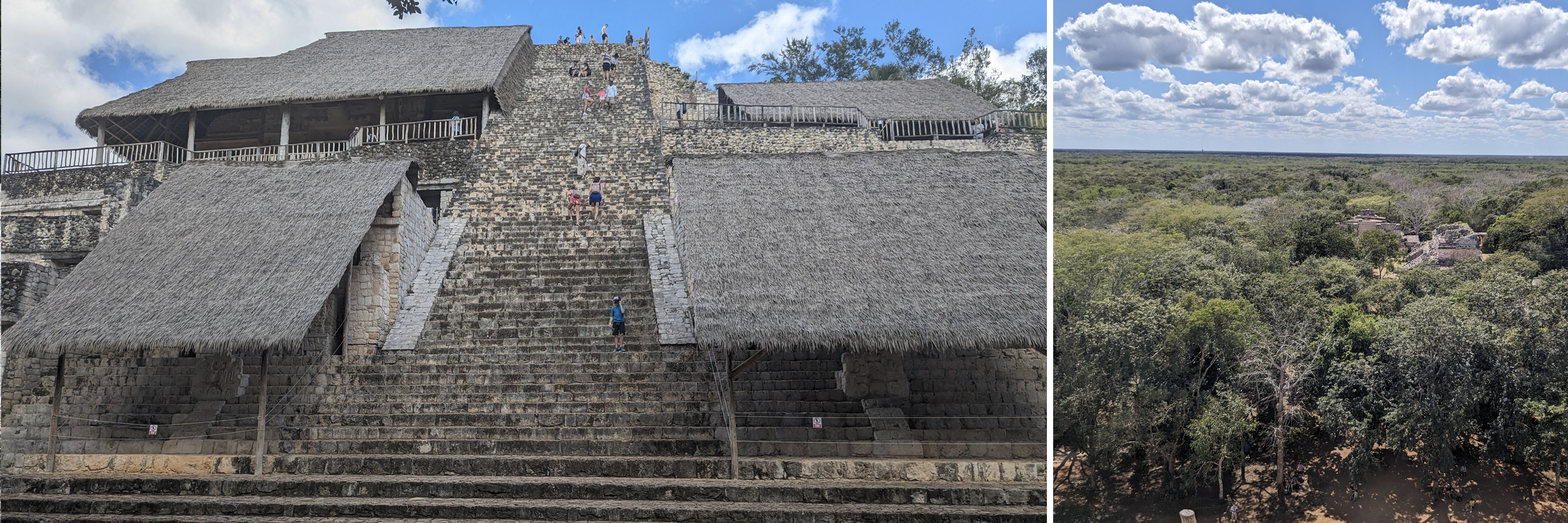
Apparently on a clear day, it’s possible to see Chichén Itzá from the top of the Acropolis in Ek Balam since they’re less than 40 miles away from each other. The biggest structure is the Acropolis, which is a mixture of a very tall and steep pyramid combined with a rectangular building with lots and lots of rooms. The Acropolis contains the tomb of Ukit Kan Lek Tokʼ, who was once the ruler of the town. His tomb has an awesome stucco facade with another earth monster mouth guarding the entrance.

Acropolis (the tomb is under the thatched roof on the top left), view from the very top

glyphs at bottom of Acropolis, tomb opening with monster mouth, close-up of carvings

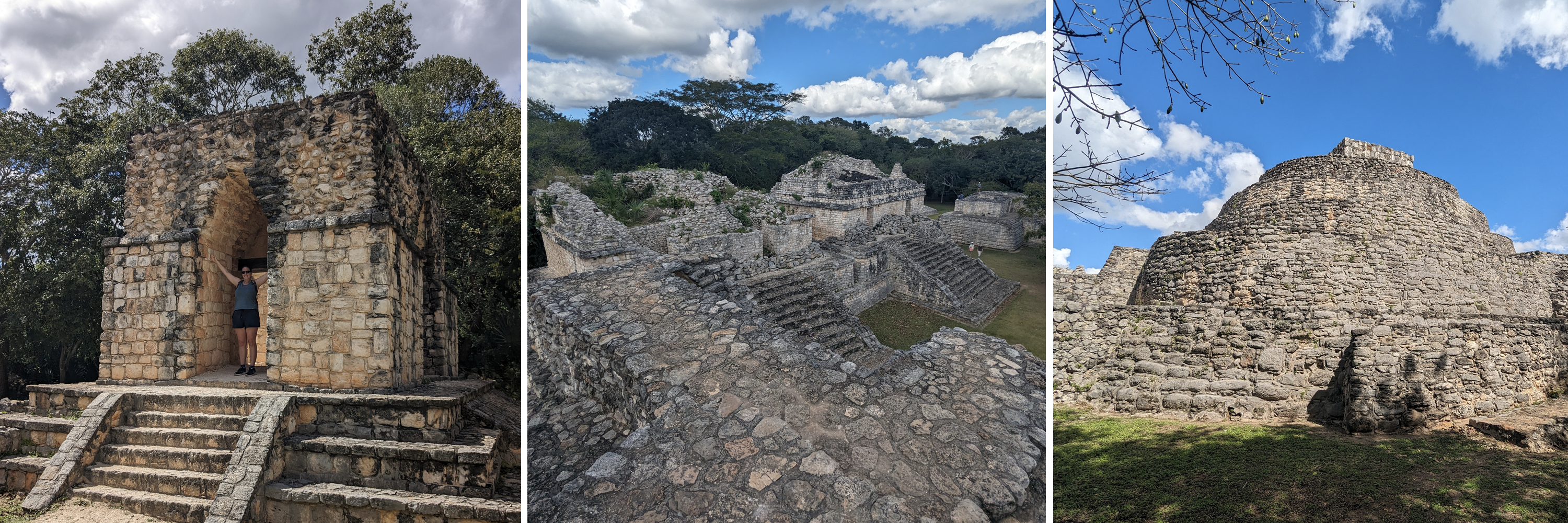
The site itself is pretty small, with an extensive set of walls encircling the city. There are four sets of walls around the city and the last one seemed have been hastily built, probably as a last ditch effort to protect the city against an invading attack.

me posing with the entry gate, two buildings called the twins, view of the thick outside wall

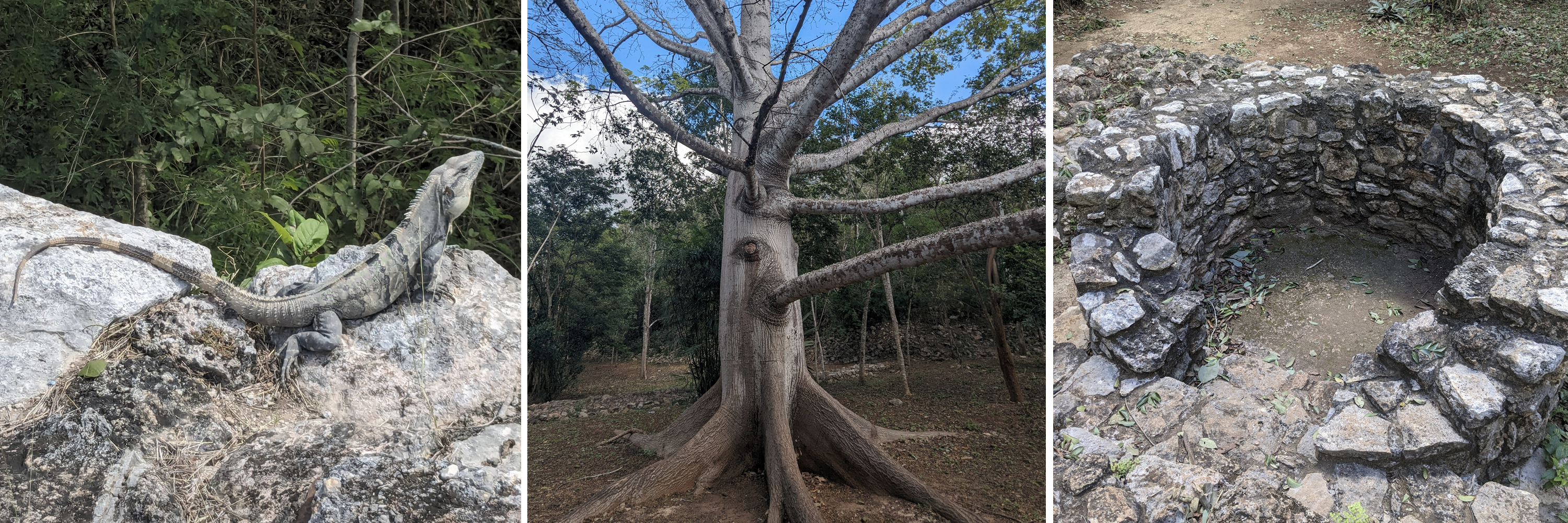
black spiny-tailed iguana, ceiba tree (central to Mayan spiritual beliefs in that it connects the underworld, the middle world, and the heavens), a steam bath

Cenote Xcanche

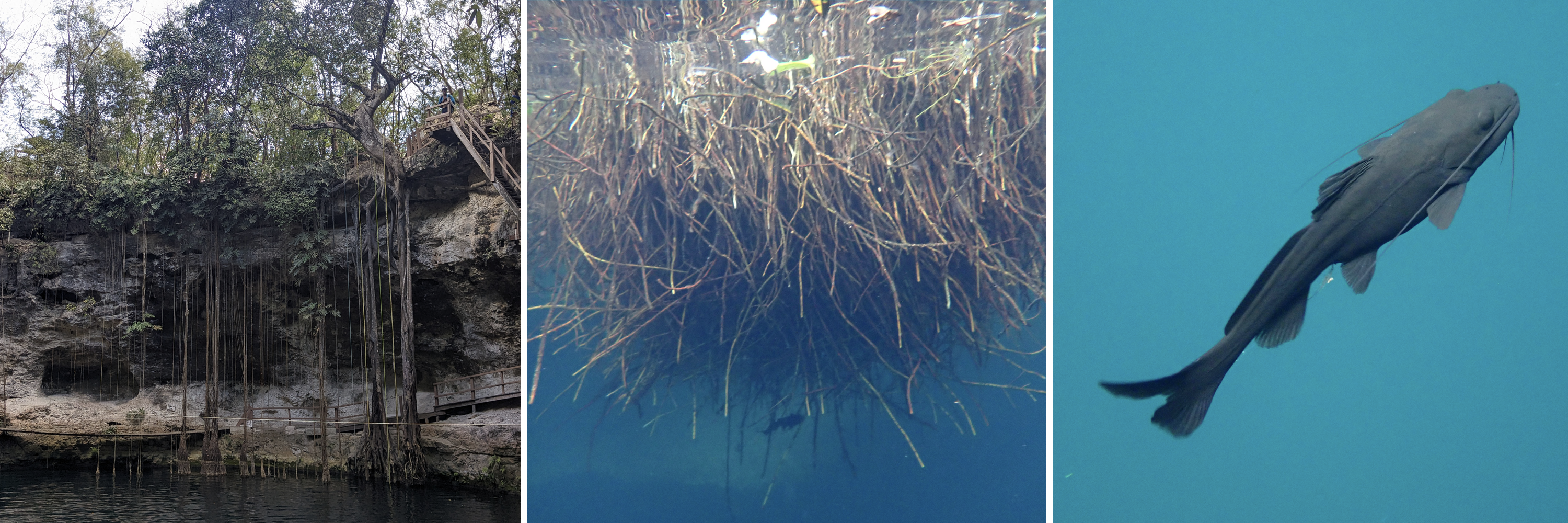
A short, bumpy bike ride away from the Ek Balam site, is this lovely cenote (bikes included as part of entry costs). This is an open-air cenote with awesome vegetation and a few catfish swimming around.

view of cenote walls plant roots underwater, pale catfish

Mérida

I stayed in Mérida for three weeks, taking Spanish classes and wandering around the city. The colonial influence is strong here and old money still has a deep hold on the community. In Mexican slang, the word fresa (literally strawberry), refers to spoiled, young people with a lot of privilege and parts of this city definitely have fresa vibes. At one time, the Yucatan was the one of the richest states and Mérida was one of the richest cities in Mexico thanks to the henequen industry, which, of course, I’d never heard of until I got here. Henequen is made from a type of agave (different species than the one used to make tequila), that was twisted into ropes, cords and fabric. People made a lot of money from the plant and their ruthless exploitation of workers. There’s actually a sizeable Korean population in Mérida because of this industry. Originally, a bunch of Koreans signed on to work 5-year contracts on henequen plantations, but earned almost nothing, were frequently beaten, and often didn’t even make enough money to return home. So they stayed and their descendants still live here.

Architecture

Because of the old money in this city, there’s a lot of European style architecture in the rich enclaves of town. Just outside the city center, the architecture switches to square cement houses built right next to each other, forming one contiguous wall on each block, interrupted by fancy windows and doors.

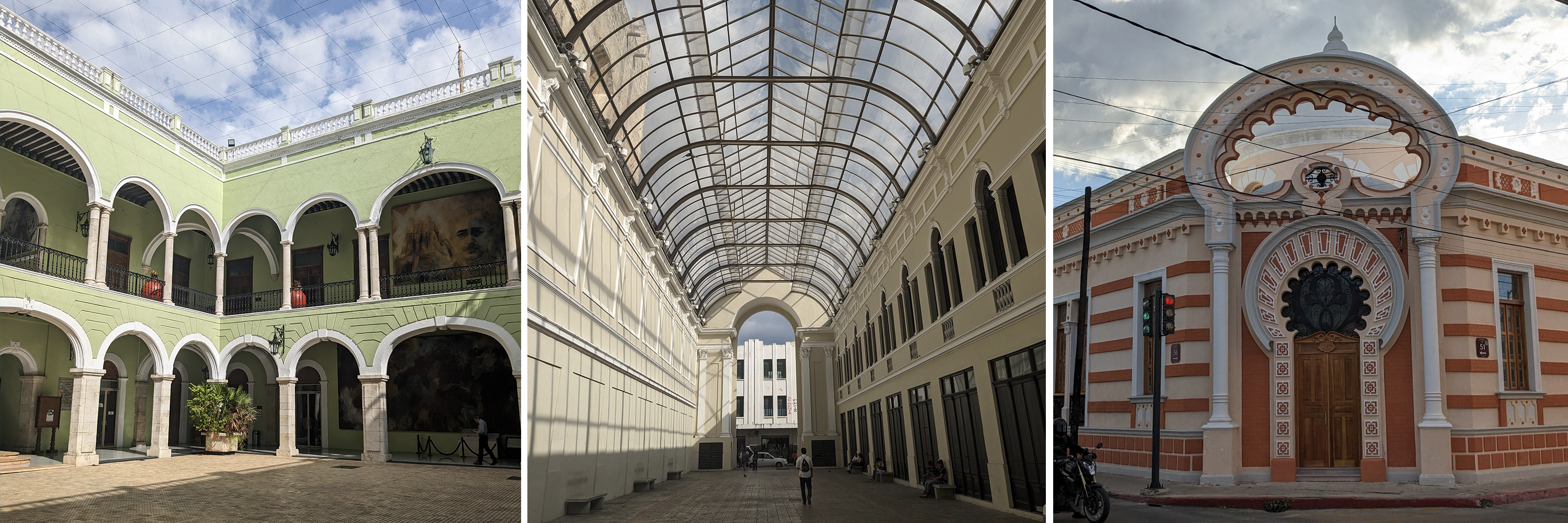
City Center: Palacio de Gobierno, Pasaje Revolución, fancy corner house (by the way, all street corners have this diagonal cutout)

Paseo Montejo: El Minaret, Monumento a La Patria, El Palacio Cantón (home to the Regional Anthropology Museum)

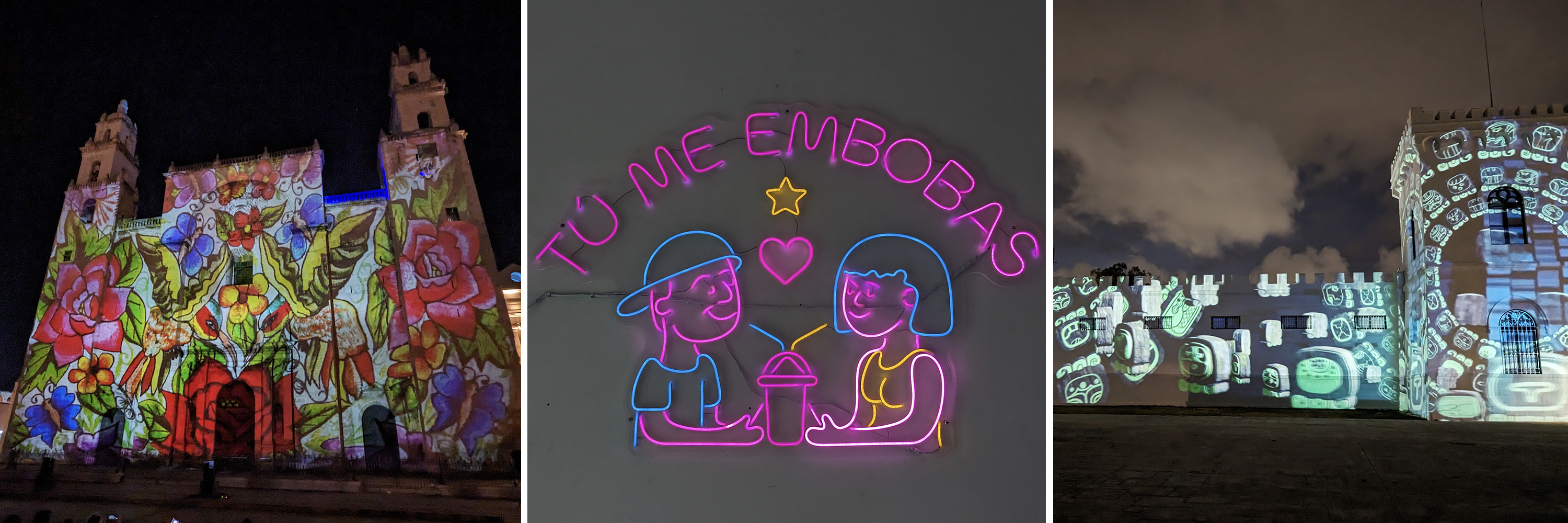
Mérida in Lights: Catedral de San Ildefonso, neon boba sign, old penitentiary lit up with Mayan calendar glyphs

Art

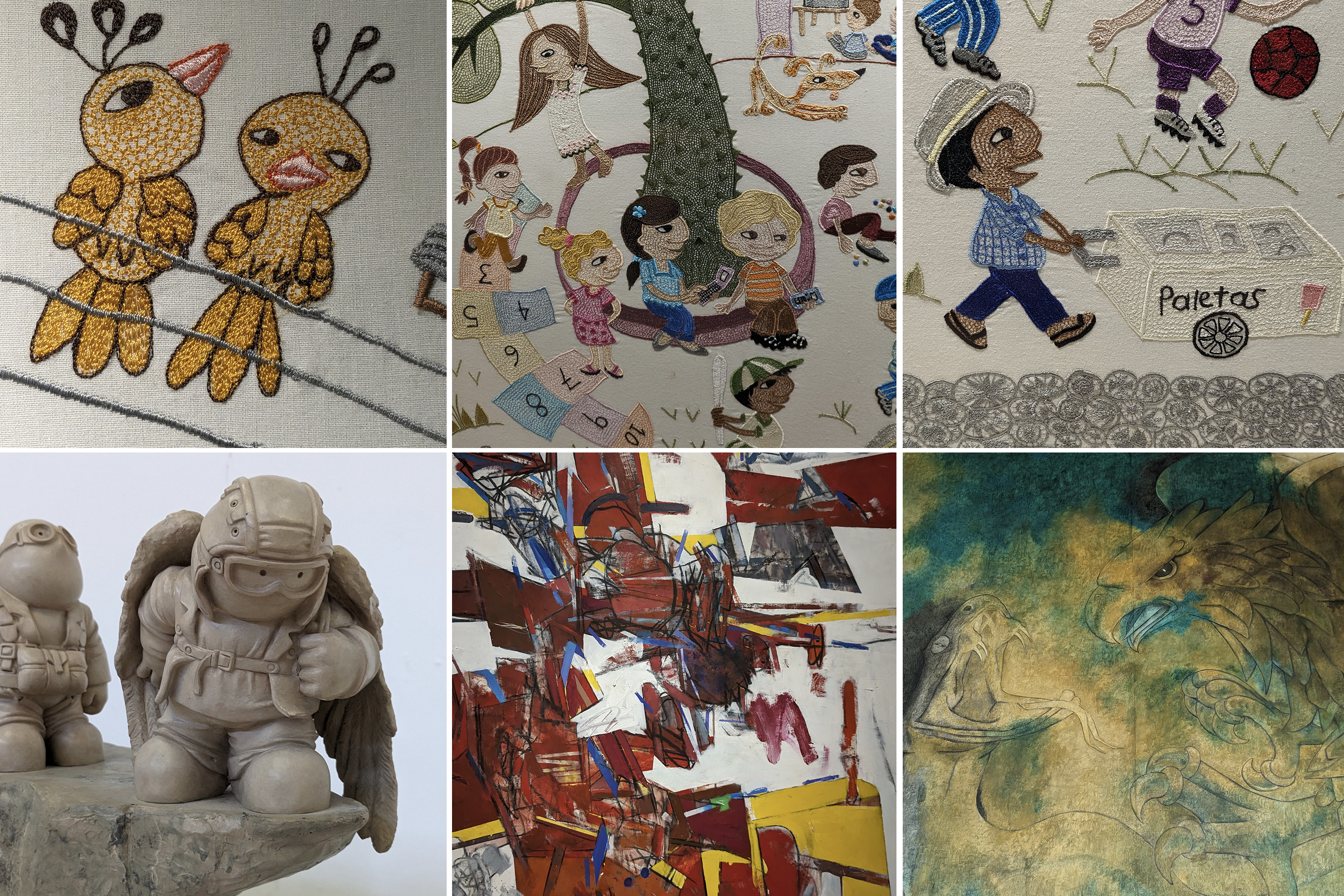
Mérida is definitely a city of museums and lots and lots of art. Every day after school was finished, I would try to get to another museum or gallery.

top (l to r): embroidery depicting typical Yucatecan scenes from the Gran Museo del Mundo Maya
bottom (l to r): sculpture in MACAY (Contemporary Art Museum), painting from MACAY, painting in the Palacio Gobierno by Fernando Castro Pacheco

Food

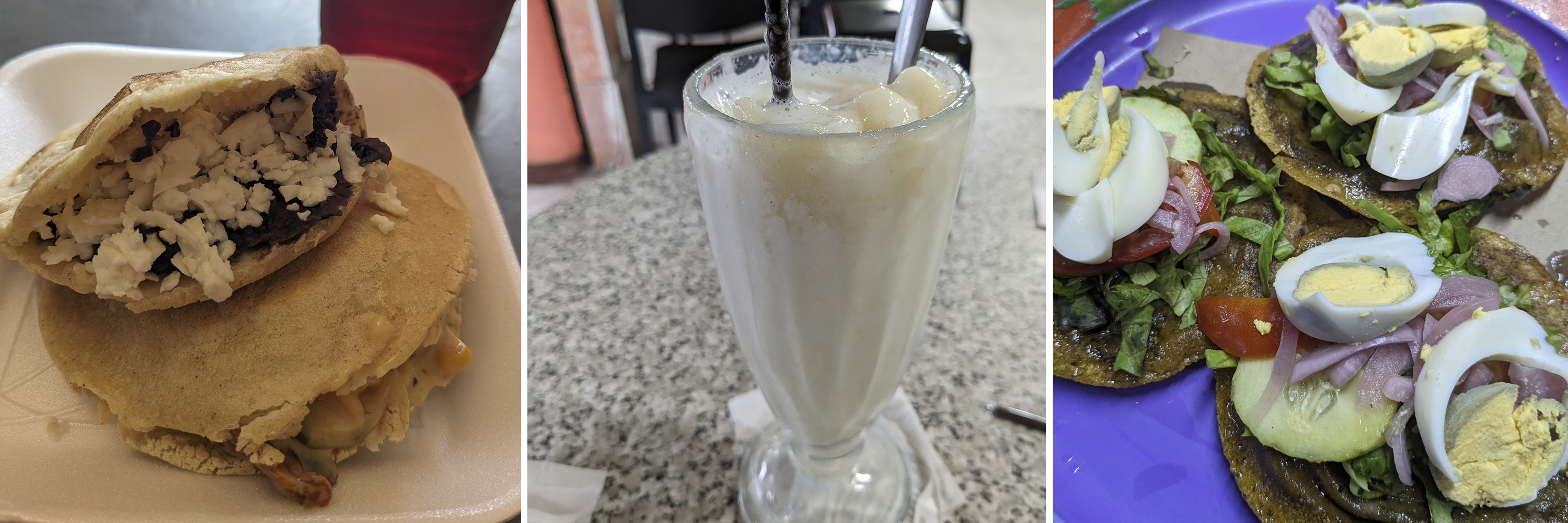
Of course, tacos are available on every other street corner, but the Yucatan has some special regional dishes. Salbutes are basically tacos, but have a puffier base than a regular tortilla. Panuchos are similar to salbutes, but are filled with beans and then fried a bit. There’s some differences in the toppings, but I’m vegetarian, so those subtleties were lost on me. Chaya, the tree spinach I briefly mentioned in an earlier post, gets tossed into a lot of dishes.

Onto the desserts: marquesitas are crepes filled with your choice of sweet toppings (nutella, cajeta (caramelized goat milk), or cream cheese), a bit of fruit (bananas and strawberries are common), and then topped with lots and lots of cheese before being rolled up into an easily portable street treat. Champola is also a speciality of Mérida in particular. It’s simple a sorbet covered in milk, but not blended together. The best flavors are guava, coconut, and mamey (a fruit with a bright orange flesh that I’ve only had while traveling, but apparently does grow in Florida and Hawai’i).

Mayan styled salbutes (with chaya and pepita seeds), vegan tacos de birria (not Yucatecan, but these were amazing), marquesita with nutella and banana

gorditas (stuffed with cheese and beans and mushrooms), coconut champola, panuchos with eggs

More Mayan Ruins

Balamkú

My guidebook mentioned that Balamkú was near Calakmul and was definitely worth a stop because of an enormous frieze that is actually open to the public. Now, I love art, but there’s a lot of art vocabulary that still baffles me and for some reason, I thought it would be a giant painted mural, maybe with a little bit of texture. I definitely wasn’t prepared for the size or scale of this piece of work. A nice guardian let me into the locked room and proceeded to share with me all of the animals carved into the giant stucco wall. There are four tall sections which are composed of a king on top, an amphibian in the middle, and the “monstruo de la tierra” (Earth monster) at the bottom. In between these four kings are kneeling jaguars. The whole scene represents entering the underworld for whatever rituals needed to be conducted there. Click on the images if you want bigger photos.

tall king section of frieze, jaguar (look for the claws), frieze and me (for scale)

pyramid view, decorative archway, and trees growing through steps on the main plaza

Within a short drive of Balamkú, the Zotz Cave puts on a nightly show with over 3 million bats leaving the cave to go in search of their dinner. There’s only room for about 20 people to watch from a path overlooking the cave. Right around sunset, the bats start to emerge. Eventually, it looks like a giant bat volcano and there are so many that the bats sometimes collide with the humans that are standing around. One bat attached to my shirt and another one landed in my hair. They both safely detached and went on their way. There are between 7-10 different species of bats that live in the cave and most of them join this nightly insect feast.

Chicanná

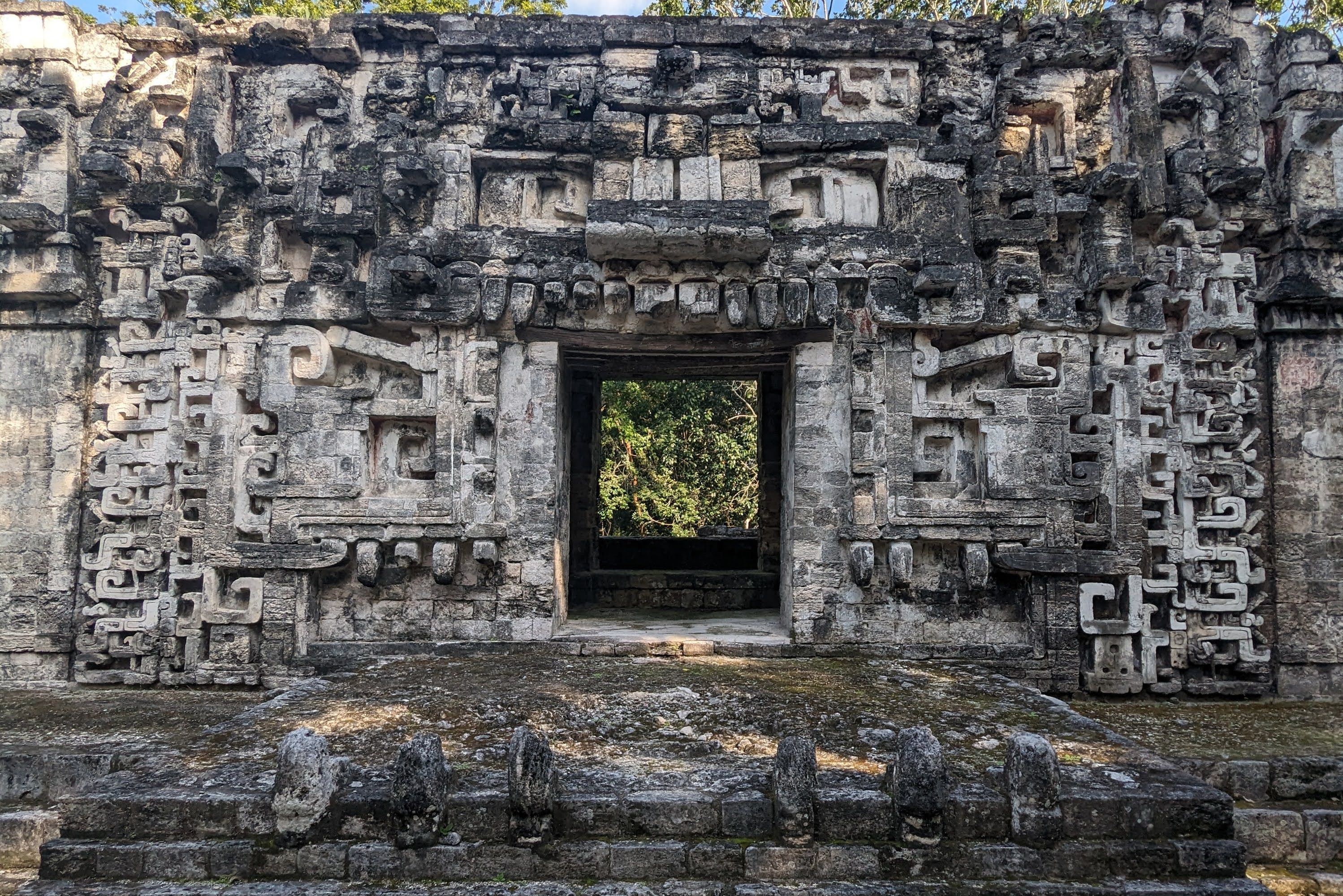
This site doesn’t have giant pyramids, but instead is a small town filled with intricate carvings and decorations. Chicanná got its name from one building in particular – the House of the Serpent Mouth. Chi means “mouth,” can means “serpent,” and na means “house” (thank you, Wikipedia). This building is still incredibly well-preserved, but when it was built around 750CE, it would have covered in a layer of stucco and been painted in vivid colors including red and green. This elaborate carving probably represents the monster of the underworld. No one knows exactly how this building was used, but one idea is that rituals were conducted here and this door representing a symbolic portal between the middle world (where humans reside) and the underworld.

House of the Serpent Mouth

Because of the huge number of decorations, archeologists think this was a town for elites where some rituals would’ve been conducted. It’s situated very close to Becán and probably functioned as a rich suburban enclave.

close-up of carvings

Becán

Becán is a big city with a giant pyramid. Due to some complicated rental car logistics, I only had about an hour to run around and climb up these awesome ruins. I definitely wished I’d budgeted some more time for this sprawling site. This city was surrounded by a giant moat, which probably functioned to both protect the city, as well as to serve as a supply of water for the town itself. It served as regional capital for the surrounding countryside where goods were brought and distributed to other locations.

biggest pyramid in Becán (Structure IX), view from the top of the pyramid down onto another ruins (Structure VIII)

One of the most interesting parts of Becán was how much housing has been uncovered and is open to tourists to enter. The rooms are relatively small, but most of them have some kind of built-in bench or bed. The Mayan arch is a a set of parallel walls that at some point is angled inwards and is then covered with a single layer of wide bricks at the very top. This approach to construction appears frequently in Río Bec architecture, the style associated with Becán, Chicanná, and Xpujil.

really thick tunnel wall with a Mayan arch, view from the top of one of the ruins, typically Mayan bedroom with Mayan arch above

Xpujil

This is a relatively small site, located close to Xpujil (pronounced eesh-poo-heel) town which is why it gets a lot of visitors. Río Bec architecture frequently includes rounded corners, temples with two towers (although this one has three), and monster mouth doorways. My photos of the large temple with three towers didn’t come out to well with the shadows from the afternoon sun.

carvings, close up of one of the temples three towers with clear layers, tree growing on top of the ruins

If you made it this far, here’s a bonus video of spider monkeys playing around in Balamkú.

Calakmul

Ancient Mayan City

Despite being one of the largest and most powerful Mayan city states, Calakmul has never gotten the same attention as Chichen Itza to the north and Tikal to the south. It does have UNESCO World Heritage status, but I’d never even heard about it until I started looking through my guidebook. Right now, the public transportation options are limited and there aren’t many group tours, so it’s challenging to get to. I chose to rent a car in Bacalar and drive many hours on pothole-filled roads. However, everything is changing: the Tren Maya is currently being built (all the heavy trucks contribute to the pothole problem) and will probably be done in the next year. This area will soon be inundated with tourists. The tiny 20-car parking lot is being expanded; the roads are being widened and repaired. Tourism and its impact on the area is about to explode.

Because I knew almost nothing about Mayan history and culture, I hired a guide for this tour and we met at 4:30 in the morning so that we could arrive in the park right when it opened. There were only a couple other people wandering around at that time and it is truly surreal to try and imagine the hustle and bustle of a once-thriving capital city when almost no one is around. The view from the top of the king’s pyramid (Structure II) is incredible: a clear view of miles and miles of trees. But 1500 years ago, there would have been settlements and roads in every direction. Even though the large structures of Calakmul have been excavated, the foundations of the old city remain buried beneath the trees.

from the top of Structure II, the home of the former kings of Calakmul and one of the tallest Mayan pyramids

The king’s palace actually has two levels and it is impossible to see the place where I’m sitting from the ground. The king’s quarters on top would’ve been relatively hidden from the common folks down below. He also would’ve had an elongated head because all of the elite Mayans had their heads tightly bound as children. Everyone in the elite class actually looked completely different from the rest of the people. Mayans also engaged in face scarification and wore a lot of heavy jewelry, especially in their ears.

view of the king’s palace from the bottom, a close up of one of the stelas that depicts a ruler standing on top of a slave who is kneeling

Stelae were often constructed to commemorate people and events. Many of the stelae at Calakmul are in bad shape. There are a few different ways to write in Mayan language: one way uses pictures to depict a specific meaning, another uses pictures to match the syllables of the word, and a third combines both of these together. Despite the complexities, experts can generally decipher most Mayan script today.

top part of stela showing the ruler standing above the slave, view of 5 stelae from the top of Structure I (pyramid that was probably used as a temple)

The pictures below show another large pyramid (Structure VI) where astronomical sightings were made. This building and others were built so that the sun would line up in specific places on the solstices and on the equinox. Some of the engravings on the sides of the stelae are still very clear even after all this time. Although the front and back of these stelae were removed by looters, the sides discuss the people involved as well as the dates of events.

view from bottom of the pyramid, view from top of the other two large pyramids, engravings on side of a stela

So far, at least four tombs have been found inside the king’s pyramid and even more tombs were found in other structures. Even houses of common folk have skeletons buried inside of them. The bodies of the elite class were buried with elaborate outfits and offerings to the gods.

Many graves not only have masks made of jade, but also necklaces, ear plugs, and other fancy adornments. There is no jade in Mexico, so all of this jade was most likely imported from what is now Guatemala, which shows the extent of trade in the region. All of these jade funerary masks below were found in Calakmul, but were removed and put into museums in the city of Campeche. (Side note: this is actually one of the reasons it took me so long to write about this, because I had to go to Campeche to see these masks.) The mask in the top right is the most elaborate and probably belonged to Yuknoom Yichʼaak Kʼahkʼ, the ruler of the Mayan snake kingdom starting around 650 CE.

top row (l to r): mask of Yuknoom Yichʼaak Kʼahkʼ, jade mask & ear plugs with cinnabar used on the mouth, another intricate mask depicting a few different animals
bottom row (l to r): a mask representing Yuknoom Ch’een II (the father of Yuknoom Yichʼaak Kʼahkʼ), another jade mask & ear plugs, jade mask probably for a priest with a second set of eyes representing his supernatural vision and the red lines on his cheek showing ritual scars

Calakmul Biosphere Reserve

After our tour of the ancient city, my guide took me on a short walk through the nearby protected natural area. Even wearing insect repellant, a swarm of mosquitos kept threatening to attack my face. There’s so much to see in the rainforest, but my guide started by showing me the chewing gum (chicle) tree. By cutting diagonal lines in the trunk, they were able to get the natural resin to flow and that was harvested and exported to make chewing gum. I also was introduced to the Mayan breadnut (ramón) tree which is used to make bread or a type of porridge. We came across a swamp and I could see a crocodile hanging out on a log. Perhaps the most exciting thing I saw was on our slow drive (avoiding potholes) back to the entrance, when a tayra crossed the road. I didn’t get a photo of it (but Wikipedia has some) and my guide said it was only the third time he’d ever seen one. Folks here call them the viejo de monte (old man of the mountain) because of their white heads.

top (l to r): chicle tree with scars, natural chewing gum, Maya breadfruit tree starting to grow from seed
bottom (l to r): papaya tree, Central American Gulf Coast toad, termite nest with holes most likely made by parrots that are living inside of it