Punakha
The last time I wrote, we were in Phobjikha Valley. After a lovely nature walk, we started our drive and our guides spotted a lively bunch of langur monkeys hanging out on the side of the road. They didn’t hang out for long, but one of them stopped to examine something stuck in its toes. It pulled out whatever was bothering it and put this toe treasure in its mouth. Apparently, tasty morsels can be found everywhere, if you’re a monkey. Eventually, we arrived in Punakha and we stopped to see the dzong, which was built on the scenic convergence of two rivers: Pho Chu (Male River) and Mo Chu (Female River).
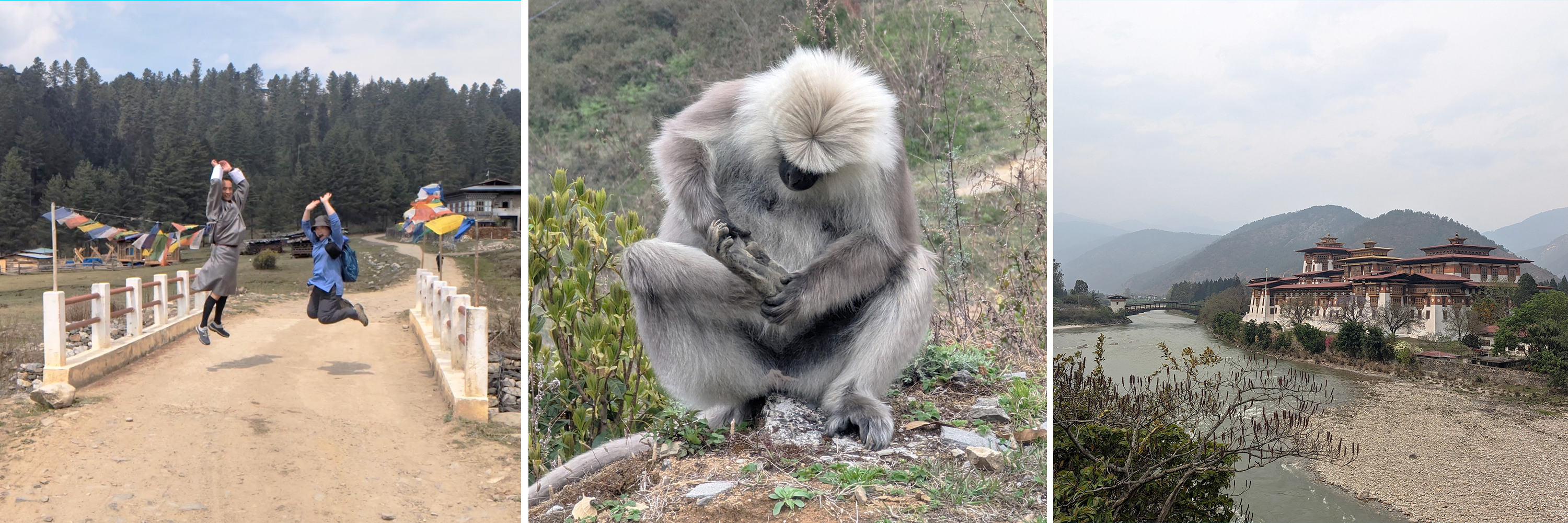
Angela and Tenzin jumping in Phobjikha, en route we ran into some langur monkeys picking things out of their feet and eating them, the stunning Punakha Dzong
Although I think the Trongsa Dzong might actually still be more beautiful on the inside, the riverside setting of the Punakha Dzong makes its exterior more photogenic. The main temple inside the Punakha Dzong is quite large. This temple is where many ceremonies involving the royal family take place since it’s the only one large enough to accommodate all the invited guests. The outside of the temple is filled with intricate carvings and the inside is covered in paintings depicting Buddha’s life. Photography is prohibited inside all religious buildings.

beautiful wooden carvings on the main temple inside the dzong that is used for official purposes, Punakha Dzong lit up at night
In order to get to the dzong, everyone crosses over a very scenic bridge over the river. Although we contemplated jumping on the bridge, there were a lot of people around and we didn’t want to seem disrespectful. Instead, we all posed for very tasteful photos with the dzong in the background. In the capital city of Thimphu, it is possible to have stamps made with a photo of your choice. We thought they just took a photo, but instead, we were asked to transfer a photo over from a phone. This was one of the most recent and cutest photos we had taken, so we purchased a couple sheets of stamps and a pile of postcards to send to family and friends. If you got one, consider yourself lucky, because those stamps had an extremely limited run of only 24.
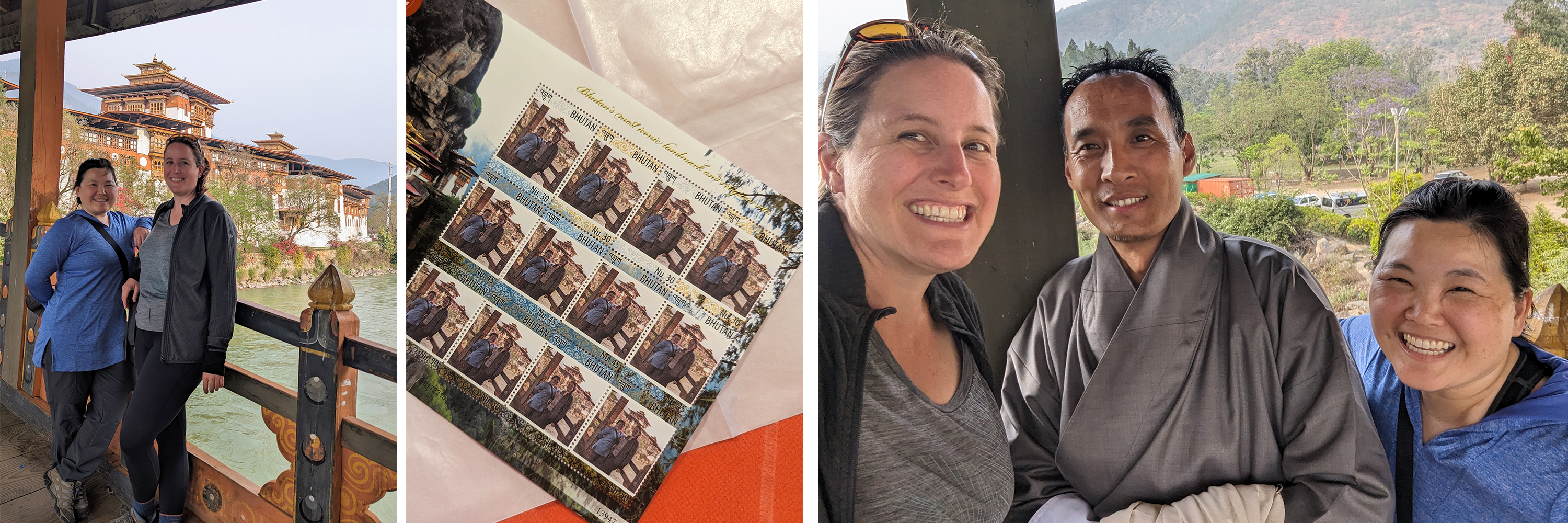
outside of Punakha dzong; same photo made into stamps we sent home with our faces on them; me, Tenzin & Angela on the bridge
Divine Madman
It doesn’t take long to notice that there are a lot of phalluses in Bhutan. They’re hanging from rooftops, painted on buildings, and used to bless tourists at festivals. Of course, there’s a story behind this, and it features a notorious monk named Drukpa Kunley, also known as the Divine Madman. He is usually depicted in paintings as having long hair, a bow and arrow, huge rings in his ears, and a hunting dog nearby. He was born in 1455 int Tibet and trained in a monastery before he later renounced his vows and took a wife.
The Divine Madman was a wandering Buddhist teacher, who started lecturing about different ways to reach enlightenment that included a lot of alcohol and sex. He used his Thunderbolt of Flaming Wisdom (a.k.a. his phallus) to subdue demons, in some cases by sticking it in their mouths. There are many stories about him seducing married women, and then their jealous husbands are converted to his ways and become an ardent follower of his teachings.
There are also stories of a Buddhist nun getting pregnant and having his child. However, the other nuns are jealous, but about a year later, there are a bunch of babies in the monastery, presumably from a very busy Drukpa Kunley. It’s easy to see why he’s associated with fertility in today’s Bhutan. Many people flock to Punakha to visit his temple, known as Chimi Lhakhang, to receive blessings and pray to have a child. There is an entire album of photographs inside the temple of people with their children they conceived after they visited. Those children are often given the name Kunley (after the monk) or Chimi (after the monastery).
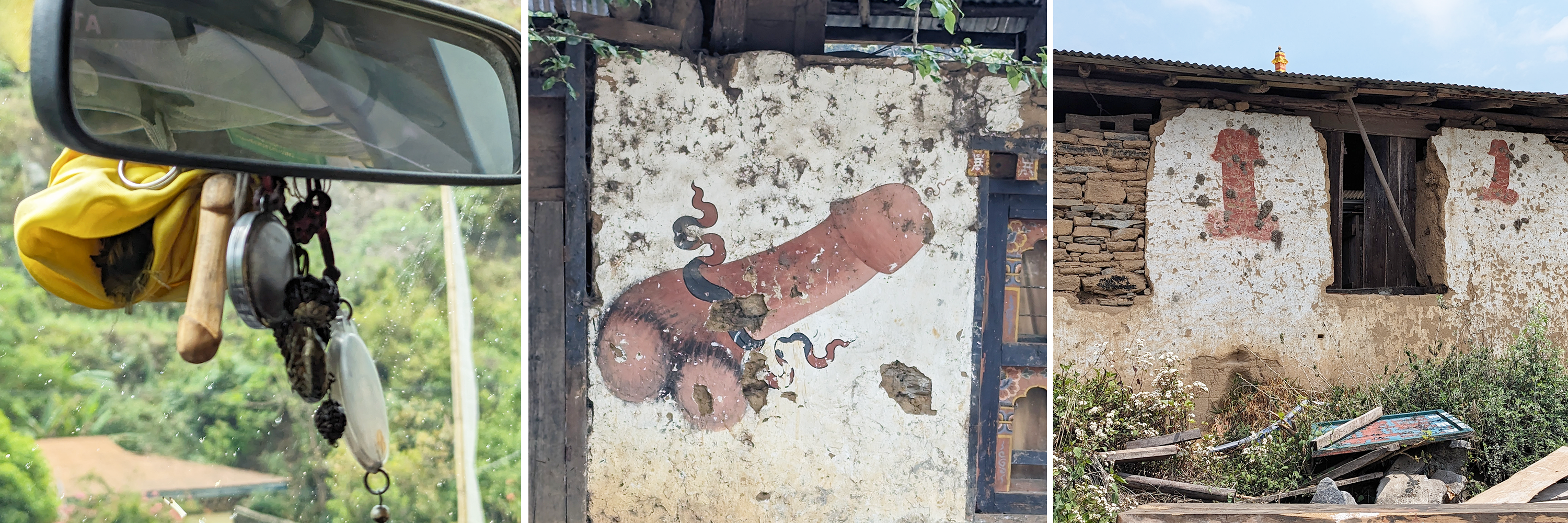
good luck phallus in the car, intricate phallus painting on a storefront, double phallus decorations in a village
Today, the phalluses all over the county are meant to ward off evil spirits and malicious gossip. They are often hung from the eaves of the roof once a home is built. The paintings often depict phalluses with a string wrapped around the middle. Apparently, someone gave the Divine Madman a sacred thread to wear around his neck. However, he instead tied it around his phallus and said he hoped it would bring him luck with the ladies.
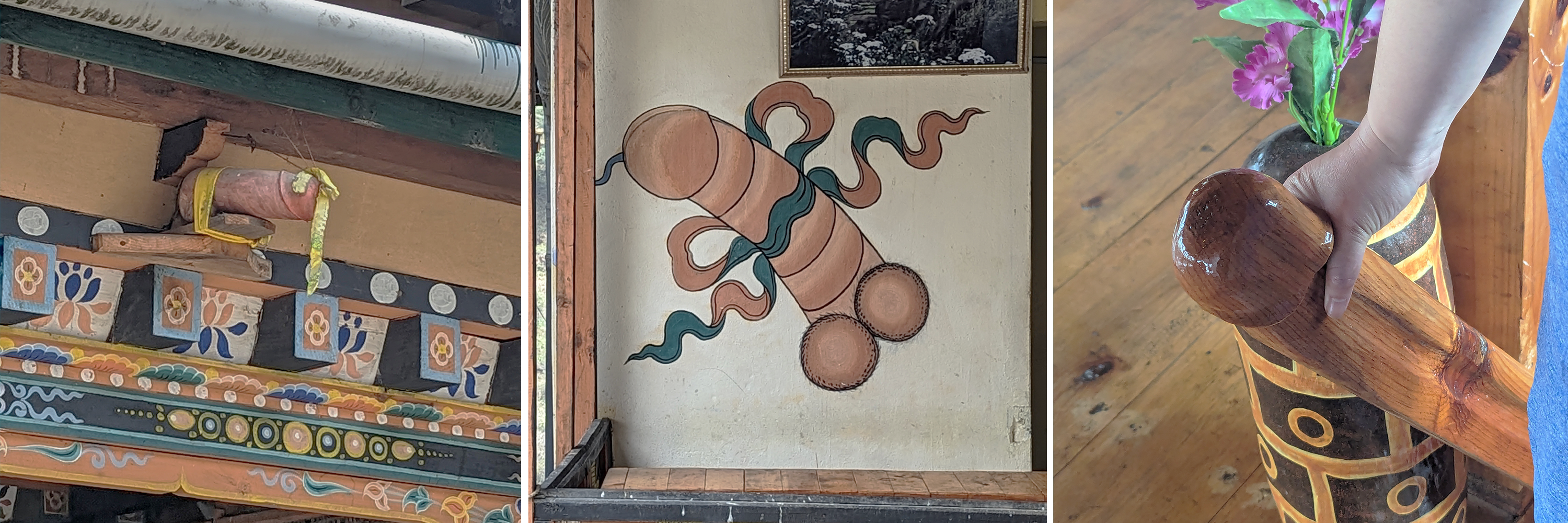
two crossed phalluses hanging from the corner of a house, painted phallus, handrail phallus carving
Although this phallic obsession is attributed to the Divine Madman, there’s been some research that shows that phalluses played a central role in the Bon religion, the animistic religion practiced in Bhutan before Buddhism became so widespread. Regardless of their origin, they continue to be a vital part of Bhutan’s cultural traditions today.
 Meandering Marbles
the handrail through hahaha
LikeLike
*though
LikeLike