This trip to Bhutan has definitely been on my to-do list for more than a few years. My college friend Angela and I started talking about this probably a decade ago, were seriously talking about going in 2020 (which of course didn’t work out), and finally the stars aligned for both of us to be available this spring.
Merak-Sakteng
After a brief stopover in Paro, we flew to the eastern edge of Bhutan. This is an area of Bhutan that travelers often don’t go to because it’s logistically challenging and requires a lot of time and in Bhutan, time is money. Travel here works very differently than other countries because the only way to visit as an American is on a guided tour. There is a sustainable development fee of $100 every day plus a set cost that is paid for lodging and meals, entry fees, guides, and travel. Souvenirs and tips are extra. The goal is to open Bhutan up to tourism, but not in a way that has a large negative effect on the community and the environment.
Our guide Tenzin flew with us and we met our driver Pema at the airport since he had been diligently driving all the way across the country the last couple days. We drove past the first university started in Bhutan, near several stupas commemorating different parts of Buddha’s life, monasteries, and through beautiful hillsides of red and pink rhododendrons that had recently bloomed. Eventually, we met our first yak and I stuck my head out the window and mooed at it. It just looked at me strangely and continued to munch grass.

stupas, Rangjung monastery, my first yak
Eventually, we arrived our destination of Merak, which is home to the Brokpa people. This used to be a semi-nomadic yak-herding tribe, but most people have a house in one of the villages nearby now. Originally, they lived on the Tibetan plateau, but eventually relocated to what is now Bhutan. There are additional Brokpa villages scattered throughout Arunachal Pradesh, India.
Our guide in Merak, Gelzen, told us the story they tell about how they ended up in Bhutan:
Once upon a time there was a Tibetan village where the wood was dry, wet, and rotten and not very useful. The people lived in the valley below the peak of a mountain, which kept the valley entirely in shade, which caused very little to grow and the people to suffer. The queen wanted to bathe in the river and it was too cold, so the king told the villagers to remove the peak of the mountain so the river would be warmer from the light of the sun.
They were running out of time to finish removing the top of the mountain when along came a small girl carrying a baby. No one knew the girl, but she told them, “It is better to chop off the head of a man than to chop off the head of the mountain.” She then kept walking on her way.
When the villagers convened that evening, everyone had seen the little girl but no one knew who she was or where she had come from. After much discussion, they decided the girl must be a deity and they should follow her advice. They hatched a plan to chop off the head of the king.
They petitioned the king to have a party to celebrate finishing their task of removing the top of the mountain. He eventually approved the plan to drink wine and dance. In those days, wine came in a large wooden container and they decided to hide an ax at the bottom of the container.
On the day of the party, the king and his entourage arrived and the party began. The dancers danced and the wine flowed freely among his soldiers and additional guests. However, the villagers did not partake in the wine because they knew about the plan. Eventually, most of the wine was finished and the last bit of wine was offered up to the king. As the villagers reached in to serve the wine, they pulled out the ax and chopped off his head. All of the villagers rejoiced in their newfound freedom.
They then discussed whether to stay in the shadow land and fight the king’s soldiers or to run away to another location. The girl arrived again and introduced herself as the deity Jomo and offered to guide them to a new land. She spotted the top of a mountain far away from where they were standing and led the villagers to that new location.
Those villagers that were stronger and were able to keep walking, continued over the mountain pass and settled the town of Merak. The less strong, weaker villagers turned around when they couldn’t make it over the pass and returned to the valley to set up the town of Sakteng. There is still a marker between the two villages that denotes where they turned back. Today the Brokpas revere Ama Jomo (Mother Jomo) as a principal deity that protects their villages.
Angela and I had decided to hike from Merak to Sakteng, which was supposed to be about 20 km, with a 1500 m elevation gain. When we checked in for our permits with the local forestry staff, they suggested it would take about 8 hours. Because we had just come to Bhutan a few days before, our guides had us spend another day in Merak to acclimatize to the elevation.
We had a lovely day walking around Merak and taking in the local culture. We visited the elementary school and as soon as we entered a classroom, all of the students stood up to say hello. Instruction in schools here is conducted in English from a very early age, so the grade 4 students answered a few of our questions, before we continued exploring. We wandered through herds of yaks, a few dzo / dzomo (the offspring of a cow and a yak), more rhododendron trees, before heading back to our homestay. While there, we ate lots of thueb (red rice porridge), fried rice, chili cheese, vegetables, and suja (butter tea). Butter tea is basically tea, milk, butter, and salt and tastes more like soup than tea. I was a bit skeptical at first, but decided I liked it for breakfast.
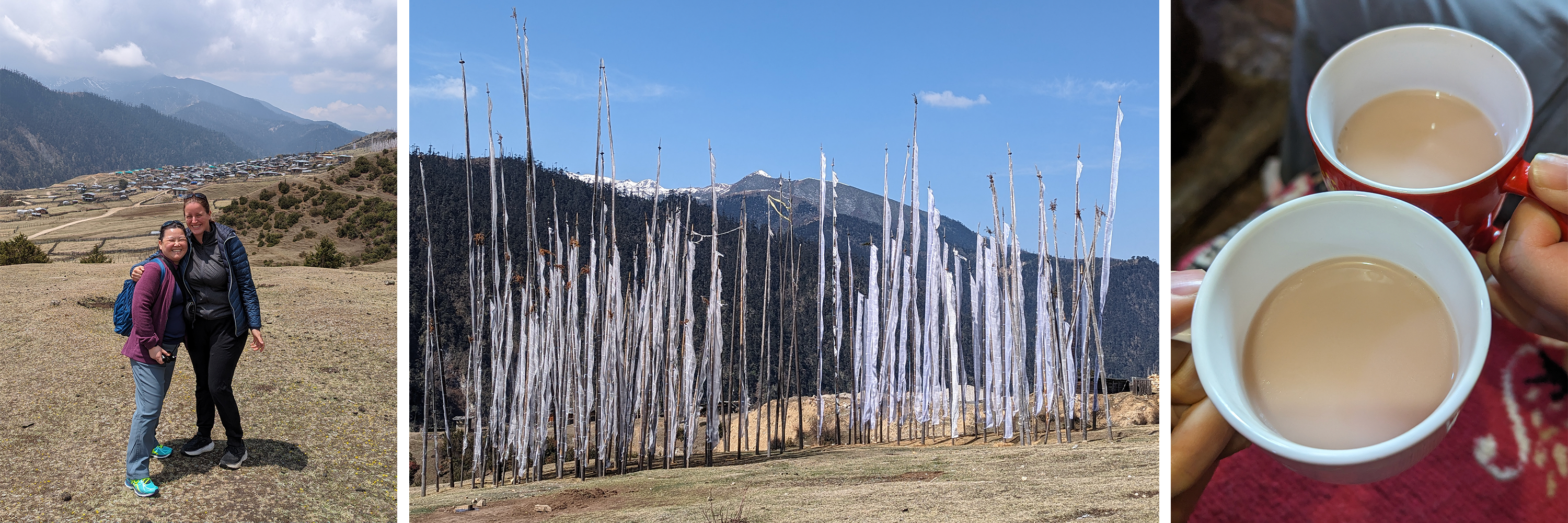
Angela and I with the town of Merak behind us, prayer flags, butter tea (suja in Dzongka)
We also got to try on traditional Brokpa clothes and a couple of women sang traditional songs for us, while the home-brewed alcohol known as ara was passed around. The ara in Merak is mostly made from potatoes, corn, and buckwheat.
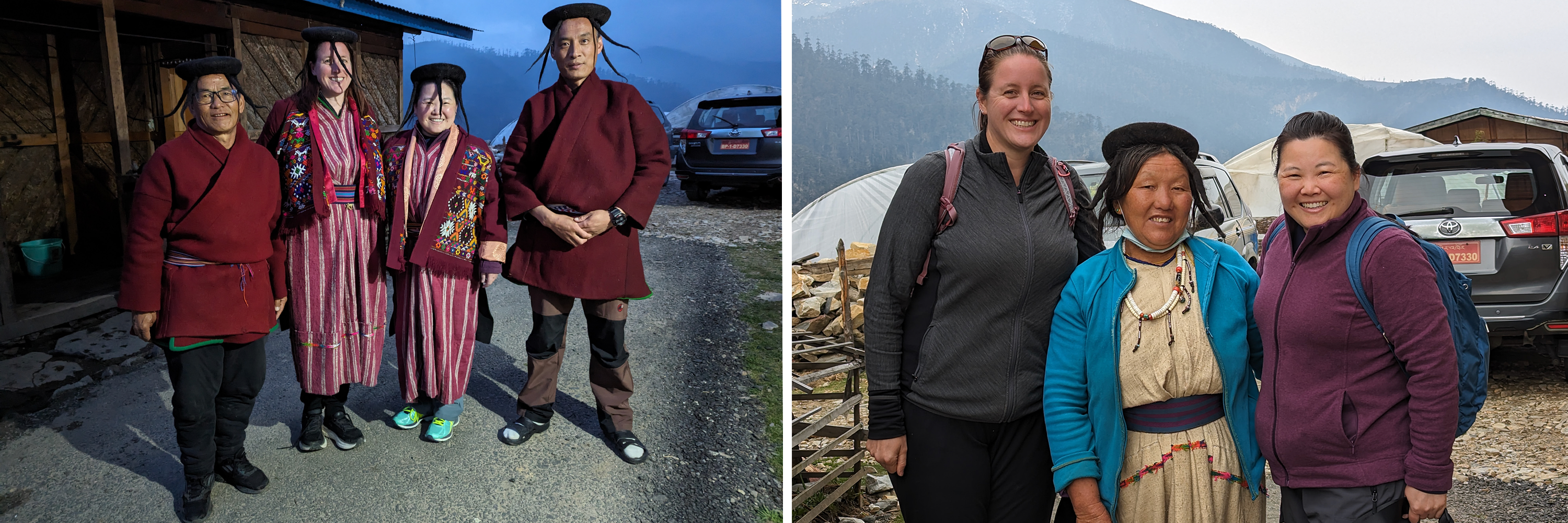
Pema, me, Angela, and Tenzin dressed up in traditional Brokpa clothing; Angela and I with our homestay Ama
The next day, we took off on our trek onwards and upwards over the Nachungla Pass which tops out at 4150 m (13,615 ft). There’s snow near the top, so, of course, I got in a snowball fight with our guide. Angela was struggling with the altitude and was having none of it. The whole trek is lined with rhododendron trees, even though they’re not quite in bloom yet because it’s too cold. At the pass, Gelzen gave us prayer flags and helped us to tie them on poles on the pass. Our porters also started a fire to appease the local deities.

Tenzin, a porter, and Angela hiking through the snow; our prayer flags at Nachungla Pass
Along the way, we found some interesting high elevation creatures including this intricately patterned beetle that Gelzen said was called a juniper bug because if you sniff it, it smells like juniper. Well, I caught one and tried to smell it and it didn’t smell like much of anything to me. Our guide Tenzin was a bit confused what we were doing and we realized that there are different kind of trekkers. Some just want to get from place to place, and some stop to smell the bugs. We definitely belong to the latter category.

juniper beetle, Himalayan tailless pika, sumo mite
Once we got down off the pass, we descended into beautiful scenery filled with mostly red and pink rhododendrons. It’s hard to describe what it feels like to hike through entire hillsides covered in brightly colored flowers, but the whole experience was magical.
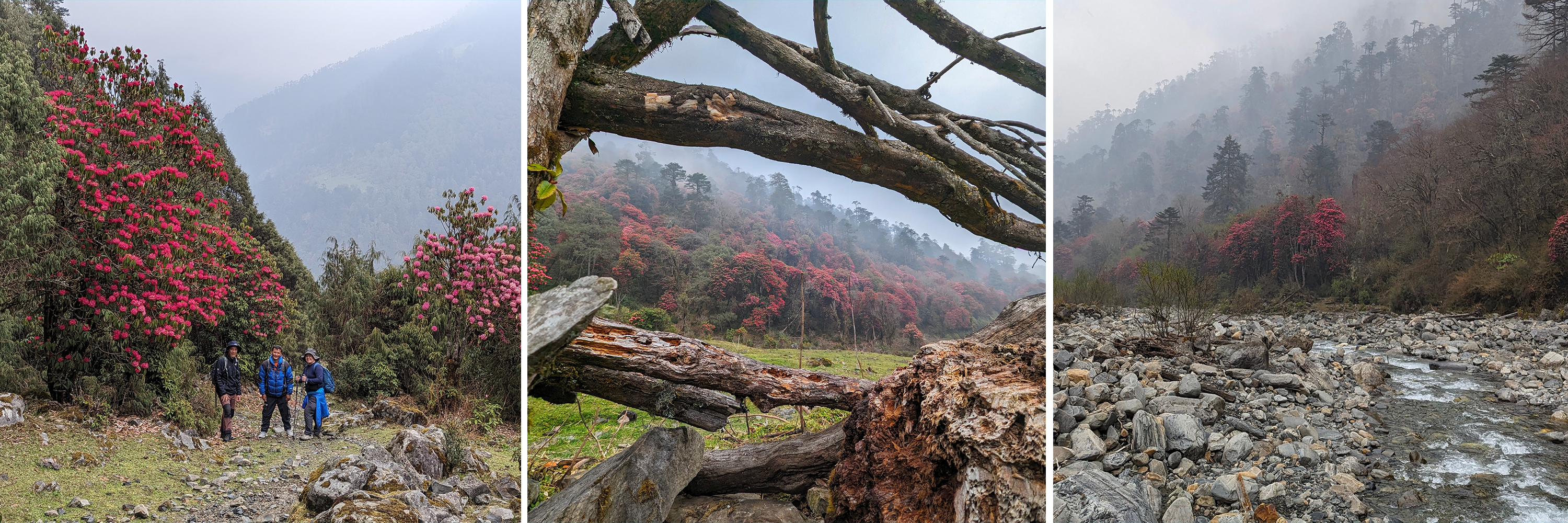
Tenzin, Gelzen, and Angela; rhododendron hillside through a yak fence; river & rhododendrons

different colored rhododendrons from our trek
Due to some slow climbing and lots of photography stops to look at flowers and beetles, we actually ended up getting into Sakteng after dark. Pema met us at the top of the hill with cups of tea and we slowly made our way down a hill and crossed two rivers on wet logs in the dark. We finally made it to our homestay, where we ate dinner and collapsed onto the mattresses on the floor.

looking back up the mountain into the fog
 Meandering Marbles
way to go, Amber! Loving your adventure news.
LikeLike
This is a wonderful read!
LikeLike
Wow! Looks magical!! So fun to “travel along” through your blog. Thanks for sharing.
LikeLike
I love that you stop to smell the bugs, both literally and figuratively 🙂
LikeLike
Flowers too. And nudibranchs, of course. 🤣
LikeLike