Playa del Carmen
Playa, as it is affectionately called locally, is a strange little oceanside town. It’s got an entire avenue (Quinta Avenida) dedicated to hawking souvenirs, tours, tequila, and sunscreen. “Mexican Disney” is how I described it to a friend. I get the appeal. There are nice beaches, lots of fresh and tasty food, and an entire English-speaking industry devoted to serving tourist needs. I understand why expats and digital nomads would decide to settle there. However, as an independent traveler type who is more excited about sea life than wave life and is looking for a bit more authenticity, I can’t really recommend the city.
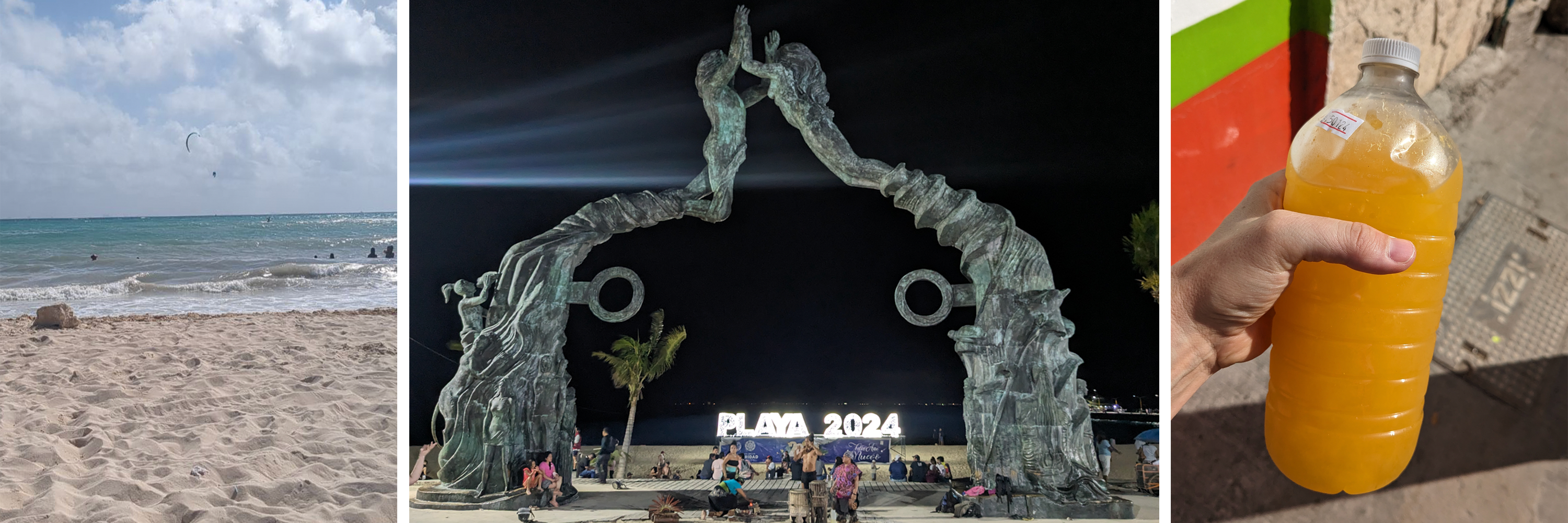
Beach 72 in Playa Del Carmen, famous Portal Maya sculpture, and a liter of passion fruit (maracuya) juice
Tulum
Word on the street is that Tulum was a lovely little town about 10-20 years ago and now has turned into the tourist destination du jour. I didn’t even go to the beach part of the town, but I did make it the Mayan ruins that gave the city its name. Probably called Zama (meaning sunrise/dawn) by the original builders, during the colonial era it got the name Tulum (meaning wall). As the city of Chitzen Itza declined in importance, Tulum came to prominence. The city has incredibly thick walls (16-26 ft deep) that surround three sides of the city and the last side faces the ocean. Tulum was well-protected because it most likely functioned as the port city for Coba with large ocean-going canoes making regular visits. Flint, ceramics, gold, salt, textiles, jade and obsidian were most likely being imported, while feathers and copper were being exported. Obsidian came from central Mexico, jade from Guatemala, copper from Honduras, and cacao beans from the Tabasco. There is also evidence of the city’s worship of the Descending God (or Diving God), seen in the photo of the temple below. This god is always pictured head-down, feet-up and may be the same as Ah Muzen Cab, the Mayan god of bees and honey.

top row (l to r): Black spiny-tailed iguana, House of Chultun, Temple of the Wind
bottom row (l to r): Temple of the Descending God, Temple of Frescoes (close up of corner carving), Dancing Platform
The entire Yucatan peninsula is dotted with cenotes, natural holes made from limestone collapsing. Cenote Yaxmulito was the first one I got to swim in, and I had it all to myself for the first 15 minutes I was there. This one was almost entirely enclosed with just a few holes allowing a bit of light in. I have to say, it is utterly surreal to swim amongst stalagmites in the dark.

Views of Cenote Yaxmulito
On the day I arrived at my hostel, there were large banners celebrating the anniversary of a local musical school. I didn’t think much about it, but that evening, there was a lovely neighborhood gathering to watch not only young performers, but also a few professionals do their thing. It’s such a gift to just wander into local events and meld into a crowd. Other kids came around and handed out streamers for us to wave in support. I took a video because the music is a bit different than I expected to hear.
Bacalar
The Laguna de Bacalar is one of only a few places in the world where stromatolites are still being formed. Stromatolites are natural structures built over time by cyanobacteria and are some of the oldest fossils we have. When I was biking across New York last fall, the fossil stromatolite I took home from the Herkimer mine was probably about 900 million years old. Of course, I got in a kayak and paddled myself around until I found some. Mostly, I just came to hang out and swim in this incredibly peaceful freshwater lake. It’s quite a ways off the beaten path, but was a nice layover en route to my next destination.
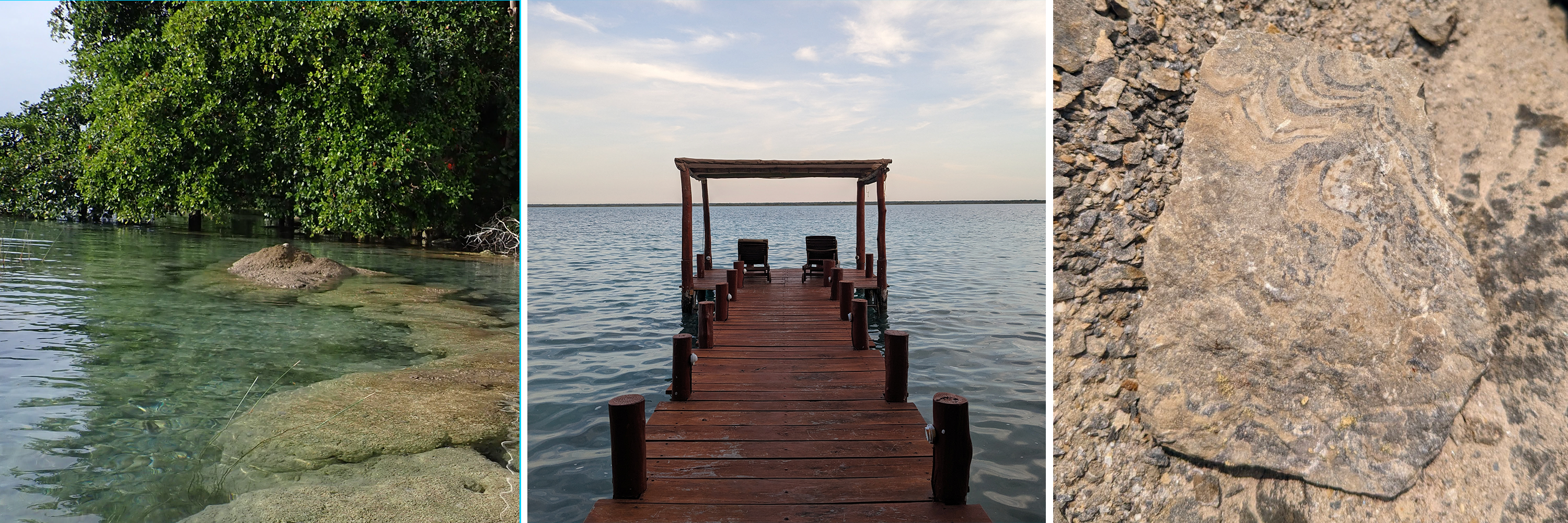
living stromatolites, view from the hotel, fossil stromatolite from Herkimer, New York
More photos of delicious food I’m eating:

mangos with chamoy, delicious vegetarian sopes across the street from the Tulum ruins, agua de piña y chaya (pineapple and chaya, which is also known as tree spinach)


That passion fruit juice looks amazing!
LikeLike
It is!
LikeLike