After our trekking in eastern Bhutan, we embarked on some long, long, windy roads to get to the center of the country. Although there were a few stops along the way, it was basically two straight days of driving. Nonetheless, we finally made it to the province of Bumthang (pronounced boom-tawng).
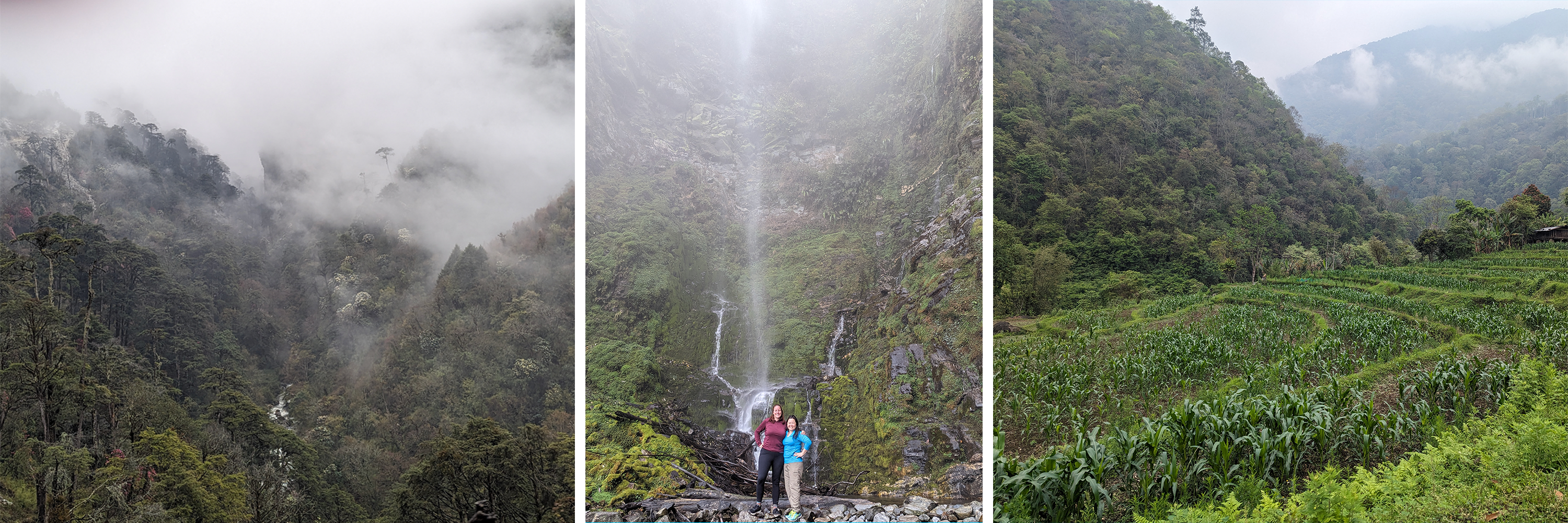
drive from Sakteng to Bumthang: foggy landscapes perfect for a fantasy novel, tall waterfalls, farming terraces
BUMTHANG
The weather had been hit or miss the previous few days and we were a bit worried we were going to be soaked by the end of our walking tour. Fortunately, clouds stayed away and we had a wonderful time as Tenzin took us to three different monasteries and a community weaving center.
The weaving in this part of the country is called yathra. Although different types of looms are used now, they still take an incredibly long time to make. Angela took one home that was at least four meters long! This particular center uses only natural dyes for their yak wool.

woman preparing the loom for weaving, natural dyes, yathra weaving in process
Before discussing any temples, it’s probably wise to talk about Guru Rinpoche. He was born in what is today known as Pakistan but due to some internal family disputes decided to leave. He lived in Tibet before entering Bhutan and in Bhutanese stories, he is foretold by the original Buddha as the next Buddha. One of his major talents was subduing local spirits and demons, which greatly abetted the spread of Buddhism throughout Bhutan. He also left behind treasures for believers to reveal in future years which could take the form of texts, objects, visions, or dances.
The biggest temple we visited in Bumthang was Kurjey Lhakhang, which now has three separate buildings. The oldest building is famous because Guru Rinpoche meditated here for three months and left an outline of his body print (in a seated posture) in the cave. He also, apparently planted his walking stick which became the giant cyprus tree outside the temple. The other two buildings were built by the first King and the Queen Mother.
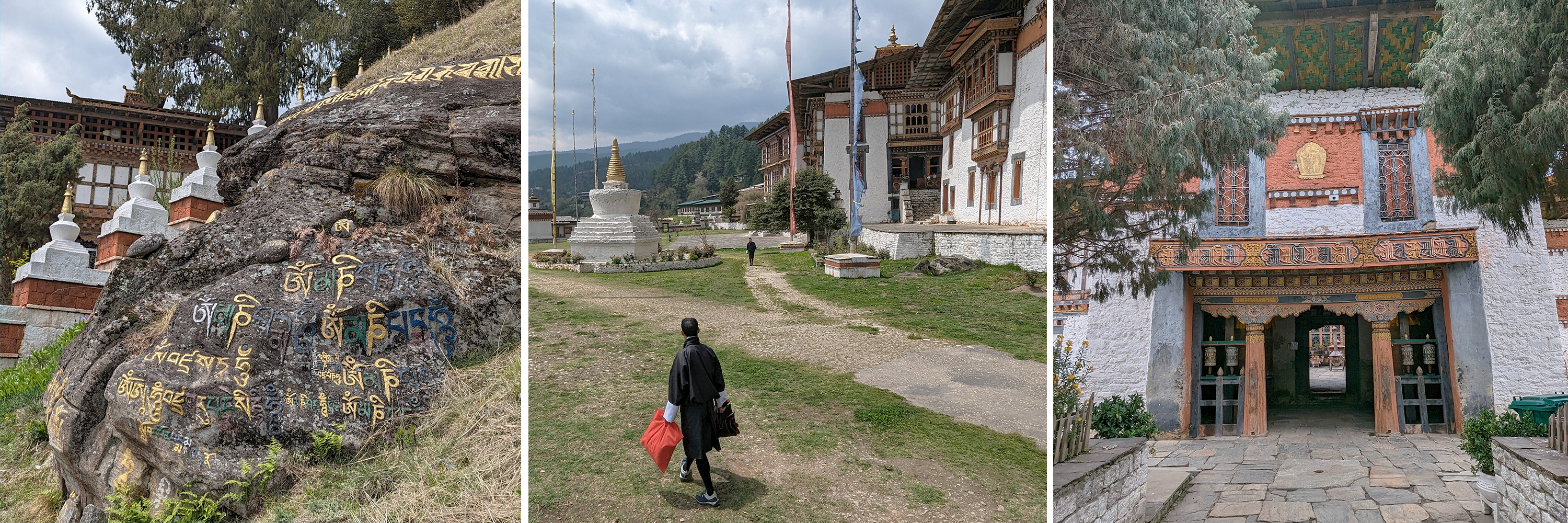
outside of Kurjey Lhakhang, Tenzin entering the grounds of Kurjey Lhakhang, outside of Jambay Lhakhang
Jambay Lhakhang was the oldest temple we visited, having been built in the 7th century. One notable difference in earlier temples is that the sculpture inside depicts future Buddha and not current Buddha, which means that the hands are in a different position (mudra).
In 1501, Tamshing Lhakhang was established by Pema Lingpa. He is revered in Bhutan as a treasure hunter. Guru Rinpoche appeared to him in a dream and told him about the treasures he would find. Eventually, a monk wandered by a couple years later and gave him a scroll which outlined where he could find his first treasure as well as a key for decoding its message. He successfully dove into a lake, retrieved another scroll, and deciphered this first treasure text. Although he was met with skepticism even in his time, Pema Lingpa won over his critics with stunning feats like retrieving treasures underwater while keeping a butter lamp burning even while he was submerged.

Tamshing Lhakhang (even monks have to do laundry), outside wall of monastery, Bumthang River
Apparently, he was a very precocious youngster and his grandfather taught him how to be a blacksmith. Inside of this temple is chain mail he made when he was still a child. Devotees sometimes wear this chain mail as they make three tours of the temple as an act of purification. Today, this temple serves as a place of learning for young monks.
DOMKHAR TSECHU
Tsechus (festivals) are a major part of Bhutanese life and when we were planning our trip, we wanted to make sure we got to see at least one. There are much bigger festivals in the large cities, but we made it to a rather tiny tsechu outside of Bumthang. Tsechus are generally celebrated on the tenth day of a month of the lunar calendar, but the month varies from temple to temple. This symbolically corresponds to the birth day of Guru Rinpoche.
About one-third of the attendees were probably tourists, but the rest were locals decked out in their finest kiras and ghos. The male fashonistas in the crowd also were wearing elaborate, fancy, fabric boots. In case you are wondering, those will set you back about US$100.

fancy boats, cute kid in kira & her grownup’s fancy boots, cute kid in gho & his fancy boots
Every tsechu has slightly different dances and events. We came on the third day of the festival, and the opening dance was a set of dancers in Garuda masks. There are four important mythical creatures in Bhutanese Buddhism: Tiger (tak), Snow Lion (seng), Garuda (chung) and Dragon (druk). These appear all over the country, especially painted on the sides of houses and temples.
Garuda is a bird-like character, with clear horns coming out of its head. There are often four of them decorating each corner of a temple’s roof. The Garuda is particularly important in Bhutan, because of its association with Guru Rinpoche. One of the ways he subdued demons was by transforming into Garuda.

Garuda dancers, another Garuda dancer, Raksha dancer with an amazing headpiece (this was actually the last dance we saw)
After the Garuda dance, a clown came around to bless guests with his giant wooden phallus. There’s a longer story here about why the phallus plays such an important role in Bhutan, but that will have to wait for a later blog post. Regardless, the clown bonked everyone on top of the head with the phallus (Angela and I both had to remove our hats to be blessed) and then he came back around and people gave small bills which he shoved into his wooden phallus in exchange for the blessing. Although tourists were his first target, he eventually walked around and blessed many of the locals as well.

clown collecting tips for blessings in his oversized phallus, tourist being blessed by phallus, ladies in beautiful kiras singing
The longest dance we watched was what I think is called the Ngaging Dance. Remember the chain mail treasure-hunting guy Pema Lingpa? One of his ongoing legacies in Bhutan is the collection of dances that were revealed to him. Remember, dances can be treasures too. This one lasted the longest and was definitely an exercise in endurance for all the dancers involved.
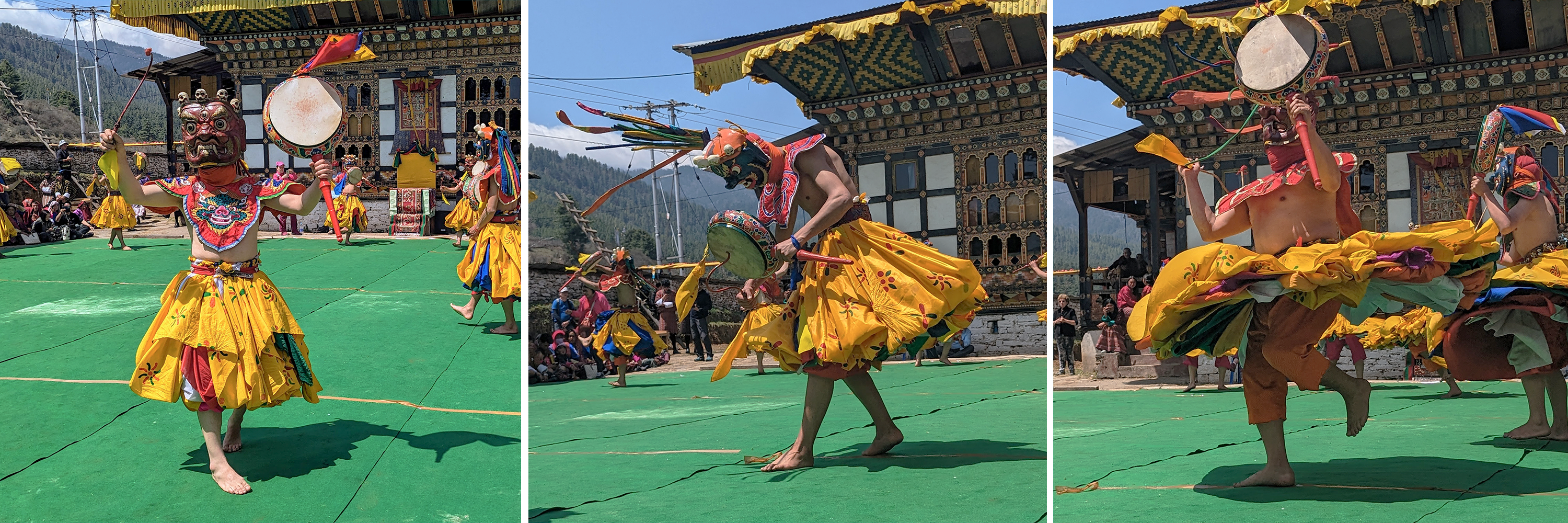
dancers performing the Ngaging Dance
This video is only a short clip of the dance that went on for over thirty minutes and maybe closer to an hour.
 Meandering Marbles