I went to Fiji in November of last year, but I’m finally getting around to writing it up. The next few posts are heavy on the photo dumps, which seems to be my default when I spend most of my vacation in the water.
Sawa-I-Lau Caves
For this trip, I headed to the Yasawa Islands arc that stretches up in a curve from the western side of the main islands. At the very top are the Sawa-I-Lau caves. Tourists are only allowed in the first two caves, the rest are considered sacred and only locals may enter them. To get from the first cave to the second, guides helped me swim through a six-foot underwater tunnel. One gave me a big push while another pulled me out on the other side, so all I really had to do was hold my breath and kick. It was a bit nerve-racking going in, but easier on the way out since I could swim toward the light. This island is made entirely of limestone, while most of the surrounding islands are volcanic. For me, the most interesting part of the caves was a freshwater eel swimming in the brackish water. I asked a lot of questions about it, but no one had any answers, only assurances that it would not hurt me.
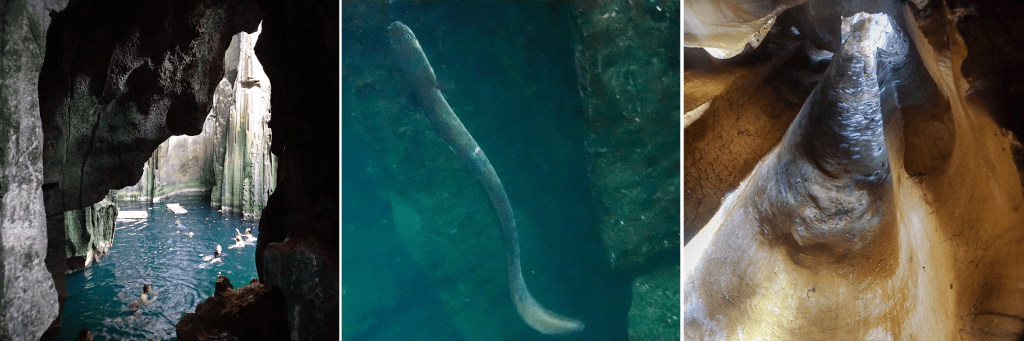
first cave, freshwater eel in the cave, cave skylight after swimming underwater in the second cave area
While waiting to take the boat back to the hotel, I found a cute little pipefish in the sandy bottoms. These are related to seahorses, but have a different body shape. Some people get these confused with the tiny eels that live in sandy bottoms (that I saw later on this trip), but they really do have distinctive postures and head shapes. That purple blob in the photo caught my attention too. At first I thought it was a soft coral, but when I got closer I could see it was covered in tiny tentacles. It is always fun to come across organisms that look completely different that what you expect.
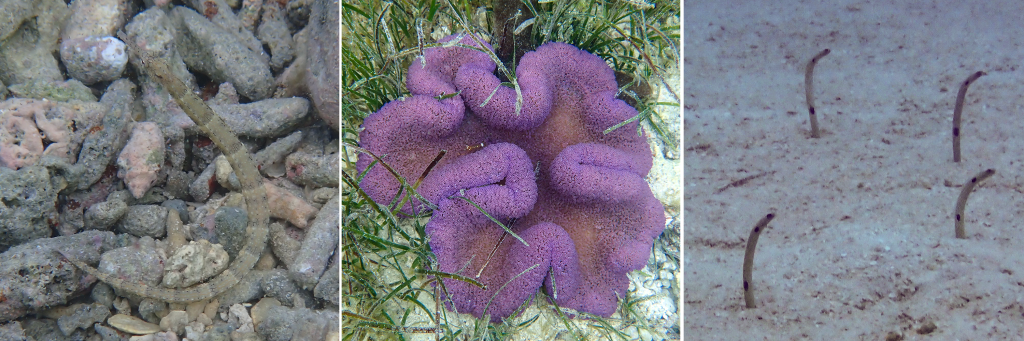
Reeftop Pipefish, Haddon’s Anemone, Spotted Garden Eel
Snorkeling and Scuba Diving – Nacula Island
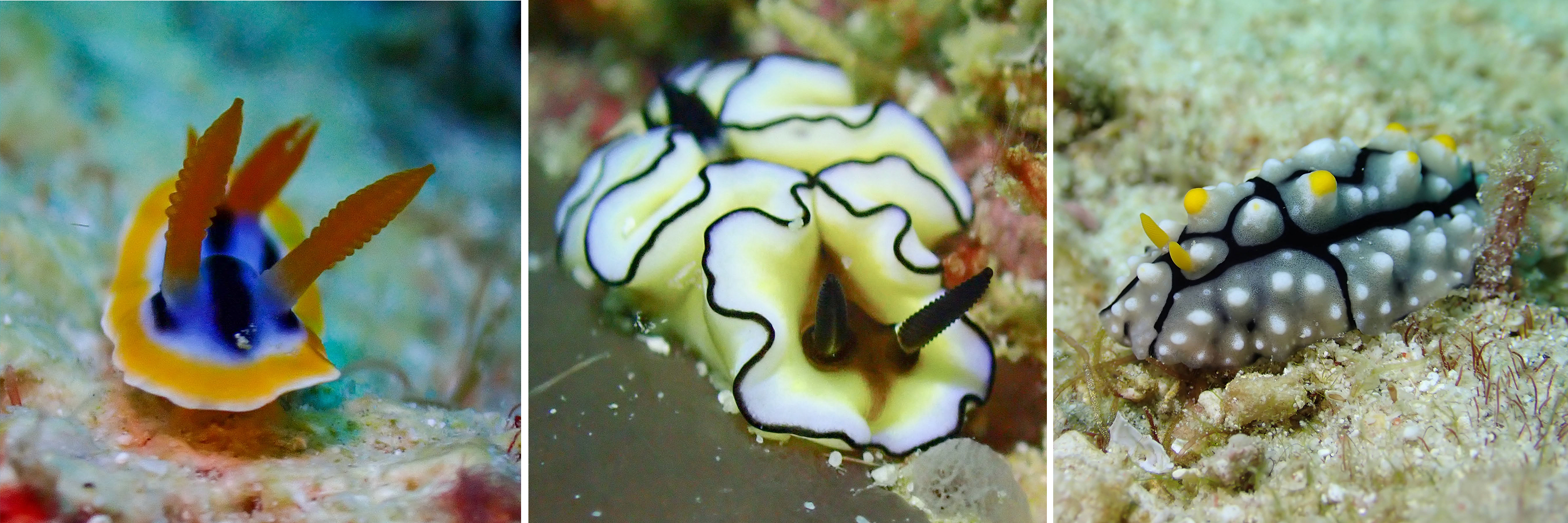
I went to Fiji because I got a great deal on a direct flight and because it’s at the very edge of the Coral Triangle. I’m always looking for nudibranchs and figured I would find a few. While there, I also decided to get my Advanced Open Water certificate so that I can dive slightly deeper dives (up to 30m / 100ft). I ended up being the only student on this trip, so I had a personal guide who helped me spot all these beautiful sea slugs. I had to learn how to do compass navigation and a variety of other skills, but after those were finished, it was all about taking cute photos of underwater life.
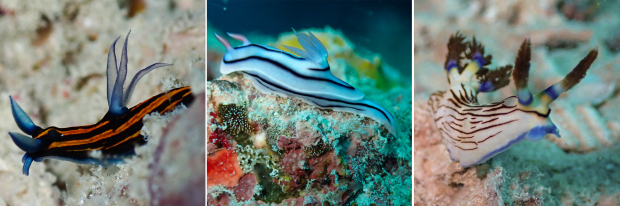
Slender Roboastra, Loch’s Chromodoris, Lined Nembrotha
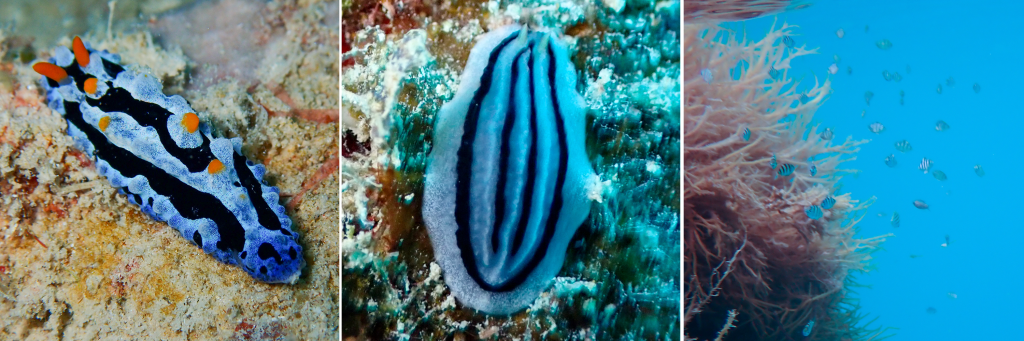
Sky Blue Phyllidia, Striped Phyllidiopsis, Baby Sergeant Major Fish
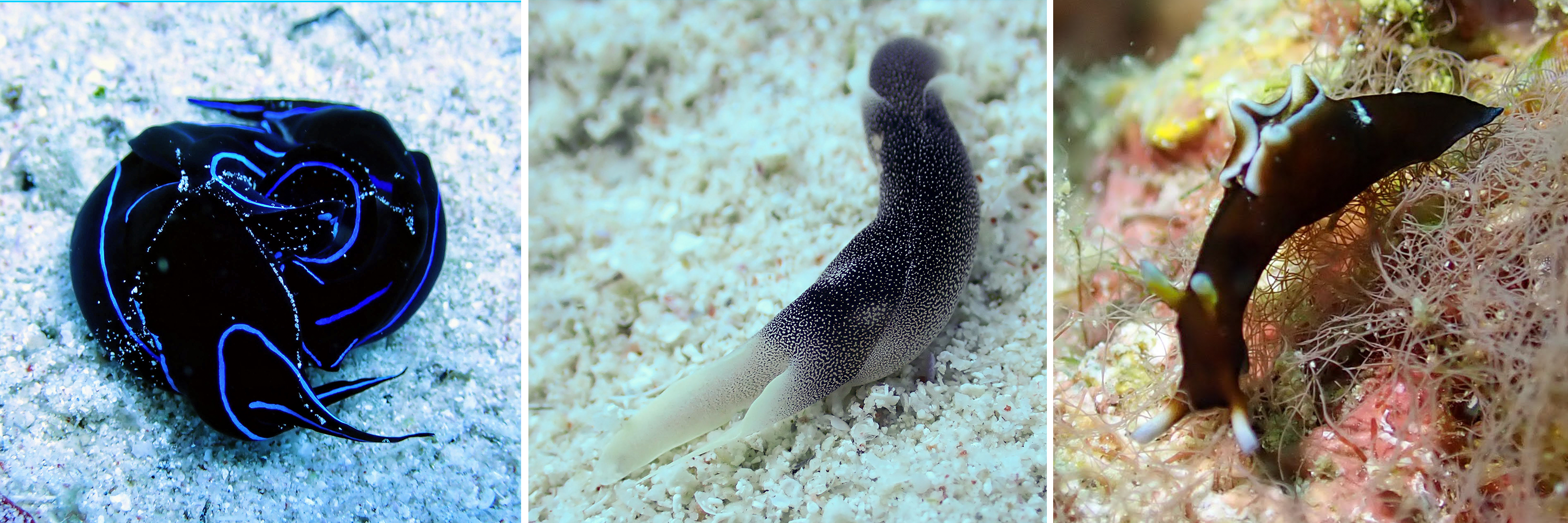
In addition to nudibranchs, there were also a bunch of flatworms which are also extremely impressive and come in a variety of shapes and colors. The one in the middle was surreal and only a few inches long. We looked it up in dive book and although the genus is known, it’s still an undescribed species (or was when the book was published).
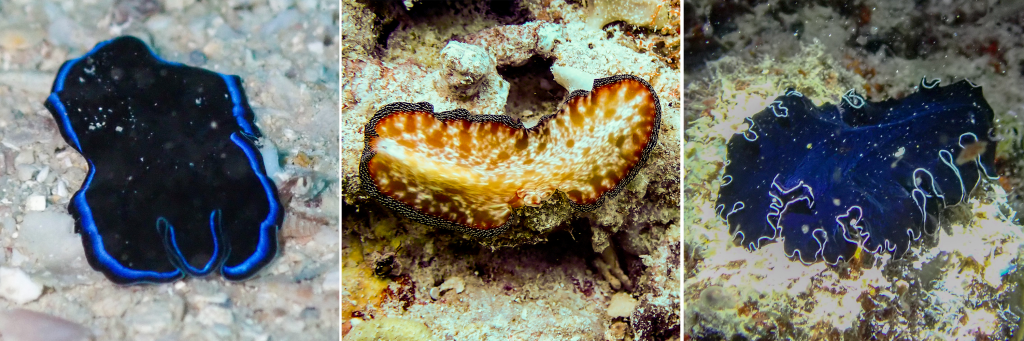
Sapphire Flatworm, Pseudobiceros sp., Family Pseudocerotidae
Sea stars also come in an amazing variety of shapes, sizes, and textures. All three of these were new to me!
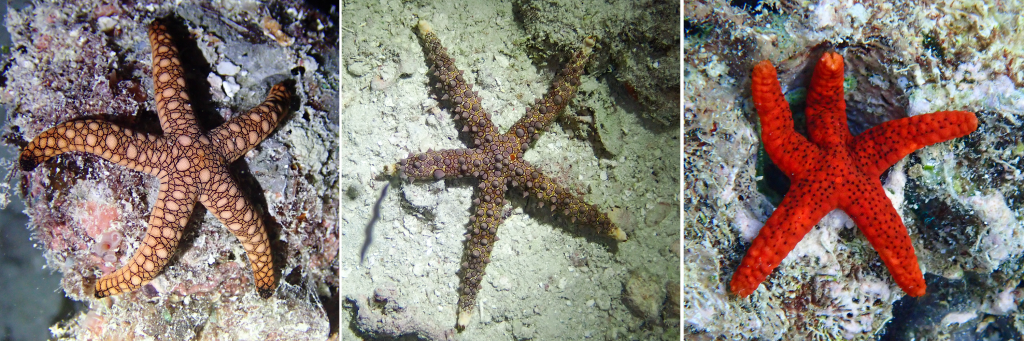
Indian Sea Star, Egyptian Sea Star, Thousand-Pores Sea Star
In addition to all the diving, I also did a fair amount of snorkeling. The corals next to the resort were pretty shallow and most of the days, the waves were calm. Usually I think of algae coming in red, green and brown varieties, so it was a bit of a shock to see the yellow one below. It looked like an underwater succulent in bloom. This species actually grows quite tall, but this one was just a baby. For the record, even though it was yellow and green, it does, in fact, belong to the brown algae family.
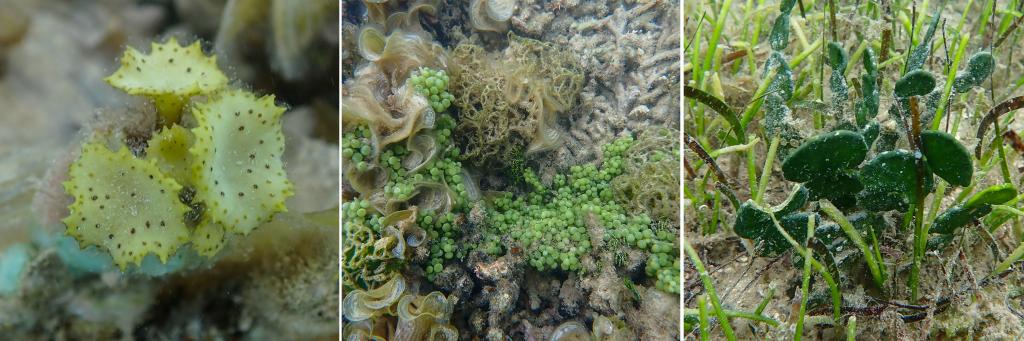
Ornate Turbanweed, Sea Grapes, Pennyweed
Here’s a small selection of fish from snorkeling. The more time I spend in the water, the more different species start to reveal their distinct personalities. I’ve seen porcupinefish all over the world, but they are almost always tucked underneath rocks or along reef walls. If you get too close, they retreat further into hiding, but otherwise they tend to stay in one place, quietly watching and waiting. On the other hand, flashy surgeonfish are zipping around all over the reef like they can’t stay in one place. The morays are always wedged into the rocks, mouths open waiting for something to swim by.
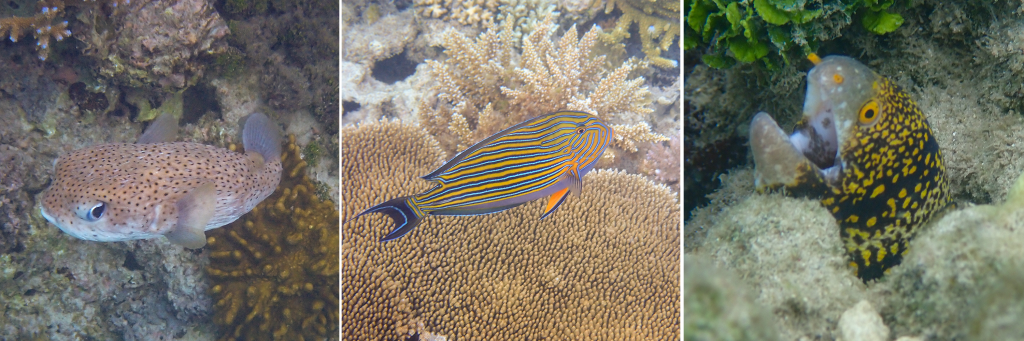
Spotted Porcupinefish, Striped Surgeonfish, Snowflake Moray
Of course, there was coral everywhere and this yellow fan coral stood out because of its bright coloration.
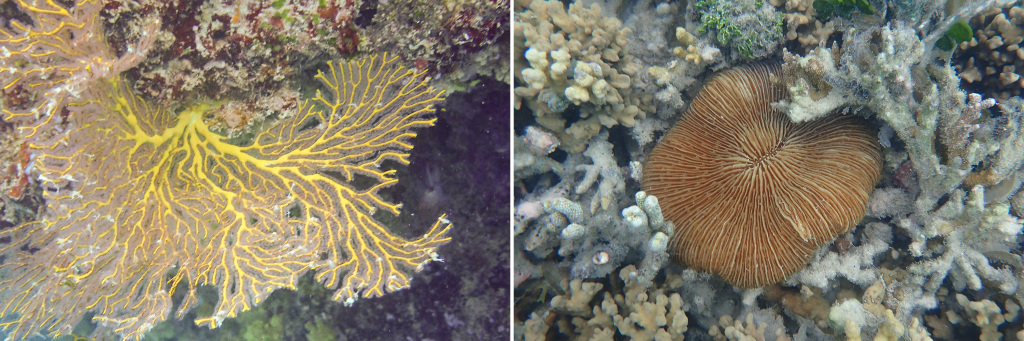
Knotted Fan Coral, Lithophyllon concinna
However, the star of the show was this color-changing coral. These belong to the genus Cladiella and the coral retracts its feeding polyps when it’s touched, which causes its color to change.
Blushing Corals (genus Cladiella)
My First Night Dive
As part of my Advanced Open Water certification, I asked to do a night dive since I had never done one before. I’ve always enjoyed night snorkeling because all kinds of critters come out at night that don’t appear during the day. While waiting for my boat to be ready, the Fijian sunset was incredible. #nofilter
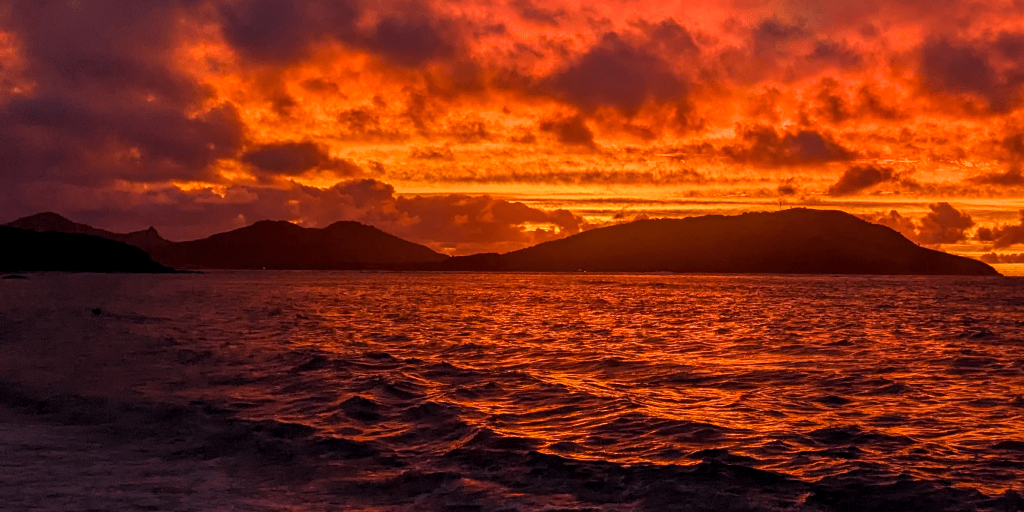
absolutely stunning Fijian sunset – on the way to the night dive
Eventually, my guide and captain sailed us over to the dive site. This was, by far, my favorite dive of the entire trip. Diving at night, illuminated only by bioluminescence and flashlights, is awesome. Here are my top three favorite photos from the dive, especially the one in the middle. Bubble coral is pretty easy to see during the daytime, but the pointy tentacles underneath only come out at night. The clam on the right is actually bioluminescent, and I wish we had turned off our flashlights to see its colors. However, to get that photo, my guide was illuminating it from below, and I was upside down, holding on to a rock, attempting to get my camera into position inside a hole. The fact that we got a photo at all was kind of a minor miracle.
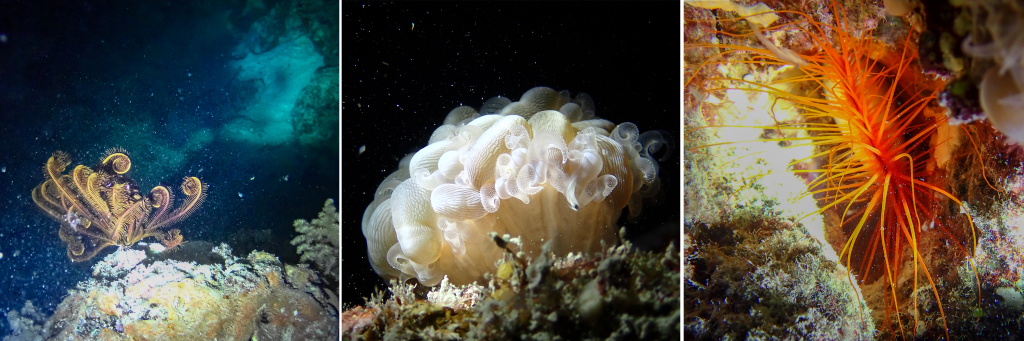
Bushy Feather Star, Bubble Coral, Electric Fileclam
The site is called the Cabbage Patch because of the huge scroll coral. It’s hard to picture how large these piles of corals are, but the giant rosettes are easily two to three times the size of a human. During the day, all kinds of life hang out inside the whirls, but at night, the parrotfish settle in for a nap.
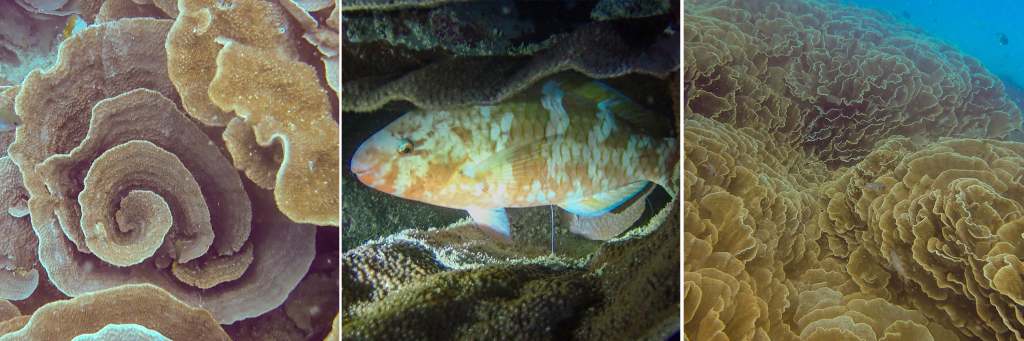
Cabbage Coral (a.k.a. Yellow Scroll Coral), sleeping Blue-barred Parrotfish, more Cabbage Coral
In addition to the sleeping fish, I found an octopus, which ironically is known as the Day Octopus because it’s one of the few octopus species that is actually diurnal instead of nocturnal. The manta rays also get more active at night; this one was roaming all over the place. During the day, these are usually nestled into the sand.
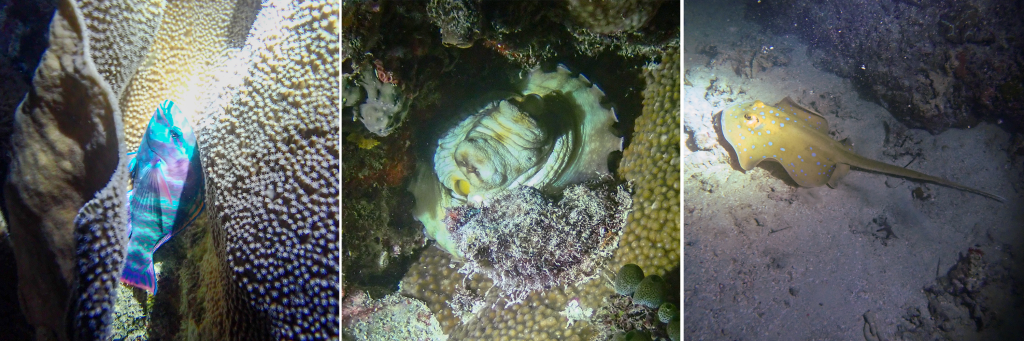
sleeping Yellowbar Parrotfish, Day Octopus, Oceanic Fantail Ray
High up near the top of the cabbage coral, we found this foot-long crab crawling along as we were doing our safety stop near the surface. Earlier, I’d found the cool green and purple urchin and my guide had spotted one of the fried egg nudibranch species.
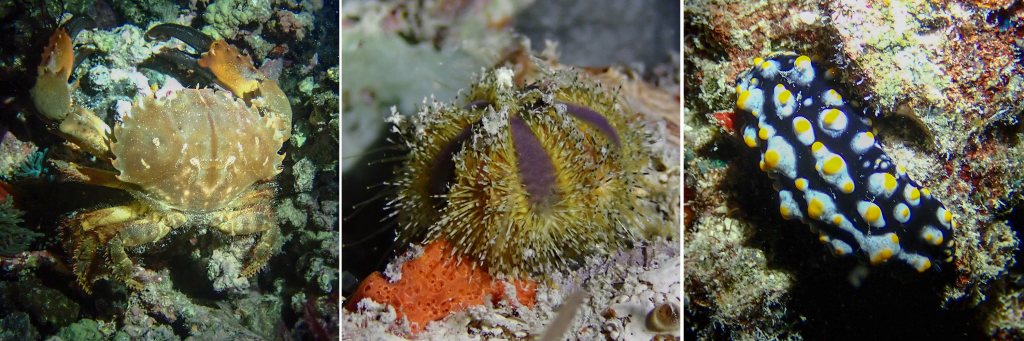
Sawedged Spooner Crab, Globe Urchin, Phyllidia Nudibranch
I still have no idea what kind of cnidarian is in the first picture below. It looks a lot like the tentacles on a bubble coral, but could just as easily be an anemone. If one of you knows what it is, please leave me a comment. I also saw my first night anemone. My guide didn’t know what it was, so it was fun to be able to identify something for him. Although it’s a super blurry photo, it was exhilarating to see a siphonophore up close. I teach about these in my Marine Biology class and they really are a strange group of colonial cnidarians. They are made up of multiple individual organisms working together as one colony. Some parts help it to feed, some parts keep it afloat, but all of the parts share nutrients and resources. The Portuguese Man O’ War is probably the most commonly known siphonophore, but I always imagine them looking more like the one below.
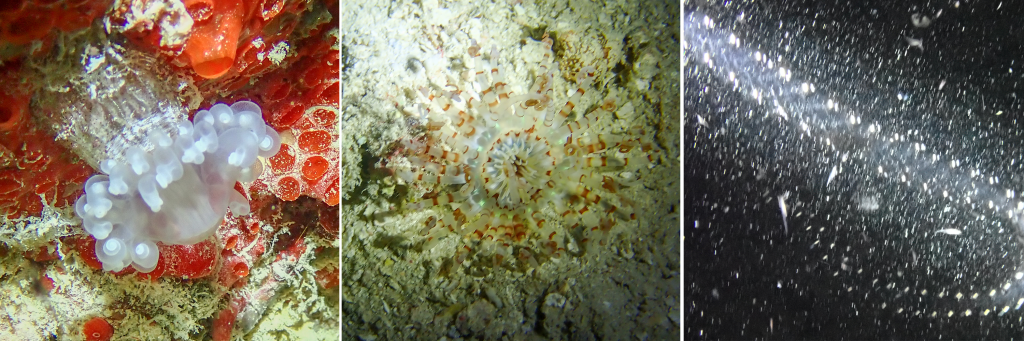
Anemone or Coral?, Night Anemone, Siphonophore
I wholeheartedly recommend night diving. It’s definitely worth the hassle and cost. Well, that about sums up my first stop in Fiji, more photos of marine life coming soon. 🙂


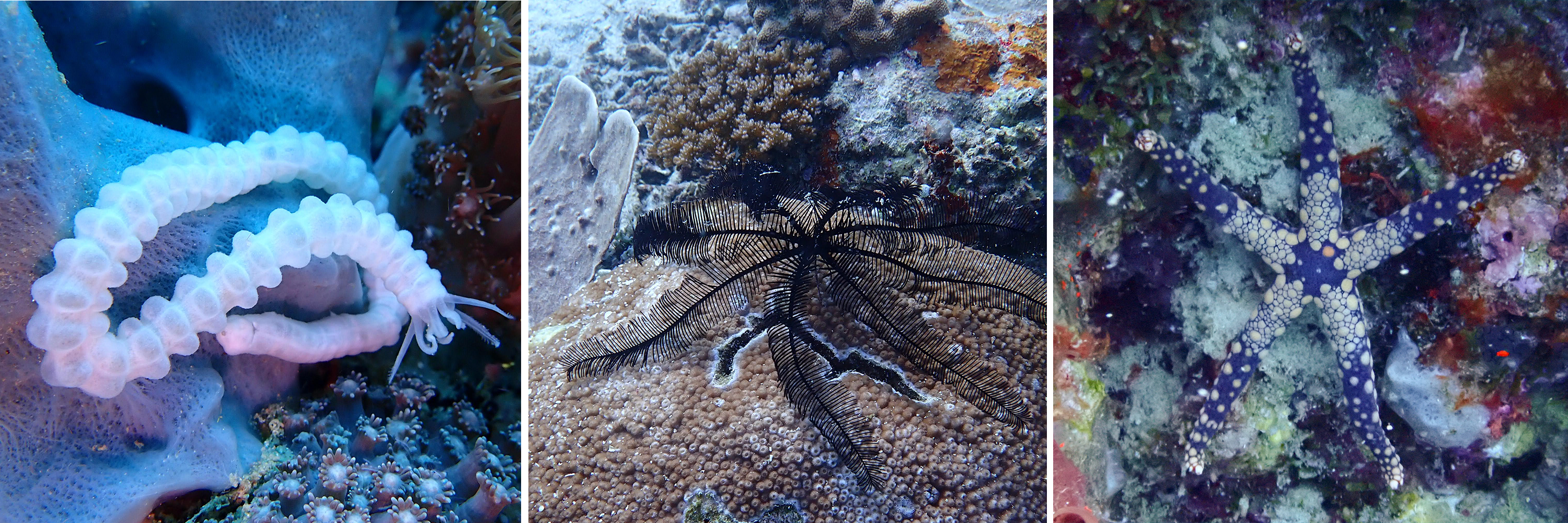





 Meandering Marbles