Chichén Itzá & Ek Balam

Chichén Itzá

Chichén Itzá is probably the most famous of all the Mayan ruins in Mexico. It has been extensively rebuilt since its heyday in roughly 700-900 CE. Early in the morning, when I visited, the site is still relatively quiet. There are a few bus loads of tour groups, but the site is large and people disperse rapidly once they’re though the gates. However, by mid-day, this site is busy, busy, busy. Vendors are selling souvenirs on every path and tourists are huddled in circles around guides listening to stories.

Even with all the commotion, Chichén Itzá is stunning. The work they have done to restore the ruins gives a clear impression of the power that this city-state used to possess. From the menacing platform of skulls to the giant pok-ta-pok playing field to the pyramid centerpiece, the elites of this city used strength and authority to control their subjects.

Pok-ta-pok features prominently at almost every Mayan ruin I visited. On signs, it’s often just called el juego de pelota, the ball game, in modern Spanish. The goal is to score points by getting a rubber ball (between 5-10 lbs) through a hoop positioned higher up on the sides of the playing court. There were two teams and players were not allowed to touch the ball with their hands or feet. They wore extensive gear to protect themselves and there are frequent mentions of bruised and injured players.

feathered serpent (kukulkan) head decorating the pok-ta-pok field, El Castillo also known as the Temple of Kukulkan, pok-ta-pok goal high up on the side of the wall

In Mérida, there’s a contemporary pok-ta-pok match every weekend across from the catherdral. I didn’t get there early enough to get good videos, but you can watch various YouTube videos of the sport. It looks a lot like hacky sack with a lot of sliding. The reason this sport is so important to Mayan culture is because it is a part of the Popol Vuh, the Mayan text that includes the story of creation. There are three sets of twins in the story, and the second set, Hun-Hunahpú and Vucub-Hanahpú, are invited to Xibalba to play in a pok-ta-pok match. They are defeated by the lords of the underworld and sentenced to death. Hun-Hunahpú’s skull is placed in a tree that produces gourds.

A woman named Xquic notices one of the gourds is in the shape of a skull, and when she goes to touch it, the skull spits on her hand and she become pregnant with Hun-Hunahpú’s twin sons. She leaves Xibalba to visit her mother-in-law who does not believe her since her sons are dead. However, she passes a test involving maize and then everyone believes her that she indeed is pregnant with this dead guy’s kids. Eventually the twin sons are born, they grow up, and return to the underworld to avenge the death of their father and uncle. They then become the sun and the moon and humans are then created from maize.

The Tzompantli was a large platform used for displaying skulls, most likely of sacrificed victims and prisoners of war. This one is located next to the pok-ta-pok field and some think that the losers of the game would be beheaded and their skulls would have been placed there. According to those interpretations, if you died during a game of pok-ta-pok, you skipped going to the underworld of Xibalba and headed straight to heaven. Because of this, others think that the winners were decapitated as a reward.
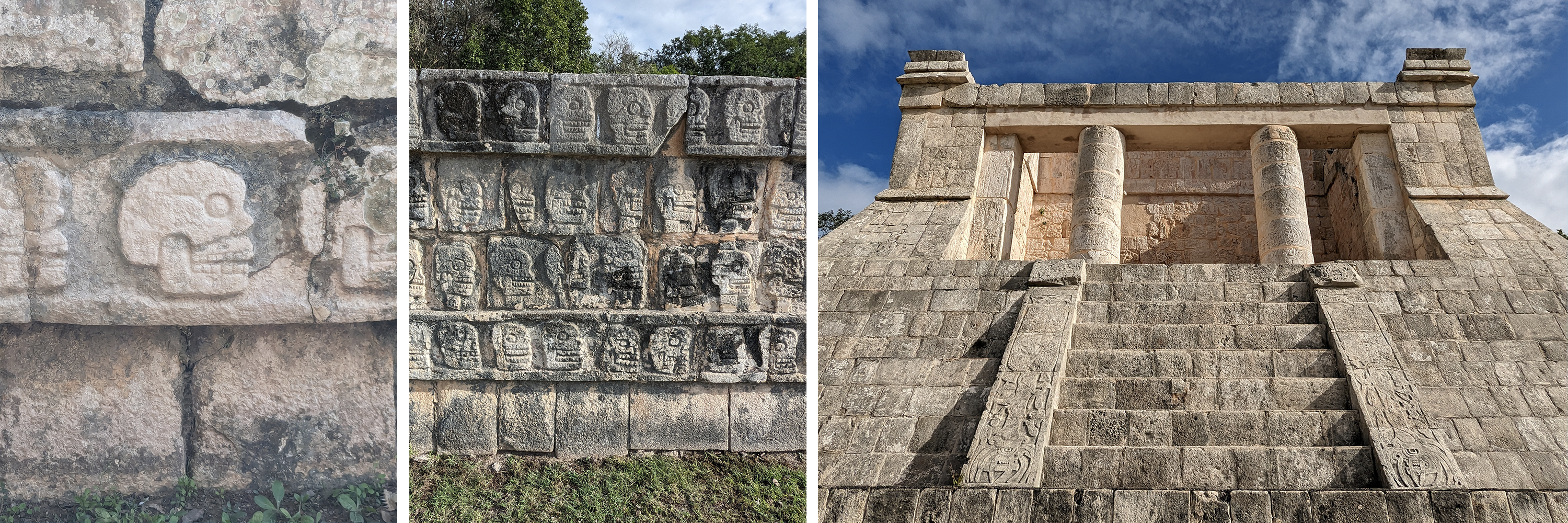
close-up of skull carving, side view of Tzompantli, Temple of the Bearded Man (named because of the carving of a bearded man)

This archeological site is huge and there are buildings still being uncovered. The Group of the Thousand Columns is a bunch of columns lined up in a grid like manner. On some of these columns, it’s easy to see carvings of warriors that would have been painted in striking colors. The whole area would’ve been covered with a roof and would’ve formed a type of passageway out of the heat of the sun. There are also at least two cenotes. The Sacred Cenote was used to dump bodies after human sacrifices and the other one was probably used as a water source for the city.

tiered building corner, Sacred Cenote, Group of the Thousand Columns

My other favorite buildings were at the end of the tour. The House of the Nuns was probably a house for Mayan royalty and its carvings are still easily visible today. El Caracol was a Mayan observatory used for tracking astronomical events. All observatories seem to be called el caracol, the Spanish word for snail, because of how the top of the building resembles a snail shell. (The tiny observatory I saw on Cozumel was also called El Caracol.)

close-up of carvings, House of the Nuns, El Caracol

Ek Balam

Apparently on a clear day, it’s possible to see Chichén Itzá from the top of the Acropolis in Ek Balam since they’re less than 40 miles away from each other. The biggest structure is the Acropolis, which is a mixture of a very tall and steep pyramid combined with a rectangular building with lots and lots of rooms. The Acropolis contains the tomb of Ukit Kan Lek Tokʼ, who was once the ruler of the town. His tomb has an awesome stucco facade with another earth monster mouth guarding the entrance.
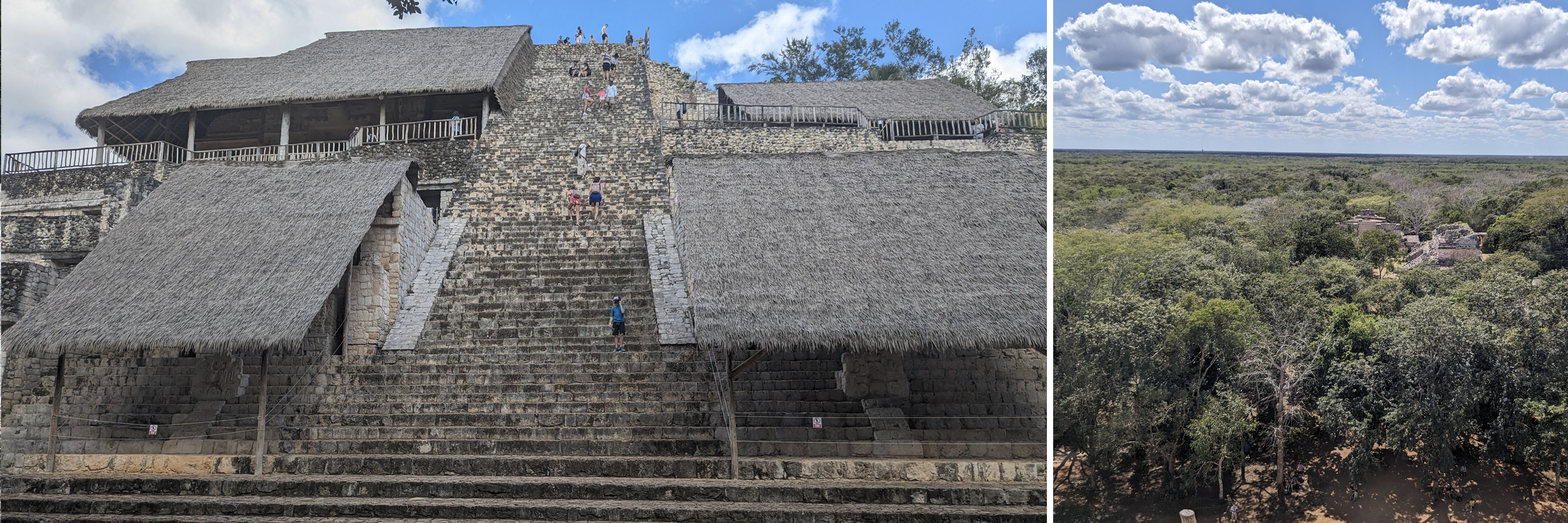
Acropolis (the tomb is under the thatched roof on the top left), view from the very top

glyphs at bottom of Acropolis, tomb opening with monster mouth, close-up of carvings

The site itself is pretty small, with an extensive set of walls encircling the city. There are four sets of walls around the city and the last one seemed have been hastily built, probably as a last ditch effort to protect the city against an invading attack.
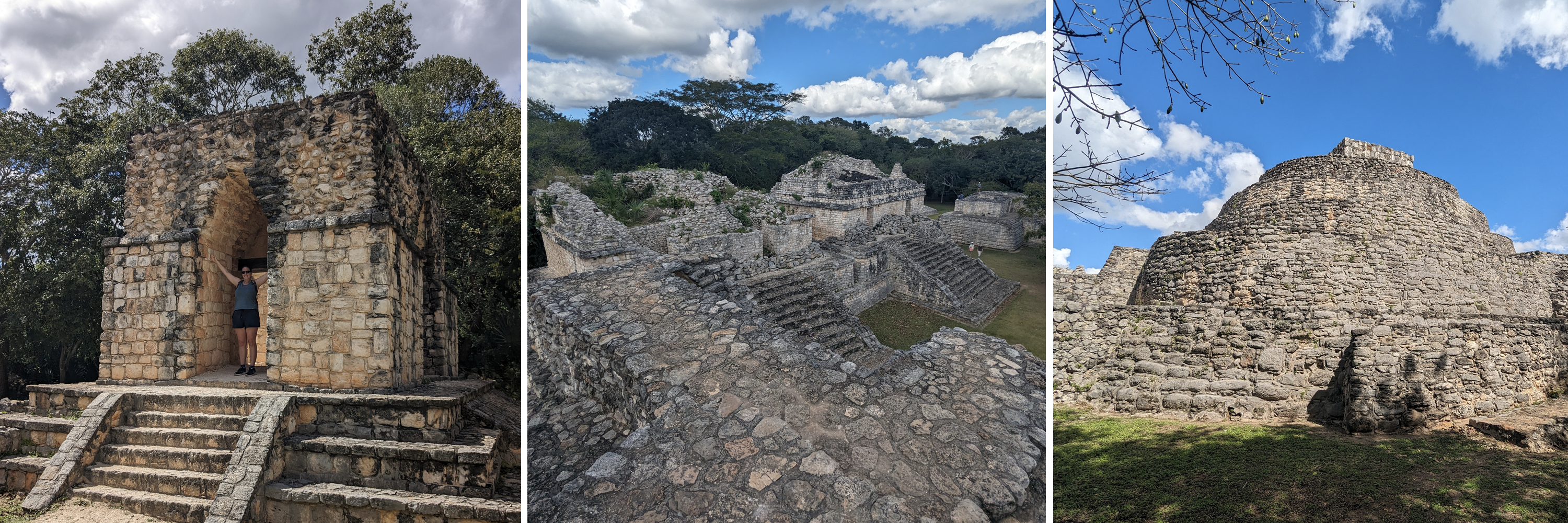
me posing with the entry gate, two buildings called the twins, view of the thick outside wall
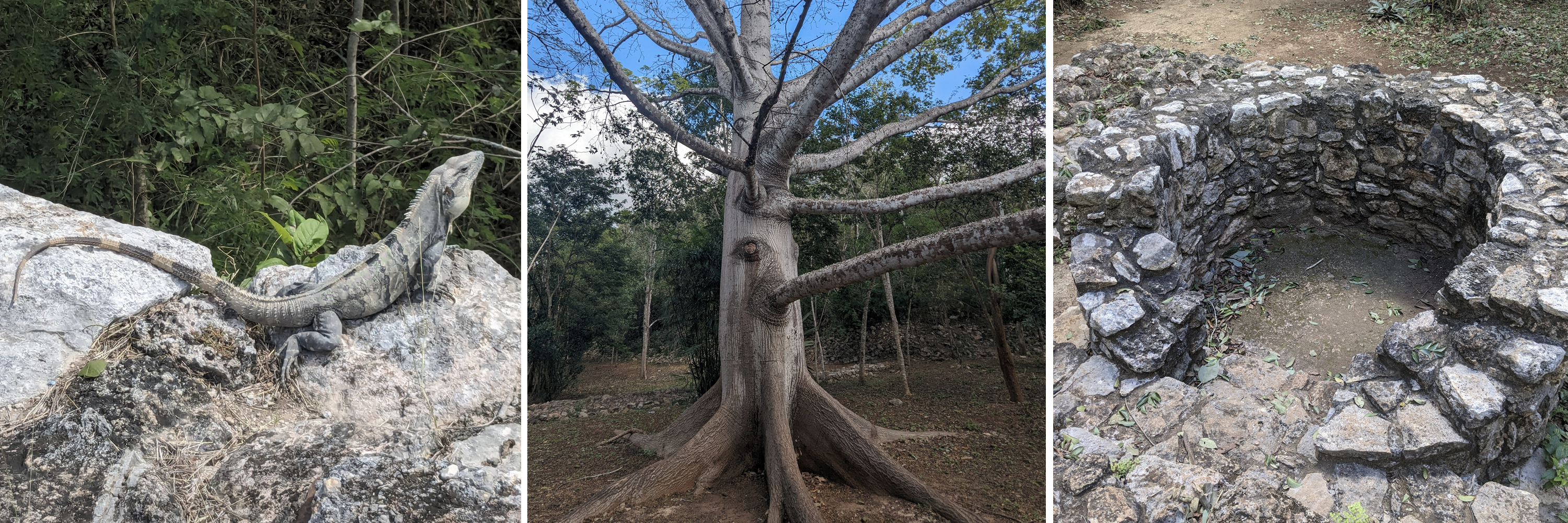
black spiny-tailed iguana, ceiba tree (central to Mayan spiritual beliefs in that it connects the underworld, the middle world, and the heavens), a steam bath

Cenote Xcanche

A short, bumpy bike ride away from the Ek Balam site, is this lovely cenote (bikes included as part of entry costs). This is an open-air cenote with awesome vegetation and a few catfish swimming around.
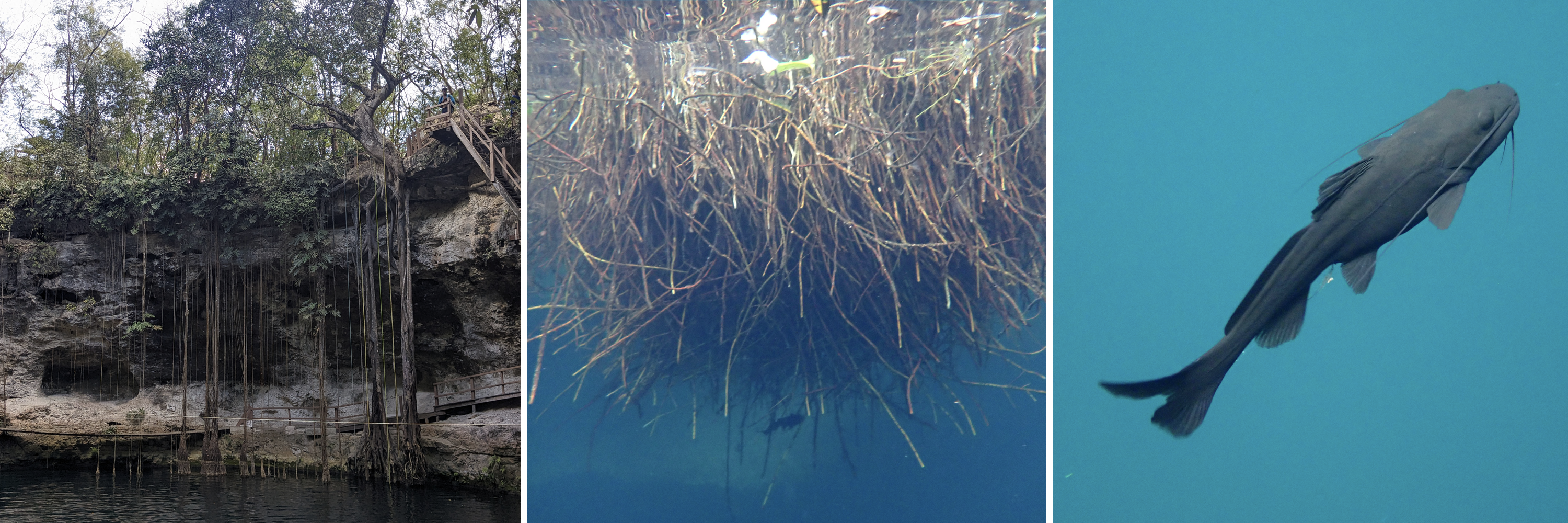
view of cenote walls plant roots underwater, pale catfish

More Mayan Ruins

Balamkú

My guidebook mentioned that Balamkú was near Calakmul and was definitely worth a stop because of an enormous frieze that is actually open to the public. Now, I love art, but there’s a lot of art vocabulary that still baffles me and for some reason, I thought it would be a giant painted mural, maybe with a little bit of texture. I definitely wasn’t prepared for the size or scale of this piece of work. A nice guardian let me into the locked room and proceeded to share with me all of the animals carved into the giant stucco wall. There are four tall sections which are composed of a king on top, an amphibian in the middle, and the “monstruo de la tierra” (Earth monster) at the bottom. In between these four kings are kneeling jaguars. The whole scene represents entering the underworld for whatever rituals needed to be conducted there. Click on the images if you want bigger photos.

tall king section of frieze, jaguar (look for the claws), frieze and me (for scale)

pyramid view, decorative archway, and trees growing through steps on the main plaza

Within a short drive of Balamkú, the Zotz Cave puts on a nightly show with over 3 million bats leaving the cave to go in search of their dinner. There’s only room for about 20 people to watch from a path overlooking the cave. Right around sunset, the bats start to emerge. Eventually, it looks like a giant bat volcano and there are so many that the bats sometimes collide with the humans that are standing around. One bat attached to my shirt and another one landed in my hair. They both safely detached and went on their way. There are between 7-10 different species of bats that live in the cave and most of them join this nightly insect feast.

Chicanná

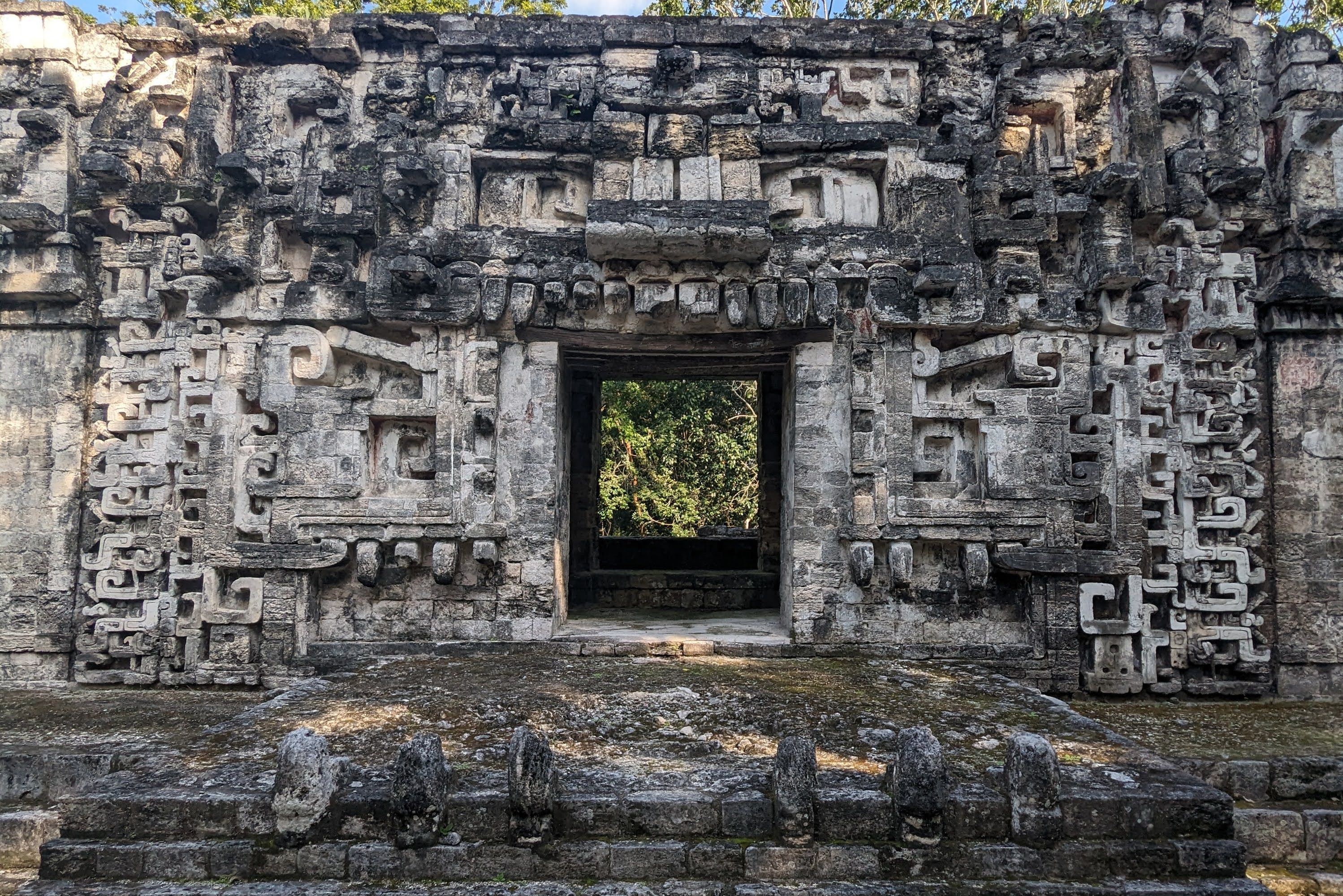
This site doesn’t have giant pyramids, but instead is a small town filled with intricate carvings and decorations. Chicanná got its name from one building in particular – the House of the Serpent Mouth. Chi means “mouth,” can means “serpent,” and na means “house” (thank you, Wikipedia). This building is still incredibly well-preserved, but when it was built around 750CE, it would have covered in a layer of stucco and been painted in vivid colors including red and green. This elaborate carving probably represents the monster of the underworld. No one knows exactly how this building was used, but one idea is that rituals were conducted here and this door representing a symbolic portal between the middle world (where humans reside) and the underworld.

House of the Serpent Mouth

Because of the huge number of decorations, archeologists think this was a town for elites where some rituals would’ve been conducted. It’s situated very close to Becán and probably functioned as a rich suburban enclave.

close-up of carvings

Becán

Becán is a big city with a giant pyramid. Due to some complicated rental car logistics, I only had about an hour to run around and climb up these awesome ruins. I definitely wished I’d budgeted some more time for this sprawling site. This city was surrounded by a giant moat, which probably functioned to both protect the city, as well as to serve as a supply of water for the town itself. It served as regional capital for the surrounding countryside where goods were brought and distributed to other locations.

biggest pyramid in Becán (Structure IX), view from the top of the pyramid down onto another ruins (Structure VIII)

One of the most interesting parts of Becán was how much housing has been uncovered and is open to tourists to enter. The rooms are relatively small, but most of them have some kind of built-in bench or bed. The Mayan arch is a a set of parallel walls that at some point is angled inwards and is then covered with a single layer of wide bricks at the very top. This approach to construction appears frequently in Río Bec architecture, the style associated with Becán, Chicanná, and Xpujil.

really thick tunnel wall with a Mayan arch, view from the top of one of the ruins, typically Mayan bedroom with Mayan arch above

Xpujil

This is a relatively small site, located close to Xpujil (pronounced eesh-poo-heel) town which is why it gets a lot of visitors. Río Bec architecture frequently includes rounded corners, temples with two towers (although this one has three), and monster mouth doorways. My photos of the large temple with three towers didn’t come out to well with the shadows from the afternoon sun.

carvings, close up of one of the temples three towers with clear layers, tree growing on top of the ruins

If you made it this far, here’s a bonus video of spider monkeys playing around in Balamkú.

Calakmul

Ancient Mayan City

Despite being one of the largest and most powerful Mayan city states, Calakmul has never gotten the same attention as Chichen Itza to the north and Tikal to the south. It does have UNESCO World Heritage status, but I’d never even heard about it until I started looking through my guidebook. Right now, the public transportation options are limited and there aren’t many group tours, so it’s challenging to get to. I chose to rent a car in Bacalar and drive many hours on pothole-filled roads. However, everything is changing: the Tren Maya is currently being built (all the heavy trucks contribute to the pothole problem) and will probably be done in the next year. This area will soon be inundated with tourists. The tiny 20-car parking lot is being expanded; the roads are being widened and repaired. Tourism and its impact on the area is about to explode.

Because I knew almost nothing about Mayan history and culture, I hired a guide for this tour and we met at 4:30 in the morning so that we could arrive in the park right when it opened. There were only a couple other people wandering around at that time and it is truly surreal to try and imagine the hustle and bustle of a once-thriving capital city when almost no one is around. The view from the top of the king’s pyramid (Structure II) is incredible: a clear view of miles and miles of trees. But 1500 years ago, there would have been settlements and roads in every direction. Even though the large structures of Calakmul have been excavated, the foundations of the old city remain buried beneath the trees.

from the top of Structure II, the home of the former kings of Calakmul and one of the tallest Mayan pyramids

The king’s palace actually has two levels and it is impossible to see the place where I’m sitting from the ground. The king’s quarters on top would’ve been relatively hidden from the common folks down below. He also would’ve had an elongated head because all of the elite Mayans had their heads tightly bound as children. Everyone in the elite class actually looked completely different from the rest of the people. Mayans also engaged in face scarification and wore a lot of heavy jewelry, especially in their ears.

view of the king’s palace from the bottom, a close up of one of the stelas that depicts a ruler standing on top of a slave who is kneeling

Stelae were often constructed to commemorate people and events. Many of the stelae at Calakmul are in bad shape. There are a few different ways to write in Mayan language: one way uses pictures to depict a specific meaning, another uses pictures to match the syllables of the word, and a third combines both of these together. Despite the complexities, experts can generally decipher most Mayan script today.

top part of stela showing the ruler standing above the slave, view of 5 stelae from the top of Structure I (pyramid that was probably used as a temple)

The pictures below show another large pyramid (Structure VI) where astronomical sightings were made. This building and others were built so that the sun would line up in specific places on the solstices and on the equinox. Some of the engravings on the sides of the stelae are still very clear even after all this time. Although the front and back of these stelae were removed by looters, the sides discuss the people involved as well as the dates of events.

view from bottom of the pyramid, view from top of the other two large pyramids, engravings on side of a stela

So far, at least four tombs have been found inside the king’s pyramid and even more tombs were found in other structures. Even houses of common folk have skeletons buried inside of them. The bodies of the elite class were buried with elaborate outfits and offerings to the gods.

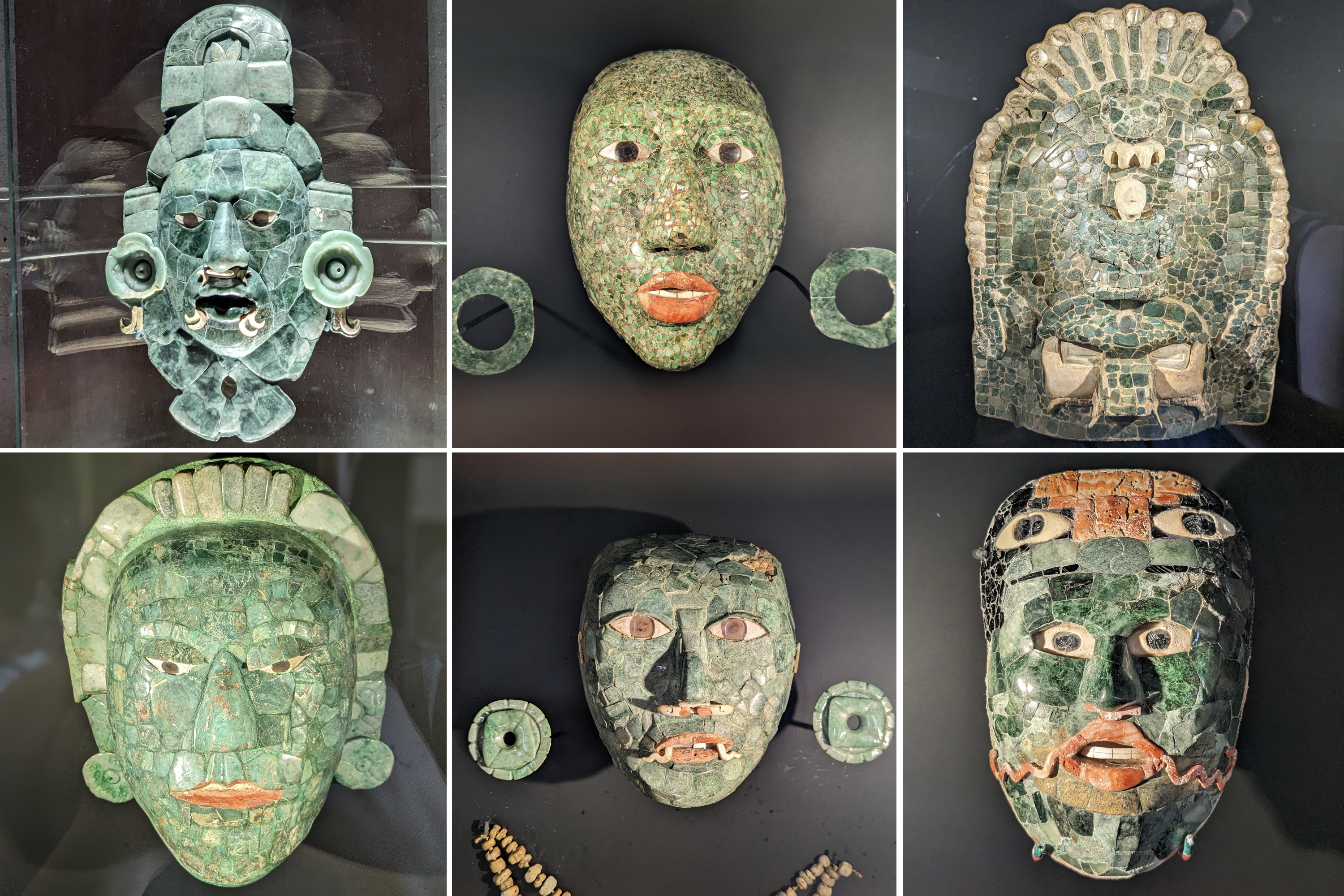
Many graves not only have masks made of jade, but also necklaces, ear plugs, and other fancy adornments. There is no jade in Mexico, so all of this jade was most likely imported from what is now Guatemala, which shows the extent of trade in the region. All of these jade funerary masks below were found in Calakmul, but were removed and put into museums in the city of Campeche. (Side note: this is actually one of the reasons it took me so long to write about this, because I had to go to Campeche to see these masks.) The mask in the top right is the most elaborate and probably belonged to Yuknoom Yichʼaak Kʼahkʼ, the ruler of the Mayan snake kingdom starting around 650 CE.

top row (l to r): mask of Yuknoom Yichʼaak Kʼahkʼ, jade mask & ear plugs with cinnabar used on the mouth, another intricate mask depicting a few different animals
bottom row (l to r): a mask representing Yuknoom Ch’een II (the father of Yuknoom Yichʼaak Kʼahkʼ), another jade mask & ear plugs, jade mask probably for a priest with a second set of eyes representing his supernatural vision and the red lines on his cheek showing ritual scars

Calakmul Biosphere Reserve

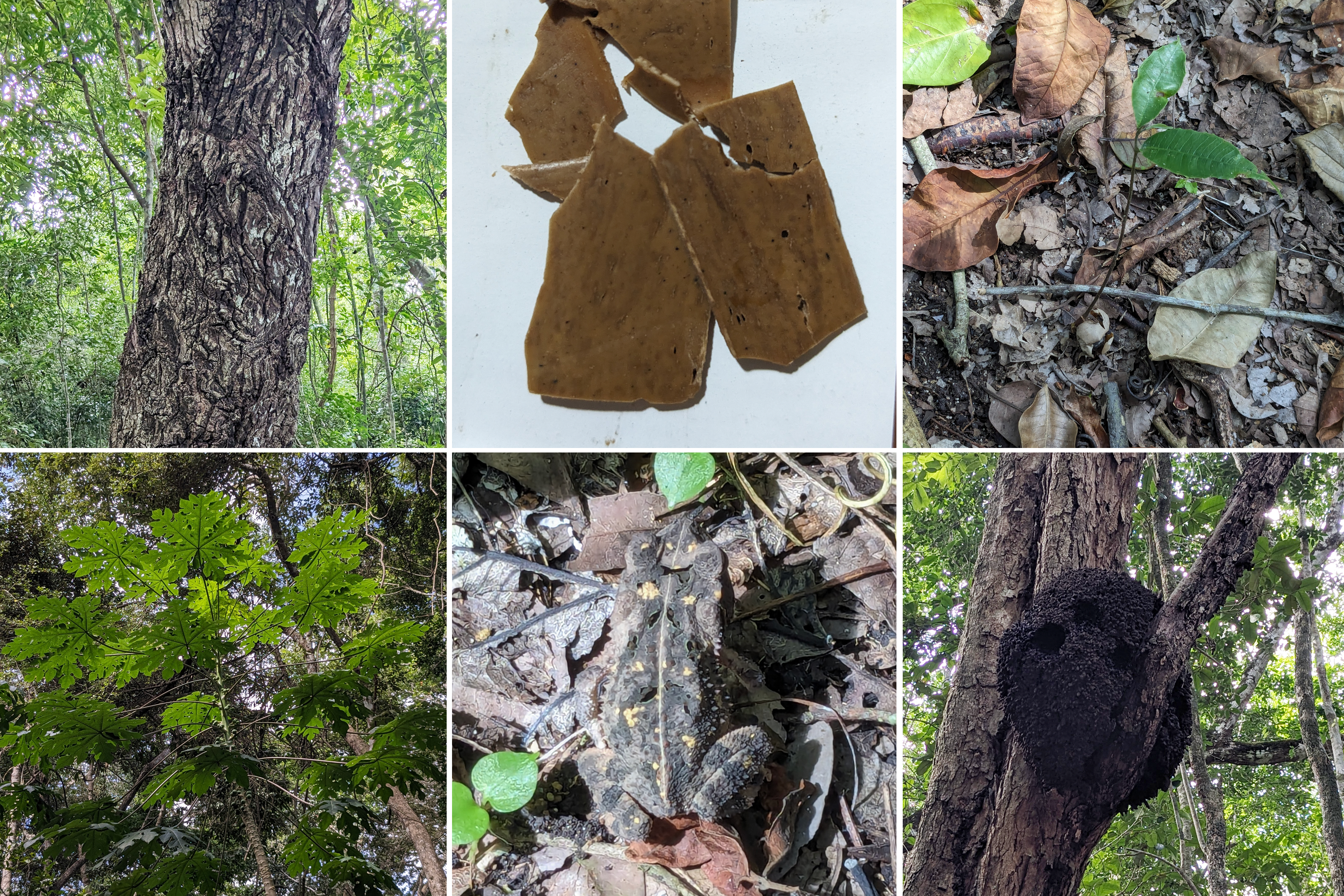
After our tour of the ancient city, my guide took me on a short walk through the nearby protected natural area. Even wearing insect repellant, a swarm of mosquitos kept threatening to attack my face. There’s so much to see in the rainforest, but my guide started by showing me the chewing gum (chicle) tree. By cutting diagonal lines in the trunk, they were able to get the natural resin to flow and that was harvested and exported to make chewing gum. I also was introduced to the Mayan breadnut (ramón) tree which is used to make bread or a type of porridge. We came across a swamp and I could see a crocodile hanging out on a log. Perhaps the most exciting thing I saw was on our slow drive (avoiding potholes) back to the entrance, when a tayra crossed the road. I didn’t get a photo of it (but Wikipedia has some) and my guide said it was only the third time he’d ever seen one. Folks here call them the viejo de monte (old man of the mountain) because of their white heads.

top (l to r): chicle tree with scars, natural chewing gum, Maya breadfruit tree starting to grow from seed
bottom (l to r): papaya tree, Central American Gulf Coast toad, termite nest with holes most likely made by parrots that are living inside of it