Xiao Liuqiu & Kaohshiung

This mini island (off the main Taiwanese island) has a bazillion spellings of its name, but regardless of the name, going there had to be one of my favorite parts of the trip. We were there during Thanksgiving, which was just a regular week day in Taiwan. Our first stop was renting scooters. Chalida was a bit fearful of the scooter, so she ended up on an e-bike and her daughter Rory climbed on board behind me. The first day, we went snorkeling and had a delicious BBQ dinner, with Chalida’s friend Nate joining us. The day of Thanksgiving, I got up early to go scuba diving (more on that below), while the rest of the group slept in. That afternoon, Cassy had a special request that we go to karaoke and after a slow start, everybody got into it.
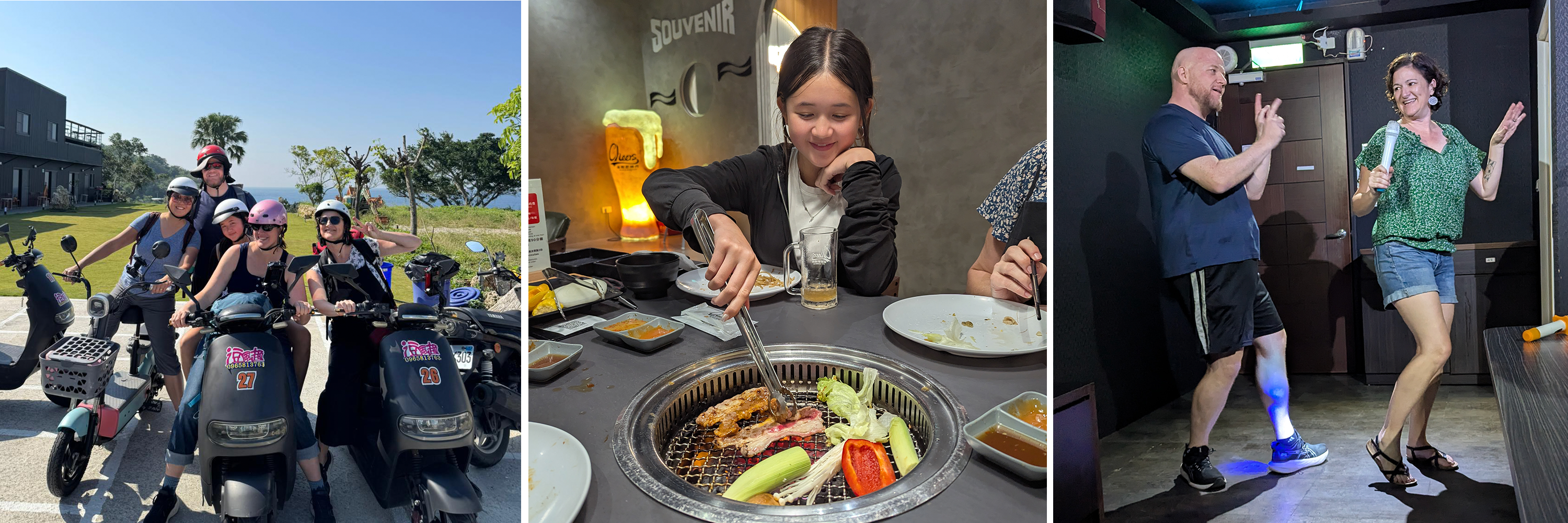
biker gang, Rory bbqing, Nate & Cassy with amazing karaoke skills

The whole time we were there, we ate so much food, drank so much boba, explored so many beaches, and saw so many green sea turtles.

Nate, Rory, Cassy, me, and Chalida at our last lunch; me & Cassy enjoying a Thanksgiving sunset

Here’s a glimpse of some of the food we ate. Most of this was from Xiao Liuqiu, but some of it was from earlier and later in the trip.
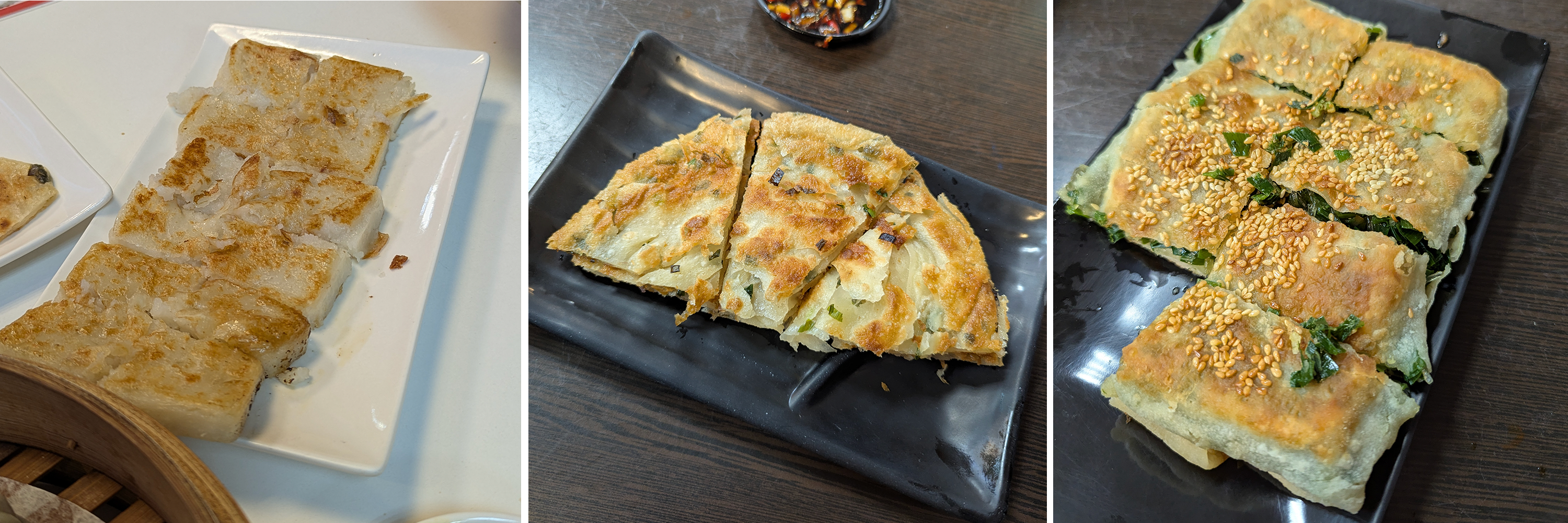
turnip cake; the best green scallion pancakes; similar to the scallion pancakes, but filled with greens instead

sesame noodles, sweet and sour veggie noodles, poop shaped waffles filled with chocolate

I figured that one of the best ways to keep my fears in check is to keep doing something regularly so the fear isn’t allowed to grow. I checked iNaturalist to see what nudibranchs were around and one of my favorite species had previously been spotted near the island. I definitely wanted to try to find it. It is a beautiful sea slug that looks like its entire back is full of butterfly wings (Cyerce nigricans). I signed up for two dives on the island and had my guide to myself on the first dive. I told her I loved nudibranchs and she asked if I knew how small they are and I assured her that I did. All of these were under an inch small, so she did a great job of finding these.

Black and Gold Sapsucking Slug, Pustulose Wart Slug, Black Margined Nudibranch

I’m still in love with giant clams, and there were plenty of those to see. The colors and patterns on the inside of the shell are so beautiful.
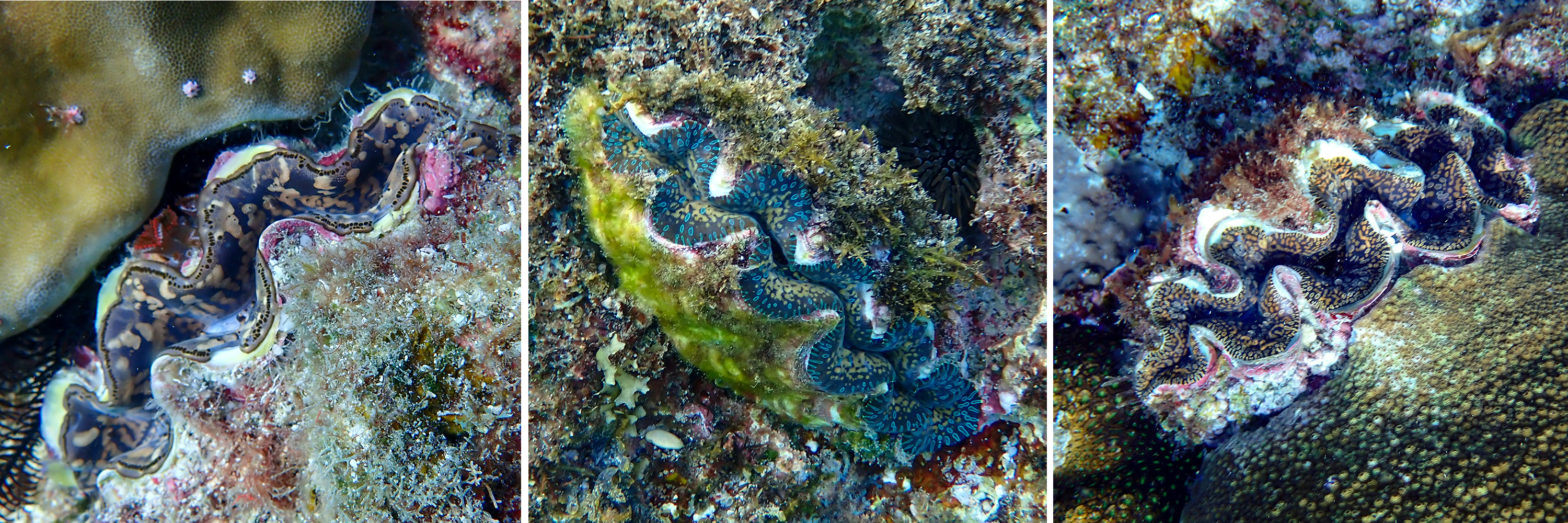
Small Giant Clam, Noah’s Giant Clams x2

There were also a range of semi-transculent underwater gems.
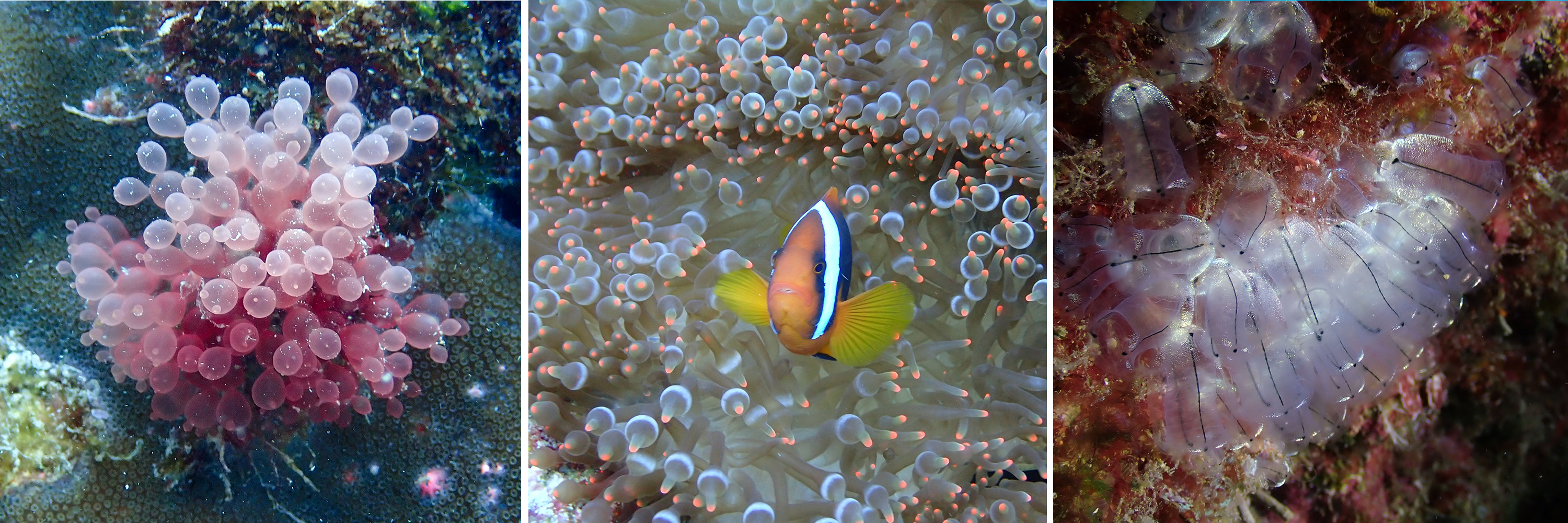
Florideophycean Algae, Clark’s Anemonefish, Tunicates

We have purple sea urchins in the United States, but white ones aren’t that common. Also, as mentioned earlier, there are green sea turtles all over this island. It’s practically impossible to get in the water and not see one.
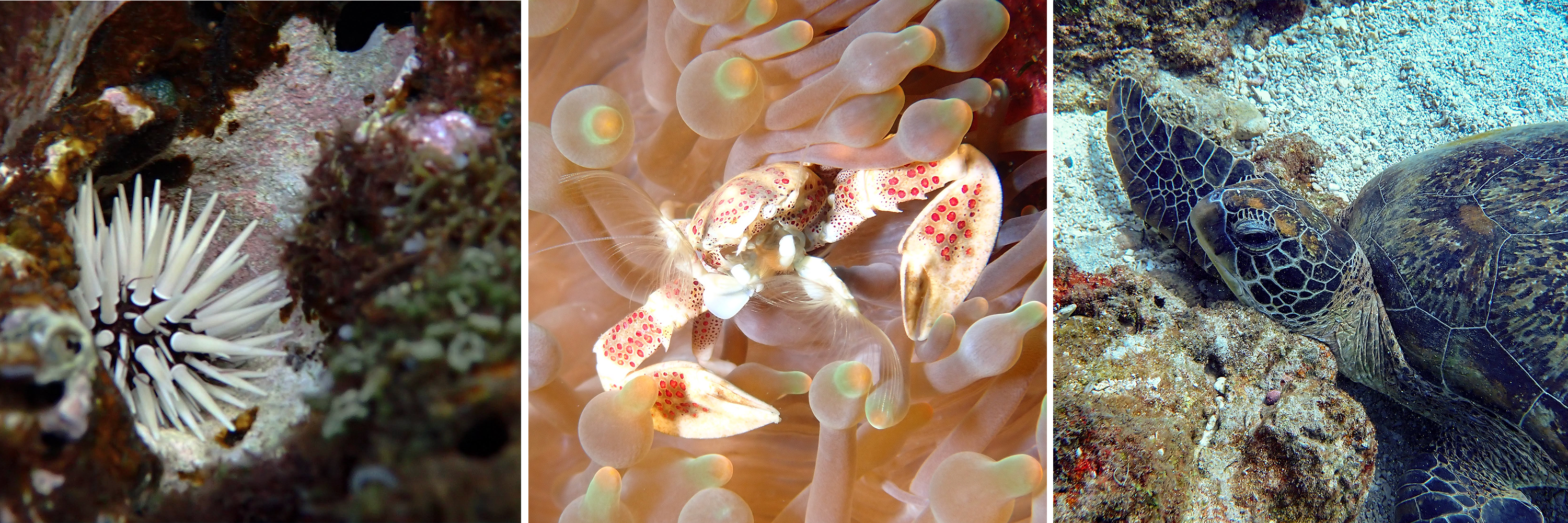
Indo-Pacific Rock Boring Sea Urchin, Porcelain Anemone Crab, Green Sea Turtle

I actually found the eel in the picture below. I got my guide’s attention to show her, but I really didn’t know the hand signal for eels, since I’m so new to diving. I gestured for her to come over and she was excited that I found it. The signal is to stick your fingers and thumb out and then bring them together so it looks like the mouth of an eel eating.
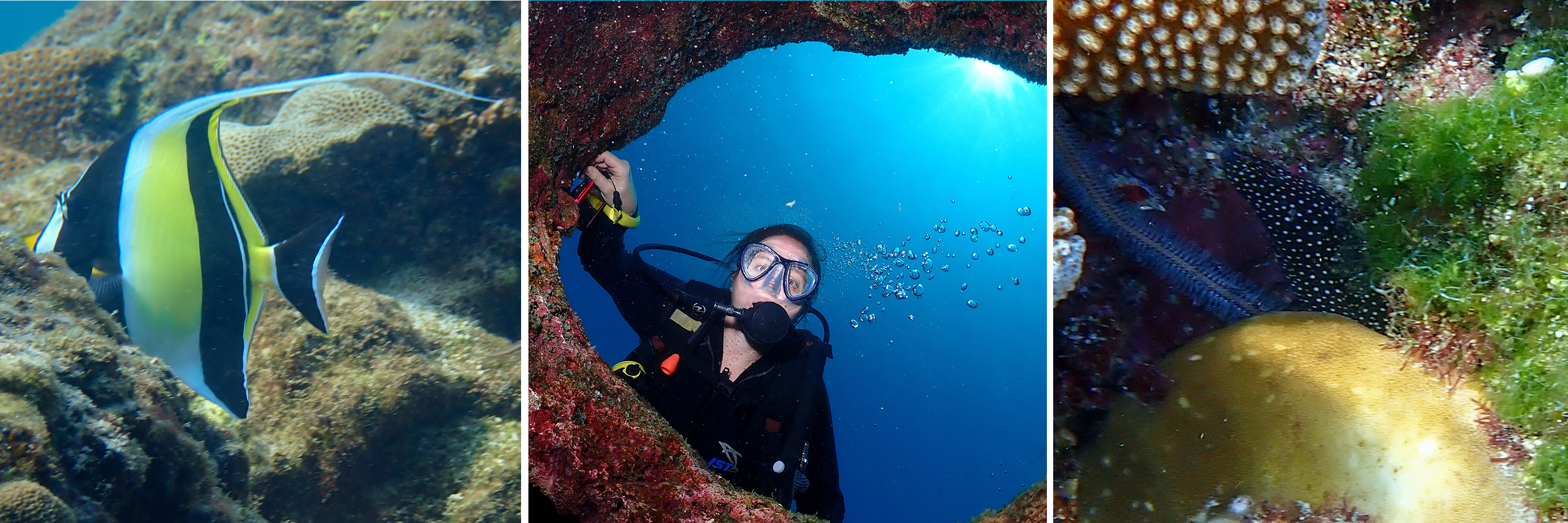
Moorish Idol, me scuba diving, Whitemouth Moray Eel

Since it was getting close to Christmas, I took some time to capture these Christmas tree polychaete worms. If they get spooked, they disappear back into their tubes, so you have to approach slowly and carefully and stay a bit of a distance away. I realize they don’t look much like worms, but the rest of their bodies are hidden inside the tubes.

Christmas Tree Worms: white, red, and blue

While the rest of the group headed back to Taipei, I stopped for a day in the city of Kaohshiung. It’s way more laid back than Taipei and had a lot of nice bike trails. The first night I wasn’t up to doing too much, so I walked along one of the rivers in town to check out the artwork and fancy buildings.

art sculptures near Pier 2, Kaohshiung Music Center lit up in Christmas colors

The next day I got up early and headed out on some bicycle explorations. As I was biking along the river, I stopped to watch a dragon boat race competition. I visited another Hakka Museum that had more information than the one we had visited in Taipei. I also went to the Art Museum and headed over to a flea market full of the most random items: sculptures, rocks, wooden bowls, mannequins, books, antiques, food, cheap souvenirs. It was a total hodgepodge of items, just like flea markets everywhere I suppose.

dragon boat racing, traditional Hakka clothing, goods for sale at the flea market

Cijin Island is a cute micro-island off the big island of Taiwan. After all of my other explorations, I took a ferry across to the island and then rented a city bicycle to ride the beautiful bike path going from one end to the other (about 15 km round trip). There’s a bunch of art sculptures along the way, as well as one super windy spot where people were flying kites. I made sure to stop in at Douliu Ice Town to try one of their peanut ice cream sandwiches before I got back on the ferry. I grabbed my backpack from the hotel and lugged it to the train station and hopped on the high speed train back to Taipei.

kite flying, giant shell art, peanut ice cream sandwich

Jiufen & Keelung

I got to Taipei a few days before the rest of the group, so I planned some mini-adventures to nearby cities that I could get to and back in a day. My first stop was Jiufen, a magical little town set in the mountains. The day I was exploring, it was cloudy and rainy all day, so a stop at teahouse seemed like a good idea. A-Mei’s Tea House is rumored to have inspired the bathhouse in the movie Spirited Away, but that’s apparently not actually true. The idea of this, however, does seem to bring in lots of tourists. Their standard tea includes a set of snacks and a giant bowl of tea leaves. A staff member walked me through how to wash the tea leaves and then prepare it. I’m not sure I got all the steps down correctly, but I did enjoy the respite from the rain.

A-Mei’s Tea House: snacks, tea, cloudy view

Jiufen is a maze of streets going up and down the side of a mountain. The stores are right next to each other and mostly protected from the weather by overhanging awnings. In the morning when I first arrived, not much was going on, but as the day went on, it got busier and busier. By evening, it felt like I was walking through a Moroccan souk: crowded, noisy, and alive.

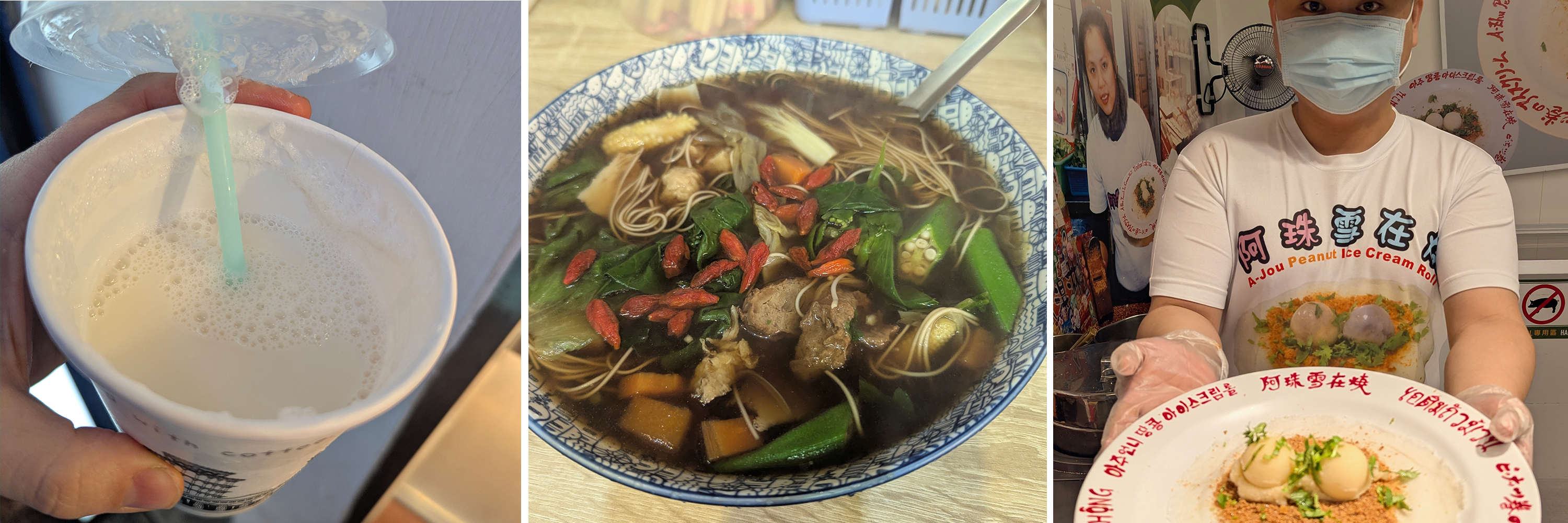
Every Taiwanese town has its specialities to try and I’m a sucker for new foods I’ve never eaten before. The Jiufen streets are a foodie paradise. A lady was hawking drinks, so I stopped and bought a drink made from apricot kernels, which I didn’t know were even edible. Apparently, the Southern Chinese variety of apricot have less toxins than other varieties, and the drink is made by grinding up the kernels into a fine powder. I also tried the famous Jiufen peanut ice cream roll. It’s basically a very thin crepe, covered with chopped up peanuts, two scoops of peanut ice cream, and a dusting of cilantro. Then it’s rolled up like a burrito and cut in two for the customer. It’s a yummy, savory and sweet dessert all in one.

apricot kernel drink, ridiculously healthy veggie noodle soup for lunch, peanut ice cream roll

Some other food highlights were barbecued mushrooms with a spicy seasoning sprinkled on top and tiny waffle-cake desserts stuffed with different fillings. Jiufen is also famous for its taro balls, topped with a sweet sauce and a variety of beans. I had high hopes for this last one, but it wasn’t my cup of tea.

bbq mushrooms, cake stuffed with taro filling, sweet taro balls mixed with beans

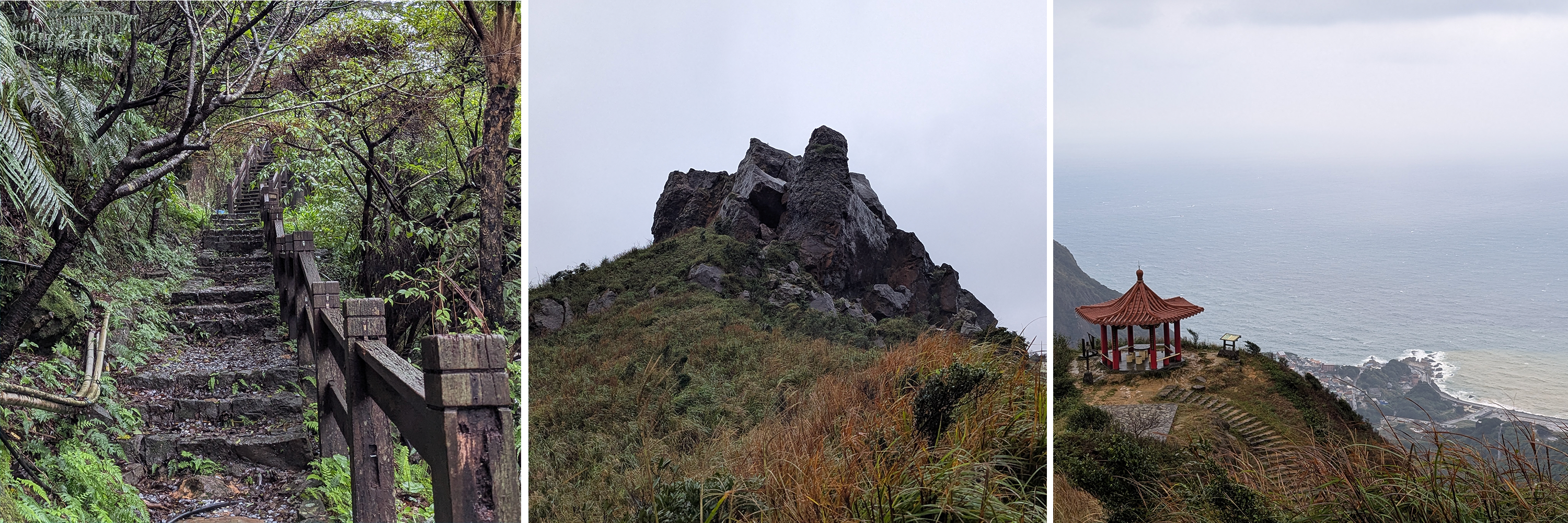
Almost accidentally, I ended up climbing a mountain. I took a bus to the nearby museum about gold mining. As I was wandering around the huge park, I saw a sign pointing up to Teapot Mountain. I’d read about it, and even with the drizzling rain, decided to go for it. I don’t usually hike with umbrellas, but I did on this walk. Taiwanese hikes seems to come in only one variety: straight up with lots and lots of stairs. Fortunately, this one came with nice views. The teapot name seems to come from the shape of the rocks at the top and most of it is roped off for safety reasons. I scrambled around on the new path and made it about halfway up the rocks before I decided they were too slippery to proceed.

lots and lots of stairs, the teapot shape of the rocks, view from the top over the sea

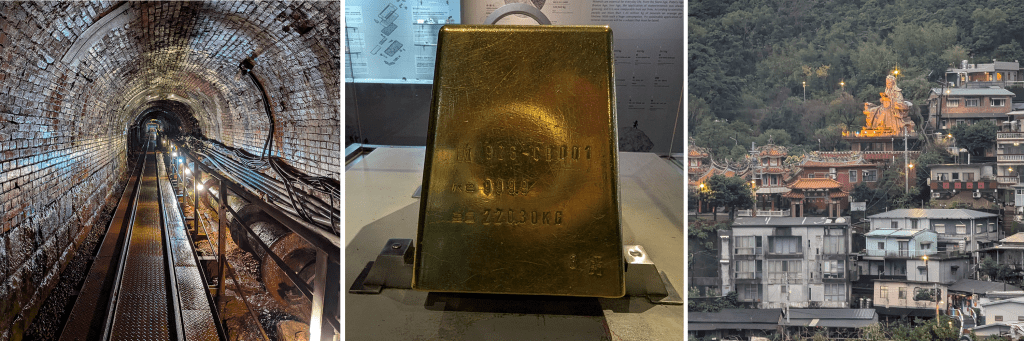
Before it got dark, I did manage to walk through the old tunnels they used for mining gold. I also touched the world’s largest solid gold block, weighing at an impressive 220 kg. Nearby was the Cyuanji Temple with a giant golden sculpture on the roof of General Guan, a Chinese general who lived around 200 CE.

golden mining tunnel, world’s largest gold block, Cyuanji Temple

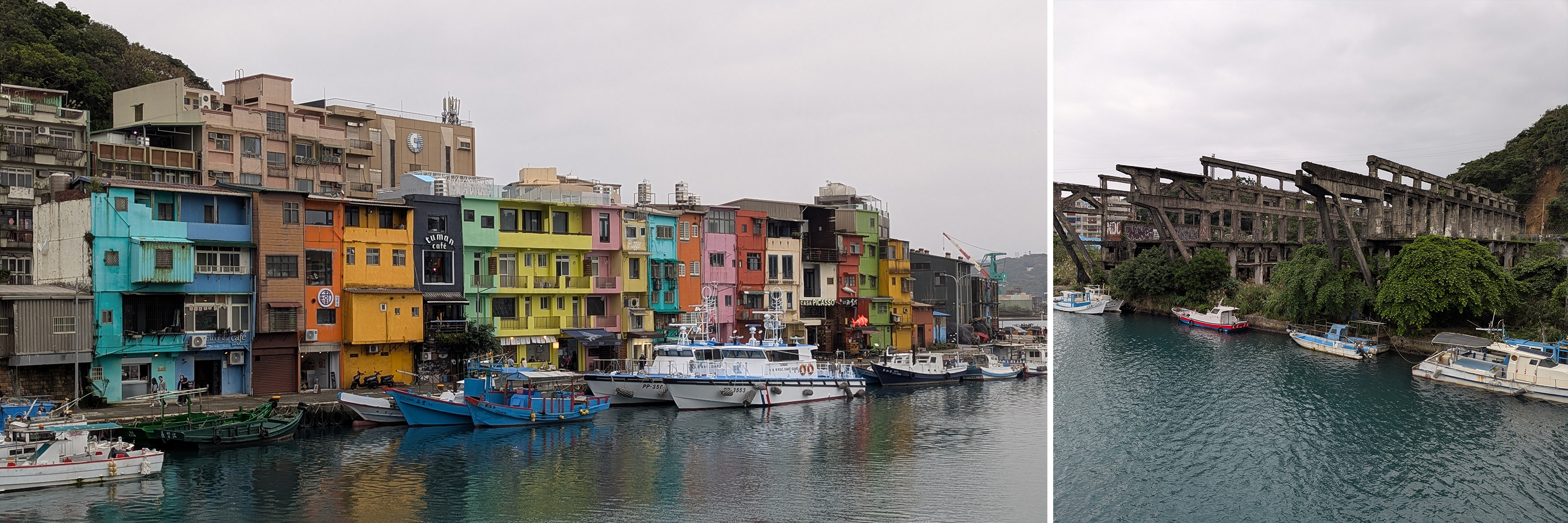
This is a sleepy waterfront town that doesn’t have much going on except for its vibrantly painted buildings. There’s a variety of fishing boats parked inside the harbor and the fascinating ruins of a former shipyard, where large boats were once built.
colorful waterfront, old abandoned shipyard

piles and piles of nets, metal squid sculpture, view of the harbor

I stopped in Zhengbin on my way to Heping Island. There’s a large ocean filled swimming pool, but the view of the rocks was my main reason for visiting, They are made of red sandstone, but because of the wind, they have been eroded into some really fun shapes, including one that looks like a nudibranch.

view of rocks, nudibranch shaped rocks, more shoreline

As I hopped off the very tiny bus I took from Heping, I heard music and noticed a crowd gathering at the train station. One of my travel rules is to always follow the music, so of course, I went to investigate. After a lot of sleuthing and Google translating, I figured out his name was Qiu Jun (邱軍) and he had won second place on a TV talent show called King of the Voice. After the performance, I headed towards the Keelung Night Market, which is known for its rows of yellow lanterns.

tiny bus to Keelung from Heping, Qiu Jun, second place winner of King of the Voice, view of Keelung Night Market

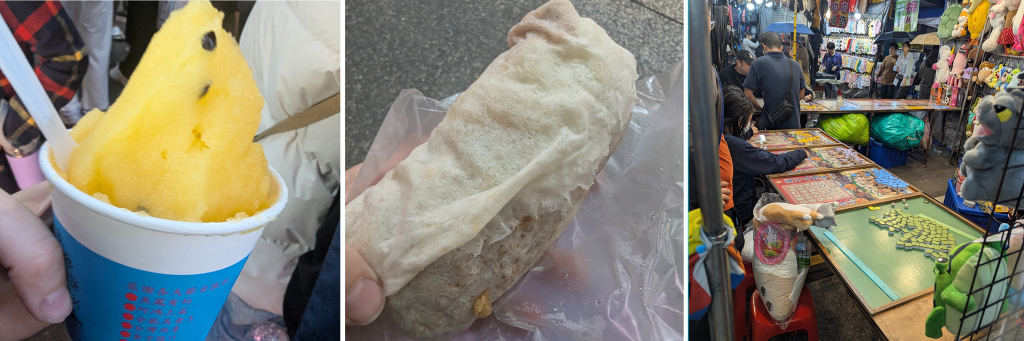
As with most night markets, there are only a few vegetarian options. I ate passionfruit pao pao bing, which is a shaved ice that tastes like a sorbet. I also found vegetarian spring rolls and scallion pancakes, my go-to when there aren’t too many choices. The Keelung Night Market is several blocks long and in addition to all the food for sale, there are whole sections of carnival games where people can win prizes.

At one point, it was raining pretty hard, so I stopped to watch one game I’d never seen before. After all these years of traveling, I still love the puzzle of trying to understand what is happening, even when I don’t speak the language. Although I’m not entirely sure of all the rules, it seemed like a bunch of mahjong tiles were shuffled around and then the player picked a certain number of them. The player then matched them up on what looked like a bingo board and based on the pattern they made, the player won or lost. I didn’t stick around long enough to see anyone win, but this booth had a steady flow of customers.

passion fruit pao pao bing, spring roll, mahjong-inspired night market game

Taipei

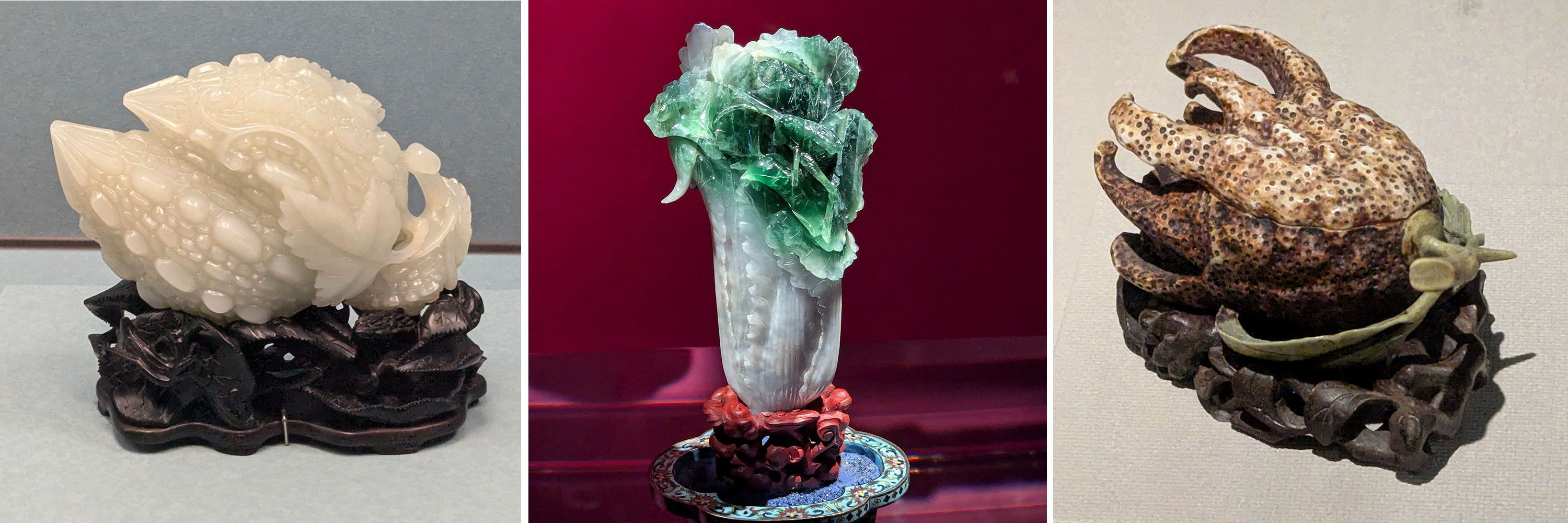
I arrived in Taipei early in the morning and tried to get myself on the right time zone as fast as possible. This meant staying awake all day if I could. My friend Cassy who lives in Taipei and was the impetus for this trip did a great job of feeding me, showing me around her neighborhood, and giving me the lowdown on all the important things I needed to know to navigate public transportation. However, by afternoon, I was ready to crash and knew that I had to keep moving if I was going to stay up. Cassy had work to do, so I headed off for the National Palace Museum. This place was full of beautiful works of art that were moved from Beijing when Chiang Kai-shek and the Kuomintang retreated to the island after being defeated by the communist party. The objects in the collection were a part of the imperial family’s collection and the jadeite cabbage below is one of the museum’s most famous pieces. If you zoom in on the photo, you can see the katydid hidden in the carving.

food inspired artwork: jade bitter melon, jadeite cabbage, Buddha’s hand citron

Giant museums like this are often overwhelming. One approach I have is to just wander into a room, walk around without reading any of the text and pick out a couple objects that catch my eye. Only then do I slow down and read the text on just those few pieces. I’m a person who is very drawn to the written word, so this helps me to focus on wonder and beauty. Below are three of pieces that drew me in. The first was displayed in a room full of beautiful jewels, but it’s emergent complexity from simple iridescent feathers made me stop in my tracks. Perhaps, a bit mundane to some, but I also loved this long scrolling map showing the routes of the old postal system in Taiwan. On special exhibit were a wide variety of inkstones, a common tool where the flat surface was used to grind up ink, mix with liquid, and then it could be used to write. This one looks like the ink started decadently oozing out of control.

feathers on feathers, postal system map of old Taiwan, fancy inkstone

A few days later, our friend Chalida and her daughter Rory arrived to join us on our adventures. These photos are all jumbled in terms of time, but one of our first adventures was to a Hakka Museum in a nearby town. Chalida’s family is part Hakka, a southern Chinese minority group who were pushed off their land over and over again. Because of their persecution, many ended up in Taiwan and other neighboring countries. They make up about 20% of the Taiwanese population and many large cities have Hakka centers and community gathering spaces to preserve Hakka culture.

We also made it to one of the Beitou Hot Springs spas, which had seven or eight pools of different temperatures and different amounts of bubbles. There was even a giant rock slab to lay down on, which pulled the heat off after a long soak. The nearby Beitou Library is one of the most beautiful buildings in all of Taipei. Cassy and Chalida are both school librarians so we had to get a photo to commemorate the pilgrimage.

Hakka Museum Barbies in traditional attire, Cassy & Chalida & the Beitou Library, fancy tea

me, Chalida, Rory, and Cassy after our Hot Spring dip; Chalida & Rory trying to blend into the mural

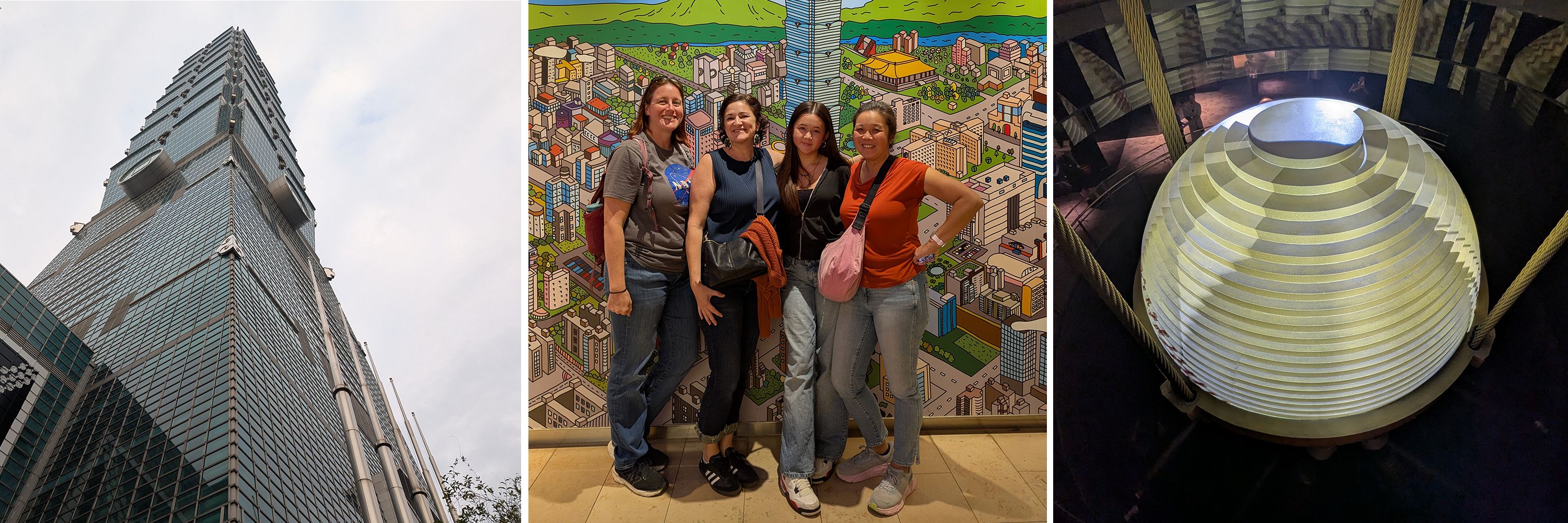
Visiting Taipei 101 is on the must-do list for most tourists. It measures 508 meters (1,667 feet) off the ground and is the second tallest building in the world (after the Burj Khalifa). The inside had an Instagram feel with lots of cute backdrops for taking photos. I really enjoyed seeing the giant mass damper, which is apparently the only one on display in the world. This giant sphere weighs about 1,500,000 lbs and moves in different directions to offset the swaying of the building, which is especially important given the frequency of earthquakes in Taiwan. There are two other smaller mass dampers (not on display) that also help to keep the building stable.

view of Taipei 101, all of us waiting in line to go up, one of the mass dampers

My other favorite part of the experience was the boba shop at the top. Rory and I, being the boba addicts that we are, had to get one since this is clearly the highest altitude boba we will probably ever enjoy. Cassy, meanwhile, got some fancy Taipei 101 themed waffles for us to enjoy. I’m convinced she makes an amazing model and we definitely should submit this photo for their marketing materials.

Cassy displaying delicious Taipei 101 treats, me & Rory and our highest altitude boba, nearby clothing market

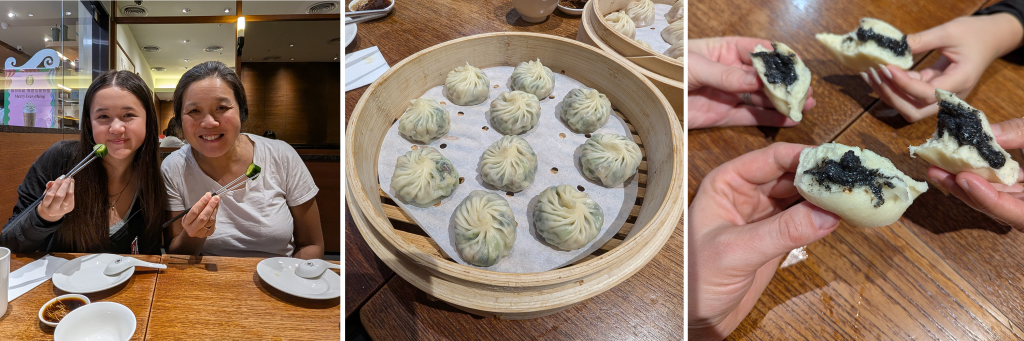
Based on a recommendation of one of Rory’s classmates, we made a pilgrimage to Din Tai Fung, a restaurant known for serving up delicious Taiwanese food. The cucumber salad was gone almost as soon as it was put on the table. I was not very impressed with their vegetarian soup dumplings (not very soupy), but their sesame buns were positively divine.

Rory & Chalida & cucumber salad, xiao long bao (soup dumplings), sesame buns

The golden lava buns below also came from Din Tai Fung, the oozing yellow middles are salted egg yolk. Taiwan is a food eater’s paradise and we ate so much while we were there. One relatively recent Taiwanese invention is delicious mango snow, which is basically hardened mango ice cream cut up in a shaved ice machine. It’s as yummy as it sounds.

fried sweet potato balls from a night market, golden lava buns, mango snow

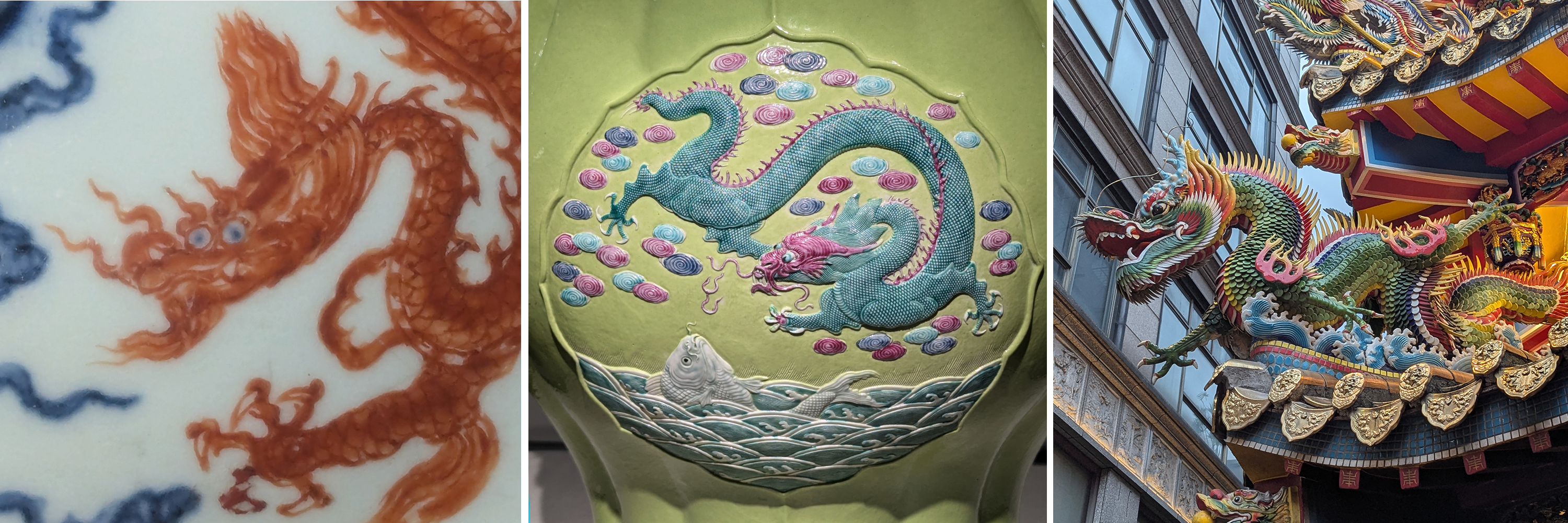
After some time in a new place, certain motifs and recurring images tend to catch my eye. Here’s some of the images I started to notice after a few days.

manhole covers (Taiwan really does have the best manhole covers)

dragons (on ceramics and temples)

temple decorations

Jakarta

Generally speaking, travelers aren’t very fond of Jakarta. The airport is a long way from the city and there is one road that goes to the city that gets backed up. Between all the cars and motorcycles and pedestrians, the traffic is overwhelming. Although there is public transportation, it isn’t easy to navigate at first and usually tourists just jump in a taxi, but then they are sitting for an hour in bumper-to-bumper traffic to get to their location. It’s hot and humid year-round. Everyone I told that I was going to Jakarta responded with horror stories.

And yet, I kind of fell in love with Jakarta (a.k.a. the Big Durian) and there was a clear moment for me when it happened. I was walking out of a big mall and there was a bunch of xylophones set up outside. A group of older ladies, carrying mallets and wearing matching blue hijabs, denim shirts, and stylish batik bottoms took the stage. They started playing “Bohemian Rhapsody” by Queen and I just marveled at the whole experience. Muslim women performing music by the very queer Freddie Mercury as a huge crowd sang along. It was so heartwarming to see the interweaving of cultures in a way that brought everybody joy. I just couldn’t stop smiling. Even now, months later, when I watch this clip, it makes me happy.

For fun, here’s a clip of the men of PINKAN Indonesia playing “Have you Ever Seen the Rain?” Watch the constant stream of scooter and car traffic in the background.

Sightseeing

I did a fair share of the normal tourist stuff in Jakarta, starting with the National Monument (also known as Monas) which celebrates Indonesian independence. Its design was inspired by a rice mortar and pestle. If you’ve been reading this blog for a while, garudas are a running theme on this trip. I found garudas on every temple in Bhutan and in church pulpits in India, and they were here on this monument in Indonesia. They feature prominently on the official emblem of Indonesia. However, the politicized version is a bit more like an eagle, than how garudas are traditionally depicted in Buddhism and Hinduism.

National Monument (Monas), golden garuda decoration outside Monas, official emblem of Indonesia

While waiting to go to the top, I visited a museum dedicated to the history of Indonesian independence underneath the monument with giant dioramas of important events in the country’s history. After my number was called, I followed a bunch of school kids in matching blue uniforms on to the elevator and up to the observation deck.

view of Jakarta from the top of the National Monument

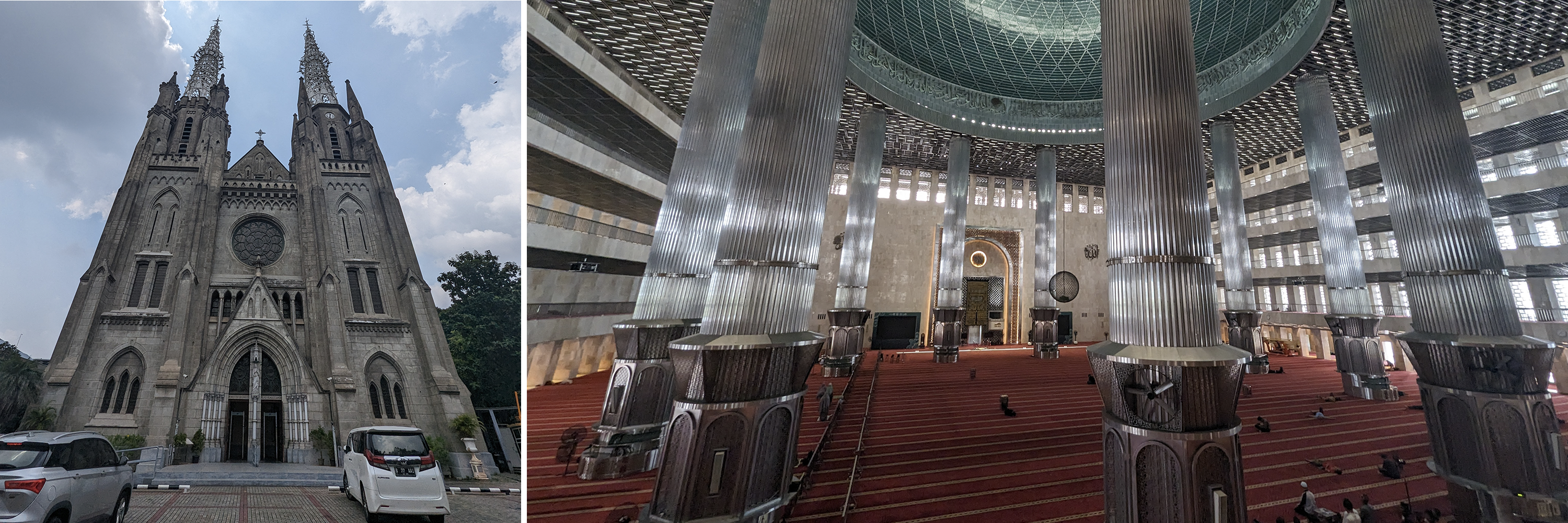
I then walked over to the Jakarta Cathedral which has two giant spires adorning either side of the entrance. Interestingly, the Istiqlal Mosque is right across the street. The mosque is named after the Arabic word for freedom. From the outside, the mosque looks like typical 1960’s concrete block office architecture. It barely resembles a mosque, except for the pointy minaret that sticks up on one side. There are seven entrances to the sprawling complex, which allow as many as 200,000 people to worship at once. The main room for prayers was exquisitely decorated and reminded me a lot of the main worship room in the mosque in Kampala, Uganda.

exterior view of Jakarta Cathedral, interior view of Istiqlal Mosque

Museums

My favorite museum was probably the Jakarta Textile Museum. The museum holds rows and rows of beautiful batik fabrics and weavings. At the very back of the museum in a separate building, they offer visitors a chance to make their own batik. Batik is a way of dyeing fabric by first applying wax to areas that will not be dyed. Then the fabric is dipped in color dye and removed, and then its dipped in hot water and the wax is removed. Through multiple steps of waxing and dying, very elaborate patterns can be produced.

Most complicated and large pieces are done with large stamps. However, applying the wax can also be done by hand using a batik pen called a canting. It has a small reservoir on top for holding the wax and then the artist must work quickly to apply the wax at the right angle as it flows from the pen tip.

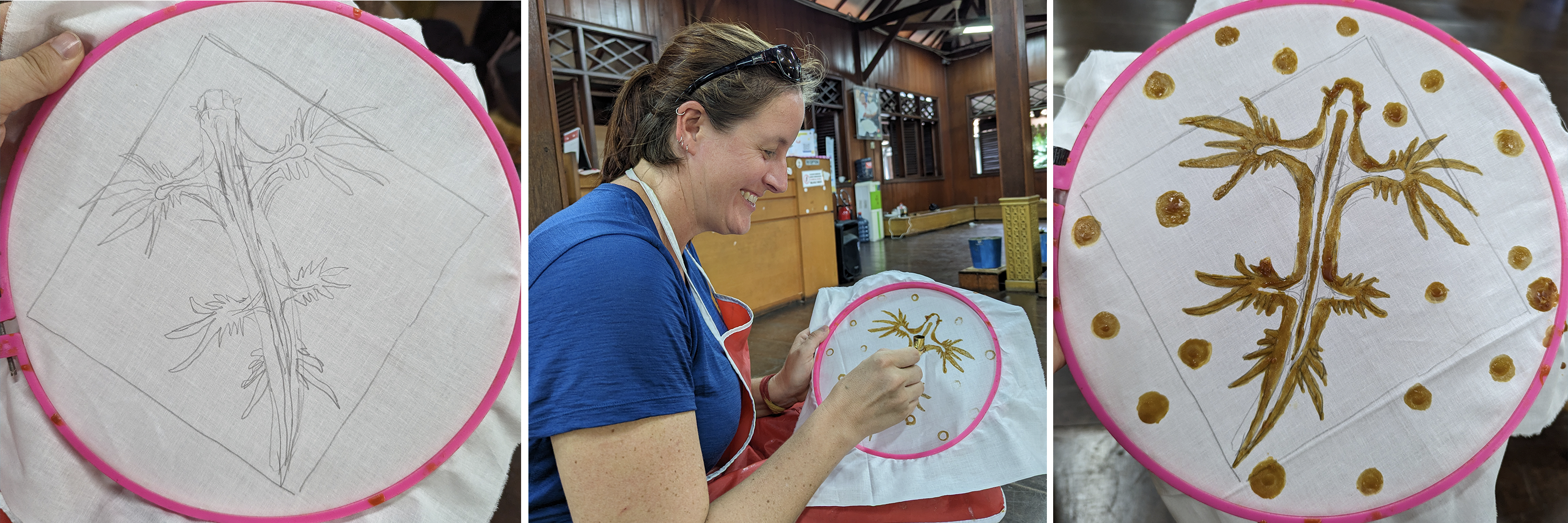
They gave me several very simple patterns to try, but instead I, of course, picked something much more difficult and decided to draw a blue dragon nudibranch. Applying the wax was challenging since it was hard to hold the pen at the proper angle without spilling it. My original design did not have all those big dots. I added them to cover up a bunch of wax dropping in the wrong place. I think they actually enhanced my final creation. What is it Bob Ross said? “We don’t make mistakes, we have happy accidents.” This process took a long time, because I had to apply wax to both the front and back sides so the dye didn’t go through.

original design, me applying wax, finished wax design

After I was done, one of the artists brushed on a light coat of wax along the edges to give it that textured border. Then he stuck my fabric in the dye, then into the hot water bath, and then on a clothesline to dry. That whole process took no more than ten minutes.

dipping design in blue dye, finished design waiting to dry, sculpture of the tool used to apply wax

The other museum I enjoyed a lot was the Kite Museum. This one is a bit outside of the center, so I hired a driver for a few hours from an app and off we went. I paid for him to visit the museum too since he’d never been there and he’d grown up in Jakarta. Kites are a part of the culture of many Indonesia islands, but especially Bali where there’s a huge festival held every year where people compete for best launch, longest flight, and best design. This museum had quite a collection of rare and special kites and at the end of the tour, they taught me how to make my own.

kite with elaborate characters, dengung kite, tour guide with elaborate life-sized kite

intricate kite with black design, owl kite, the kite I made at the end of my tour

Food

Indonesian food is definitely meat heavy, but Jakarta had a wide selection of vegetarian options. I found a vegan spot pretty close to the mall where the xylophone performance was held that served a meatless marangi satay. These are skewers marinated in sweet soy sauce and other spices before being grilled.

The Istiqlal Mosque had a whole food court in the complex and while waiting for the tour, I ate ketoprak which is basically tofu, veggies, rice cake, and rice vermicelli served in peanut sauce. The lady who made this for me and I communicated entirely through gestures, but we worked it out. It’s amazing what nonverbal communication can accomplish. I also ate some roti bakar at a fancy coffee shop, which is basically just grilled toast with some kind of filling, like coconut jam and butter.

vegan marangi satay, ketoprak, roti bakar

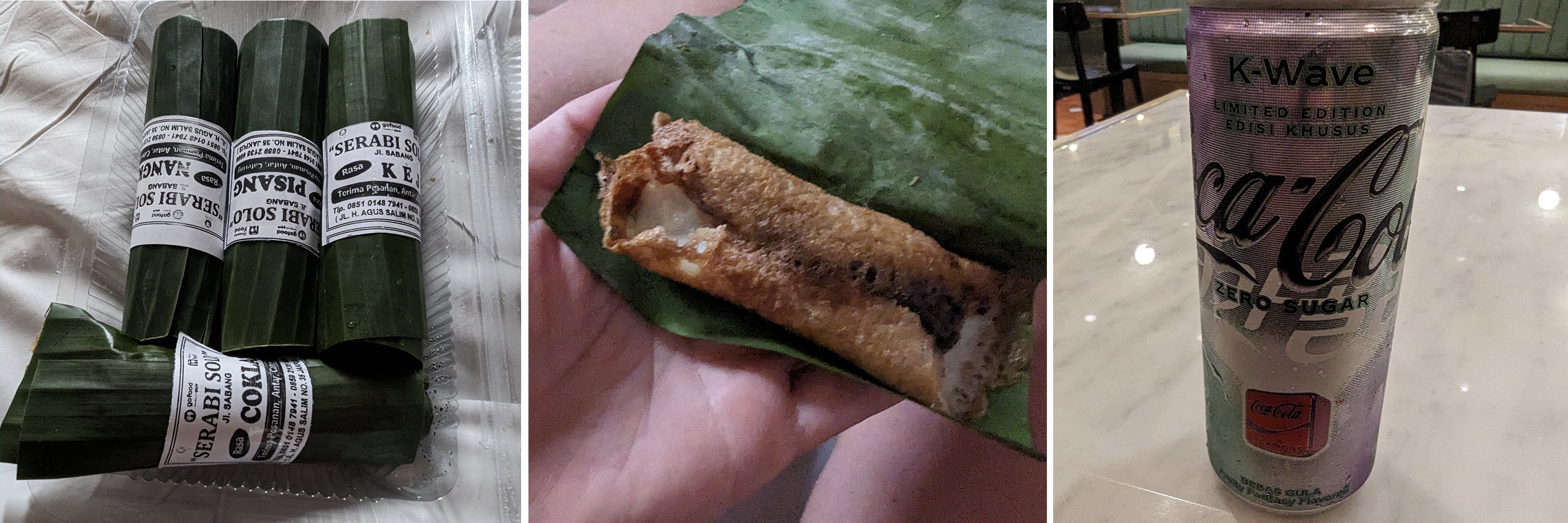
Serabi are pancakes that originally came from Java, the island Jakarta is on. Traditional ones are made from rice flour, coconut milk, and coconut sugar. I bought these from a guy on the street who wrapped them in leaves for easy transport. They were delicious.

serabi pancakes (one each of chocolate, cheese, jackfruit and banana), unrolled pancake, random Coca-Cola flavor K-Wave

Indian Food

Here is the long-overdue epic Indian food post.

Northern India

I ate lots of delicious things when I was in West Bengal, right after I entered India. The Tibetan influence is strong from all the waves of immigration. I’m a big fan of momos, Tibetan dumplings which are made with slightly thicker dough than Chinese ones. The ones in the photo below came from the restaurant in Jaldapara National Park. I also had a giant meal of rice and two dishes – mixed vegetables and butter paneer. Butter chicken is jokingly known as the dish white Americans order from Indian restaurants because they can’t handle the spice. However, I’d never had the vegetarian version made with paneer (Indian cheese) so I figured I should try it. It was okay, but I truly enjoy a little more heat in my food. My other favorite part of many of my meals in India were getting mixed sodas. These usually have a base of lemon or lime juice, sparkling water, and both salt and sugar added. Not everyone likes salty-sweet lemonades and limeades, but in the hot weather, I am a huge fan. Side note: Mexican limonadas are made the same way.

I ate thukpa (a Tibetan noodle soup made with curry powder and vegetables) at the highly recommended Kunga’s Restaurant in Darjeeling. I waited in line for about twenty minutes and was about to give up when a woman came out and said she had room for one. I ended up sharing a table with a Bengali couple from Kolkata who were taking a long holiday weekend in the highland cooler temperatures. The whole restaurant had maybe seven or eight tables with barely any room to walk. Just as I sat down and ordered my food, the entire staff sat down around the one big table in back to eat their lunch. My new friends shared travel and festival recommendations from Kolkata while we waited a rather long time for our food to arrive. However, when it finally came, the soup was delicious and I even ordered some steamed vegetable momos to go.

vegetarian momos with dipping sauce; mixed lemon soda, rice, curried vegetables and butter paneer; vegetable thukpa

Panaji

I mentioned in an earlier post my love for Cafe Tato. They serve traditional Goan food and delicious breakfast and snacks. Chole masala is very similar to what is often called chana masala in Indian restaurants in the United States. It refers to the Punjabi way of making it, which has a very specific set of spices. Puri is delicious puffy fried bread. The best way to eat the chole is to break off a piece of puri and scoop it up with your hands. After living in Morocco for two years, I’m a big fan of not using utensils at every meal. I used the puri to eat the mushroom dish in the pictures below and I also got to try a mushroom samosa for the first time.

chole masala, puri, mushroom bhaji, mushroom samosa

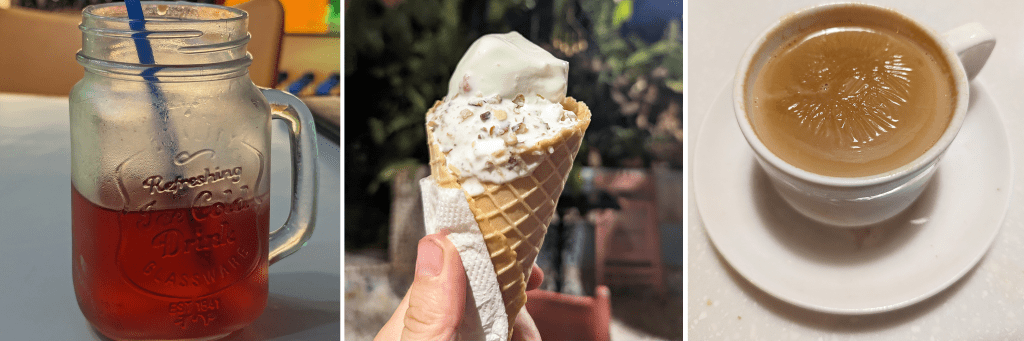
Panaji was hot and I was mostly thinking about cooling down whenever I stopped for refreshments. A tiny shop across my hotel was selling these kokum coolers which were sweet and tangy. An Amul ice cream shop was a quick stop for me to escape a rainstorm. And, of course, the only hot item on here is a masala chai. I could only really drink these in the morning, because by the afternoon it was too hot.

kokum cooler, chopped almonds ice cream, masala chai

One of my favorite things to do when I visit any new place is to go into supermarkets and buy all kinds of snacks that I’ve never had before. I bought all these in Panaji and slowly made my way through them over the next few days. The sour gummy feet were like sour candies everywhere. The bugles made from billet were tastier than I thought they’d be, but they still tasted healthy. Monkers are just cheap M&Ms and the sesame balls were harder than I thought they’d be. Sabudana is actually made from sago flour and usually has the consistency of tapioca. However, these were puffed, mixed with peanuts and tiny fried potato sticks, and had the salty-sweet flavor of kettle corn. It was definitely one of my favorites.

gummy feet, millet bugles, monkers (like m&ms) and sesame balls, sabudana mix

Arambol

Arambol is much better known for its beach scene than its food. However, there was one bakery in town with a blue awning that was famous for its baked goods. Its chocolate croissants were not exactly croissants, but they were made with dark chocolate and were tasty and cheap. The mango cheesecake was passable. However, the prize for best food in Arambol unexpectedly went to a little cafe on the beach. My friend and I got a vegetarian biryani, which is a mixed rice dish cooked with vegetable and spices. This one even came with fried onions on top and was absolutely divine.

best chocolate croissant in Arambol, delicious vegetarian biryani, mango cheesecake

Bhutanese Food

Eezay

The most important part of every Bhutanese meal is a small dish of chilies, known as eezay. There are many different varieties of eezay. Some are nothing more than piles of red chilies; others are mixed with cilantro and other herbs. Often, the restaurant food caters to Western tourists that prefer their food on the blander side. I, however, prefer my food with a little more spice and by the last week of the trip, I just asked for a dish of eezay at every meal.

bag of chillies at the Paro market, old school giant mortar and pestle used for crushing chilies, side dish of eezay

Food in Eastern Bhutan

The food from our homestay in Merak was delicious. Every morning, we got thueb, red rice porridge with little cubes of paneer (homemade cheese). We also got a pile of fried red rice, a hard-boiled egg, and a cup of butter tea.

On our day-long Merak-Sakteng trek, our porters carried lunch for us and I got my first taste of my favorite Bhutanese food, nakay datshi. This is a dish made of fiddleheads, the fronds of the fern before they unravel in the spring. I’ve definitely eaten fiddleheads in the United States, but they’re pretty rare and often just sauteed in a simple butter sauce. These were cooked in a cheese sauce with chilies; something about this flavor combination is extremely satisfying. Datshi means cheese in Dzongkha and is featured in many dishes in Bhutan. For example, kewa datshi is potatoes with cheese (kewa means potato) and shamu datshi is mushrooms with cheese (shamu means mushroom). The amount of chillies in each dish depends on the preference of the chef.

Merak trek food (clockwise from left): eggs, mixed vegetables, eezay (chillies), rice, and nakay datsay; Angela getting her daily portion of thueb; drinking butter tea

Food in Central Bhutan

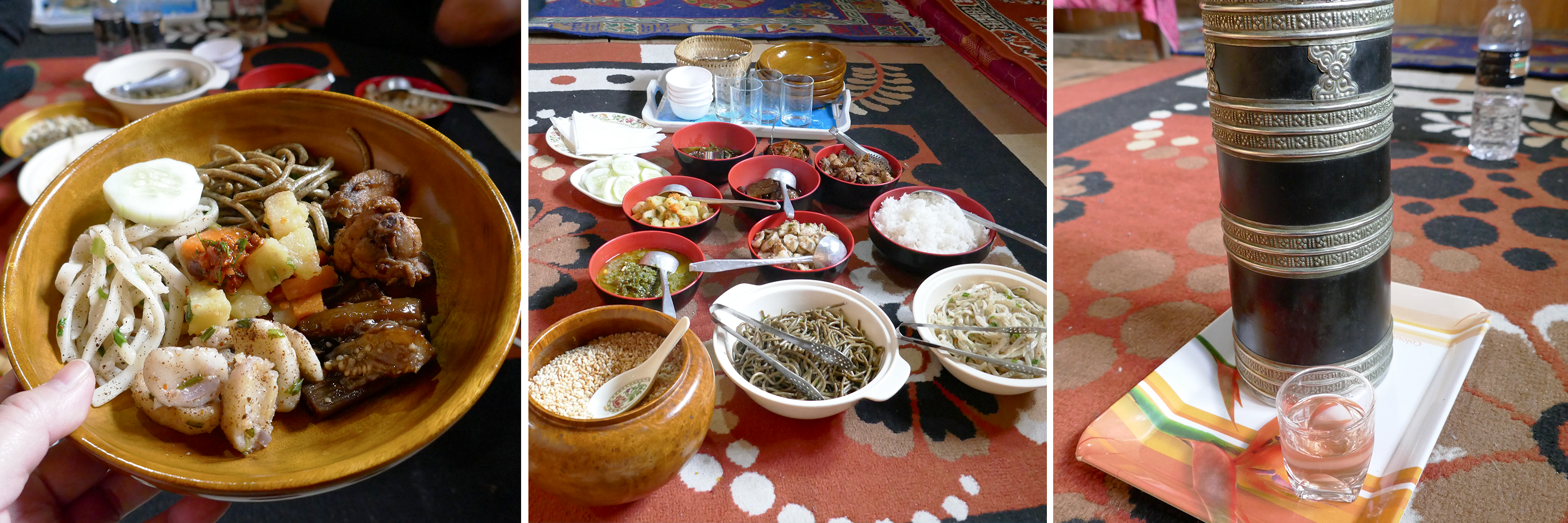
For lunch on our temple tour day, Tenzin took us to a local homestay that served a huge spread of food. We started with milk tea and then we tossed in some puffed rice (think Rice Krispies) for some added texture. Bumthang is known for buckwheat, so we got to sample long, skinny buckwheat noodles as well as two kind of wheat noodles: long, flat ones and short, fat pinched ones. We also drank some ara, the local moonshine which in this area had been brewed with sandalwood, giving it a slight pinkish tint.

Angela’s lunch plate full of noodles, the whole spread, and a traditional ara serving vessel with a glass of ara in front

In Bumthang, we also ate some delicious buckwheat pancakes for breakfast, smothered in local honey. Somewhere along the way, Tenzin figured out that Angela loves dumplings, so for a few dinners we ate a bunch of vegetable and potato dumplings. While we were in Phobjikha Valley, we ate kapchi, roasted wheat flour egg drop soup. Apparently this is a common soup to eat when you’re feeling sick and it was a surprisingly satisfying first course.

delicious buckwheat pancake, momo (dumplings), kapchi (toasted wheat soup)

Olo Choto

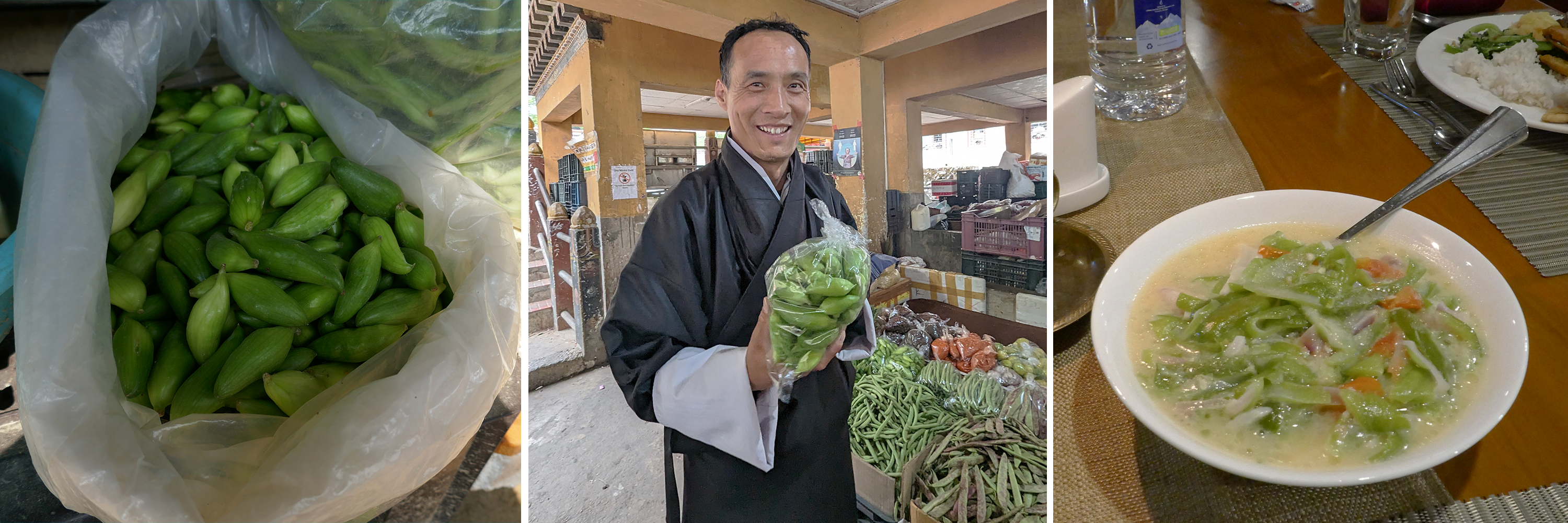
I had never seen this vegetable before in my life. Locally, it’s known as crow’s beak due to its shape. Tenzin showed it to us when we started our trip in Paro and both Angela and I had lots of questions about how people prepare it. She went down an internet rabbit hole and found out that there is a related variety that grows in Peru and Bolivia known as achocha.

We were walking through the Trongsa market and when we saw it again and we both started talking about how we wanted to try it, but it had to be cooked. Tenzin overheard us and was like, I’ll buy you some olo choto and I’ll have the hotel make it for dinner. In the car, we started discussing having an olo choto party and we were all laughing so hard. The hotel staff were kind enough to prepare the olo choto with cheese and chili. It was a delicious dinner and our guide and driver got to share in the olo choto fun as well.

pile of olo choto, Tenzin proudly showing off his purchase, prepared olo choto datshi

Best Meal of the Trip

For me, one of the best meals we had on our trip was on our way out of Thimphu. I kept asking Tenzin to find a place with some nakay datshi and he totally hooked us up. We started with a cup of milk tea (butter tea was also an option) with puffed rice (zao in Dzongkha). Then we were served a simple pumpkin soup before a bunch of different dishes arrived.

First up was ema datshi, which is practically the national dish of Bhutan. Ema means chilli in Dzongkha and this is a dish made of chilies and cheese, with different amounts of soupiness depending on the part of the country (I personally think the less soupy version is a bit better). This time of year, green chillies are the main ingredient. Next came my favorite nakay datshi, made with the seasonal fiddleheads mentioned earlier. There were also scrambled eggs, kewa datshi (potatoes and cheese), and the ever-present dish of eezay. We also were served Bhutanese red rice, which still has part of the bran left on the outside of each kernel. It has a slight nutty flavor and has quite a bit more nutrients than white rice. Interestingly, red rice is the only food item that the United States imports from Bhutan.

fiddleheads (nakay) at the market, one of the best meals we had in Thimphu (clockwise): red rice, eezay, nakay datshi, kewa datshi, eggs, ema datshi

Special thanks to Angela for providing most of the photos in this post!

Mérida

I stayed in Mérida for three weeks, taking Spanish classes and wandering around the city. The colonial influence is strong here and old money still has a deep hold on the community. In Mexican slang, the word fresa (literally strawberry), refers to spoiled, young people with a lot of privilege and parts of this city definitely have fresa vibes. At one time, the Yucatan was the one of the richest states and Mérida was one of the richest cities in Mexico thanks to the henequen industry, which, of course, I’d never heard of until I got here. Henequen is made from a type of agave (different species than the one used to make tequila), that was twisted into ropes, cords and fabric. People made a lot of money from the plant and their ruthless exploitation of workers. There’s actually a sizeable Korean population in Mérida because of this industry. Originally, a bunch of Koreans signed on to work 5-year contracts on henequen plantations, but earned almost nothing, were frequently beaten, and often didn’t even make enough money to return home. So they stayed and their descendants still live here.

Architecture

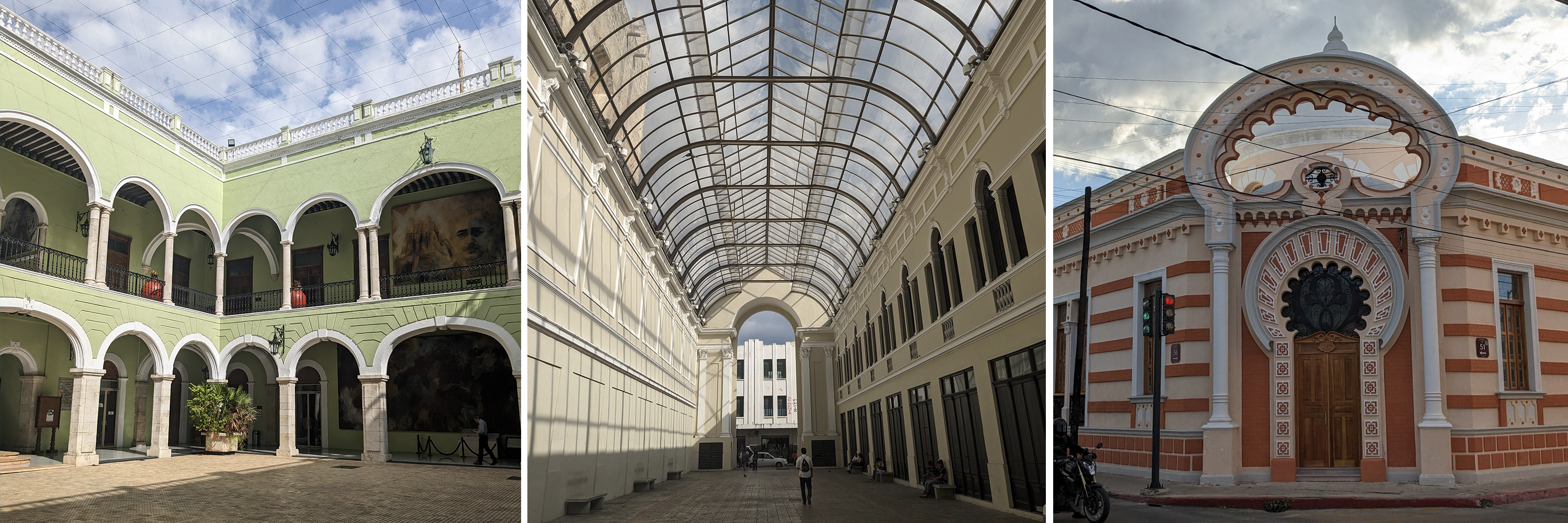
Because of the old money in this city, there’s a lot of European style architecture in the rich enclaves of town. Just outside the city center, the architecture switches to square cement houses built right next to each other, forming one contiguous wall on each block, interrupted by fancy windows and doors.

City Center: Palacio de Gobierno, Pasaje Revolución, fancy corner house (by the way, all street corners have this diagonal cutout)

Paseo Montejo: El Minaret, Monumento a La Patria, El Palacio Cantón (home to the Regional Anthropology Museum)

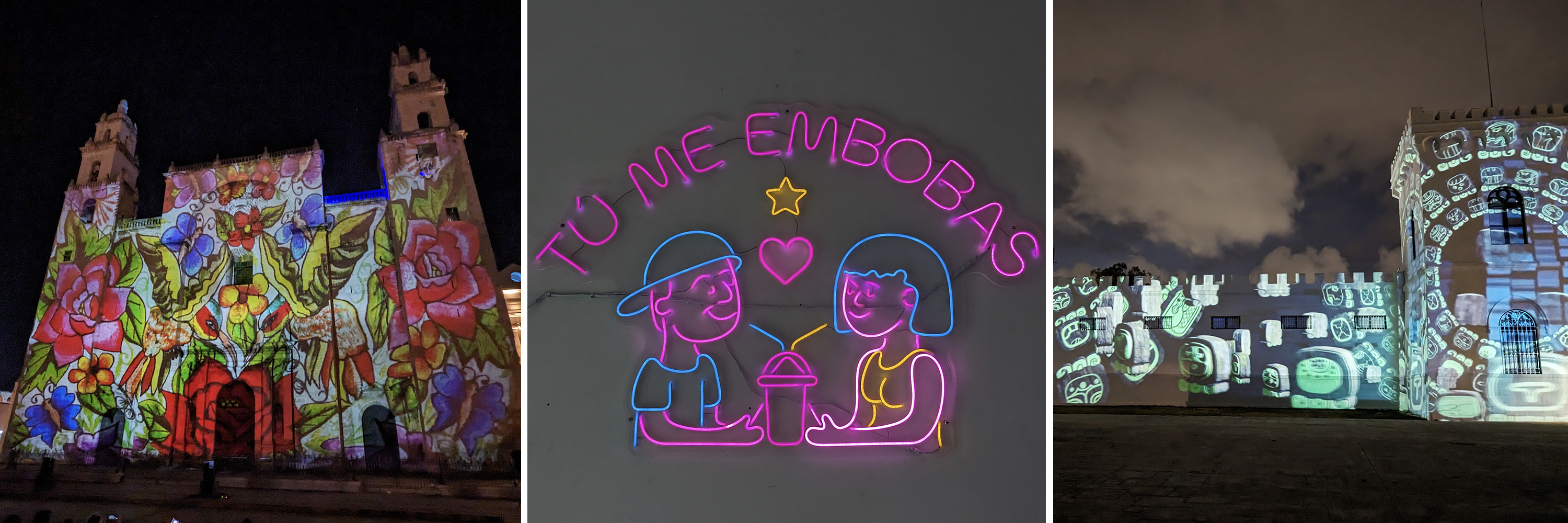
Mérida in Lights: Catedral de San Ildefonso, neon boba sign, old penitentiary lit up with Mayan calendar glyphs

Art

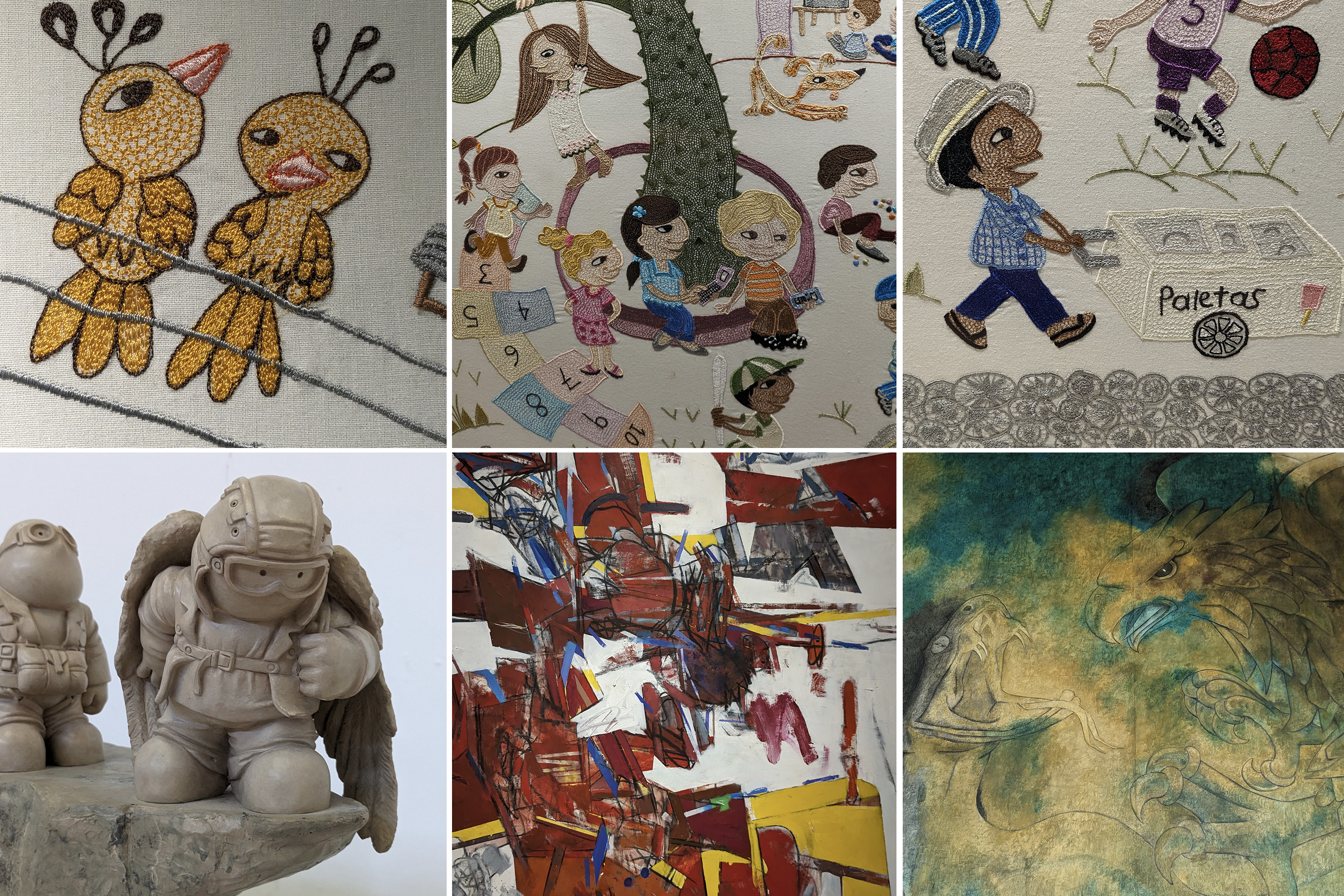
Mérida is definitely a city of museums and lots and lots of art. Every day after school was finished, I would try to get to another museum or gallery.

top (l to r): embroidery depicting typical Yucatecan scenes from the Gran Museo del Mundo Maya
bottom (l to r): sculpture in MACAY (Contemporary Art Museum), painting from MACAY, painting in the Palacio Gobierno by Fernando Castro Pacheco

Food

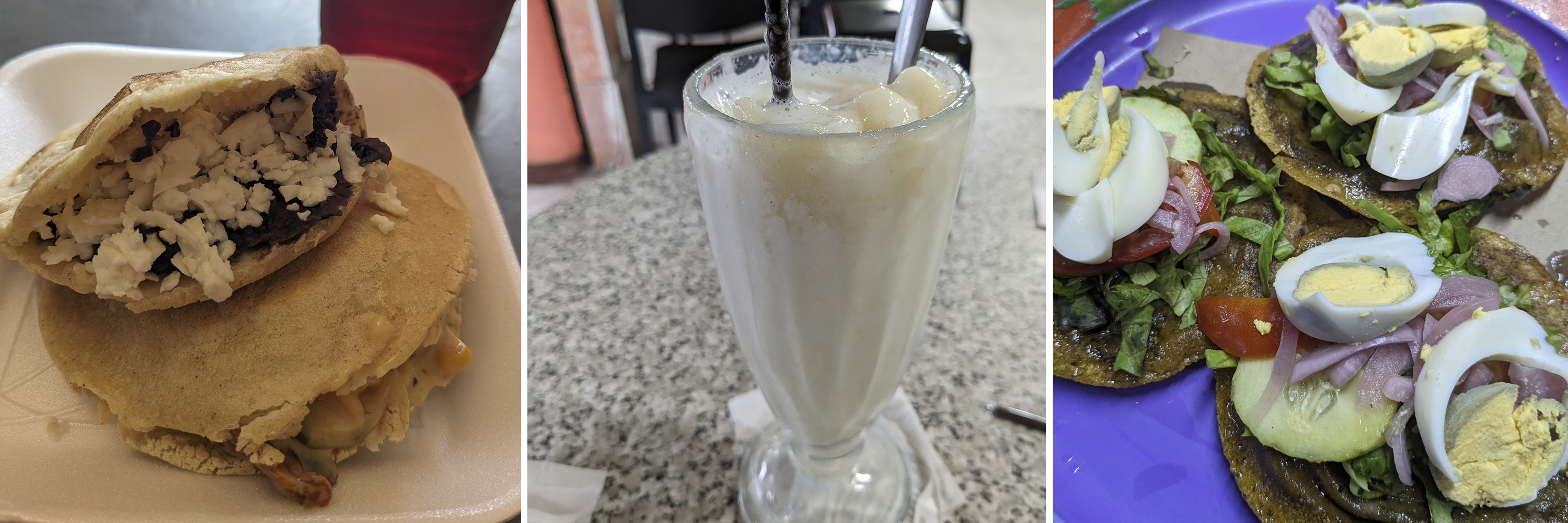
Of course, tacos are available on every other street corner, but the Yucatan has some special regional dishes. Salbutes are basically tacos, but have a puffier base than a regular tortilla. Panuchos are similar to salbutes, but are filled with beans and then fried a bit. There’s some differences in the toppings, but I’m vegetarian, so those subtleties were lost on me. Chaya, the tree spinach I briefly mentioned in an earlier post, gets tossed into a lot of dishes.

Onto the desserts: marquesitas are crepes filled with your choice of sweet toppings (nutella, cajeta (caramelized goat milk), or cream cheese), a bit of fruit (bananas and strawberries are common), and then topped with lots and lots of cheese before being rolled up into an easily portable street treat. Champola is also a speciality of Mérida in particular. It’s simple a sorbet covered in milk, but not blended together. The best flavors are guava, coconut, and mamey (a fruit with a bright orange flesh that I’ve only had while traveling, but apparently does grow in Florida and Hawai’i).

Mayan styled salbutes (with chaya and pepita seeds), vegan tacos de birria (not Yucatecan, but these were amazing), marquesita with nutella and banana

gorditas (stuffed with cheese and beans and mushrooms), coconut champola, panuchos with eggs