Fiji – Yasawas Part 2

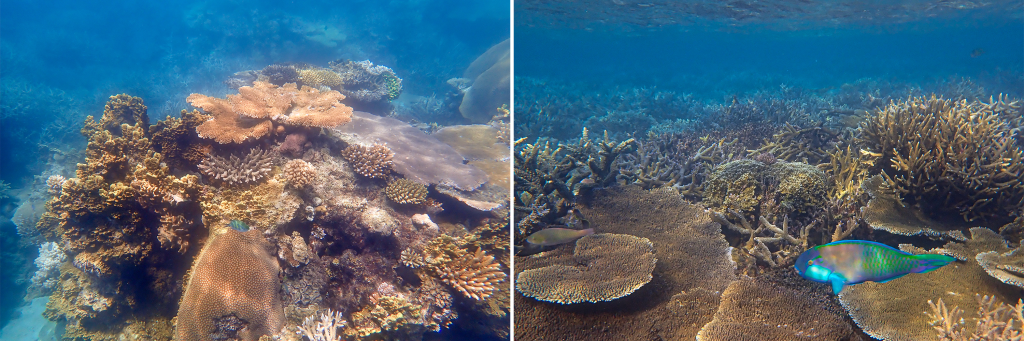
I slowly made my way down the Yasawas, stopping at a couple resorts along the way back to the main island. It is impossible to capture how stunning it is to swim out from shore and be surrounded by yards of coral reefs in crystal clear waters.

Although corals can grow in a variety of environments, most coral reefs are found between 30°N and 30°S latitudes. Corals are small animals that capture and eat plankton using stinging cells, similar to jellyfish. However, they also host a type of symbiotic plankton called dinoflagellates. These dinoflagellates perform photosynthesis and produce sugars that corals use for energy to grow, build, and survive. In return, corals provide the dinoflagellates with a safe place to live.

A single coral structure contains hundreds of genetically identical individuals living together as a colony. This cooperative structure allows them to sustain themselves and build the protective coral skeleton that shelters the entire colony. Corals require abundant sunlight and nutrient-poor water to thrive. When nutrient levels rise (particularly nitrogen, phosphorus, potassium, and iron), algae can flourish, overgrow the coral, and block the sunlight they depend on for survival.

coral reefs stretching forever

The beautiful colors of coral reefs come from the dinoflagellates living within them. When ocean temperatures rise too high, the chloroplasts in these organisms become stressed and release oxygen. This oxygen damages the coral’s cells, and the coral expels the dinoflagellates for behaving badly. This process is known as coral bleaching, and such events are becoming more common as ocean temperatures continue to rise in these regions.

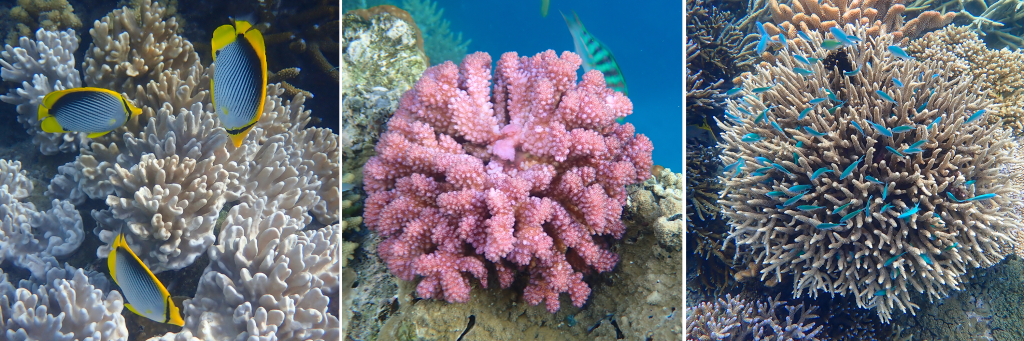
Blackback Butterflyfish with corals, Cauliflower Coral, Black-axil Chromises

If the water cools down in time, corals may allow the dinoflagellates to return. However, if the water remains too warm for too long, the corals can become permanently bleached. This is because corals obtain up to 90% of their energy from their symbiotic plankton and often die when that energy source is lost.

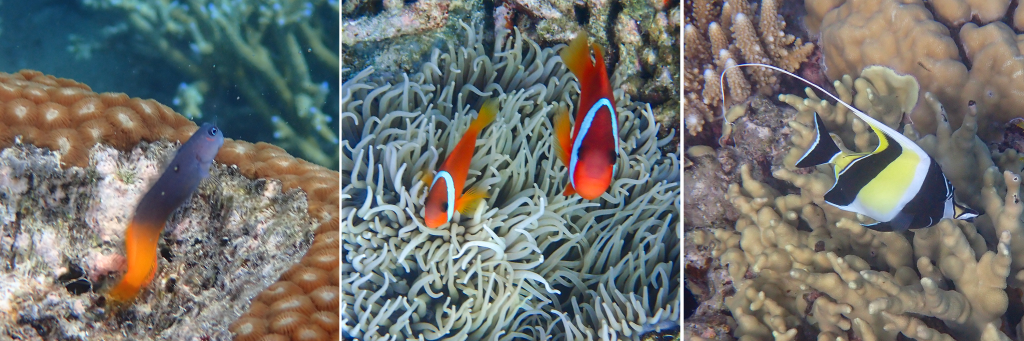
Bicolor Blenny, Fiji Tomato Clownfish, Moorish Idol

Coral reefs cover less than 1% of the ocean floor, yet they are among the most important ecosystems in the ocean because they serve as nurseries for many species. They provide shelter and protection where young organisms can hide and grow until they are large enough to fend for themselves.

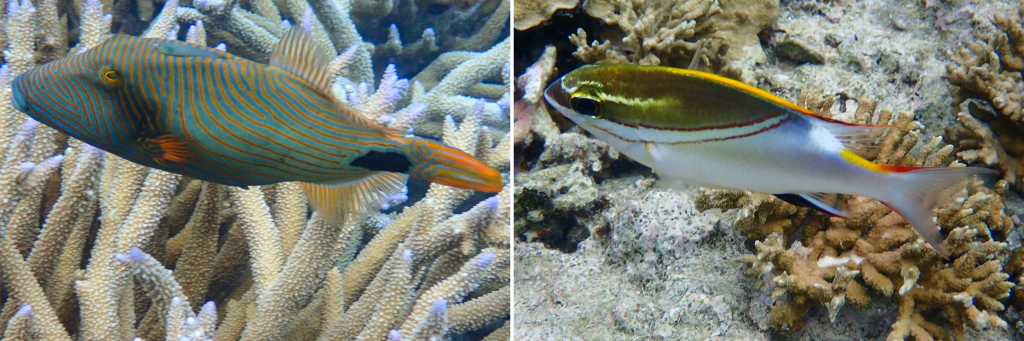
Orangestripe Triggerfish, Bridled Monocle Bream

Corals are considered to be foundation species, because the entire coral reef ecosystem wouldn’t exist without their skeletons. These animals create an area that allows all these other organisms to thrive.

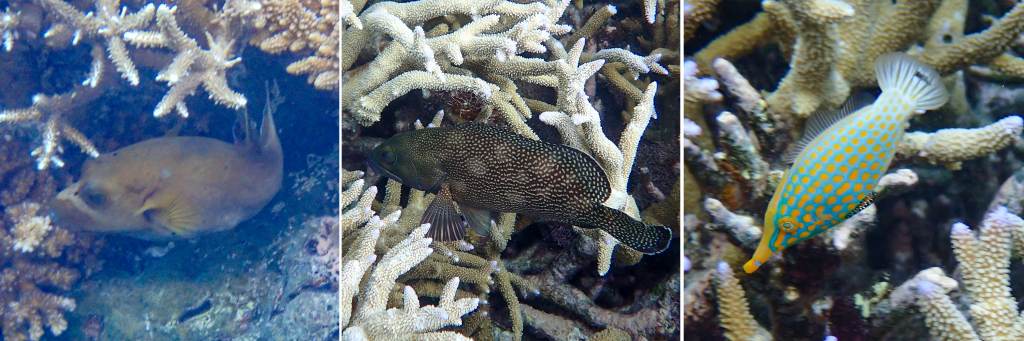
Blackspotted Puffer, Specklefin Grouper, Longnose Filefish

The corals in these photos are part of a Marine Protected Area. In this case, this means that people cannot fish or remove species from the area. As fish and other organisms mature within the MPA, they gradually move into surrounding waters, where they can help repopulate other regions or become part of the food web for humans and other animals. Marine Protected Areas allow organisms, especially fish, to grow large enough to reproduce and sustain future generations.

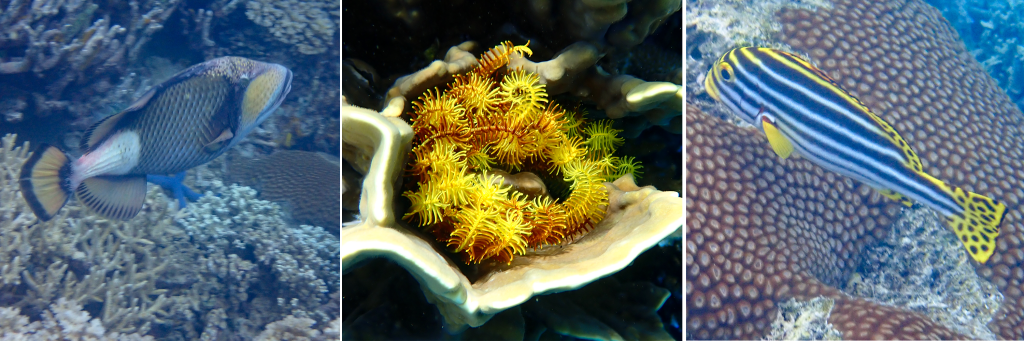
Titan Triggerfish, Bushy Feather Star, Oriental Sweetlips

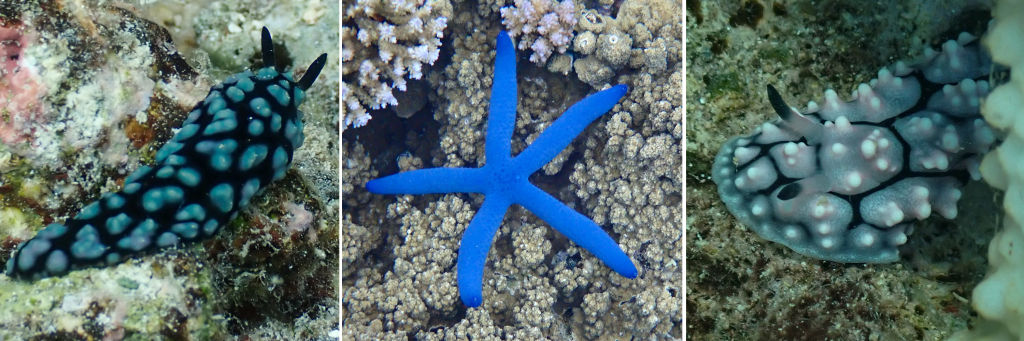
As always, I went out looking for nudibranchs, and although there weren’t very many, I did manage to find a couple hiding between the corals.

Pustulose Wart Slug, Blue Linckia, Krempf’s Phyllidiopsis

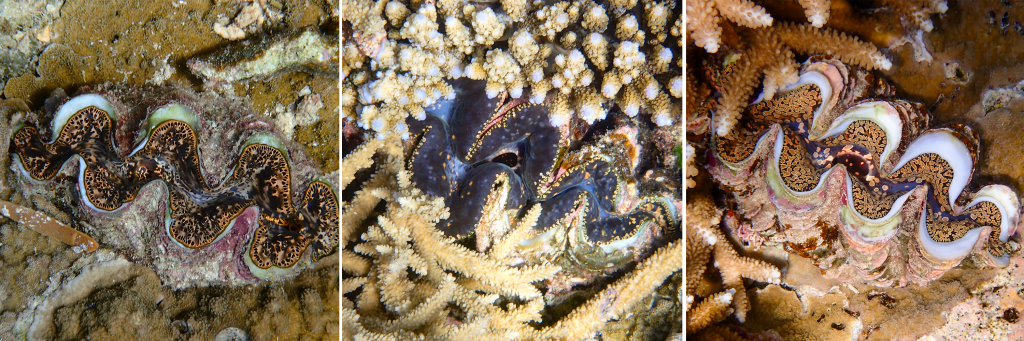
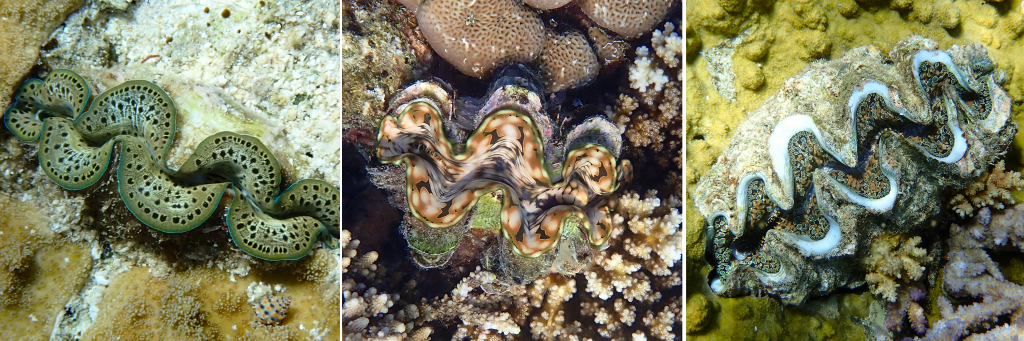
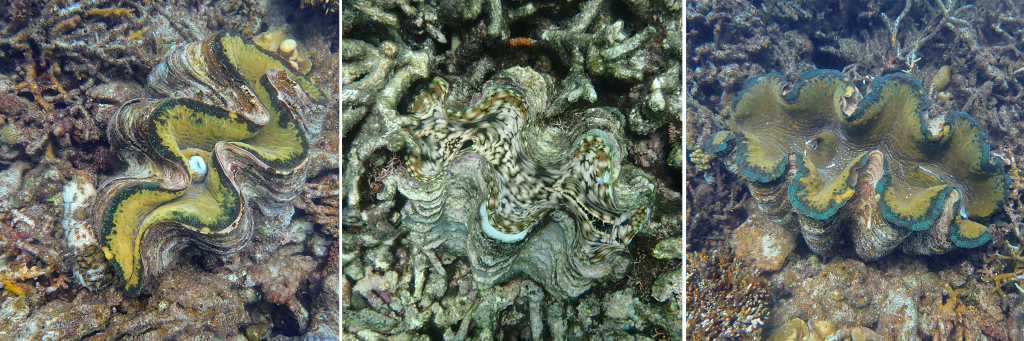
Giants clams of all kinds continue to be my other favorite invertebrate find. The patterns on their mantles are intricately colored and vary dramatically between individuals.

Gigas Giant Clam, Fluted Giant Clam, Gigas Giant Clam

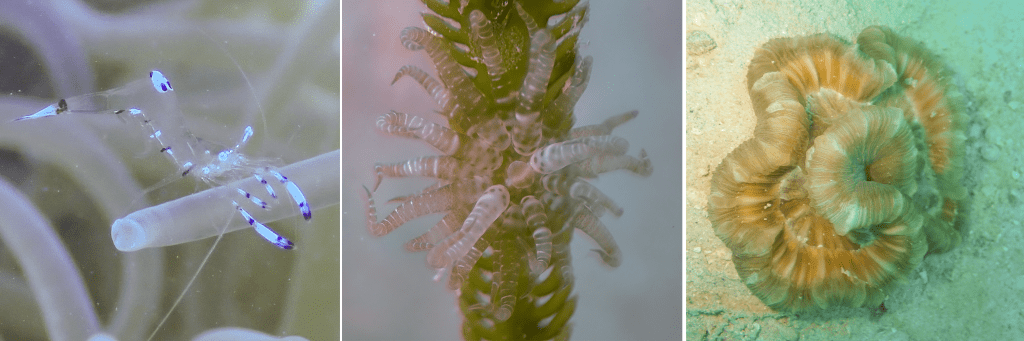
I had heard rumors of some tiny nudibranchs down in the sandy bottoms, so I signed myself up for a muck dive. This is basically looking through sediment for weird, camouflaged organisms. I didn’t find any nudibranchs unfortunately, but I did see transparent shrimp and this tiny, patterned anemone attached to a blade of seaweed.

Sarasvati Anemone Shrimp, Swimming Anemone, Banana Coral

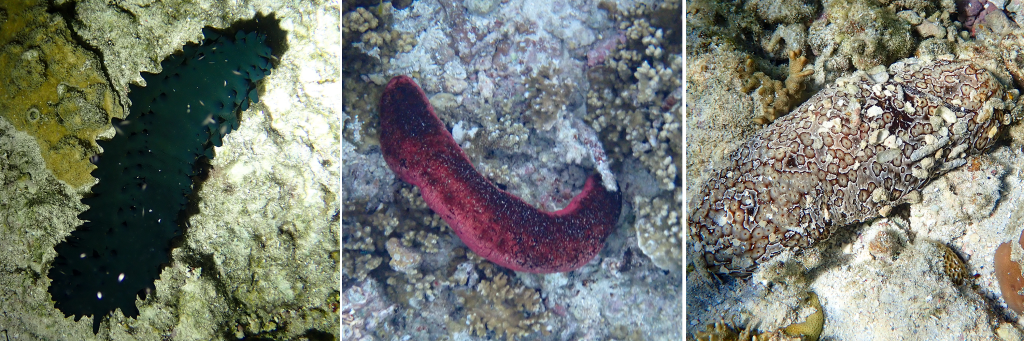
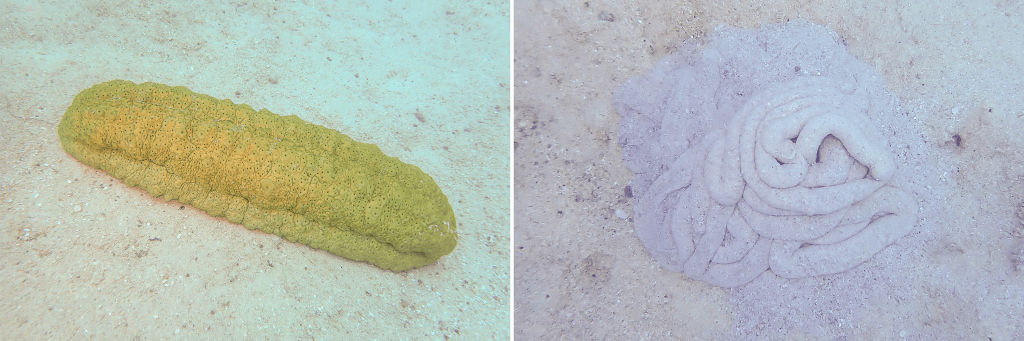
The most ridiculous muck dive find was a giant yellow sea cucumber that was over two feet long. Sea cucumbers feed on detritus (poop and decaying organic matter) from the ocean floor. They ingest sand, digest the organic material within it, and then get rid of the remaining sand out of their back end. Nearby was evidence of its recent activity, a large mound of sandy poop that was at least a foot across.

Herrmann’s Sea Cucumber (over 2 ft long), giant pile of sea cucumber poop (1 ft across)

Fiji – Yasawas Part 1

I went to Fiji in November of last year, but I’m finally getting around to writing it up. The next few posts are heavy on the photo dumps, which seems to be my default when I spend most of my vacation in the water.

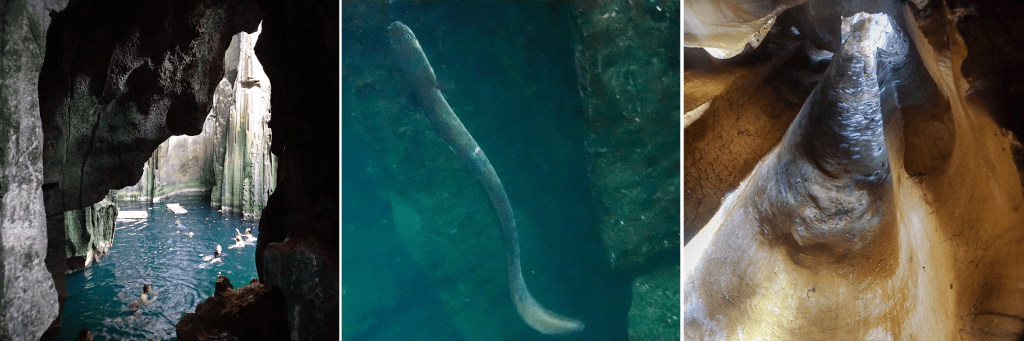
For this trip, I headed to the Yasawa Islands arc that stretches up in a curve from the western side of the main islands. At the very top are the Sawa-I-Lau caves. Tourists are only allowed in the first two caves, the rest are considered sacred and only locals may enter them. To get from the first cave to the second, guides helped me swim through a six-foot underwater tunnel. One gave me a big push while another pulled me out on the other side, so all I really had to do was hold my breath and kick. It was a bit nerve-racking going in, but easier on the way out since I could swim toward the light. This island is made entirely of limestone, while most of the surrounding islands are volcanic. For me, the most interesting part of the caves was a freshwater eel swimming in the brackish water. I asked a lot of questions about it, but no one had any answers, only assurances that it would not hurt me.

first cave, freshwater eel in the cave, cave skylight after swimming underwater in the second cave area

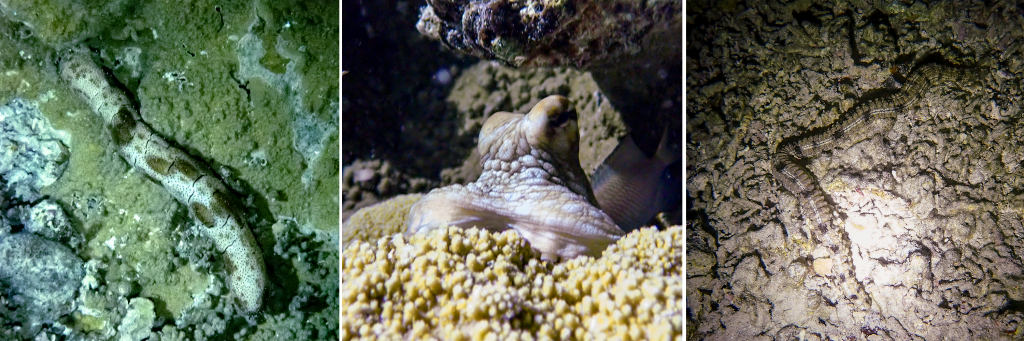
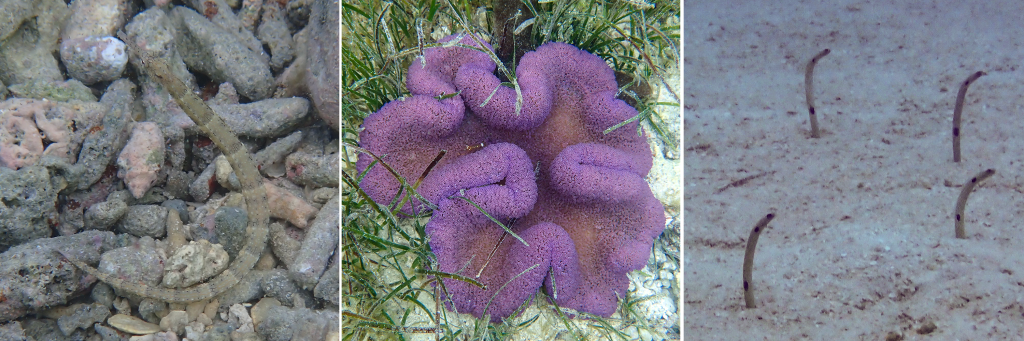
While waiting to take the boat back to the hotel, I found a cute little pipefish in the sandy bottoms. These are related to seahorses, but have a different body shape. Some people get these confused with the tiny eels that live in sandy bottoms (that I saw later on this trip), but they really do have distinctive postures and head shapes. That purple blob in the photo caught my attention too. At first I thought it was a soft coral, but when I got closer I could see it was covered in tiny tentacles. It is always fun to come across organisms that look completely different that what you expect.

Reeftop Pipefish, Haddon’s Anemone, Spotted Garden Eel

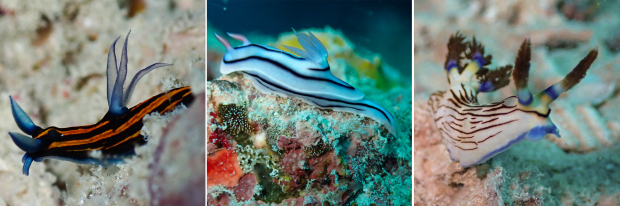
I went to Fiji because I got a great deal on a direct flight and because it’s at the very edge of the Coral Triangle. I’m always looking for nudibranchs and figured I would find a few. While there, I also decided to get my Advanced Open Water certificate so that I can dive slightly deeper dives (up to 30m / 100ft). I ended up being the only student on this trip, so I had a personal guide who helped me spot all these beautiful sea slugs. I had to learn how to do compass navigation and a variety of other skills, but after those were finished, it was all about taking cute photos of underwater life.

Slender Roboastra, Loch’s Chromodoris, Lined Nembrotha

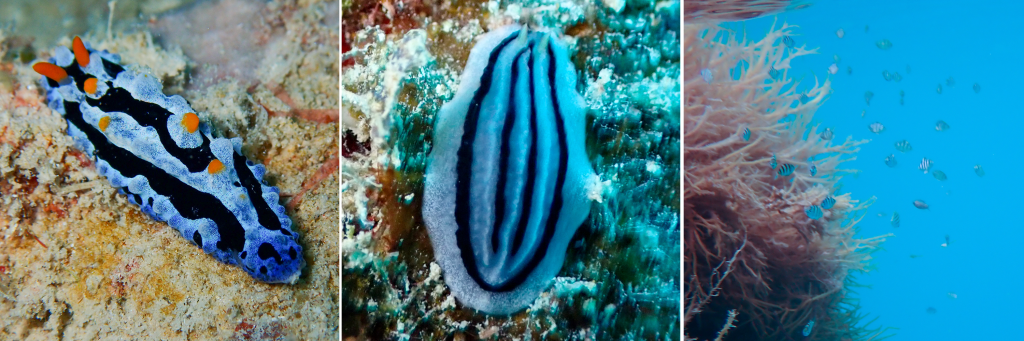
Sky Blue Phyllidia, Striped Phyllidiopsis, Baby Sergeant Major Fish

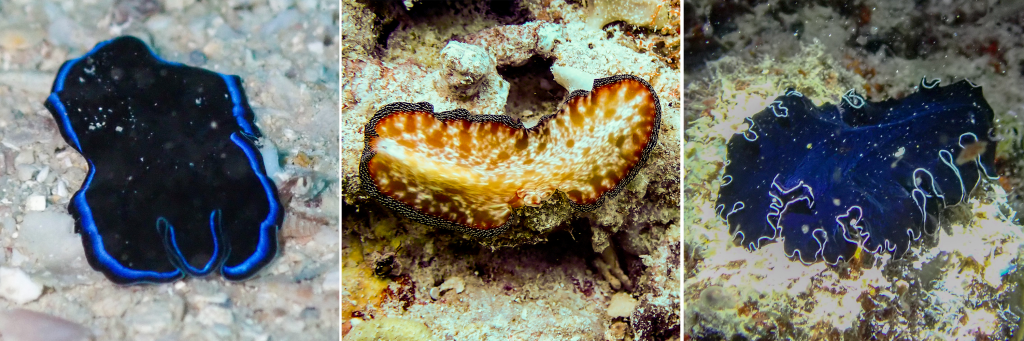
In addition to nudibranchs, there were also a bunch of flatworms which are also extremely impressive and come in a variety of shapes and colors. The one in the middle was surreal and only a few inches long. We looked it up in dive book and although the genus is known, it’s still an undescribed species (or was when the book was published).

Sapphire Flatworm, Pseudobiceros sp., Family Pseudocerotidae

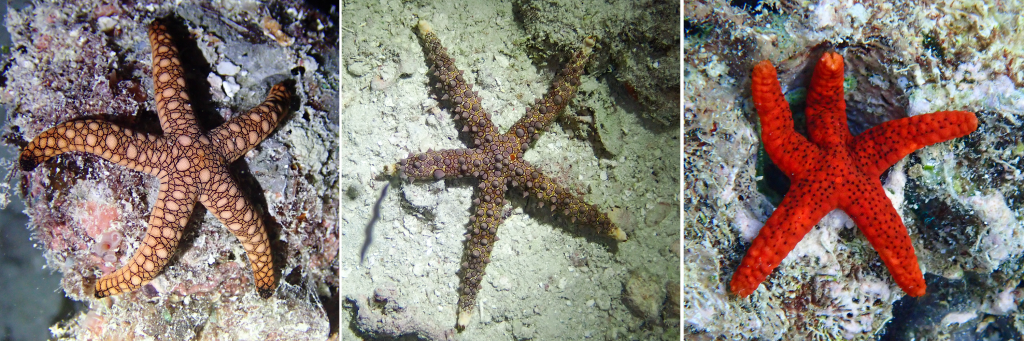
Sea stars also come in an amazing variety of shapes, sizes, and textures. All three of these were new to me!

Indian Sea Star, Egyptian Sea Star, Thousand-Pores Sea Star

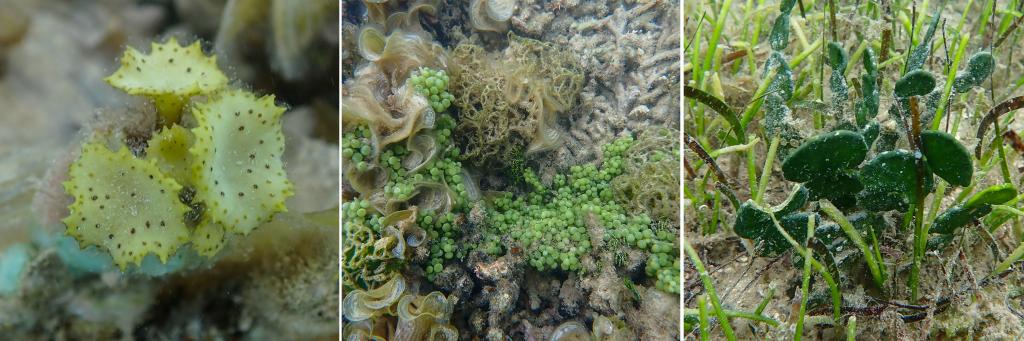
In addition to all the diving, I also did a fair amount of snorkeling. The corals next to the resort were pretty shallow and most of the days, the waves were calm. Usually I think of algae coming in red, green and brown varieties, so it was a bit of a shock to see the yellow one below. It looked like an underwater succulent in bloom. This species actually grows quite tall, but this one was just a baby. For the record, even though it was yellow and green, it does, in fact, belong to the brown algae family.

Ornate Turbanweed, Sea Grapes, Pennyweed

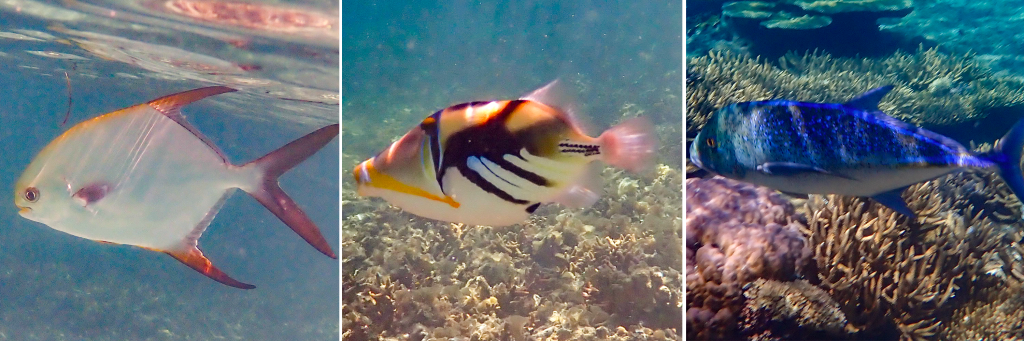
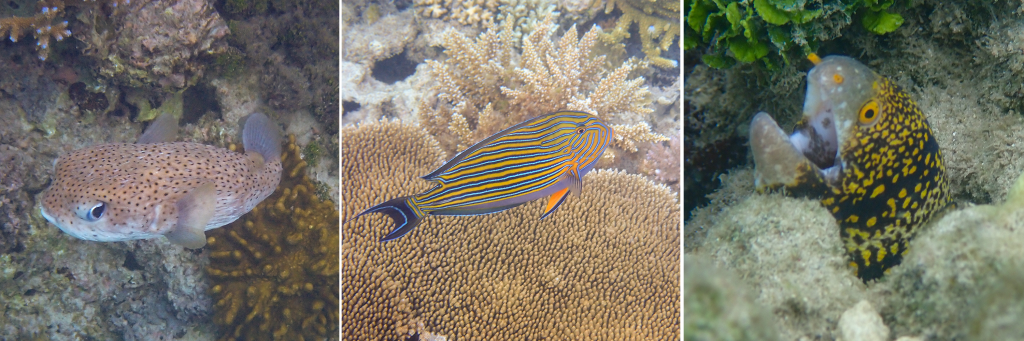
Here’s a small selection of fish from snorkeling. The more time I spend in the water, the more different species start to reveal their distinct personalities. I’ve seen porcupinefish all over the world, but they are almost always tucked underneath rocks or along reef walls. If you get too close, they retreat further into hiding, but otherwise they tend to stay in one place, quietly watching and waiting. On the other hand, flashy surgeonfish are zipping around all over the reef like they can’t stay in one place. The morays are always wedged into the rocks, mouths open waiting for something to swim by.

Spotted Porcupinefish, Striped Surgeonfish, Snowflake Moray

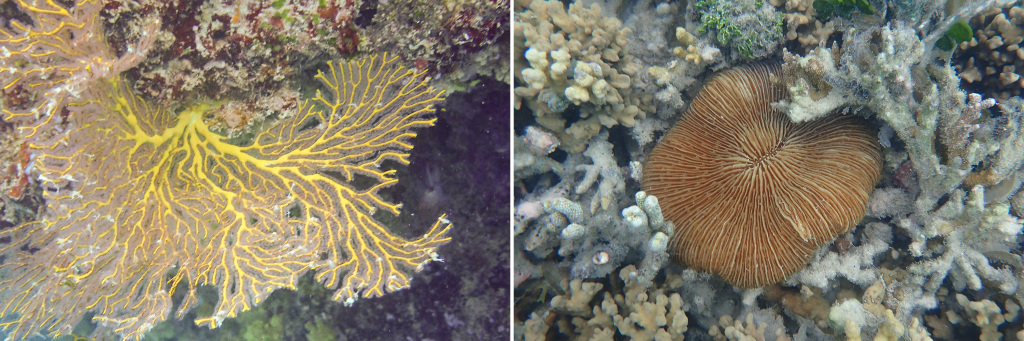
Of course, there was coral everywhere and this yellow fan coral stood out because of its bright coloration.

Knotted Fan Coral, Lithophyllon concinna

However, the star of the show was this color-changing coral. These belong to the genus Cladiella and the coral retracts its feeding polyps when it’s touched, which causes its color to change.

Blushing Corals (genus Cladiella)

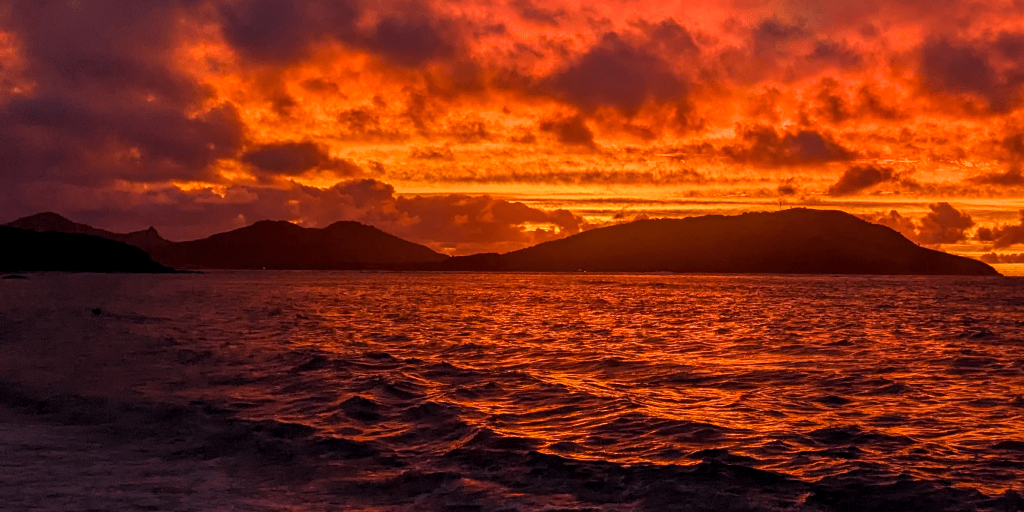
As part of my Advanced Open Water certification, I asked to do a night dive since I had never done one before. I’ve always enjoyed night snorkeling because all kinds of critters come out at night that don’t appear during the day. While waiting for my boat to be ready, the Fijian sunset was incredible. #nofilter

absolutely stunning Fijian sunset – on the way to the night dive

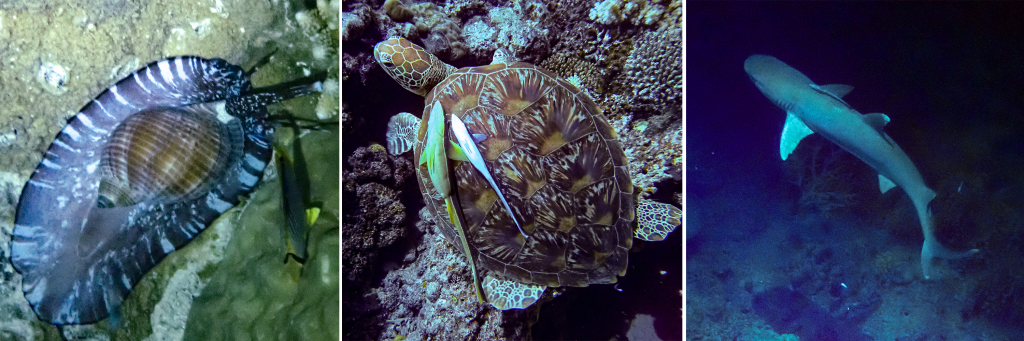
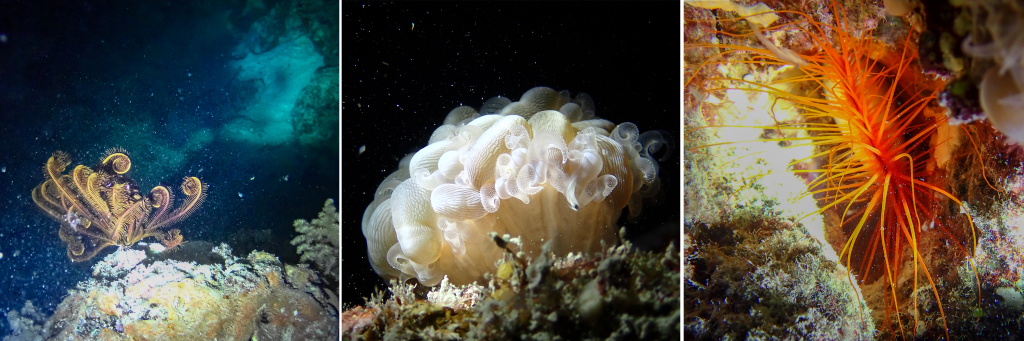
Eventually, my guide and captain sailed us over to the dive site. This was, by far, my favorite dive of the entire trip. Diving at night, illuminated only by bioluminescence and flashlights, is awesome. Here are my top three favorite photos from the dive, especially the one in the middle. Bubble coral is pretty easy to see during the daytime, but the pointy tentacles underneath only come out at night. The clam on the right is actually bioluminescent, and I wish we had turned off our flashlights to see its colors. However, to get that photo, my guide was illuminating it from below, and I was upside down, holding on to a rock, attempting to get my camera into position inside a hole. The fact that we got a photo at all was kind of a minor miracle.

Bushy Feather Star, Bubble Coral, Electric Fileclam

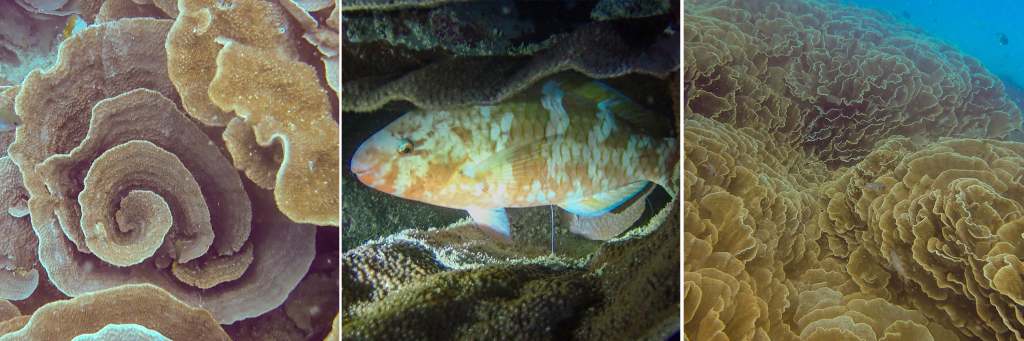
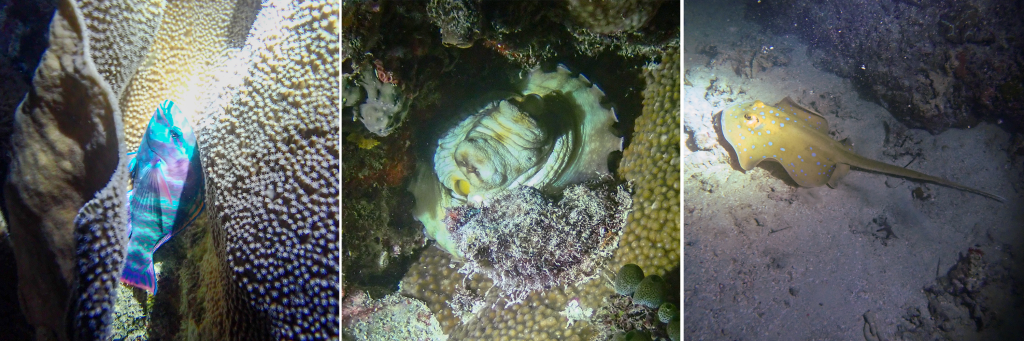
The site is called the Cabbage Patch because of the huge scroll coral. It’s hard to picture how large these piles of corals are, but the giant rosettes are easily two to three times the size of a human. During the day, all kinds of life hang out inside the whirls, but at night, the parrotfish settle in for a nap.

Cabbage Coral (a.k.a. Yellow Scroll Coral), sleeping Blue-barred Parrotfish, more Cabbage Coral

In addition to the sleeping fish, I found an octopus, which ironically is known as the Day Octopus because it’s one of the few octopus species that is actually diurnal instead of nocturnal. The manta rays also get more active at night; this one was roaming all over the place. During the day, these are usually nestled into the sand.

sleeping Yellowbar Parrotfish, Day Octopus, Oceanic Fantail Ray

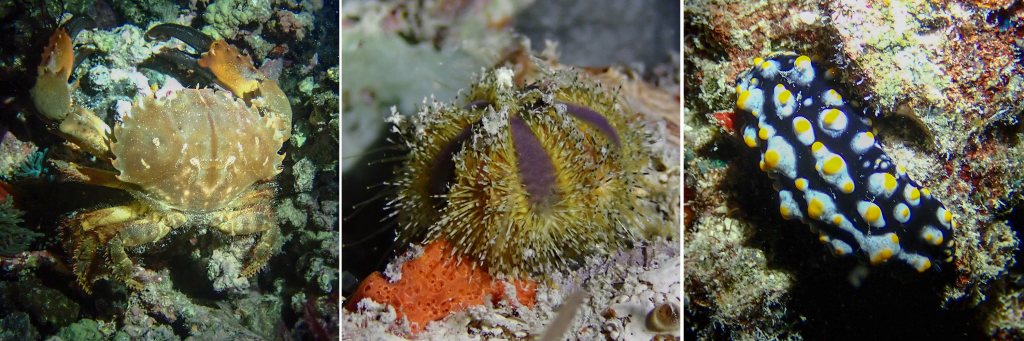
High up near the top of the cabbage coral, we found this foot-long crab crawling along as we were doing our safety stop near the surface. Earlier, I’d found the cool green and purple urchin and my guide had spotted one of the fried egg nudibranch species.

Sawedged Spooner Crab, Globe Urchin, Phyllidia Nudibranch

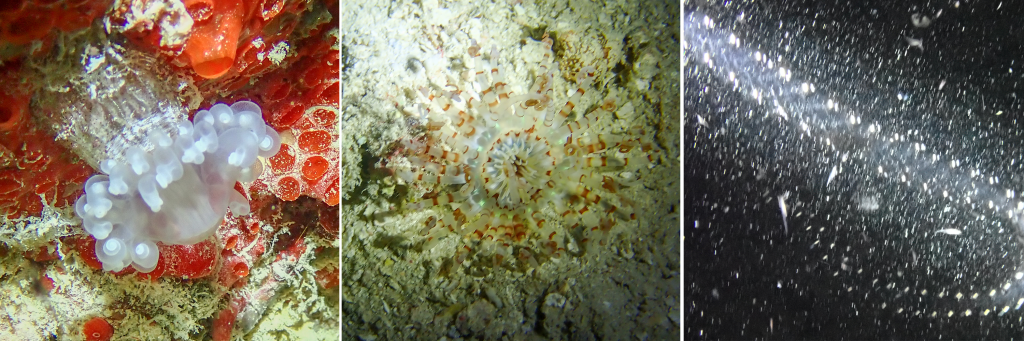
I still have no idea what kind of cnidarian is in the first picture below. It looks a lot like the tentacles on a bubble coral, but could just as easily be an anemone. If one of you knows what it is, please leave me a comment. I also saw my first night anemone. My guide didn’t know what it was, so it was fun to be able to identify something for him. Although it’s a super blurry photo, it was exhilarating to see a siphonophore up close. I teach about these in my Marine Biology class and they really are a strange group of colonial cnidarians. They are made up of multiple individual organisms working together as one colony. Some parts help it to feed, some parts keep it afloat, but all of the parts share nutrients and resources. The Portuguese Man O’ War is probably the most commonly known siphonophore, but I always imagine them looking more like the one below.

Anemone or Coral?, Night Anemone, Siphonophore

I wholeheartedly recommend night diving. It’s definitely worth the hassle and cost. Well, that about sums up my first stop in Fiji, more photos of marine life coming soon. 🙂

Fiji Wonderings

Jet-lagged and still coping with time differences, I woke up at 5am to the tapering end of a massive rain storm. I stumbled out of bed, grabbed my headlamp, and pulled my sneakers on to head out on a “mountain” hike. Mountain is truly a bit of an exaggeration for a steep hill located on a small island in the Yasawas of northwestern Fiji. Winding behind the staff quarters, I glanced up to a see a 4-inch spider hovering around her eggs high up in a web stretching from the fence to the building behind it. As I left the property, the hike headed mostly up at an angle that would’ve been challenging on a dry day, but was made even more complicated by the water running through the middle of the path. I eventually just embraced the squishy mud and started making steady progress to the top. Somewhere along the way, I noticed footsteps in the mud, sometimes in a flat shoe, sometimes with toes spread wide. Yet it seemed to be just one person walking due to the gait and placements of the steps.

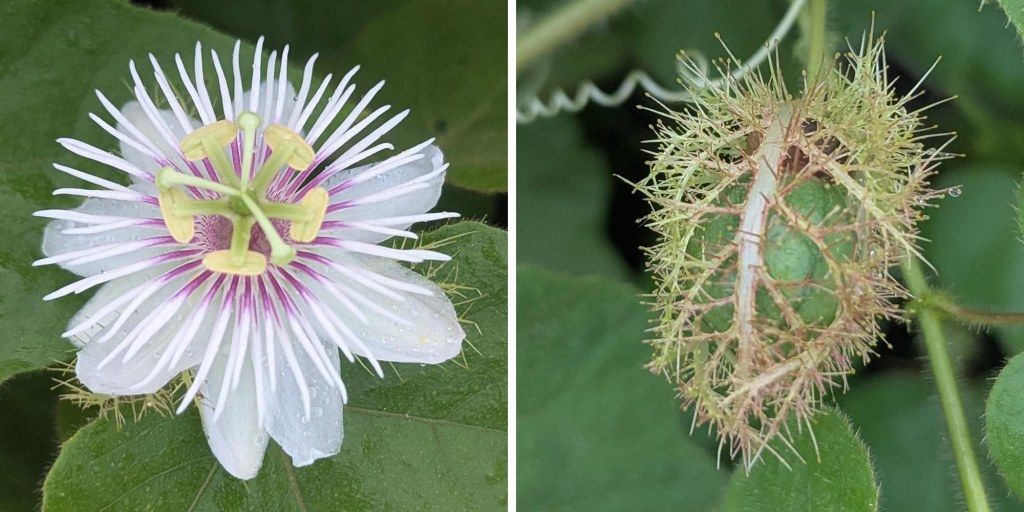
Through the cover of trees, I walked, stopping briefly to check out a passion flower plant. They all have an outer ring of rounded petals, followed by a ring of slender multi-colored petals sticking straight out. In the scientific literature, these are called corona filaments: corona like the outermost plasma surrounding the sun, filament like the tiny wire that burns so brightly in an incandescent bulb. These skinny petals form a ring around the dangling male anthers, filled with pollen, ready to be brushed away on the back of a visiting bumblebee. The hanging, sticky female stigmas are situated even higher, above the male organs, ready to hold on to pollen from other plants arriving via those same pollinators.

passion flower and passion fruit

I know this plant well since a vine of passion flower grows on my back fence at home. I was confident in my ability to recognize it, but this passion fruit was different. Instead of the round purple fruits that deflate into a squashed balloon when they’re ready to eat, this passion fruit was green and enclosed in a green cage of spiky, sticky protrusions clearly meant to protect. It looked other worldly and yet this was natural armor, created through years of gradual modifications. Whenever I see a new plant, my mind jumps to two questions: Can I eat it? Is it native? 1 Out there, on the “mountain,” I had no phone service, so I shelved these questions for later and kept walking.

I passed the one other person who climbed the mountain before me that morning. He was wearing flip flops and the footprints from the start of the hike started to make sense. When he got to the muddy part of the hill, he took off his sandals when they got stuck and tried a barefoot approach. He nodded a hello and I did the same, silently acknowledging the strange and awkward fellowship of two random people who felt the need to rise before the sun was up in order to solo climb a ridiculously muddy hill during a break in a downpour. No words were necessary, this was not the time to disturb his serenity or mine. I followed the trail towards the open ocean to the north, which was rapidly appearing in my view along the edge of the hillside.

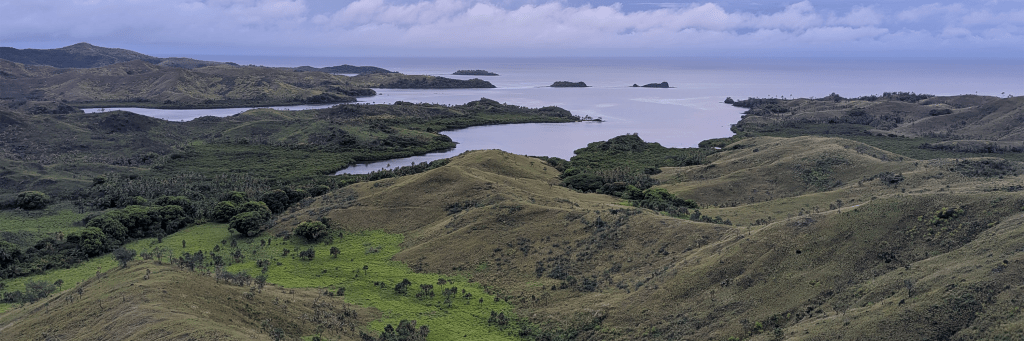
view towards the northern end of Nacula Island

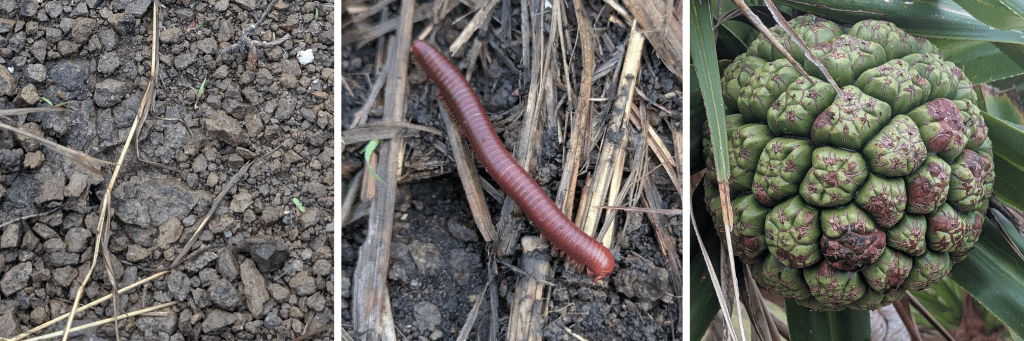
As I squatted to rest and embrace the view, I noticed the reddish brownish rock beneath my feet. Volcanic in origin, probably basalt, formed underwater and then brought up to the surface. I had more questions: How did these volcanic islands pop out of the Indian Ocean? Were they formed from hot spots or is this on the edge of a subduction zone? How long ago did this happen? 2 Curiosity is a restless creature. Once you open the gate, it carries you off with no promise of where you’ll end up.

The view over the north side of the island was stunning. The sun had risen during my hike, but it was hidden behind the clouds. The path forward looked like a solid descent to the ocean on the north side, and I wasn’t in the mood to climb back up, so I turned around and started hiking back. On the way, I saw a millipede crossing my path. Or was it a centipede? Was it poisonous? Is it centipedes or millipedes that are poisonous? I wasn’t sure what I was looking at, so I snapped a photo to identify on iNaturalist later. 3

Before I reached the steep hill back down to the hotel, I came across a hala tree which was identifiable because of its bumpy faintly-pineapple shaped fruit. They’re very common throughout the Pacific Islands because they grow in rough soil and salty environments. On a previous trip to Hawaiʻi, I’d learned that Polynesians used to weave the leaves into giant canoe sails. These were the sails that took early explorers thousands of miles across the ocean.

basalt, Rusty Millipede, hala fruit

Sometimes I just have to laugh. I had gone on this hike to clear my mind and relax. By the time I returned to the hotel, I had ten more questions that I wanted answers for. But that’s also the beautiful part of staying curious about the natural world, it keeps me present in the world around me. All the questions are both grounding and expansive, somehow at the same time. When I make a new friend, it takes an investment of time, energy and care before the other person trusts me. Meeting a place is very similar, and slowly, little by little (with a little help from the internet), it reveals its secrets.

Footnotes

  1. The type of passionflower in Fiji I saw is known as Passiflora foetida, the stinking passionflower. While waiting for the sun to go down for my night scuba, my scuba guide confirmed it is edible, but not during the season that I was visiting. This species is not native to Fiji, but is native to the southwestern United States, parts of the Caribbean, Central America and South America. ↩︎
  2. The Yasawa Islands formed about 8 million years ago as part of a volcanic island arc. They developed above a subduction zone, where one tectonic plate was forced under another. As the descending plate sank into the mantle, it released water and other fluids, which lowered the melting point of the overlying mantle. This caused partial melting and generated magma that rose through the crust and erupted first on the seafloor and later above sea level, building the islands. ↩︎
  3. It was a Rusty Millipede (Trigoniulus corallinus). ↩︎