Chichén Itzá
Chichén Itzá is probably the most famous of all the Mayan ruins in Mexico. It has been extensively rebuilt since its heyday in roughly 700-900 CE. Early in the morning, when I visited, the site is still relatively quiet. There are a few bus loads of tour groups, but the site is large and people disperse rapidly once they’re though the gates. However, by mid-day, this site is busy, busy, busy. Vendors are selling souvenirs on every path and tourists are huddled in circles around guides listening to stories.
Even with all the commotion, Chichén Itzá is stunning. The work they have done to restore the ruins gives a clear impression of the power that this city-state used to possess. From the menacing platform of skulls to the giant pok-ta-pok playing field to the pyramid centerpiece, the elites of this city used strength and authority to control their subjects.
Pok-ta-pok features prominently at almost every Mayan ruin I visited. On signs, it’s often just called el juego de pelota, the ball game, in modern Spanish. The goal is to score points by getting a rubber ball (between 5-10 lbs) through a hoop positioned higher up on the sides of the playing court. There were two teams and players were not allowed to touch the ball with their hands or feet. They wore extensive gear to protect themselves and there are frequent mentions of bruised and injured players.

feathered serpent (kukulkan) head decorating the pok-ta-pok field, El Castillo also known as the Temple of Kukulkan, pok-ta-pok goal high up on the side of the wall
In Mérida, there’s a contemporary pok-ta-pok match every weekend across from the catherdral. I didn’t get there early enough to get good videos, but you can watch various YouTube videos of the sport. It looks a lot like hacky sack with a lot of sliding. The reason this sport is so important to Mayan culture is because it is a part of the Popol Vuh, the Mayan text that includes the story of creation. There are three sets of twins in the story, and the second set, Hun-Hunahpú and Vucub-Hanahpú, are invited to Xibalba to play in a pok-ta-pok match. They are defeated by the lords of the underworld and sentenced to death. Hun-Hunahpú’s skull is placed in a tree that produces gourds.
A woman named Xquic notices one of the gourds is in the shape of a skull, and when she goes to touch it, the skull spits on her hand and she become pregnant with Hun-Hunahpú’s twin sons. She leaves Xibalba to visit her mother-in-law who does not believe her since her sons are dead. However, she passes a test involving maize and then everyone believes her that she indeed is pregnant with this dead guy’s kids. Eventually the twin sons are born, they grow up, and return to the underworld to avenge the death of their father and uncle. They then become the sun and the moon and humans are then created from maize.
The Tzompantli was a large platform used for displaying skulls, most likely of sacrificed victims and prisoners of war. This one is located next to the pok-ta-pok field and some think that the losers of the game would be beheaded and their skulls would have been placed there. According to those interpretations, if you died during a game of pok-ta-pok, you skipped going to the underworld of Xibalba and headed straight to heaven. Because of this, others think that the winners were decapitated as a reward.
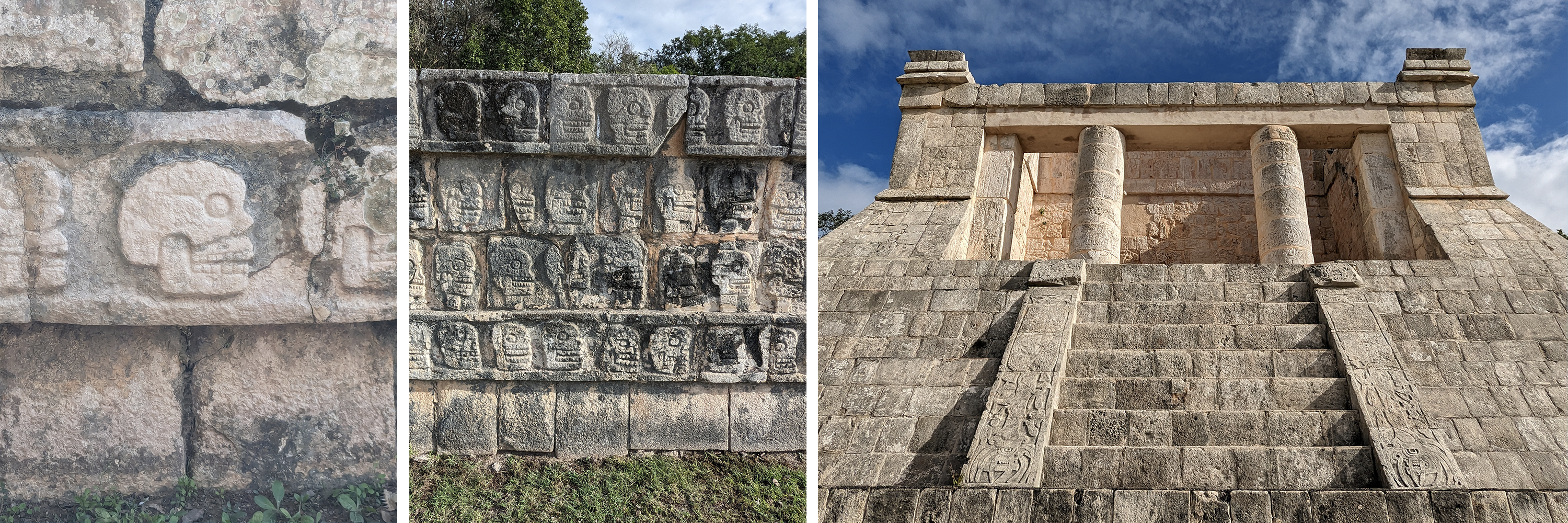
close-up of skull carving, side view of Tzompantli, Temple of the Bearded Man (named because of the carving of a bearded man)
This archeological site is huge and there are buildings still being uncovered. The Group of the Thousand Columns is a bunch of columns lined up in a grid like manner. On some of these columns, it’s easy to see carvings of warriors that would have been painted in striking colors. The whole area would’ve been covered with a roof and would’ve formed a type of passageway out of the heat of the sun. There are also at least two cenotes. The Sacred Cenote was used to dump bodies after human sacrifices and the other one was probably used as a water source for the city.

tiered building corner, Sacred Cenote, Group of the Thousand Columns
My other favorite buildings were at the end of the tour. The House of the Nuns was probably a house for Mayan royalty and its carvings are still easily visible today. El Caracol was a Mayan observatory used for tracking astronomical events. All observatories seem to be called el caracol, the Spanish word for snail, because of how the top of the building resembles a snail shell. (The tiny observatory I saw on Cozumel was also called El Caracol.)

close-up of carvings, House of the Nuns, El Caracol
Ek Balam
Apparently on a clear day, it’s possible to see Chichén Itzá from the top of the Acropolis in Ek Balam since they’re less than 40 miles away from each other. The biggest structure is the Acropolis, which is a mixture of a very tall and steep pyramid combined with a rectangular building with lots and lots of rooms. The Acropolis contains the tomb of Ukit Kan Lek Tokʼ, who was once the ruler of the town. His tomb has an awesome stucco facade with another earth monster mouth guarding the entrance.
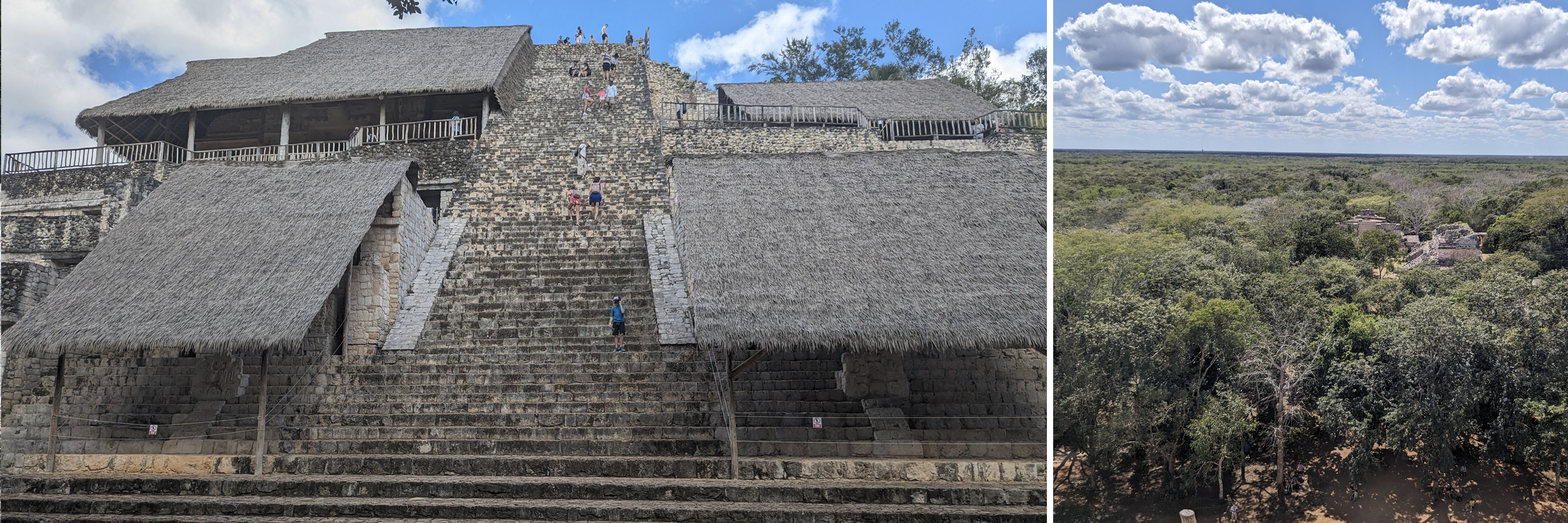
Acropolis (the tomb is under the thatched roof on the top left), view from the very top

glyphs at bottom of Acropolis, tomb opening with monster mouth, close-up of carvings
The site itself is pretty small, with an extensive set of walls encircling the city. There are four sets of walls around the city and the last one seemed have been hastily built, probably as a last ditch effort to protect the city against an invading attack.
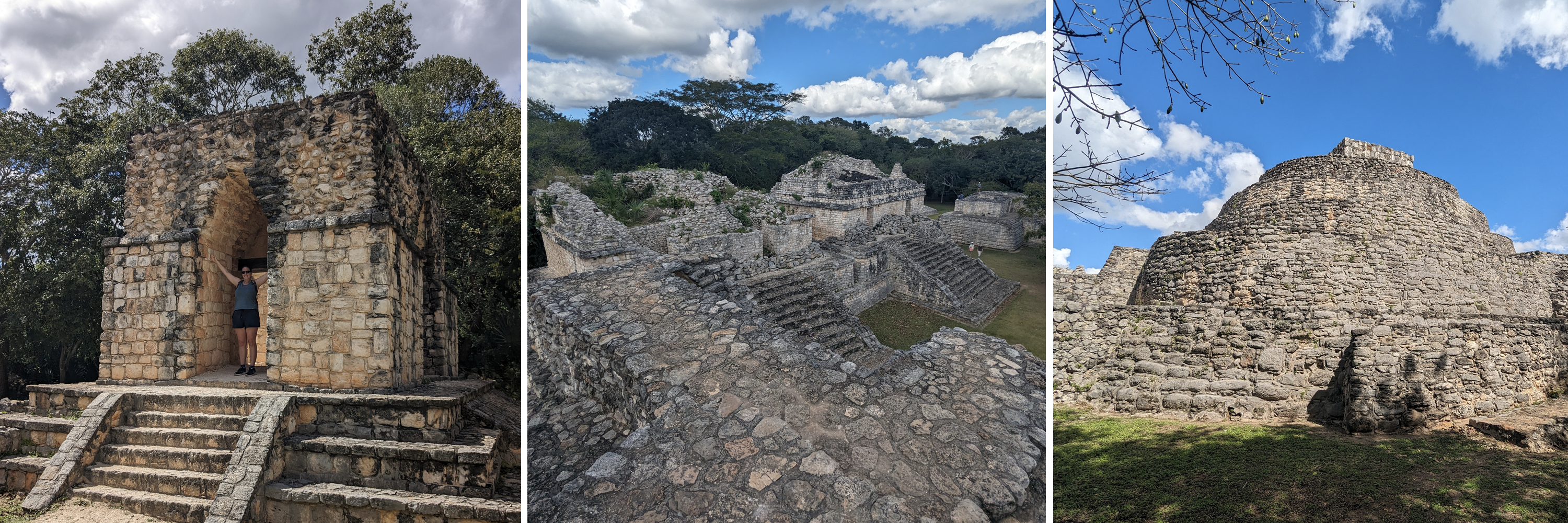
me posing with the entry gate, two buildings called the twins, view of the thick outside wall
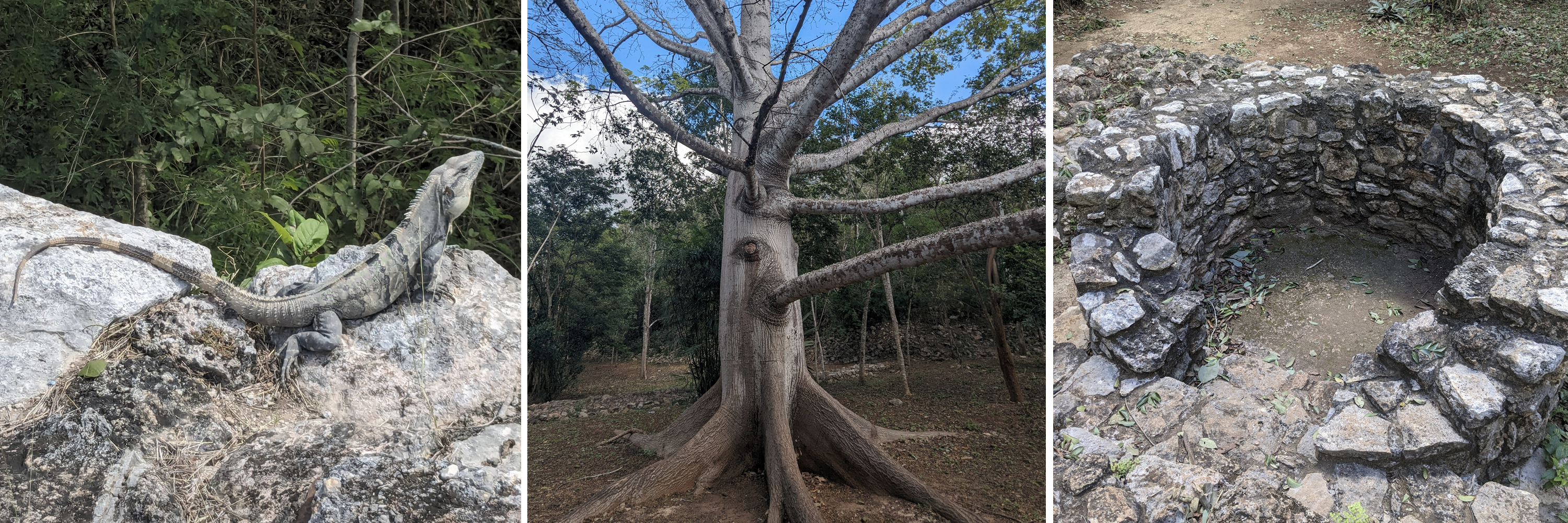
black spiny-tailed iguana, ceiba tree (central to Mayan spiritual beliefs in that it connects the underworld, the middle world, and the heavens), a steam bath
Cenote Xcanche
A short, bumpy bike ride away from the Ek Balam site, is this lovely cenote (bikes included as part of entry costs). This is an open-air cenote with awesome vegetation and a few catfish swimming around.
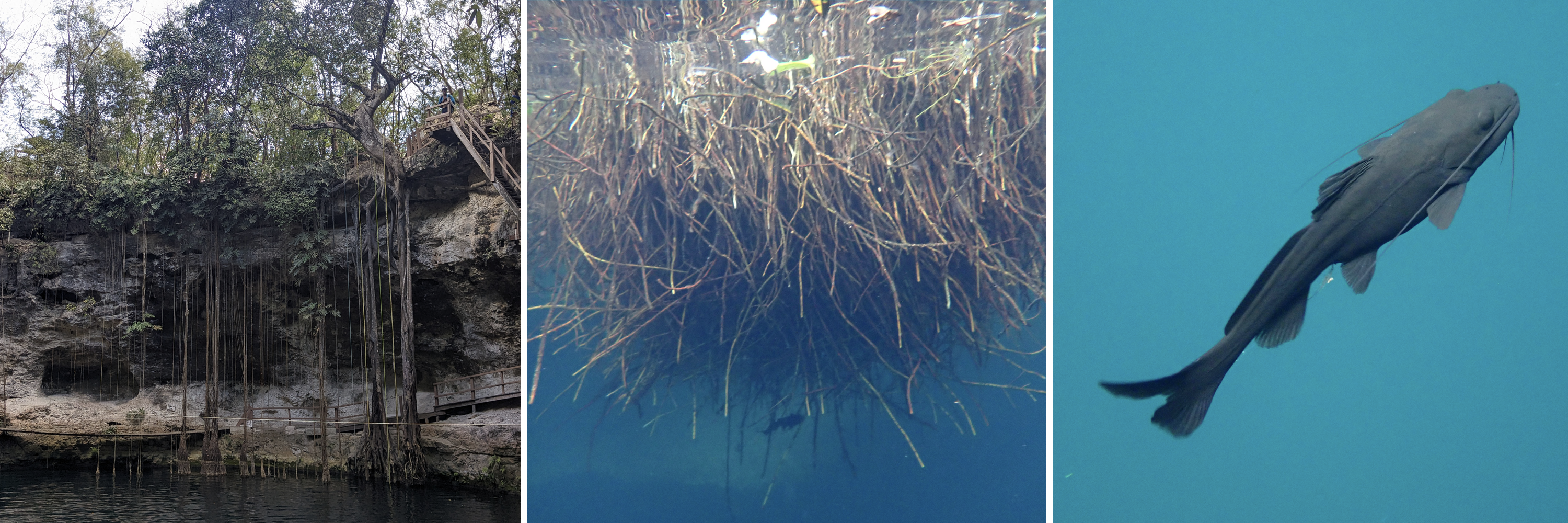
view of cenote walls plant roots underwater, pale catfish



 Meandering Marbles