Generally speaking, travelers aren’t very fond of Jakarta. The airport is a long way from the city and there is one road that goes to the city that gets backed up. Between all the cars and motorcycles and pedestrians, the traffic is overwhelming. Although there is public transportation, it isn’t easy to navigate at first and usually tourists just jump in a taxi, but then they are sitting for an hour in bumper-to-bumper traffic to get to their location. It’s hot and humid year-round. Everyone I told that I was going to Jakarta responded with horror stories.
And yet, I kind of fell in love with Jakarta (a.k.a. the Big Durian) and there was a clear moment for me when it happened. I was walking out of a big mall and there was a bunch of xylophones set up outside. A group of older ladies, carrying mallets and wearing matching blue hijabs, denim shirts, and stylish batik bottoms took the stage. They started playing “Bohemian Rhapsody” by Queen and I just marveled at the whole experience. Muslim women performing music by the very queer Freddie Mercury as a huge crowd sang along. It was so heartwarming to see the interweaving of cultures in a way that brought everybody joy. I just couldn’t stop smiling. Even now, months later, when I watch this clip, it makes me happy.
For fun, here’s a clip of the men of PINKAN Indonesia playing “Have you Ever Seen the Rain?” Watch the constant stream of scooter and car traffic in the background.
Sightseeing
I did a fair share of the normal tourist stuff in Jakarta, starting with the National Monument (also known as Monas) which celebrates Indonesian independence. Its design was inspired by a rice mortar and pestle. If you’ve been reading this blog for a while, garudas are a running theme on this trip. I found garudas on every temple in Bhutan and in church pulpits in India, and they were here on this monument in Indonesia. They feature prominently on the official emblem of Indonesia. However, the politicized version is a bit more like an eagle, than how garudas are traditionally depicted in Buddhism and Hinduism.

National Monument (Monas), golden garuda decoration outside Monas, official emblem of Indonesia
While waiting to go to the top, I visited a museum dedicated to the history of Indonesian independence underneath the monument with giant dioramas of important events in the country’s history. After my number was called, I followed a bunch of school kids in matching blue uniforms on to the elevator and up to the observation deck.

view of Jakarta from the top of the National Monument
I then walked over to the Jakarta Cathedral which has two giant spires adorning either side of the entrance. Interestingly, the Istiqlal Mosque is right across the street. The mosque is named after the Arabic word for freedom. From the outside, the mosque looks like typical 1960’s concrete block office architecture. It barely resembles a mosque, except for the pointy minaret that sticks up on one side. There are seven entrances to the sprawling complex, which allow as many as 200,000 people to worship at once. The main room for prayers was exquisitely decorated and reminded me a lot of the main worship room in the mosque in Kampala, Uganda.
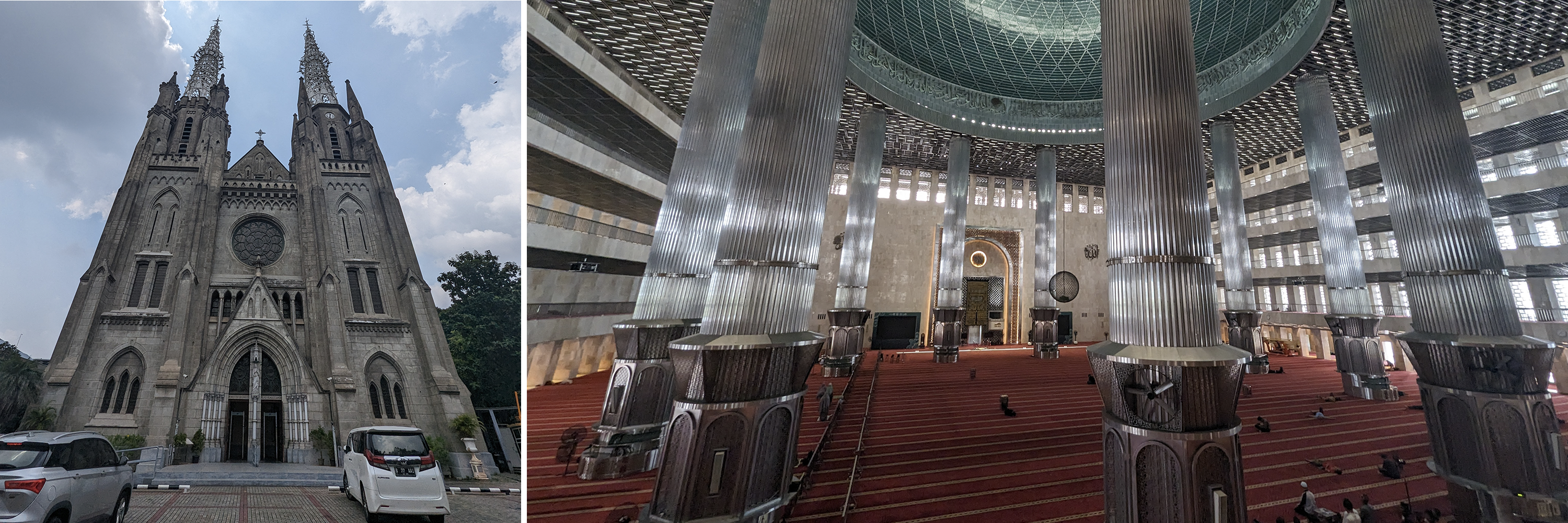
exterior view of Jakarta Cathedral, interior view of Istiqlal Mosque
Museums
My favorite museum was probably the Jakarta Textile Museum. The museum holds rows and rows of beautiful batik fabrics and weavings. At the very back of the museum in a separate building, they offer visitors a chance to make their own batik. Batik is a way of dyeing fabric by first applying wax to areas that will not be dyed. Then the fabric is dipped in color dye and removed, and then its dipped in hot water and the wax is removed. Through multiple steps of waxing and dying, very elaborate patterns can be produced.
Most complicated and large pieces are done with large stamps. However, applying the wax can also be done by hand using a batik pen called a canting. It has a small reservoir on top for holding the wax and then the artist must work quickly to apply the wax at the right angle as it flows from the pen tip.
They gave me several very simple patterns to try, but instead I, of course, picked something much more difficult and decided to draw a blue dragon nudibranch. Applying the wax was challenging since it was hard to hold the pen at the proper angle without spilling it. My original design did not have all those big dots. I added them to cover up a bunch of wax dropping in the wrong place. I think they actually enhanced my final creation. What is it Bob Ross said? “We don’t make mistakes, we have happy accidents.” This process took a long time, because I had to apply wax to both the front and back sides so the dye didn’t go through.
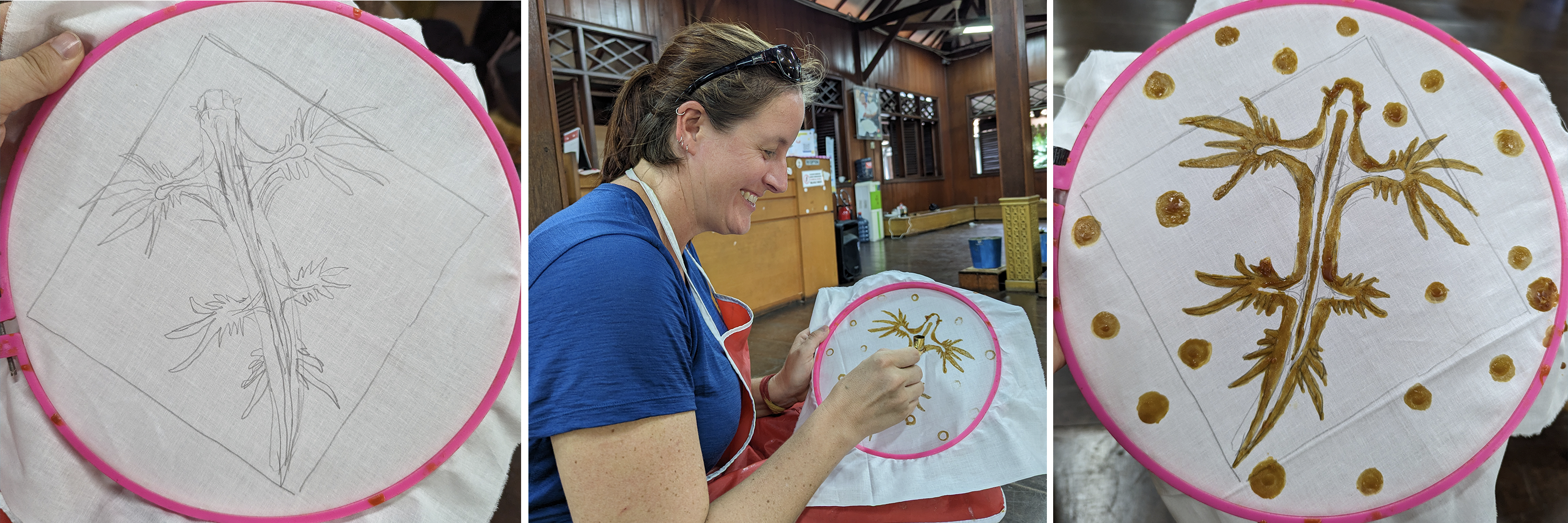
original design, me applying wax, finished wax design
After I was done, one of the artists brushed on a light coat of wax along the edges to give it that textured border. Then he stuck my fabric in the dye, then into the hot water bath, and then on a clothesline to dry. That whole process took no more than ten minutes.

dipping design in blue dye, finished design waiting to dry, sculpture of the tool used to apply wax
The other museum I enjoyed a lot was the Kite Museum. This one is a bit outside of the center, so I hired a driver for a few hours from an app and off we went. I paid for him to visit the museum too since he’d never been there and he’d grown up in Jakarta. Kites are a part of the culture of many Indonesia islands, but especially Bali where there’s a huge festival held every year where people compete for best launch, longest flight, and best design. This museum had quite a collection of rare and special kites and at the end of the tour, they taught me how to make my own.

kite with elaborate characters, dengung kite, tour guide with elaborate life-sized kite

intricate kite with black design, owl kite, the kite I made at the end of my tour
Food
Indonesian food is definitely meat heavy, but Jakarta had a wide selection of vegetarian options. I found a vegan spot pretty close to the mall where the xylophone performance was held that served a meatless marangi satay. These are skewers marinated in sweet soy sauce and other spices before being grilled.
The Istiqlal Mosque had a whole food court in the complex and while waiting for the tour, I ate ketoprak which is basically tofu, veggies, rice cake, and rice vermicelli served in peanut sauce. The lady who made this for me and I communicated entirely through gestures, but we worked it out. It’s amazing what nonverbal communication can accomplish. I also ate some roti bakar at a fancy coffee shop, which is basically just grilled toast with some kind of filling, like coconut jam and butter.

vegan marangi satay, ketoprak, roti bakar
Serabi are pancakes that originally came from Java, the island Jakarta is on. Traditional ones are made from rice flour, coconut milk, and coconut sugar. I bought these from a guy on the street who wrapped them in leaves for easy transport. They were delicious.
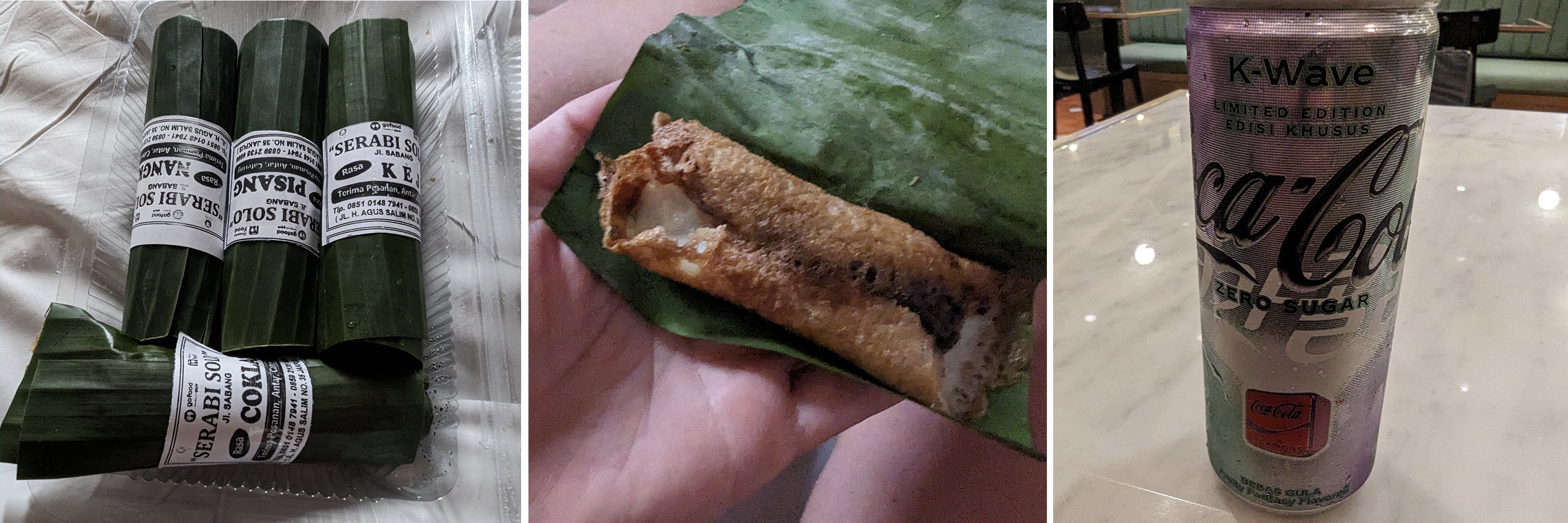
serabi pancakes (one each of chocolate, cheese, jackfruit and banana), unrolled pancake, random Coca-Cola flavor K-Wave
 Meandering Marbles