Old Goa

Velha Goa

After my yoga training, I headed back into the heart of Goa and signed up for a walking tour of Velha Goa (Portuguese for “Old Goa”). This city started out as a Muslim sultanate, but the Portuguese came in with guns ablazing and conquered it in 1510. Most of the Catholic orders sent priests here after it was conquered and each separate order set up a church. I felt, in many ways, like I was walking through an old European city. There’s a common refrain among travelers in Europe about being tired of touring churches and this is probably the only place in India where the same thing might be heard. My walking tour featured five churches that were all within a couple miles of each other. All of the churches and convents in the area are designated a UNESCO World Heritage site.

Viceroy’s Arch, old city walls dating back to the sultanate, closeup of fancy door work

St. Cajetan Church was built by Italian Catholics. Although the Portuguese initially didn’t want the Italian priests to construct a church, one of them went to Portugal and convinced the king to let them build it in the interests of spreading Christianity. My favorite part was finding a garuda carved into the pulpit. As a way of converting locals, symbols from previous beliefs and ideologies were integrated into the architecture.
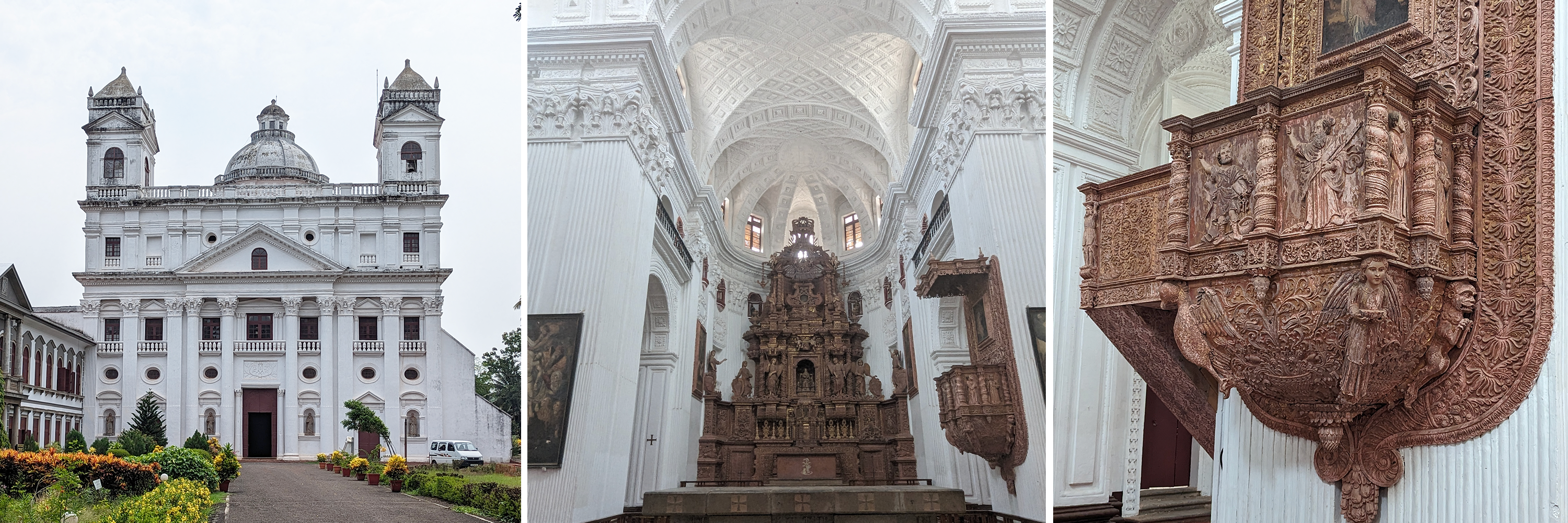
St. Cajetan Church: from the outside, big domed ceiling, upclose of the pulpit with garuda motif

The next two were both built by the Portuguese. The Sé Cathedral is known for two things: it is the largest church in India and it is unsymmetrical since one of the towers fell down and was never rebuilt. The Church of St. Francis of Assisi was built by Portuguese Franciscan priests. The doors leading into this church had fun carvings of cashew and pomegranate fruits.

Sé Cathedral, close-up of fruit motifs in door frame, Church of St. Francis of Assisi

Next up was the tiny Portuguese Chapel of St. Catherine with a lovely brick interior and a colony of bats roosting in the ceiling. Last, but certainly not least, was the famous Basilica of Bom Jesus, built by Portuguese Jesuits. It is a large, sprawling building and many believers make a pilgrimage to visit. The first Jesuit missionary to Japan, St. Francis Xavier, is entombed there.

Chapel of St. Catherine, view of the altar inside St. Catherine, Basilica of Bom Jesus

Goan Food

After the tour of Old Goa, I visited a spice plantation outside of town. I took lots of photos, but most of the plants weren’t actually fruiting when we were there so my pictures aren’t worth sharing. We did get to see kokum, cinnamon, and black pepper trees as well as lemongrass and cardamom plants. Kokum fruits are related to mangosteens and are quite tasty in juice form. The farm also offered a lovely lunch served with a refreshingly salty and sweet drink known as kokum curry and samples of cashew feni, alcohol made from the cashew fruit. To help us deal with the heat, at the end of the tour, they poured a ladle full of scented water down the back of each of our shirts. Although momentarily refreshing, it was so hot our clothes were dry less than fifteen minutes later. Indian heat is no joke.

fresh young coconut, spice plantation lunch, kokum curry, pav bhaji street food

Paro & Stupas

En Route to Paro

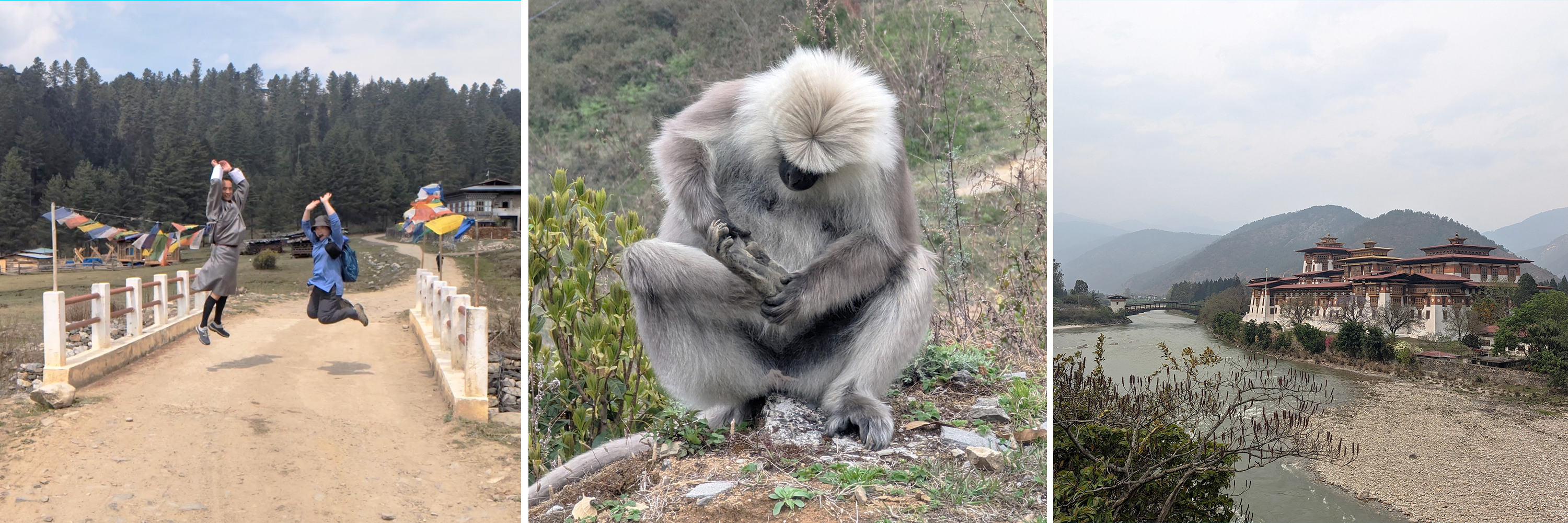
We stopped on the way back to Paro to see the Tachogang Lhakhang Bridge which was built over 600 years ago. Now it has an additional support structure, but this was forged from iron with wooden supports by Thangtong Gyalpo in the late 1300’s. This guy made over 100 bridges all over Bhutan and Tibet and this was the first ever bridge built in Bhutan.

view of bridge, up close of chain link, last jumping picture of the four of us

Paro

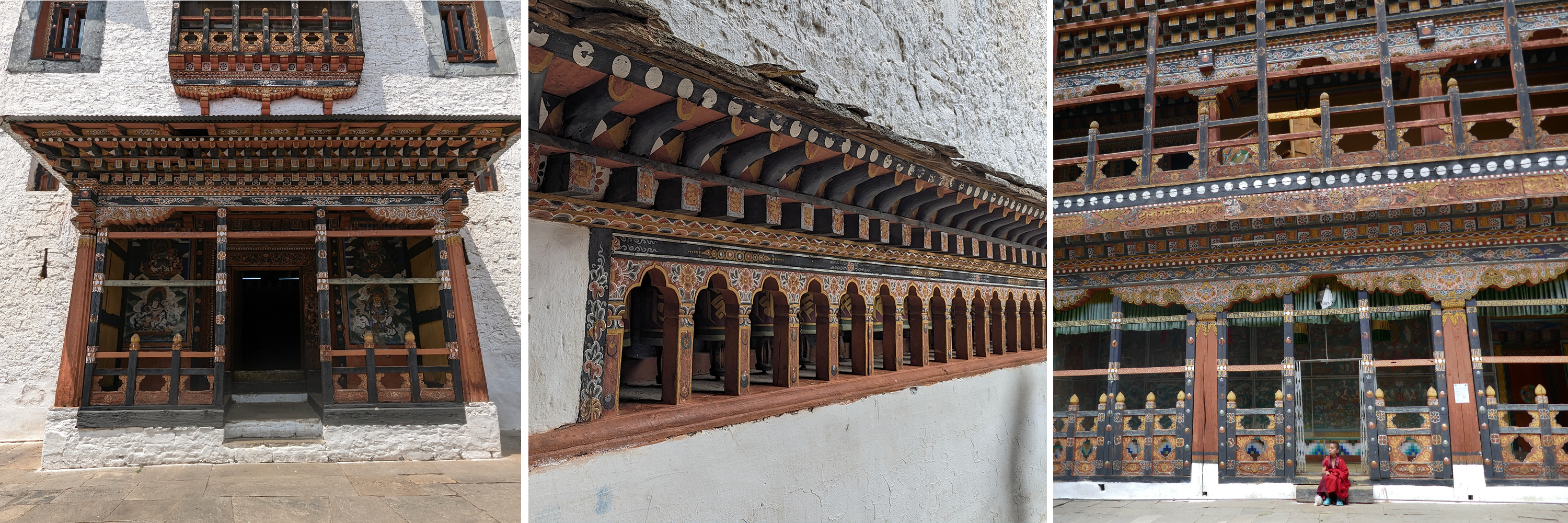
Angela and I actually did almost all of our Paro sightseeing at the beginning of the trip, but I got too excited to blog about our Eastern Bhutan adventures to write about it then. Our very first stop in the city was the National Museum of Bhutan set inside a watchtower overlooking the town. I remember feeling completely overwhelmed with all the information. There were so many Buddhist deities and Bhutanese historical figures to wrap my head around, while still dealing with jet lag from just arriving that morning. After the museum tour, we headed out to the Paro Dzong.

watchtower, Angela and the Paro Dzong, inside the Paro Dzong

This was the first dzong we visited and it functions the same way as the others we saw: part is for governmental administrative purposes and part is for monastic religious purposes.

decorations inside Paro Dzong, row of prayer wheels, monk-in-training

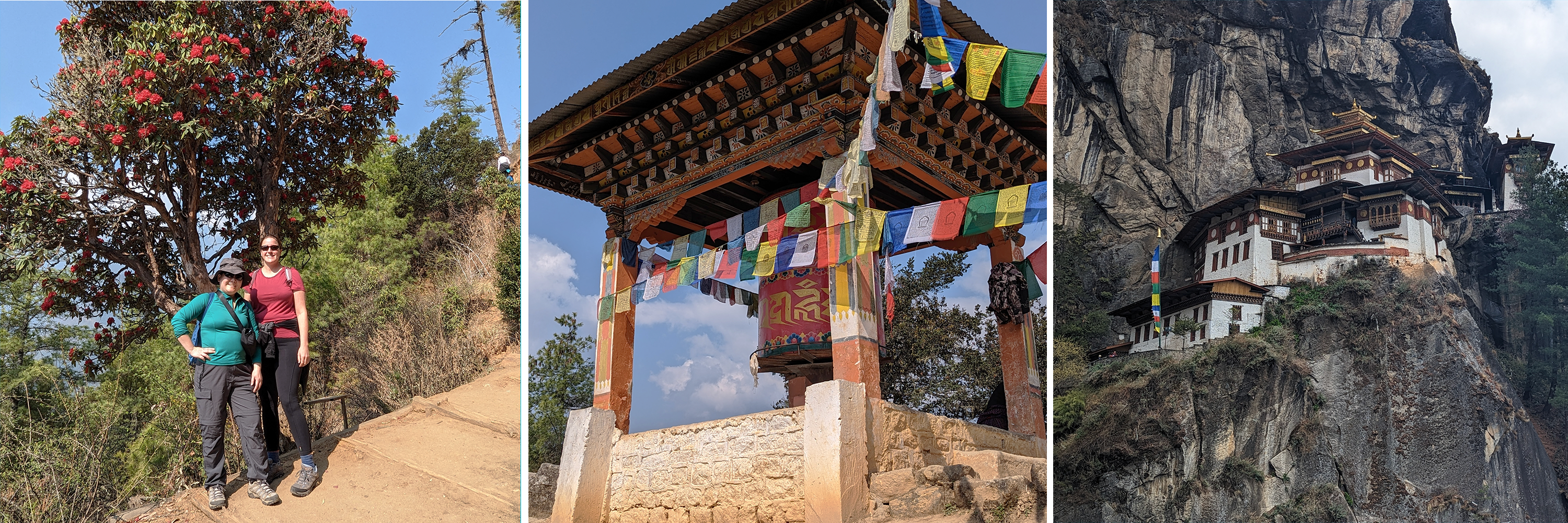
Our second day in Bhutan, we set out for one of the most notable sights in Bhutan: Tiger’s Nest Monastery. It’s built into the side of a mountain and is probably the most picturesque structure in all of Bhutan. It’s not that long of a trail (only 3-4 miles), but the elevation gain is 1500 ft and Paro is way over a mile above sea level (7200 ft). We took it real slow and huffed and puffed our way to the top. I was moving a bit faster than Angela on the way up, so I asked Tenzin to start teaching me the numbers in Dzongkha. It seemed pretty easy at first, and I got through 1 through 5 without too many problems (chee, nyi, zhi, sum, nga). My brain kept screwing up the order of the higher numbers though, but we both managed to learn up to ten by the time the day was over.

Once we got to the top, Tenzin told us the story behind the monastery, which stars our old friend Guru Rinpoche. He came to this location standing upright (think surfing) on the back of a flying tiger. This tiger was another form of his Tibetan consort Yeshe Tsogyal. Once he arrived at this spot in the mountain, he subdued a local demon and then meditated for three years, three months, three days, and three hours in a cave, thus, the name Tiger’s Nest. The whole monastery actually burned down in 1998 (probably from an overturned butter lamp) and was carefully rebuilt to match the original.

Angela & I and our first rhododendron, giant prayer wheel en route, Tiger’s Nest Monastery

I’m including the photo below so you can really revel in its dramatic beauty. And, yes, I took that photo on my phone.

Side Note on Stupas

Stupas are everywhere in Bhutan and there are often eight of them in a row and each of them are slightly different. They represent different stages of the life of Buddha. When there is a singular stupa, it is often connected to a specific individual or a specific event that a group of people are trying to commemorate. These stupas were all new to me, so when I had wi-fi one evening, I downloaded a cheat sheet of the 8 types of stupas and then it became a game to see if we could figure out the types of stupas we saw on the road.

The easiest one to identify is Nirvana, because it has a totally unique shape than the rest, more of a bell shape. The rest are a bit more subtle, but over time, I could see the differences a bit easier. At some point I made the comment that all these versions were “stupa-fying.” I have to admit to being rather proud of my dad joke. The stupas in these photos are fancier than most and I took them on the last day’s drive near a town called Gedu in the south. Note: In Bhutan, these are also called chortens which is the Tibetan word for a stupa.

  • Lotus Blossom Stupa (characterized by lotus flower carvings on four circular steps) – This represents Buddha’s birth. When he was born, he came out of the side of his mother’s body and then immediately stood and walked seven steps, and a lotus flower bloomed in each stop he had walked.
  • Enlightenment Stupa (characterized by four levels of steps) – This represents Buddha attaining enlightenment under the bodhi tree at the age of 35.
  • Many Doors Stupa (characterized by many openings that look like gates or doors) – This represents his first teachings to his five disciples in the deer park in Sarnath, which is located close to modern-day Varanasi in India. These ideas were entrances and pathways to understanding dharma.
  • Great Miracles Stupa (characterized by a center section that sticks out further than the surrounding steps) – This represents the miracles he performed in Shravasti, where he made flames come out of his shoulders and water come out of his feet. He then made the flames and water switch positions several times.

Lotus Blossom, Enlightenment, Many Doors, Great Miracles (click on the image to enlarge)

  • Descent from Heaven Stupa (characterized by three ladders in the center of the steps) – This represents Buddha’s return from his trip to heaven. He went there to teach the dharma to his mother who had already passed away.
  • Reconciliation Stupa (characterized by four steps with equal sides) – This represents the resolution of a schism between some of Buddha’s monks. His cousin Devadatta had tried to lead a breakaway group of monks, but Buddha sent two of his disciples and the situation was reconciled peacefully with the monks rejoining the main group.
  • Complete Victory Stupa (characterized by three circular steps) – This represents Buddha, at the age of 80, agreeing to live for three months after being asked to do so by one of his followers).
  • Nirvana Stupa (characterized by the bell shaped dome) – This represents Buddha entering nirvana into a state of true peace, beyond death.

Descent from Heaven, Reconciliation, Total Victory, Nirvana (click on the image to enlarge)

Punakha to Thimphu

Last of Punakha

Before we left Punakha, we hiked up to see the Khamsum Yulley Namgyal Chorten. The terraced fields were stunning, and the monument itself is an impressive four-story affair, with a rooftop deck looking out over the surrounding area. It was built by the Queen Mother to help her son defeat any potential obstacles that he faces. Inside the monument, there are many paintings and statues of the wrathful god Vajrakilaya. This is a protector god who is usually depicted with three heads, six arms, and four legs. In two of his arms, he is holding a vajra, which is a Buddhist ritual object that represents a thunderbolt. (The Divine Madman, you might recall, named his phallus the Thunderbolt of Flaming Wisdom.) There are a lot of deities in Buddhism, and this is one of the gods I think I can now actually identify in a painting.

terraced fields of different crops, chorten, rows of stupas on surrounding wall

On the drive from eastern Bhutan, we started taking jumping photos with our guides. The first one was in front of a large monument, but then we took some on a bridge next to the Trongsa Dzong. Slowly, it became a ritual to take jumping photos whenever we found a bridge. Obviously, when we walked over the longest suspension bridge in Bhutan, we had to take some photos. We were pretty proud of these because it looks like we jumped way higher than we actually did.

Tenzin and me, Angela & Aja Pema

Onwards to Thimphu

The capital city of Thimphu looks and feels completely different than the rest of Bhutan. It was built in a meandering river valley, surrounded by hilly terrain. Unlike the quaint houses in small towns, Thimphu is full of government-subsidized multi-storied apartment complexes. Thimphu is the center of commerce and where most jobs are located. Many people who grew up in rural areas move into Thimphu to make more money than they can in their village. There are also a substantial number of Bhutanese moving abroad for educational and career opportunities. Many go to university in India or Australia and find ways to live overseas and send money home. Brain drain, the massive outward flow of educated citizens to other countries, is a real issue for modern Bhutan.

view of Thimphu driving into the city

I think one of the first times I ever heard about Bhutan was when the fourth king introduced the concept of measuring progress through Gross National Happiness. Basically, the idea is that non-economic aspects of life are as important as economic impacts (sometimes measured in Gross Domestic Product). The Gross National Happiness Index was developed to look at these other nine domains: psychological well-being, health, education, time use, cultural diversity and resilience, good governance, community vitality, ecological diversity and resilience, and living standards. Each of these domains has specific indicators and citizens are polled on their responses.

The fourth king brought the idea of Gross National Happiness to the United Nations and because of his work, the United Nations now produces an annual World Happiness Report. The Bhutanese version includes items specific to Bhutanese culture, including spiritual measures such as meditation and prayer. The UN version leaves much of this out, but basically asks people to answer how happy they are on a scale of 1-10. There is much discussion about whether there are better ways to determine happiness. However, using these metrics, Finland has been rated the world’s happiest country for several years. Out of 150+ countries, Bhutan usually ends up somewhere in the 90’s.

According to this one survey, Bhutan may not be the world’s happiest country. However, on their own index, they do continue to see positive progress from year to year, even after the pandemic. The fourth king was also responsible for overseeing the introduction of democracy. The king still serves as head of state, but in 2008, the new constitution established an elected Parliament. The country is slowly changing and opening up to outsiders and business, but the idea is to do this at a pace that allows the country to hold on to its identity and culture.

Thimphu is the center of all this change, where new and old come together. In spite of being the most populous city in Bhutan, there are still no traffic lights. At the busiest intersection in the city, a policeman directs the flow of traffic. Apparently a few were installed in 1995 but drivers ignored them, so they were removed after 24 hours.

The capital city is also home to a takin preserve. Takins are Bhutan’s national animal. The local story is that they were created by the Divine Madmen when locals asked him to perform a miracle in front of them. He said he would if he was given a whole cow and a whole goat for lunch. He devoured both of them, leaving only the bones. He then took the skull of the goat and attached it to the rest of the cow’s skeleton and then brought this creature to life. In case you’re wondering, mitochondrial DNA suggests they are closely related to mountain goats.

takin, biggest Buddha statue in Bhutan, cop directing traffic in Thimphu

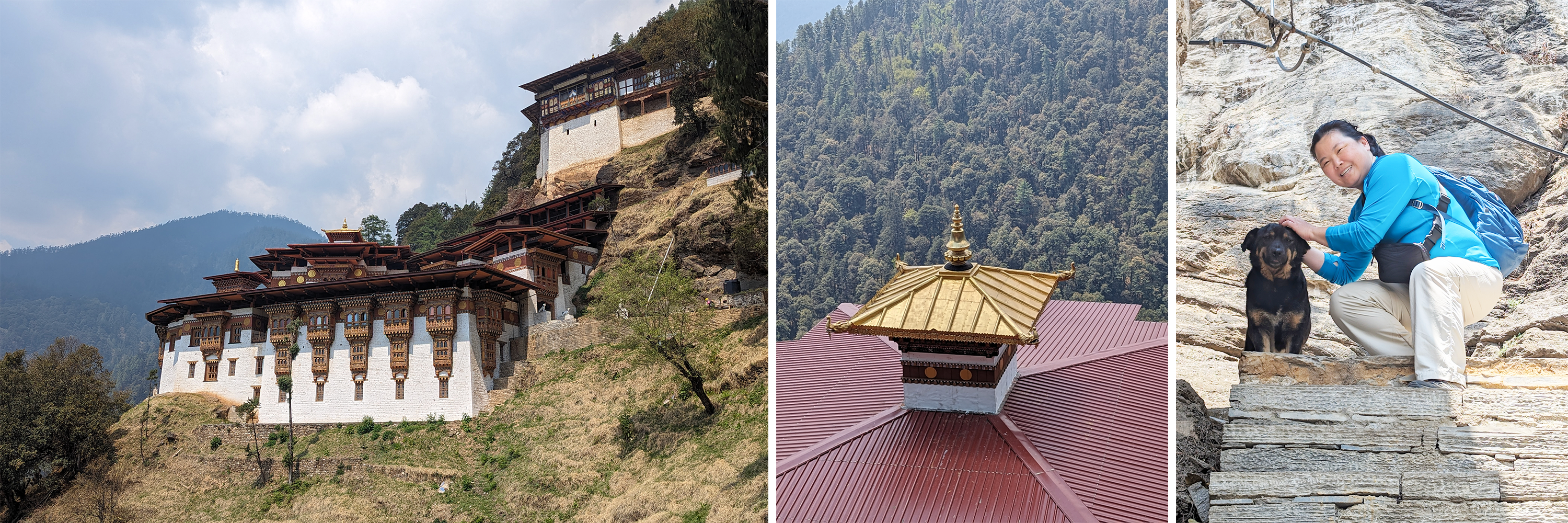
Thimphu is also home to one of the first monasteries established by Zhabdrung Rinpoche, the man responsible for uniting the eastern and western parts of Bhutan. He set up the Bhutanese government system of having both a spiritual leader (Je Khenpo) who runs the monasteries and an administrative leader (Druk Desi) who runs the government. Cheri Monastery was built into the side of a hill and it’s a pretty steep climb to the top. It recently went through a picturesque renovation, with new decorations both outside and inside.

view of Cheri Monastery, temple roof (notice the garudas on the four corners), Angela and her new friend

At the start of the hike there is a bridge. Of course, we took more jumping photos.

bridge jumps – me, Tenzin, Angela & Aja Pema

This bridge crosses the Thimphu River and there is a sign at this spot that recalls a local story. Apparently an enlightened master had seven children with his consort. In order to test the dharma of his children, he threw them into the river. Only four of them survived and were considered worthy to continue living. Regardless of that gruesome story, the view off the bridge was jaw-droppingly gorgeous. This is probably one of my favorite photos that I took in all of Bhutan.

Punakha Valley

Punakha

The last time I wrote, we were in Phobjikha Valley. After a lovely nature walk, we started our drive and our guides spotted a lively bunch of langur monkeys hanging out on the side of the road. They didn’t hang out for long, but one of them stopped to examine something stuck in its toes. It pulled out whatever was bothering it and put this toe treasure in its mouth. Apparently, tasty morsels can be found everywhere, if you’re a monkey. Eventually, we arrived in Punakha and we stopped to see the dzong, which was built on the scenic convergence of two rivers: Pho Chu (Male River) and Mo Chu (Female River).

Angela and Tenzin jumping in Phobjikha, en route we ran into some langur monkeys picking things out of their feet and eating them, the stunning Punakha Dzong

Although I think the Trongsa Dzong might actually still be more beautiful on the inside, the riverside setting of the Punakha Dzong makes its exterior more photogenic. The main temple inside the Punakha Dzong is quite large. This temple is where many ceremonies involving the royal family take place since it’s the only one large enough to accommodate all the invited guests. The outside of the temple is filled with intricate carvings and the inside is covered in paintings depicting Buddha’s life. Photography is prohibited inside all religious buildings.

beautiful wooden carvings on the main temple inside the dzong that is used for official purposes, Punakha Dzong lit up at night

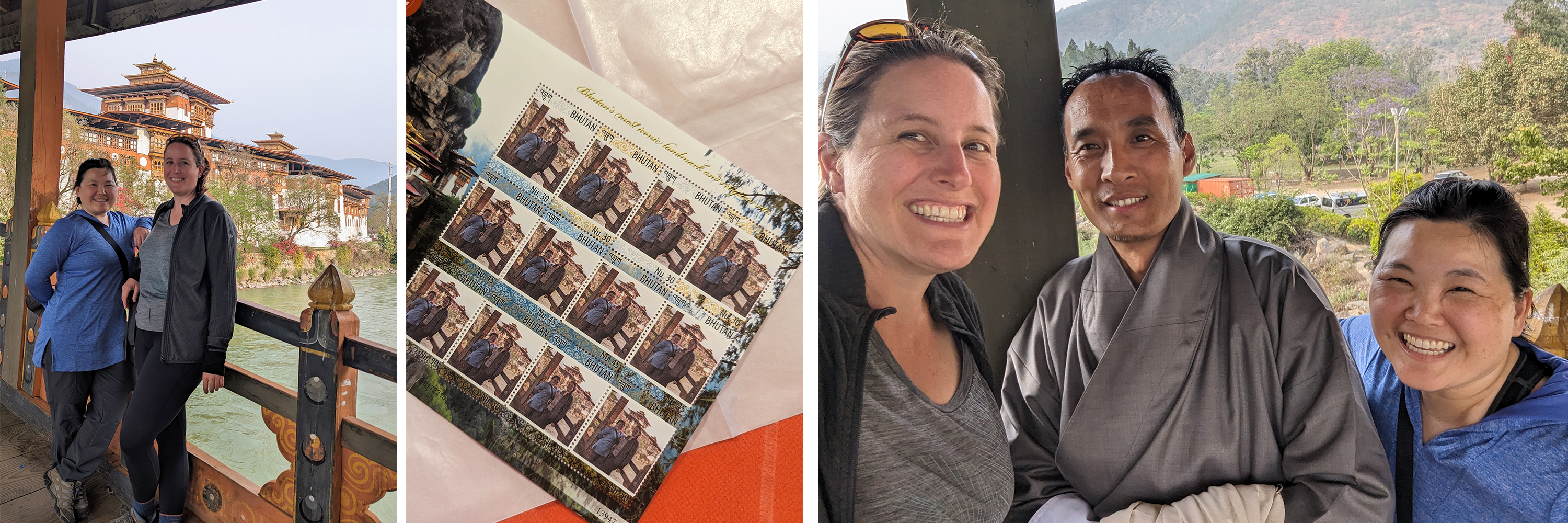
In order to get to the dzong, everyone crosses over a very scenic bridge over the river. Although we contemplated jumping on the bridge, there were a lot of people around and we didn’t want to seem disrespectful. Instead, we all posed for very tasteful photos with the dzong in the background. In the capital city of Thimphu, it is possible to have stamps made with a photo of your choice. We thought they just took a photo, but instead, we were asked to transfer a photo over from a phone. This was one of the most recent and cutest photos we had taken, so we purchased a couple sheets of stamps and a pile of postcards to send to family and friends. If you got one, consider yourself lucky, because those stamps had an extremely limited run of only 24.

outside of Punakha dzong; same photo made into stamps we sent home with our faces on them; me, Tenzin & Angela on the bridge

Divine Madman

It doesn’t take long to notice that there are a lot of phalluses in Bhutan. They’re hanging from rooftops, painted on buildings, and used to bless tourists at festivals. Of course, there’s a story behind this, and it features a notorious monk named Drukpa Kunley, also known as the Divine Madman. He is usually depicted in paintings as having long hair, a bow and arrow, huge rings in his ears, and a hunting dog nearby. He was born in 1455 int Tibet and trained in a monastery before he later renounced his vows and took a wife.

The Divine Madman was a wandering Buddhist teacher, who started lecturing about different ways to reach enlightenment that included a lot of alcohol and sex. He used his Thunderbolt of Flaming Wisdom (a.k.a. his phallus) to subdue demons, in some cases by sticking it in their mouths. There are many stories about him seducing married women, and then their jealous husbands are converted to his ways and become an ardent follower of his teachings.

There are also stories of a Buddhist nun getting pregnant and having his child. However, the other nuns are jealous, but about a year later, there are a bunch of babies in the monastery, presumably from a very busy Drukpa Kunley. It’s easy to see why he’s associated with fertility in today’s Bhutan. Many people flock to Punakha to visit his temple, known as Chimi Lhakhang, to receive blessings and pray to have a child. There is an entire album of photographs inside the temple of people with their children they conceived after they visited. Those children are often given the name Kunley (after the monk) or Chimi (after the monastery).

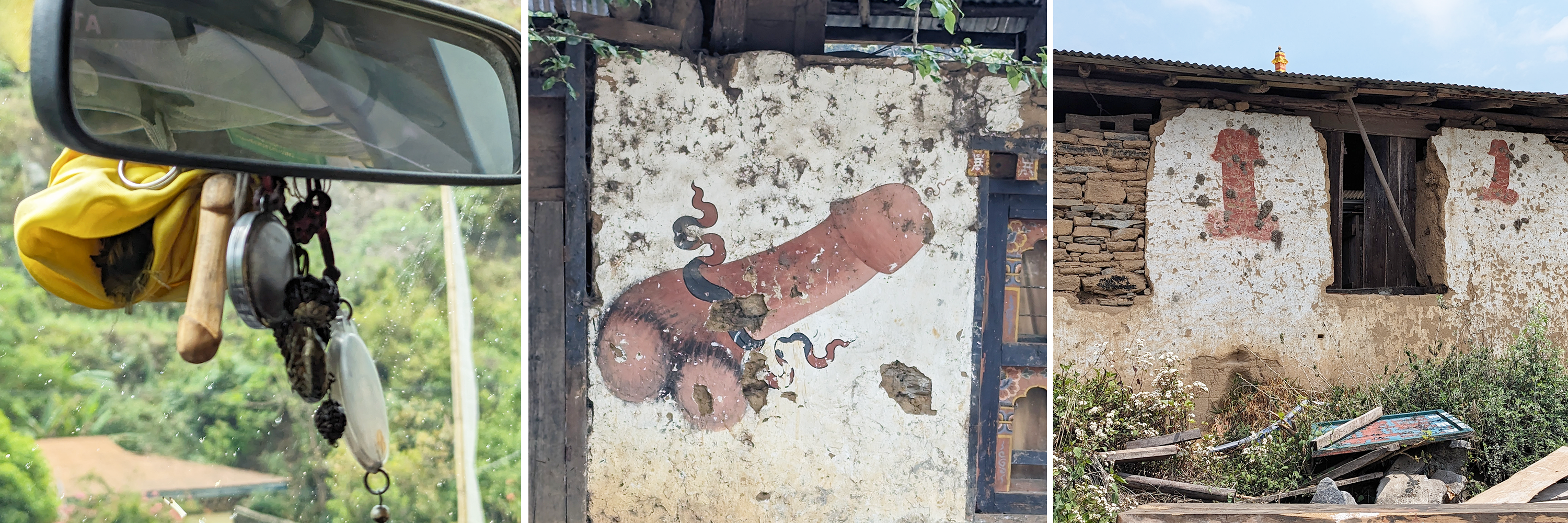
good luck phallus in the car, intricate phallus painting on a storefront, double phallus decorations in a village

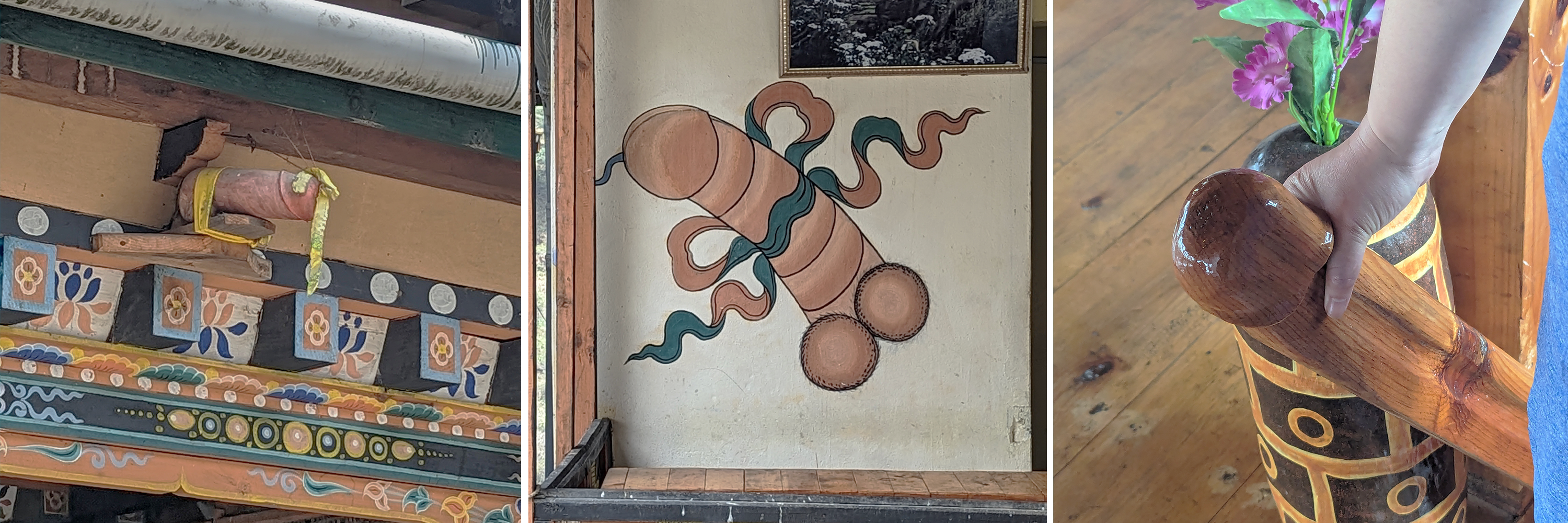
Today, the phalluses all over the county are meant to ward off evil spirits and malicious gossip. They are often hung from the eaves of the roof once a home is built. The paintings often depict phalluses with a string wrapped around the middle. Apparently, someone gave the Divine Madman a sacred thread to wear around his neck. However, he instead tied it around his phallus and said he hoped it would bring him luck with the ladies.

two crossed phalluses hanging from the corner of a house, painted phallus, handrail phallus carving

Although this phallic obsession is attributed to the Divine Madman, there’s been some research that shows that phalluses played a central role in the Bon religion, the animistic religion practiced in Bhutan before Buddhism became so widespread. Regardless of their origin, they continue to be a vital part of Bhutan’s cultural traditions today.

Bhutanese Food

Eezay

The most important part of every Bhutanese meal is a small dish of chilies, known as eezay. There are many different varieties of eezay. Some are nothing more than piles of red chilies; others are mixed with cilantro and other herbs. Often, the restaurant food caters to Western tourists that prefer their food on the blander side. I, however, prefer my food with a little more spice and by the last week of the trip, I just asked for a dish of eezay at every meal.
bag of chillies at the Paro market, old school giant mortar and pestle used for crushing chilies, side dish of eezay

Food in Eastern Bhutan

The food from our homestay in Merak was delicious. Every morning, we got thueb, red rice porridge with little cubes of paneer (homemade cheese). We also got a pile of fried red rice, a hard-boiled egg, and a cup of butter tea.

On our day-long Merak-Sakteng trek, our porters carried lunch for us and I got my first taste of my favorite Bhutanese food, nakay datshi. This is a dish made of fiddleheads, the fronds of the fern before they unravel in the spring. I’ve definitely eaten fiddleheads in the United States, but they’re pretty rare and often just sauteed in a simple butter sauce. These were cooked in a cheese sauce with chilies; something about this flavor combination is extremely satisfying. Datshi means cheese in Dzongkha and is featured in many dishes in Bhutan. For example, kewa datshi is potatoes with cheese (kewa means potato) and shamu datshi is mushrooms with cheese (shamu means mushroom). The amount of chillies in each dish depends on the preference of the chef.

Merak trek food (clockwise from left): eggs, mixed vegetables, eezay (chillies), rice, and nakay datsay; Angela getting her daily portion of thueb; drinking butter tea

Food in Central Bhutan

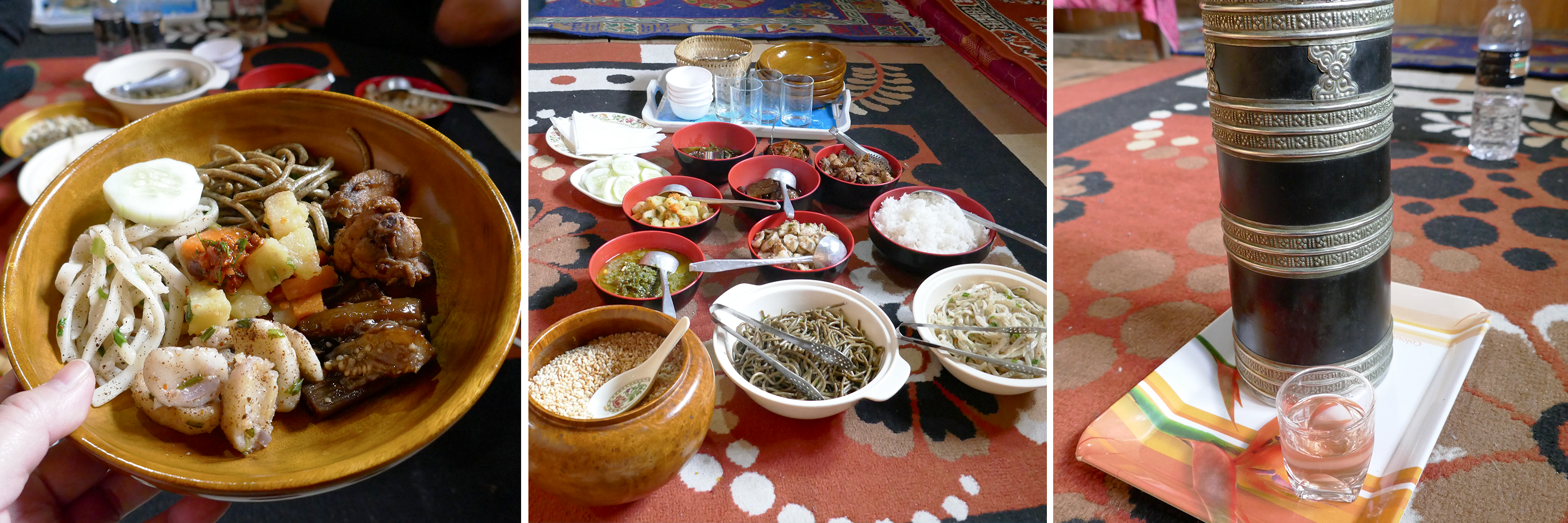
For lunch on our temple tour day, Tenzin took us to a local homestay that served a huge spread of food. We started with milk tea and then we tossed in some puffed rice (think Rice Krispies) for some added texture. Bumthang is known for buckwheat, so we got to sample long, skinny buckwheat noodles as well as two kind of wheat noodles: long, flat ones and short, fat pinched ones. We also drank some ara, the local moonshine which in this area had been brewed with sandalwood, giving it a slight pinkish tint.

Angela’s lunch plate full of noodles, the whole spread, and a traditional ara serving vessel with a glass of ara in front

In Bumthang, we also ate some delicious buckwheat pancakes for breakfast, smothered in local honey. Somewhere along the way, Tenzin figured out that Angela loves dumplings, so for a few dinners we ate a bunch of vegetable and potato dumplings. While we were in Phobjikha Valley, we ate kapchi, roasted wheat flour egg drop soup. Apparently this is a common soup to eat when you’re feeling sick and it was a surprisingly satisfying first course.

delicious buckwheat pancake, momo (dumplings), kapchi (toasted wheat soup)

Olo Choto

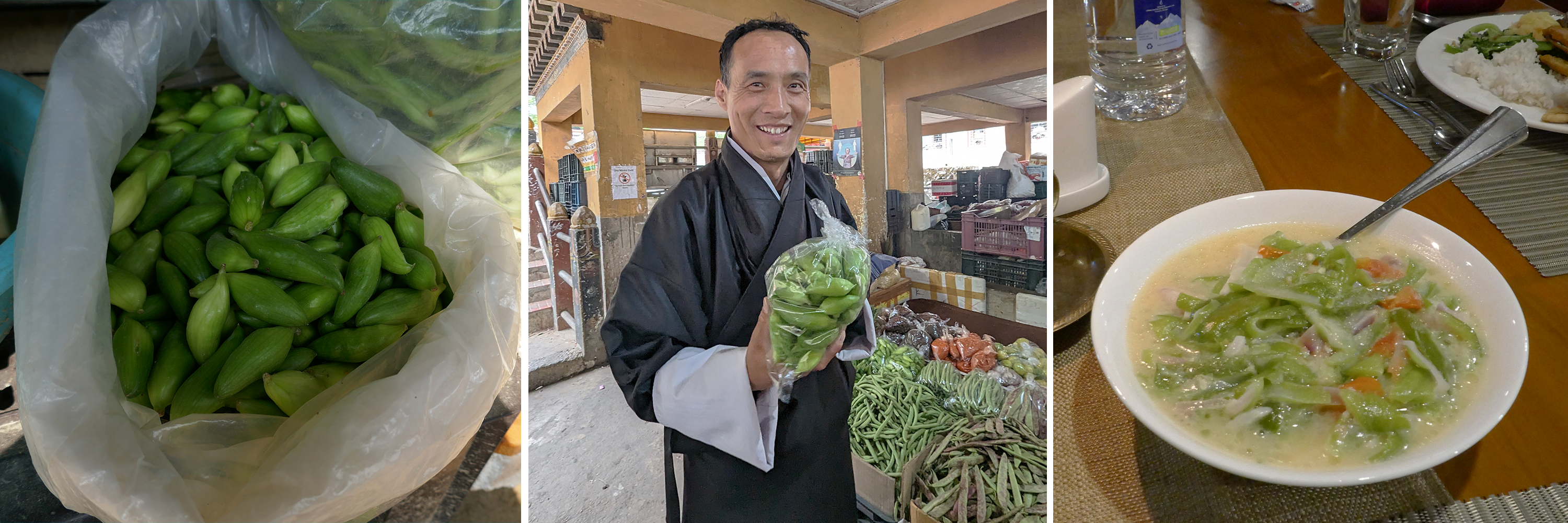
I had never seen this vegetable before in my life. Locally, it’s known as crow’s beak due to its shape. Tenzin showed it to us when we started our trip in Paro and both Angela and I had lots of questions about how people prepare it. She went down an internet rabbit hole and found out that there is a related variety that grows in Peru and Bolivia known as achocha.

We were walking through the Trongsa market and when we saw it again and we both started talking about how we wanted to try it, but it had to be cooked. Tenzin overheard us and was like, I’ll buy you some olo choto and I’ll have the hotel make it for dinner. In the car, we started discussing having an olo choto party and we were all laughing so hard. The hotel staff were kind enough to prepare the olo choto with cheese and chili. It was a delicious dinner and our guide and driver got to share in the olo choto fun as well.

pile of olo choto, Tenzin proudly showing off his purchase, prepared olo choto datshi

Best Meal of the Trip

For me, one of the best meals we had on our trip was on our way out of Thimphu. I kept asking Tenzin to find a place with some nakay datshi and he totally hooked us up. We started with a cup of milk tea (butter tea was also an option) with puffed rice (zao in Dzongkha). Then we were served a simple pumpkin soup before a bunch of different dishes arrived.

First up was ema datshi, which is practically the national dish of Bhutan. Ema means chilli in Dzongkha and this is a dish made of chilies and cheese, with different amounts of soupiness depending on the part of the country (I personally think the less soupy version is a bit better). This time of year, green chillies are the main ingredient. Next came my favorite nakay datshi, made with the seasonal fiddleheads mentioned earlier. There were also scrambled eggs, kewa datshi (potatoes and cheese), and the ever-present dish of eezay. We also were served Bhutanese red rice, which still has part of the bran left on the outside of each kernel. It has a slight nutty flavor and has quite a bit more nutrients than white rice. Interestingly, red rice is the only food item that the United States imports from Bhutan.

fiddleheads (nakay) at the market, one of the best meals we had in Thimphu (clockwise): red rice, eezay, nakay datshi, kewa datshi, eggs, ema datshi

Special thanks to Angela for providing most of the photos in this post!

Trongsa & Phobjikha Valley

Trongsa Dzong

When I started reading about traveling to Bhutan, the word dzong kept showing up over and over again in the guidebooks. The most commonly used English translation is fortress, but it’s a bit more than that. Although they originally served as fortifications, they also hold both the administrative offices for the government as well as separate sections for monasteries. In other words, dzongs run both the secular and non-secular aspects of the region. The Trongsa Dzong became one of the most important ones due to its location near the middle of hte country. Whoever ruled Trongsa (called the Penlop), controlled the taxation of goods from one part of the country to another. The role of Penlop of Trongsa is traditionally given to the heir apparent and was last held by the current king of Bhutan before he assumed the throne.

outside of Trongsa Dzong, inside of Trongsa Dzong, view from top of Trongsa Dzong

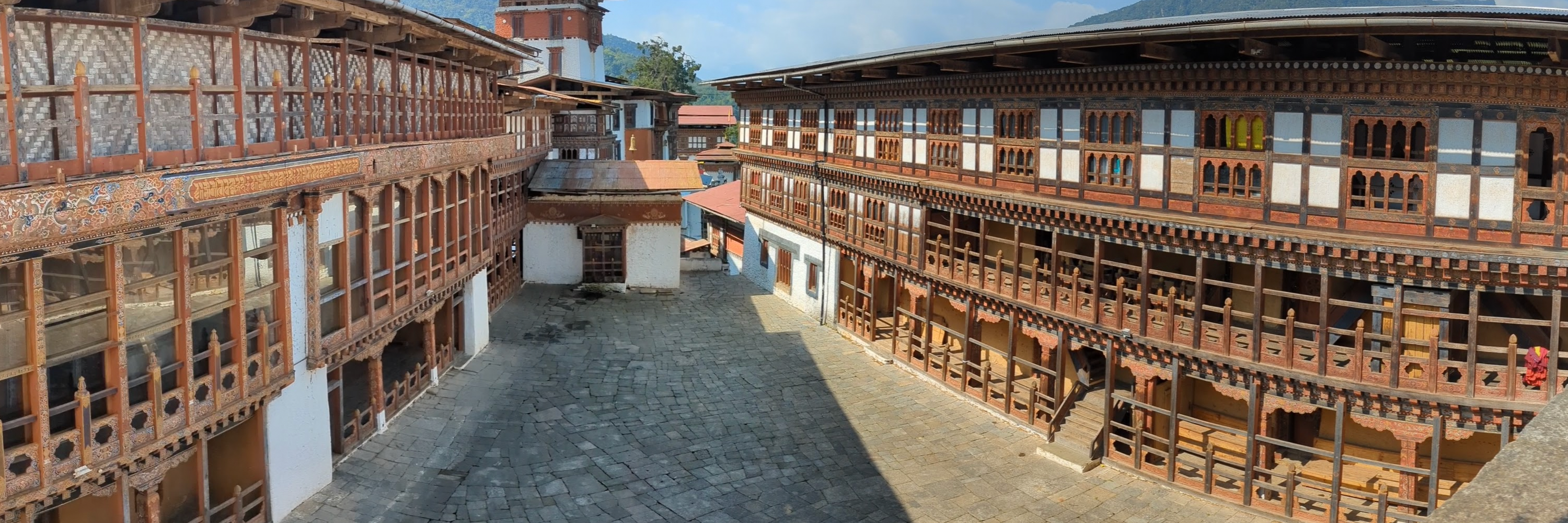
The inside courtyard is expansive. We briefly got to meet Tenzin’s uncle, who has been a monk at the monastery here for many years.

panoramic view of Trongsa Dzong courtyard

One of the aspects of Bhutan that is so extraordinary is the amount of art that is incorporated into both public and private construction. This artistry is supported and promoted by the government. Dragons often adorn the pillars of temples. Prayer bells line the outside of temple walls. The four mythical creatures are carved and painted into various motifs. The art is everywhere, and it is exquisitely executed.

details inside Trongsa Dzong: dragon, prayer bells, garuda

wood carving over a door showing the four mythical Bhutanese animals: tiger, snow lion, dragon, and garuda

Tshangkha Village

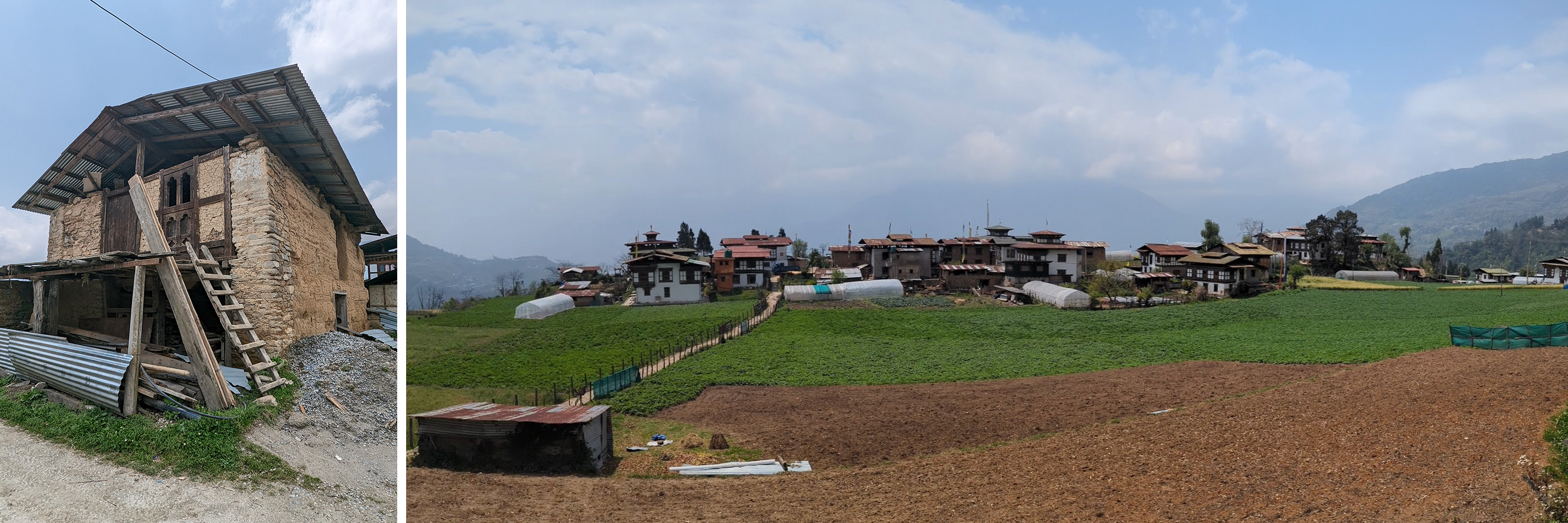
The same day, Tenzin took us to Tshangkha, the small village where he grew up. We got to meet his brother, his mother, and a bunch of other extended relatives. From the photo below, you can see it is a rather small village, with lots of fields filled with crops. Most people who grew up in the village have moved to Thimphu, the capital, which has more job opportunities. They make money in the city and then build nicer houses for the relatives that remain in the village, so there’s a lot of new construction going on in Tshangkha.

old mud house, view of village from the local temple

Phobjikha Valley

I had picked up a book of Bhutanese folktales and was reading them during our travels. One of the stories was about the fastest messenger who used to run messages from Trongsa to Wangdue for the king. He was so tired from running all the time that one day as he was running, he wished that he would die. Afterwards, as he passed by a river, he saw a woman washing the entrails of an ox in the water, but he didn’t understand how that was possible since there was no villages nearby. He completed his delivery to the king, and then promptly went to his room and fell asleep, never to wake up again. The woman was actually a demoness named Nyala who was actually washing his entrails (he was the sign of an ox). Eventually, the Nyala demon was subdued and the Chendebji Chorten was built upon its remains. I happened to read this story and then the very next day, we ended up visiting the chorten. It’s built in the Nepalese style, with eyes painted on the top of the stupa.

Tenzin also bought us to some fermented yak cheese to try, which honestly has just a faint taste of cheese to it. I mostly noticed how rock hard it was and how long it took to break down. I chewed on my cube for almost an hour and I think it took Angela at least two hours to get through hers. Good for exercising your jaw muscles, but maybe not my new favorite snack.

We took a brief stop at a black-necked crane center, which cares for two cranes that can’t be released into the wild. The migrating cranes stop here in the autumn months and fill up the entire Phobjikha Valley. There’s an entire festival for the cranes, and one of the dances involves people dressing up in crane costumes. Currently these cranes are vulnerable, but not endangered. I also learned there are only 15 different species of cranes around the world (I think I’ve seen at least 3 in the wild).

Chendebji Chorten (where Nyala was subdued), fermented yak cheese, black-necked crane

Gangtey Goemba

Most Buddhist temples in Bhutan are overseen by the government-supported Commision for Monastic Affairs headed by the Je Khenpo, basically the chief monk. However, there are still a few that are privately operated and this is one of them. Pema Lingpa (the chainmail-making, treasure hunting guy from the last blog post) visited this area and prophesied that his descendants would build a monastery here. His grandson actually built the first monastery, but is has been expanded several times over the generations. Fun fact: the current royal family actually traces their ancestry back to Pema Lingpa.

This monastery is located quite close to the nesting cranes of the aforementioned black-necked cranes. People say that they circle the monastery three times when they arrive and then repeat these three circles when they return to Tibet to breed in the summer. It gets quite a few visitors and went through a long renovation, where the paintings inside were redone and the outside decorations spruced up. Photo taking is only allowed outside of temples, out of respect for religious practices. Click on the photo to enlarge it to see all the fantastic details.

beautiful prayer wheels and temple decorations

Central Bhutan

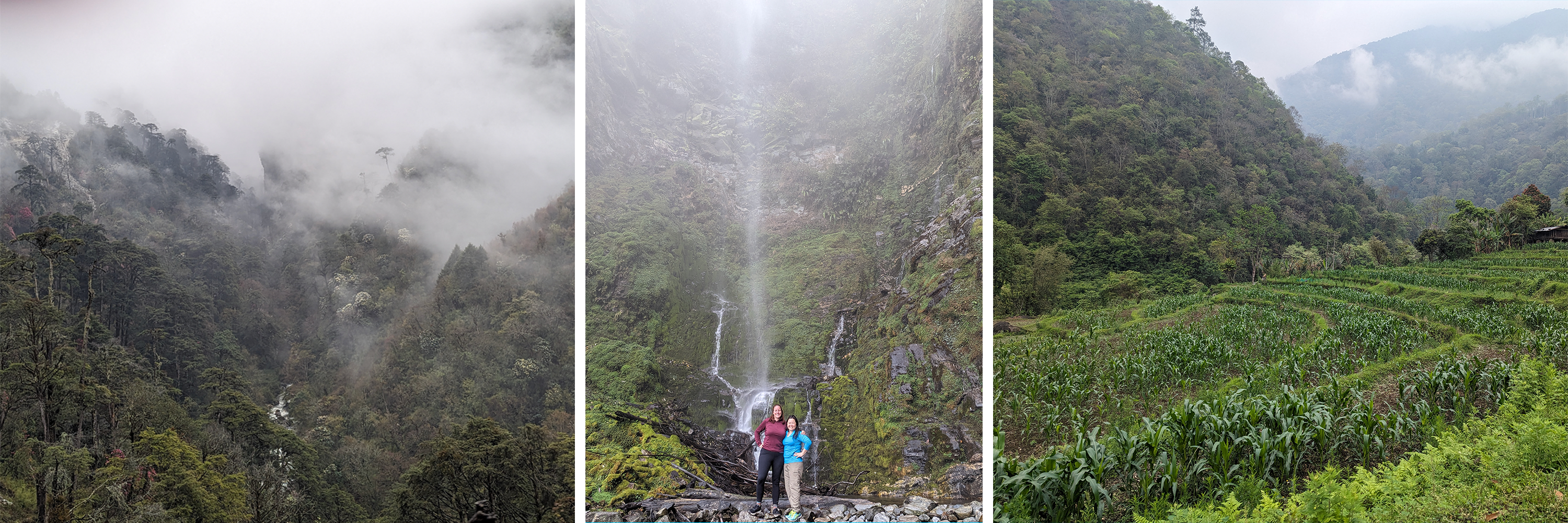
After our trekking in eastern Bhutan, we embarked on some long, long, windy roads to get to the center of the country. Although there were a few stops along the way, it was basically two straight days of driving. Nonetheless, we finally made it to the province of Bumthang (pronounced boom-tawng).

drive from Sakteng to Bumthang: foggy landscapes perfect for a fantasy novel, tall waterfalls, farming terraces

BUMTHANG

The weather had been hit or miss the previous few days and we were a bit worried we were going to be soaked by the end of our walking tour. Fortunately, clouds stayed away and we had a wonderful time as Tenzin took us to three different monasteries and a community weaving center.

The weaving in this part of the country is called yathra. Although different types of looms are used now, they still take an incredibly long time to make. Angela took one home that was at least four meters long! This particular center uses only natural dyes for their yak wool.

woman preparing the loom for weaving, natural dyes, yathra weaving in process

Before discussing any temples, it’s probably wise to talk about Guru Rinpoche. He was born in what is today known as Pakistan but due to some internal family disputes decided to leave. He lived in Tibet before entering Bhutan and in Bhutanese stories, he is foretold by the original Buddha as the next Buddha. One of his major talents was subduing local spirits and demons, which greatly abetted the spread of Buddhism throughout Bhutan. He also left behind treasures for believers to reveal in future years which could take the form of texts, objects, visions, or dances.

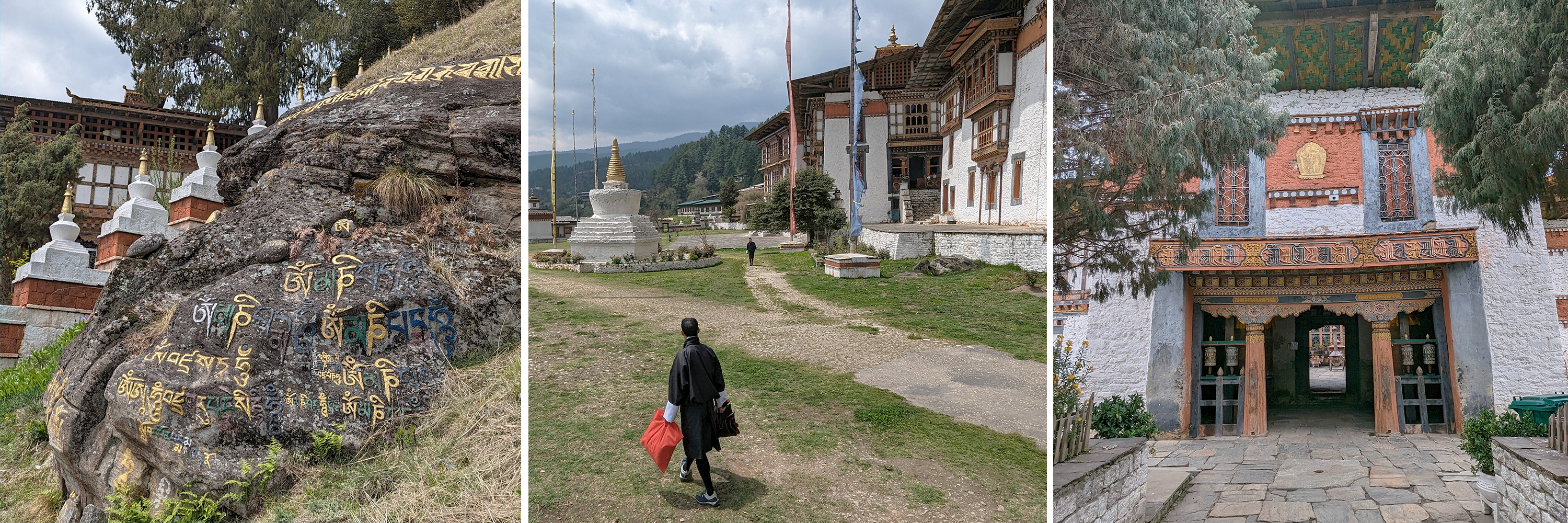
The biggest temple we visited in Bumthang was Kurjey Lhakhang, which now has three separate buildings. The oldest building is famous because Guru Rinpoche meditated here for three months and left an outline of his body print (in a seated posture) in the cave. He also, apparently planted his walking stick which became the giant cyprus tree outside the temple. The other two buildings were built by the first King and the Queen Mother.

outside of Kurjey Lhakhang, Tenzin entering the grounds of Kurjey Lhakhang, outside of Jambay Lhakhang

Jambay Lhakhang was the oldest temple we visited, having been built in the 7th century. One notable difference in earlier temples is that the sculpture inside depicts future Buddha and not current Buddha, which means that the hands are in a different position (mudra).

In 1501, Tamshing Lhakhang was established by Pema Lingpa. He is revered in Bhutan as a treasure hunter. Guru Rinpoche appeared to him in a dream and told him about the treasures he would find. Eventually, a monk wandered by a couple years later and gave him a scroll which outlined where he could find his first treasure as well as a key for decoding its message. He successfully dove into a lake, retrieved another scroll, and deciphered this first treasure text. Although he was met with skepticism even in his time, Pema Lingpa won over his critics with stunning feats like retrieving treasures underwater while keeping a butter lamp burning even while he was submerged.

Tamshing Lhakhang (even monks have to do laundry), outside wall of monastery, Bumthang River

Apparently, he was a very precocious youngster and his grandfather taught him how to be a blacksmith. Inside of this temple is chain mail he made when he was still a child. Devotees sometimes wear this chain mail as they make three tours of the temple as an act of purification. Today, this temple serves as a place of learning for young monks.

DOMKHAR TSECHU

Tsechus (festivals) are a major part of Bhutanese life and when we were planning our trip, we wanted to make sure we got to see at least one. There are much bigger festivals in the large cities, but we made it to a rather tiny tsechu outside of Bumthang. Tsechus are generally celebrated on the tenth day of a month of the lunar calendar, but the month varies from temple to temple. This symbolically corresponds to the birth day of Guru Rinpoche.

About one-third of the attendees were probably tourists, but the rest were locals decked out in their finest kiras and ghos. The male fashonistas in the crowd also were wearing elaborate, fancy, fabric boots. In case you are wondering, those will set you back about US$100.

fancy boats, cute kid in kira & her grownup’s fancy boots, cute kid in gho & his fancy boots

Every tsechu has slightly different dances and events. We came on the third day of the festival, and the opening dance was a set of dancers in Garuda masks. There are four important mythical creatures in Bhutanese Buddhism: Tiger (tak), Snow Lion (seng), Garuda (chung) and Dragon (druk). These appear all over the country, especially painted on the sides of houses and temples.

Garuda is a bird-like character, with clear horns coming out of its head. There are often four of them decorating each corner of a temple’s roof. The Garuda is particularly important in Bhutan, because of its association with Guru Rinpoche. One of the ways he subdued demons was by transforming into Garuda.

Garuda dancers, another Garuda dancer, Raksha dancer with an amazing headpiece (this was actually the last dance we saw)

After the Garuda dance, a clown came around to bless guests with his giant wooden phallus. There’s a longer story here about why the phallus plays such an important role in Bhutan, but that will have to wait for a later blog post. Regardless, the clown bonked everyone on top of the head with the phallus (Angela and I both had to remove our hats to be blessed) and then he came back around and people gave small bills which he shoved into his wooden phallus in exchange for the blessing. Although tourists were his first target, he eventually walked around and blessed many of the locals as well.

clown collecting tips for blessings in his oversized phallus, tourist being blessed by phallus, ladies in beautiful kiras singing

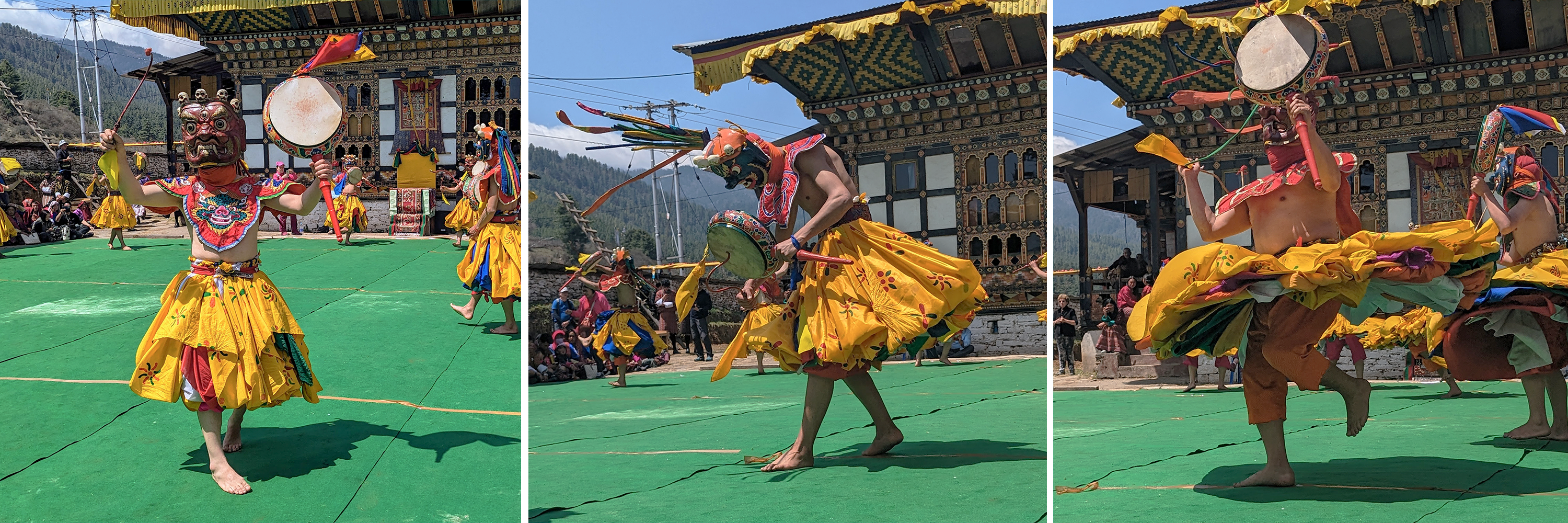
The longest dance we watched was what I think is called the Ngaging Dance. Remember the chain mail treasure-hunting guy Pema Lingpa? One of his ongoing legacies in Bhutan is the collection of dances that were revealed to him. Remember, dances can be treasures too. This one lasted the longest and was definitely an exercise in endurance for all the dancers involved.

dancers performing the Ngaging Dance

This video is only a short clip of the dance that went on for over thirty minutes and maybe closer to an hour.