Jet-lagged and still coping with time differences, I woke up at 5am to the tapering end of a massive rain storm. I stumbled out of bed, grabbed my headlamp, and pulled my sneakers on to head out on a “mountain” hike. Mountain is truly a bit of an exaggeration for a steep hill located on a small island in the Yasawas of northwestern Fiji. Winding behind the staff quarters, I glanced up to a see a 4-inch spider hovering around her eggs high up in a web stretching from the fence to the building behind it. As I left the property, the hike headed mostly up at an angle that would’ve been challenging on a dry day, but was made even more complicated by the water running through the middle of the path. I eventually just embraced the squishy mud and started making steady progress to the top. Somewhere along the way, I noticed footsteps in the mud, sometimes in a flat shoe, sometimes with toes spread wide. Yet it seemed to be just one person walking due to the gait and placements of the steps.
Through the cover of trees, I walked, stopping briefly to check out a passion flower plant. They all have an outer ring of rounded petals, followed by a ring of slender multi-colored petals sticking straight out. In the scientific literature, these are called corona filaments: corona like the outermost plasma surrounding the sun, filament like the tiny wire that burns so brightly in an incandescent bulb. These skinny petals form a ring around the dangling male anthers, filled with pollen, ready to be brushed away on the back of a visiting bumblebee. The hanging, sticky female stigmas are situated even higher, above the male organs, ready to hold on to pollen from other plants arriving via those same pollinators.
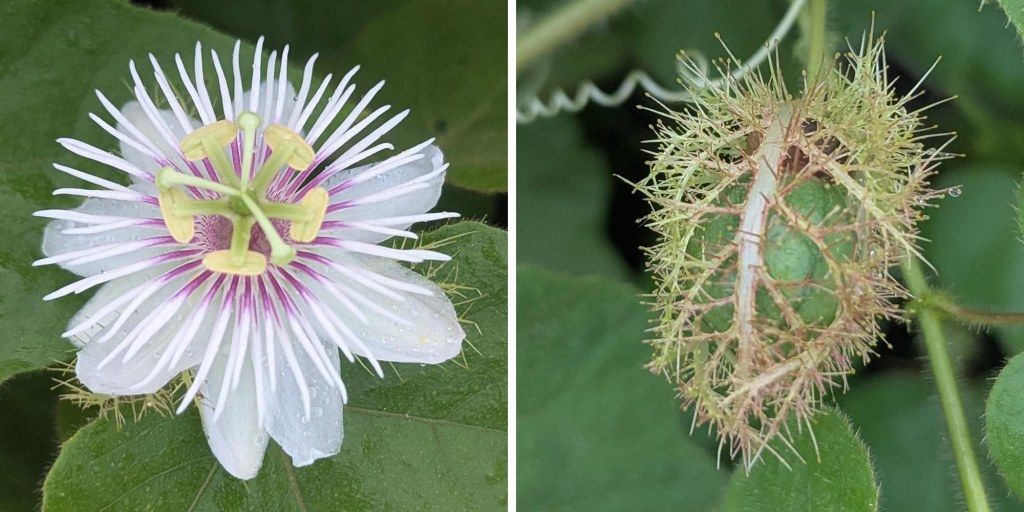
passion flower and passion fruit
I know this plant well since a vine of passion flower grows on my back fence at home. I was confident in my ability to recognize it, but this passion fruit was different. Instead of the round purple fruits that deflate into a squashed balloon when they’re ready to eat, this passion fruit was green and enclosed in a green cage of spiky, sticky protrusions clearly meant to protect. It looked other worldly and yet this was natural armor, created through years of gradual modifications. Whenever I see a new plant, my mind jumps to two questions: Can I eat it? Is it native? 1 Out there, on the “mountain,” I had no phone service, so I shelved these questions for later and kept walking.
I passed the one other person who climbed the mountain before me that morning. He was wearing flip flops and the footprints from the start of the hike started to make sense. When he got to the muddy part of the hill, he took off his sandals when they got stuck and tried a barefoot approach. He nodded a hello and I did the same, silently acknowledging the strange and awkward fellowship of two random people who felt the need to rise before the sun was up in order to solo climb a ridiculously muddy hill during a break in a downpour. No words were necessary, this was not the time to disturb his serenity or mine. I followed the trail towards the open ocean to the north, which was rapidly appearing in my view along the edge of the hillside.
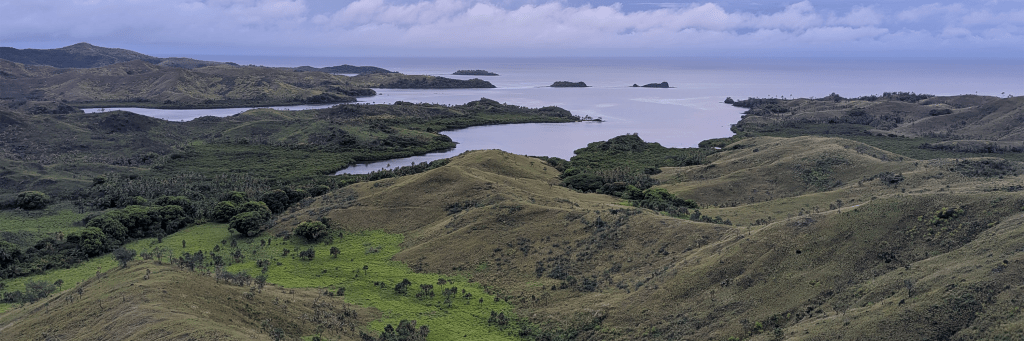
view towards the northern end of Nacula Island
As I squatted to rest and embrace the view, I noticed the reddish brownish rock beneath my feet. Volcanic in origin, probably basalt, formed underwater and then brought up to the surface. I had more questions: How did these volcanic islands pop out of the Indian Ocean? Were they formed from hot spots or is this on the edge of a subduction zone? How long ago did this happen? 2 Curiosity is a restless creature. Once you open the gate, it carries you off with no promise of where you’ll end up.
The view over the north side of the island was stunning. The sun had risen during my hike, but it was hidden behind the clouds. The path forward looked like a solid descent to the ocean on the north side, and I wasn’t in the mood to climb back up, so I turned around and started hiking back. On the way, I saw a millipede crossing my path. Or was it a centipede? Was it poisonous? Is it centipedes or millipedes that are poisonous? I wasn’t sure what I was looking at, so I snapped a photo to identify on iNaturalist later. 3
Before I reached the steep hill back down to the hotel, I came across a hala tree which was identifiable because of its bumpy faintly-pineapple shaped fruit. They’re very common throughout the Pacific Islands because they grow in rough soil and salty environments. On a previous trip to Hawaiʻi, I’d learned that Polynesians used to weave the leaves into giant canoe sails. These were the sails that took early explorers thousands of miles across the ocean.
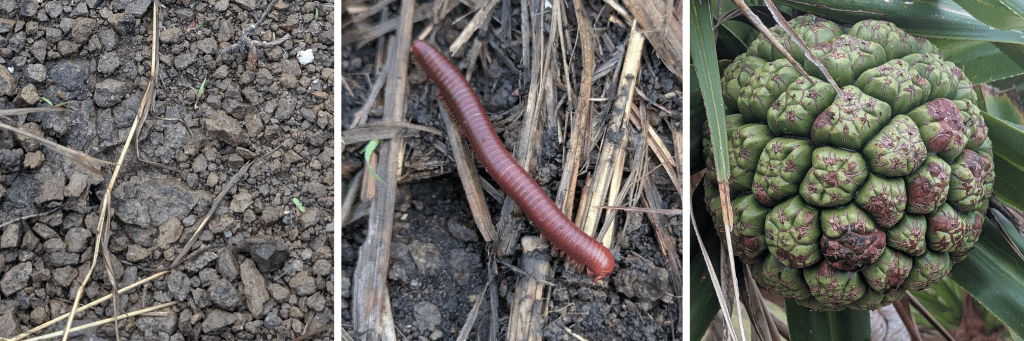
basalt, Rusty Millipede, hala fruit
Sometimes I just have to laugh. I had gone on this hike to clear my mind and relax. By the time I returned to the hotel, I had ten more questions that I wanted answers for. But that’s also the beautiful part of staying curious about the natural world, it keeps me present in the world around me. All the questions are both grounding and expansive, somehow at the same time. When I make a new friend, it takes an investment of time, energy and care before the other person trusts me. Meeting a place is very similar, and slowly, little by little (with a little help from the internet), it reveals its secrets.
Footnotes
- The type of passionflower in Fiji I saw is known as Passiflora foetida, the stinking passionflower. While waiting for the sun to go down for my night scuba, my scuba guide confirmed it is edible, but not during the season that I was visiting. This species is not native to Fiji, but is native to the southwestern United States, parts of the Caribbean, Central America and South America. ↩︎
- The Yasawa Islands formed about 8 million years ago as part of a volcanic island arc. They developed above a subduction zone, where one tectonic plate was forced under another. As the descending plate sank into the mantle, it released water and other fluids, which lowered the melting point of the overlying mantle. This caused partial melting and generated magma that rose through the crust and erupted first on the seafloor and later above sea level, building the islands. ↩︎
- It was a Rusty Millipede (Trigoniulus corallinus). ↩︎
 Meandering Marbles