Trongsa & Phobjikha Valley

Trongsa Dzong

When I started reading about traveling to Bhutan, the word dzong kept showing up over and over again in the guidebooks. The most commonly used English translation is fortress, but it’s a bit more than that. Although they originally served as fortifications, they also hold both the administrative offices for the government as well as separate sections for monasteries. In other words, dzongs run both the secular and non-secular aspects of the region. The Trongsa Dzong became one of the most important ones due to its location near the middle of hte country. Whoever ruled Trongsa (called the Penlop), controlled the taxation of goods from one part of the country to another. The role of Penlop of Trongsa is traditionally given to the heir apparent and was last held by the current king of Bhutan before he assumed the throne.

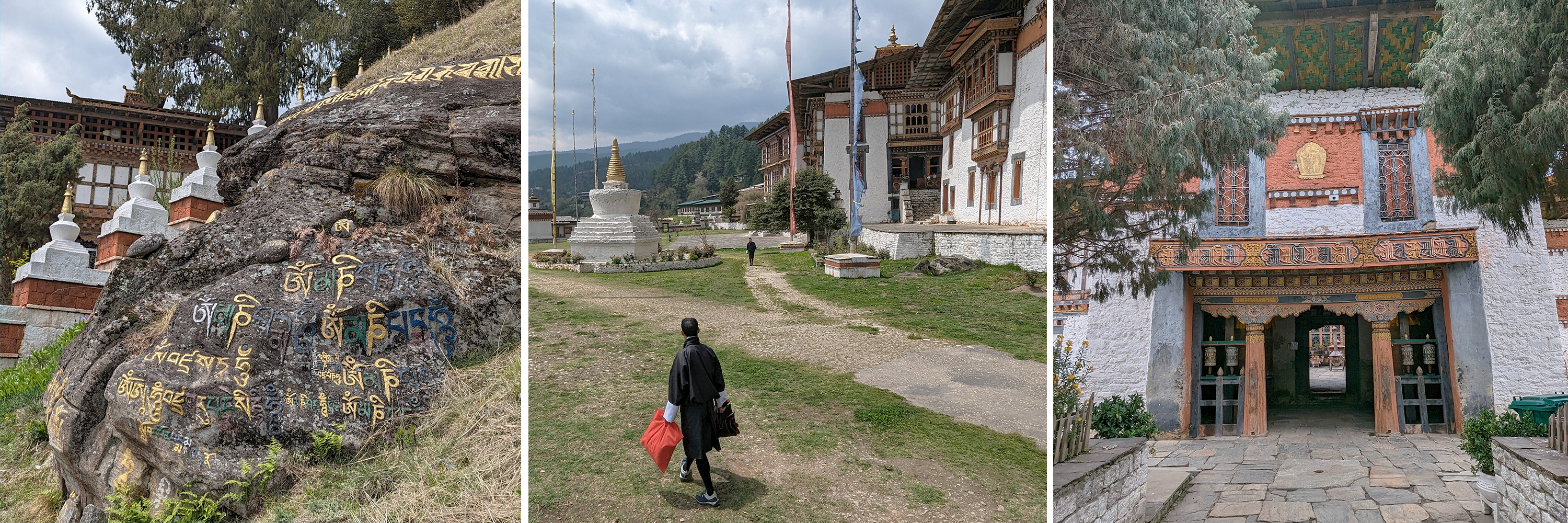
outside of Trongsa Dzong, inside of Trongsa Dzong, view from top of Trongsa Dzong

The inside courtyard is expansive. We briefly got to meet Tenzin’s uncle, who has been a monk at the monastery here for many years.
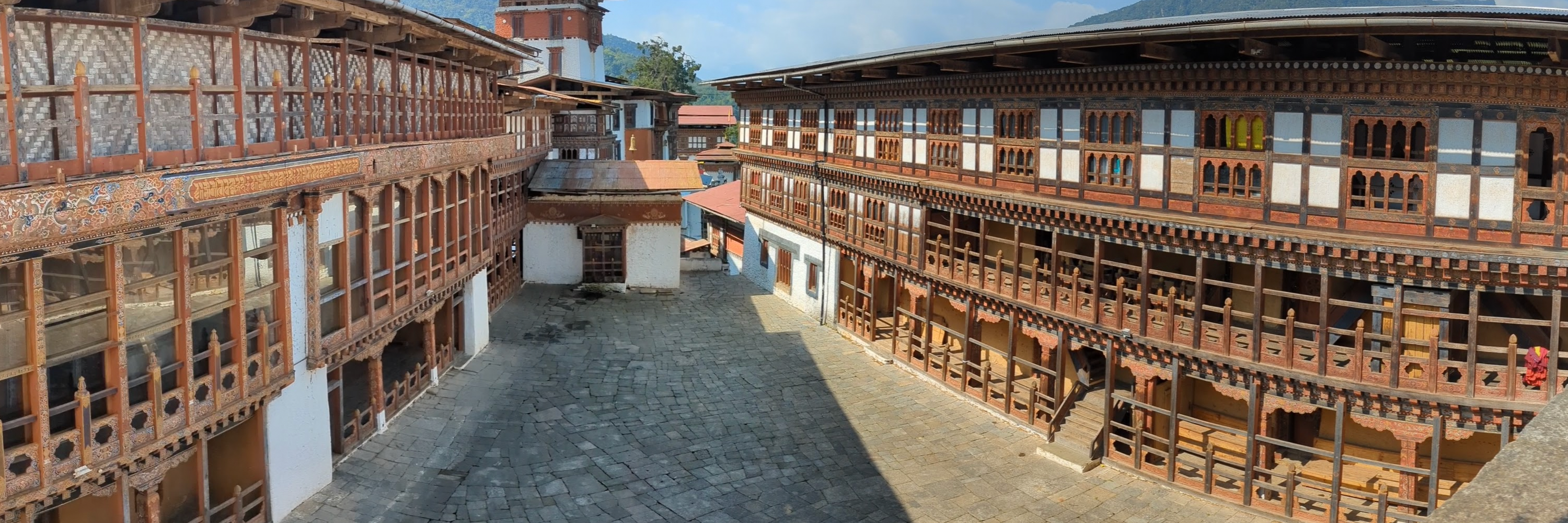
panoramic view of Trongsa Dzong courtyard

One of the aspects of Bhutan that is so extraordinary is the amount of art that is incorporated into both public and private construction. This artistry is supported and promoted by the government. Dragons often adorn the pillars of temples. Prayer bells line the outside of temple walls. The four mythical creatures are carved and painted into various motifs. The art is everywhere, and it is exquisitely executed.

details inside Trongsa Dzong: dragon, prayer bells, garuda

wood carving over a door showing the four mythical Bhutanese animals: tiger, snow lion, dragon, and garuda

Tshangkha Village

The same day, Tenzin took us to Tshangkha, the small village where he grew up. We got to meet his brother, his mother, and a bunch of other extended relatives. From the photo below, you can see it is a rather small village, with lots of fields filled with crops. Most people who grew up in the village have moved to Thimphu, the capital, which has more job opportunities. They make money in the city and then build nicer houses for the relatives that remain in the village, so there’s a lot of new construction going on in Tshangkha.
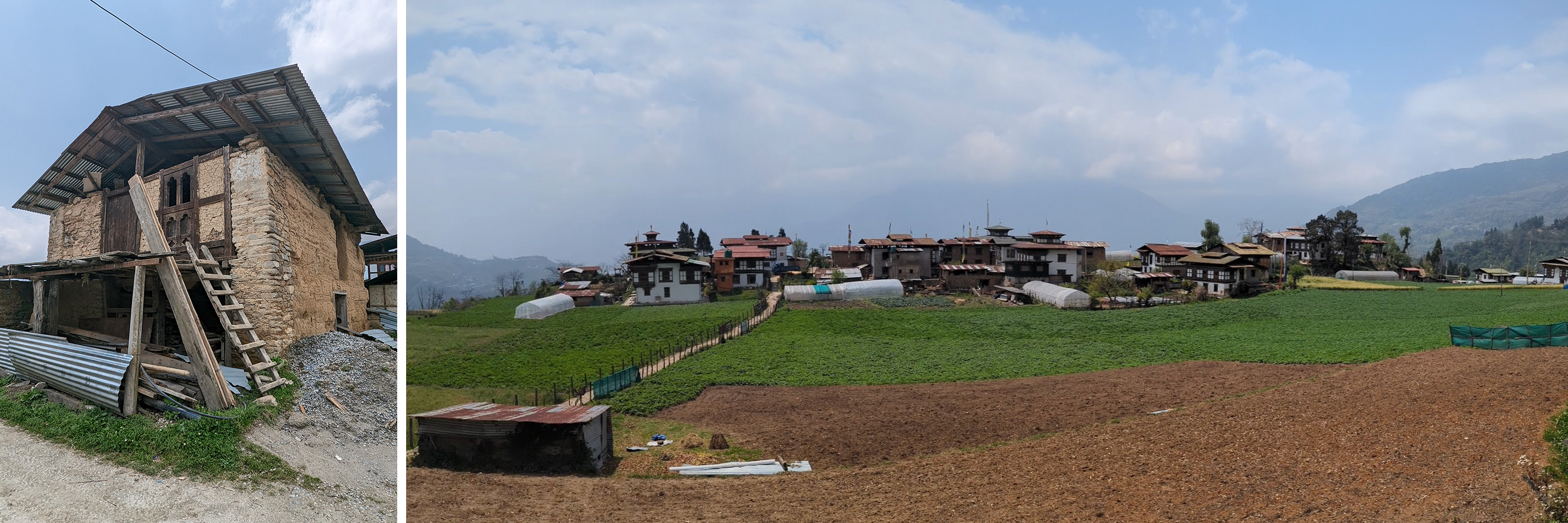
old mud house, view of village from the local temple

Phobjikha Valley

I had picked up a book of Bhutanese folktales and was reading them during our travels. One of the stories was about the fastest messenger who used to run messages from Trongsa to Wangdue for the king. He was so tired from running all the time that one day as he was running, he wished that he would die. Afterwards, as he passed by a river, he saw a woman washing the entrails of an ox in the water, but he didn’t understand how that was possible since there was no villages nearby. He completed his delivery to the king, and then promptly went to his room and fell asleep, never to wake up again. The woman was actually a demoness named Nyala who was actually washing his entrails (he was the sign of an ox). Eventually, the Nyala demon was subdued and the Chendebji Chorten was built upon its remains. I happened to read this story and then the very next day, we ended up visiting the chorten. It’s built in the Nepalese style, with eyes painted on the top of the stupa.

Tenzin also bought us to some fermented yak cheese to try, which honestly has just a faint taste of cheese to it. I mostly noticed how rock hard it was and how long it took to break down. I chewed on my cube for almost an hour and I think it took Angela at least two hours to get through hers. Good for exercising your jaw muscles, but maybe not my new favorite snack.

We took a brief stop at a black-necked crane center, which cares for two cranes that can’t be released into the wild. The migrating cranes stop here in the autumn months and fill up the entire Phobjikha Valley. There’s an entire festival for the cranes, and one of the dances involves people dressing up in crane costumes. Currently these cranes are vulnerable, but not endangered. I also learned there are only 15 different species of cranes around the world (I think I’ve seen at least 3 in the wild).

Chendebji Chorten (where Nyala was subdued), fermented yak cheese, black-necked crane

Gangtey Goemba

Most Buddhist temples in Bhutan are overseen by the government-supported Commision for Monastic Affairs headed by the Je Khenpo, basically the chief monk. However, there are still a few that are privately operated and this is one of them. Pema Lingpa (the chainmail-making, treasure hunting guy from the last blog post) visited this area and prophesied that his descendants would build a monastery here. His grandson actually built the first monastery, but is has been expanded several times over the generations. Fun fact: the current royal family actually traces their ancestry back to Pema Lingpa.

This monastery is located quite close to the nesting cranes of the aforementioned black-necked cranes. People say that they circle the monastery three times when they arrive and then repeat these three circles when they return to Tibet to breed in the summer. It gets quite a few visitors and went through a long renovation, where the paintings inside were redone and the outside decorations spruced up. Photo taking is only allowed outside of temples, out of respect for religious practices. Click on the photo to enlarge it to see all the fantastic details.

beautiful prayer wheels and temple decorations
Central Bhutan

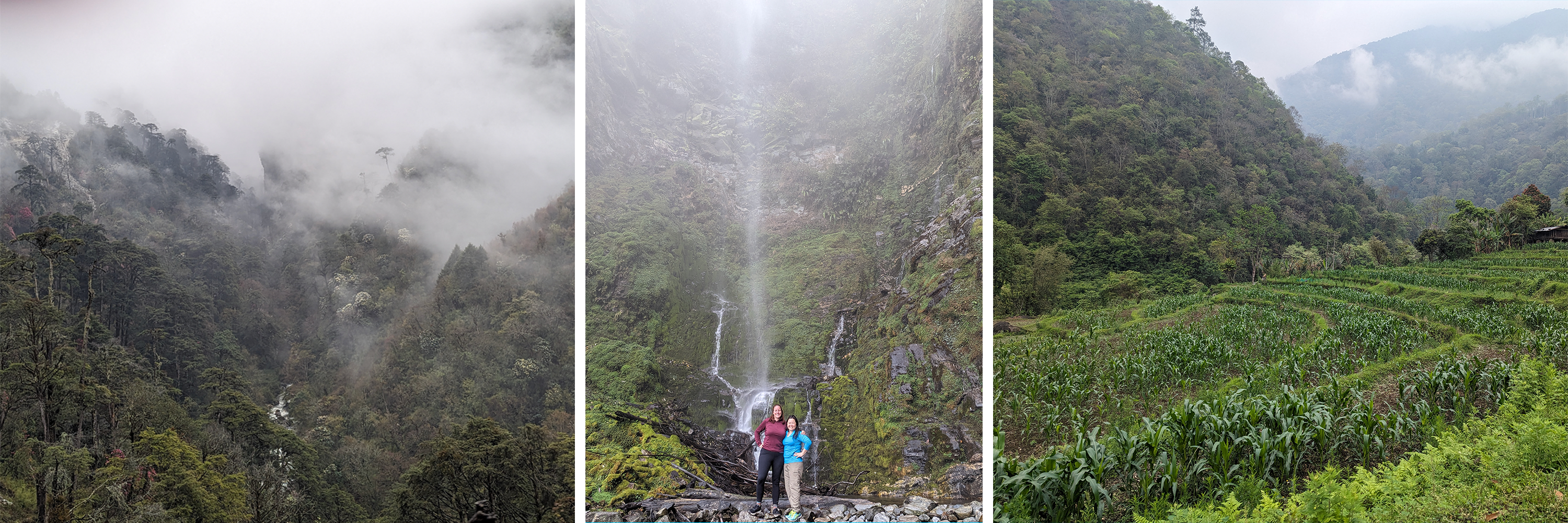
After our trekking in eastern Bhutan, we embarked on some long, long, windy roads to get to the center of the country. Although there were a few stops along the way, it was basically two straight days of driving. Nonetheless, we finally made it to the province of Bumthang (pronounced boom-tawng).

drive from Sakteng to Bumthang: foggy landscapes perfect for a fantasy novel, tall waterfalls, farming terraces

BUMTHANG

The weather had been hit or miss the previous few days and we were a bit worried we were going to be soaked by the end of our walking tour. Fortunately, clouds stayed away and we had a wonderful time as Tenzin took us to three different monasteries and a community weaving center.

The weaving in this part of the country is called yathra. Although different types of looms are used now, they still take an incredibly long time to make. Angela took one home that was at least four meters long! This particular center uses only natural dyes for their yak wool.

woman preparing the loom for weaving, natural dyes, yathra weaving in process

Before discussing any temples, it’s probably wise to talk about Guru Rinpoche. He was born in what is today known as Pakistan but due to some internal family disputes decided to leave. He lived in Tibet before entering Bhutan and in Bhutanese stories, he is foretold by the original Buddha as the next Buddha. One of his major talents was subduing local spirits and demons, which greatly abetted the spread of Buddhism throughout Bhutan. He also left behind treasures for believers to reveal in future years which could take the form of texts, objects, visions, or dances.

The biggest temple we visited in Bumthang was Kurjey Lhakhang, which now has three separate buildings. The oldest building is famous because Guru Rinpoche meditated here for three months and left an outline of his body print (in a seated posture) in the cave. He also, apparently planted his walking stick which became the giant cyprus tree outside the temple. The other two buildings were built by the first King and the Queen Mother.

outside of Kurjey Lhakhang, Tenzin entering the grounds of Kurjey Lhakhang, outside of Jambay Lhakhang

Jambay Lhakhang was the oldest temple we visited, having been built in the 7th century. One notable difference in earlier temples is that the sculpture inside depicts future Buddha and not current Buddha, which means that the hands are in a different position (mudra).

In 1501, Tamshing Lhakhang was established by Pema Lingpa. He is revered in Bhutan as a treasure hunter. Guru Rinpoche appeared to him in a dream and told him about the treasures he would find. Eventually, a monk wandered by a couple years later and gave him a scroll which outlined where he could find his first treasure as well as a key for decoding its message. He successfully dove into a lake, retrieved another scroll, and deciphered this first treasure text. Although he was met with skepticism even in his time, Pema Lingpa won over his critics with stunning feats like retrieving treasures underwater while keeping a butter lamp burning even while he was submerged.

Tamshing Lhakhang (even monks have to do laundry), outside wall of monastery, Bumthang River

Apparently, he was a very precocious youngster and his grandfather taught him how to be a blacksmith. Inside of this temple is chain mail he made when he was still a child. Devotees sometimes wear this chain mail as they make three tours of the temple as an act of purification. Today, this temple serves as a place of learning for young monks.

DOMKHAR TSECHU

Tsechus (festivals) are a major part of Bhutanese life and when we were planning our trip, we wanted to make sure we got to see at least one. There are much bigger festivals in the large cities, but we made it to a rather tiny tsechu outside of Bumthang. Tsechus are generally celebrated on the tenth day of a month of the lunar calendar, but the month varies from temple to temple. This symbolically corresponds to the birth day of Guru Rinpoche.

About one-third of the attendees were probably tourists, but the rest were locals decked out in their finest kiras and ghos. The male fashonistas in the crowd also were wearing elaborate, fancy, fabric boots. In case you are wondering, those will set you back about US$100.

fancy boats, cute kid in kira & her grownup’s fancy boots, cute kid in gho & his fancy boots

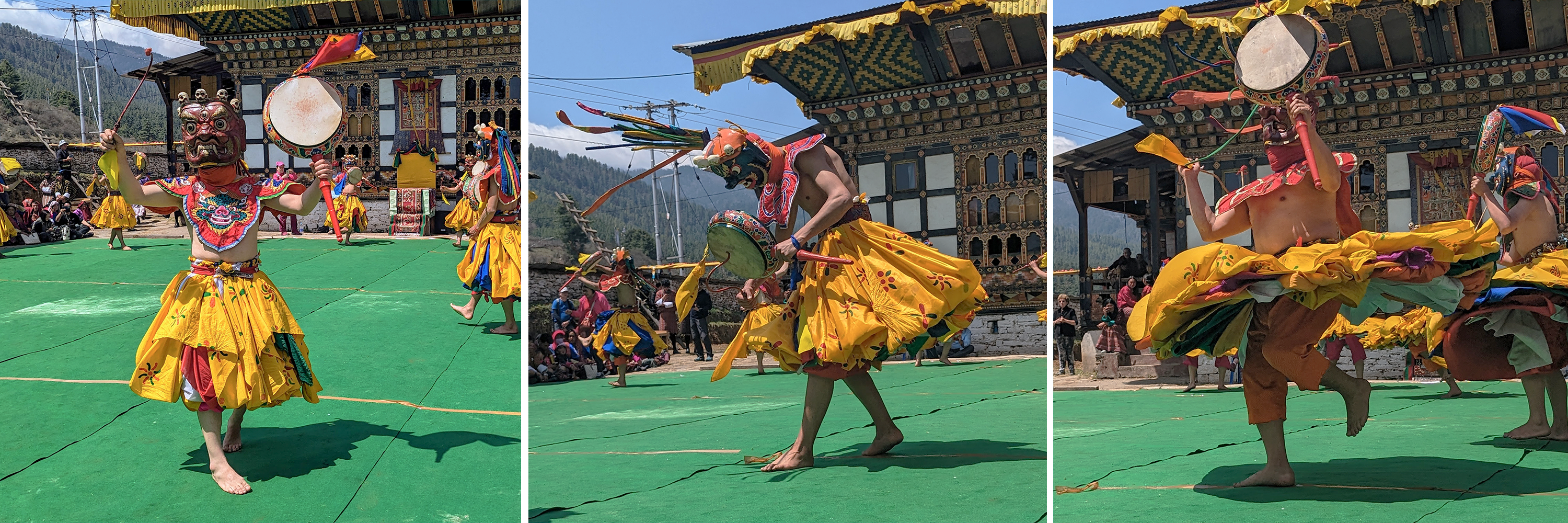
Every tsechu has slightly different dances and events. We came on the third day of the festival, and the opening dance was a set of dancers in Garuda masks. There are four important mythical creatures in Bhutanese Buddhism: Tiger (tak), Snow Lion (seng), Garuda (chung) and Dragon (druk). These appear all over the country, especially painted on the sides of houses and temples.

Garuda is a bird-like character, with clear horns coming out of its head. There are often four of them decorating each corner of a temple’s roof. The Garuda is particularly important in Bhutan, because of its association with Guru Rinpoche. One of the ways he subdued demons was by transforming into Garuda.

Garuda dancers, another Garuda dancer, Raksha dancer with an amazing headpiece (this was actually the last dance we saw)

After the Garuda dance, a clown came around to bless guests with his giant wooden phallus. There’s a longer story here about why the phallus plays such an important role in Bhutan, but that will have to wait for a later blog post. Regardless, the clown bonked everyone on top of the head with the phallus (Angela and I both had to remove our hats to be blessed) and then he came back around and people gave small bills which he shoved into his wooden phallus in exchange for the blessing. Although tourists were his first target, he eventually walked around and blessed many of the locals as well.

clown collecting tips for blessings in his oversized phallus, tourist being blessed by phallus, ladies in beautiful kiras singing

The longest dance we watched was what I think is called the Ngaging Dance. Remember the chain mail treasure-hunting guy Pema Lingpa? One of his ongoing legacies in Bhutan is the collection of dances that were revealed to him. Remember, dances can be treasures too. This one lasted the longest and was definitely an exercise in endurance for all the dancers involved.

dancers performing the Ngaging Dance

This video is only a short clip of the dance that went on for over thirty minutes and maybe closer to an hour.

Eastern Bhutan

This trip to Bhutan has definitely been on my to-do list for more than a few years. My college friend Angela and I started talking about this probably a decade ago, were seriously talking about going in 2020 (which of course didn’t work out), and finally the stars aligned for both of us to be available this spring.

Merak-Sakteng

After a brief stopover in Paro, we flew to the eastern edge of Bhutan. This is an area of Bhutan that travelers often don’t go to because it’s logistically challenging and requires a lot of time and in Bhutan, time is money. Travel here works very differently than other countries because the only way to visit as an American is on a guided tour. There is a sustainable development fee of $100 every day plus a set cost that is paid for lodging and meals, entry fees, guides, and travel. Souvenirs and tips are extra. The goal is to open Bhutan up to tourism, but not in a way that has a large negative effect on the community and the environment.

Our guide Tenzin flew with us and we met our driver Pema at the airport since he had been diligently driving all the way across the country the last couple days. We drove past the first university started in Bhutan, near several stupas commemorating different parts of Buddha’s life, monasteries, and through beautiful hillsides of red and pink rhododendrons that had recently bloomed. Eventually, we met our first yak and I stuck my head out the window and mooed at it. It just looked at me strangely and continued to munch grass.

stupas, Rangjung monastery, my first yak

Eventually, we arrived our destination of Merak, which is home to the Brokpa people. This used to be a semi-nomadic yak-herding tribe, but most people have a house in one of the villages nearby now. Originally, they lived on the Tibetan plateau, but eventually relocated to what is now Bhutan. There are additional Brokpa villages scattered throughout Arunachal Pradesh, India.

Our guide in Merak, Gelzen, told us the story they tell about how they ended up in Bhutan:

Once upon a time there was a Tibetan village where the wood was dry, wet, and rotten and not very useful. The people lived in the valley below the peak of a mountain, which kept the valley entirely in shade, which caused very little to grow and the people to suffer. The queen wanted to bathe in the river and it was too cold, so the king told the villagers to remove the peak of the mountain so the river would be warmer from the light of the sun.

They were running out of time to finish removing the top of the mountain when along came a small girl carrying a baby. No one knew the girl, but she told them, “It is better to chop off the head of a man than to chop off the head of the mountain.” She then kept walking on her way.

When the villagers convened that evening, everyone had seen the little girl but no one knew who she was or where she had come from. After much discussion, they decided the girl must be a deity and they should follow her advice. They hatched a plan to chop off the head of the king.

They petitioned the king to have a party to celebrate finishing their task of removing the top of the mountain. He eventually approved the plan to drink wine and dance. In those days, wine came in a large wooden container and they decided to hide an ax at the bottom of the container.

On the day of the party, the king and his entourage arrived and the party began. The dancers danced and the wine flowed freely among his soldiers and additional guests. However, the villagers did not partake in the wine because they knew about the plan. Eventually, most of the wine was finished and the last bit of wine was offered up to the king. As the villagers reached in to serve the wine, they pulled out the ax and chopped off his head. All of the villagers rejoiced in their newfound freedom.

They then discussed whether to stay in the shadow land and fight the king’s soldiers or to run away to another location. The girl arrived again and introduced herself as the deity Jomo and offered to guide them to a new land. She spotted the top of a mountain far away from where they were standing and led the villagers to that new location.

Those villagers that were stronger and were able to keep walking, continued over the mountain pass and settled the town of Merak. The less strong, weaker villagers turned around when they couldn’t make it over the pass and returned to the valley to set up the town of Sakteng. There is still a marker between the two villages that denotes where they turned back. Today the Brokpas revere Ama Jomo (Mother Jomo) as a principal deity that protects their villages.

Angela and I had decided to hike from Merak to Sakteng, which was supposed to be about 20 km, with a 1500 m elevation gain. When we checked in for our permits with the local forestry staff, they suggested it would take about 8 hours. Because we had just come to Bhutan a few days before, our guides had us spend another day in Merak to acclimatize to the elevation.

We had a lovely day walking around Merak and taking in the local culture. We visited the elementary school and as soon as we entered a classroom, all of the students stood up to say hello. Instruction in schools here is conducted in English from a very early age, so the grade 4 students answered a few of our questions, before we continued exploring. We wandered through herds of yaks, a few dzo / dzomo (the offspring of a cow and a yak), more rhododendron trees, before heading back to our homestay. While there, we ate lots of thueb (red rice porridge), fried rice, chili cheese, vegetables, and suja (butter tea). Butter tea is basically tea, milk, butter, and salt and tastes more like soup than tea. I was a bit skeptical at first, but decided I liked it for breakfast.

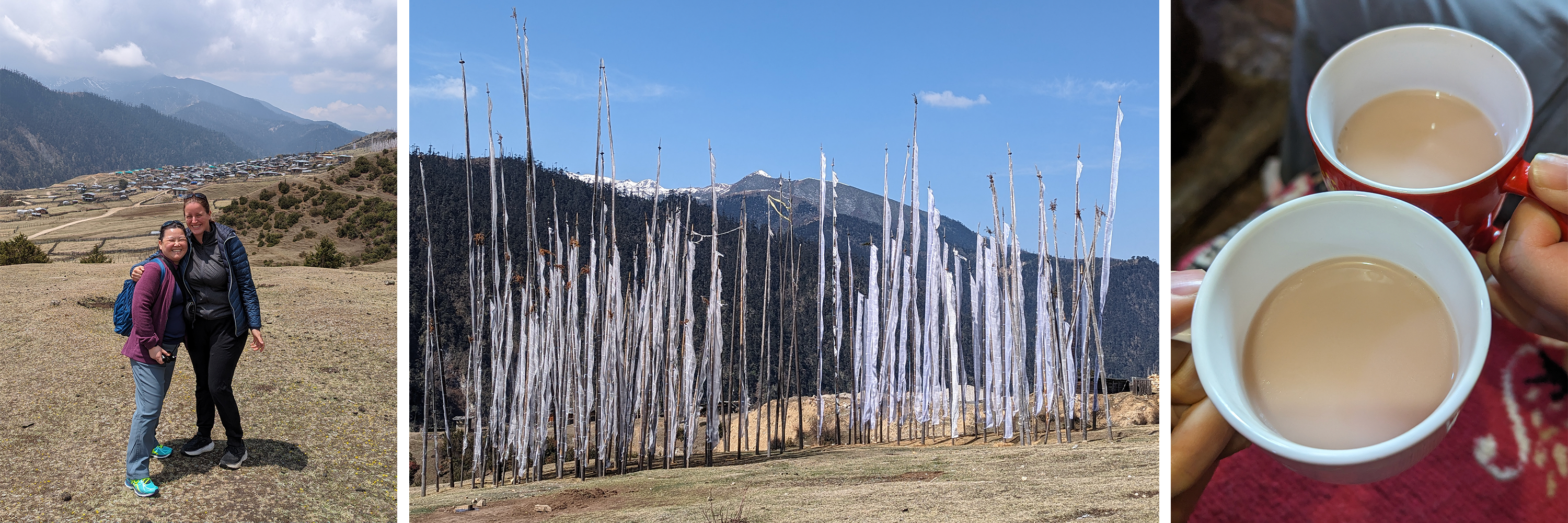
Angela and I with the town of Merak behind us, prayer flags, butter tea (suja in Dzongka)

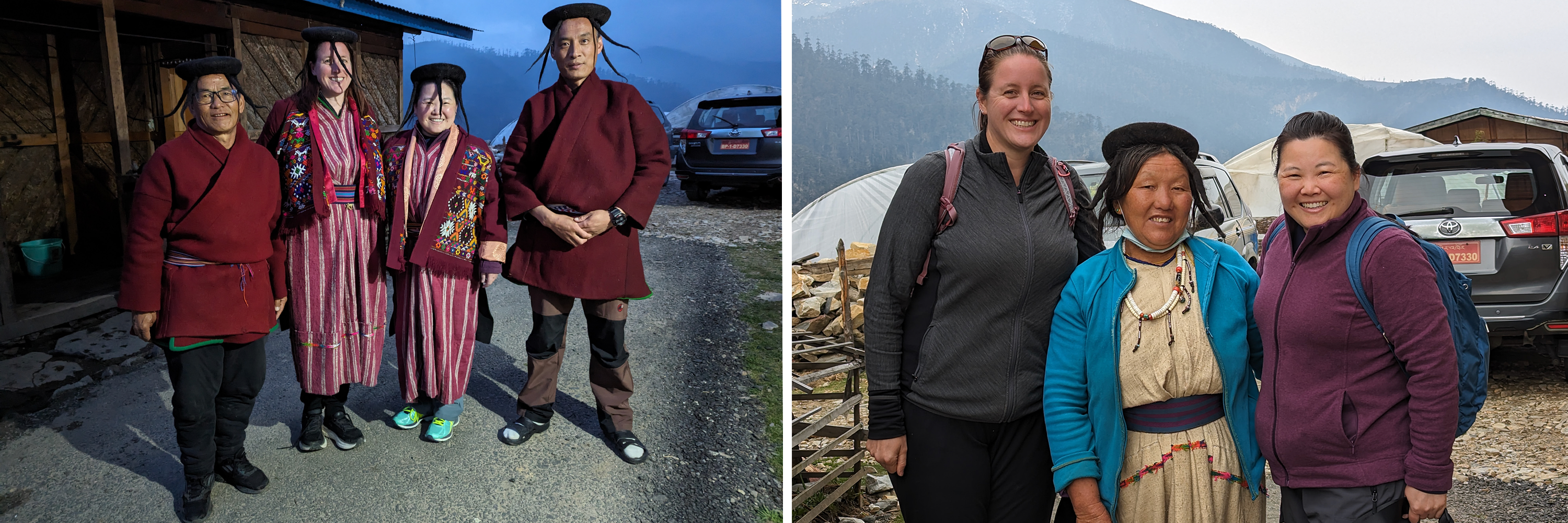
We also got to try on traditional Brokpa clothes and a couple of women sang traditional songs for us, while the home-brewed alcohol known as ara was passed around. The ara in Merak is mostly made from potatoes, corn, and buckwheat.

Pema, me, Angela, and Tenzin dressed up in traditional Brokpa clothing; Angela and I with our homestay Ama

The next day, we took off on our trek onwards and upwards over the Nachungla Pass which tops out at 4150 m (13,615 ft). There’s snow near the top, so, of course, I got in a snowball fight with our guide. Angela was struggling with the altitude and was having none of it. The whole trek is lined with rhododendron trees, even though they’re not quite in bloom yet because it’s too cold. At the pass, Gelzen gave us prayer flags and helped us to tie them on poles on the pass. Our porters also started a fire to appease the local deities.

Tenzin, a porter, and Angela hiking through the snow; our prayer flags at Nachungla Pass

Along the way, we found some interesting high elevation creatures including this intricately patterned beetle that Gelzen said was called a juniper bug because if you sniff it, it smells like juniper. Well, I caught one and tried to smell it and it didn’t smell like much of anything to me. Our guide Tenzin was a bit confused what we were doing and we realized that there are different kind of trekkers. Some just want to get from place to place, and some stop to smell the bugs. We definitely belong to the latter category.

juniper beetle, Himalayan tailless pika, sumo mite

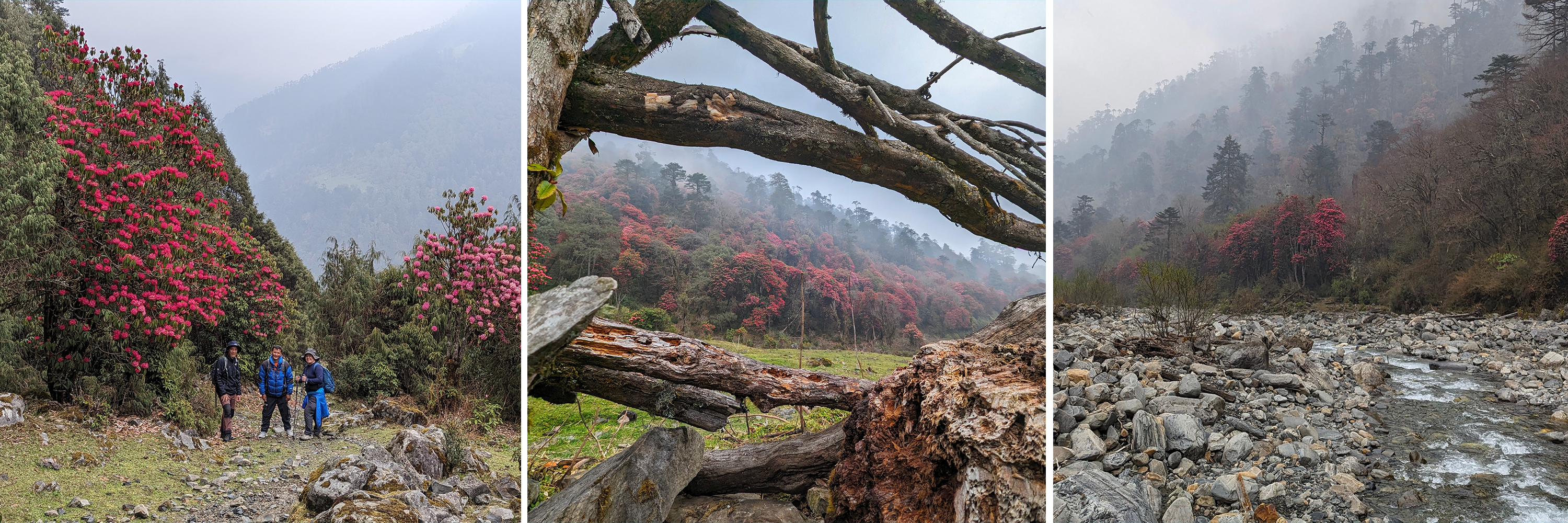
Once we got down off the pass, we descended into beautiful scenery filled with mostly red and pink rhododendrons. It’s hard to describe what it feels like to hike through entire hillsides covered in brightly colored flowers, but the whole experience was magical.

Tenzin, Gelzen, and Angela; rhododendron hillside through a yak fence; river & rhododendrons

different colored rhododendrons from our trek

Due to some slow climbing and lots of photography stops to look at flowers and beetles, we actually ended up getting into Sakteng after dark. Pema met us at the top of the hill with cups of tea and we slowly made our way down a hill and crossed two rivers on wet logs in the dark. We finally made it to our homestay, where we ate dinner and collapsed onto the mattresses on the floor.

looking back up the mountain into the fog