After my yoga training, I headed back into the heart of Goa and signed up for a walking tour of Velha Goa (Portuguese for “Old Goa”). This city started out as a Muslim sultanate, but the Portuguese came in with guns ablazing and conquered it in 1510. Most of the Catholic orders sent priests here after it was conquered and each separate order set up a church. I felt, in many ways, like I was walking through an old European city. There’s a common refrain among travelers in Europe about being tired of touring churches and this is probably the only place in India where the same thing might be heard. My walking tour featured five churches that were all within a couple miles of each other. All of the churches and convents in the area are designated a UNESCO World Heritage site.
Viceroy’s Arch, old city walls dating back to the sultanate, closeup of fancy door work
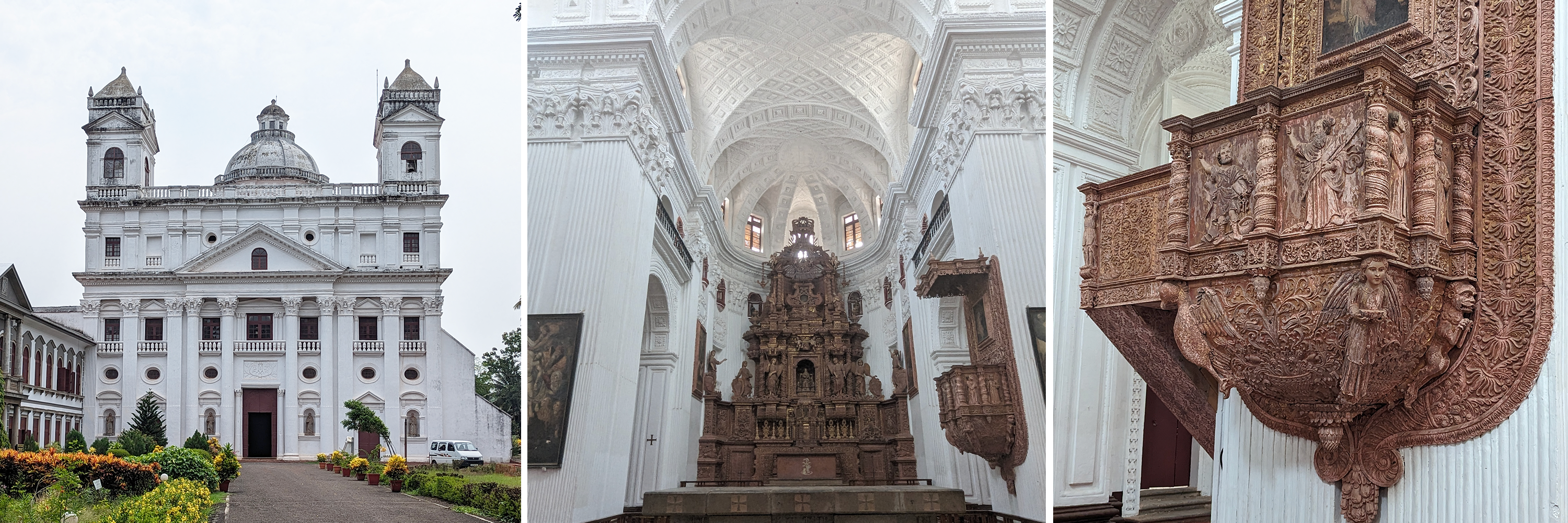
St. Cajetan Church was built by Italian Catholics. Although the Portuguese initially didn’t want the Italian priests to construct a church, one of them went to Portugal and convinced the king to let them build it in the interests of spreading Christianity. My favorite part was finding a garuda carved into the pulpit. As a way of converting locals, symbols from previous beliefs and ideologies were integrated into the architecture.
St. Cajetan Church: from the outside, big domed ceiling, upclose of the pulpit with garuda motif
The next two were both built by the Portuguese. The Sé Cathedral is known for two things: it is the largest church in India and it is unsymmetrical since one of the towers fell down and was never rebuilt. The Church of St. Francis of Assisi was built by Portuguese Franciscan priests. The doors leading into this church had fun carvings of cashew and pomegranate fruits.
Sé Cathedral, close-up of fruit motifs in door frame, Church of St. Francis of Assisi
Next up was the tiny Portuguese Chapel of St. Catherine with a lovely brick interior and a colony of bats roosting in the ceiling. Last, but certainly not least, was the famous Basilica of Bom Jesus, built by Portuguese Jesuits. It is a large, sprawling building and many believers make a pilgrimage to visit. The first Jesuit missionary to Japan, St. Francis Xavier, is entombed there.
Chapel of St. Catherine, view of the altar inside St. Catherine, Basilica of Bom Jesus
Goan Food
After the tour of Old Goa, I visited a spice plantation outside of town. I took lots of photos, but most of the plants weren’t actually fruiting when we were there so my pictures aren’t worth sharing. We did get to see kokum, cinnamon, and black pepper trees as well as lemongrass and cardamom plants. Kokum fruits are related to mangosteens and are quite tasty in juice form. The farm also offered a lovely lunch served with a refreshingly salty and sweet drink known as kokum curry and samples of cashew feni, alcohol made from the cashew fruit. To help us deal with the heat, at the end of the tour, they poured a ladle full of scented water down the back of each of our shirts. Although momentarily refreshing, it was so hot our clothes were dry less than fifteen minutes later. Indian heat is no joke.
fresh young coconut, spice plantation lunch, kokum curry, pav bhaji street food
I spent three weeks doing a 200-hour teacher training in Arambol, a small town in north Goa that was part of the hippie trail in the seventies. I was the oldest person in the training class by about 10 years and I must admit I shed many tears the first week. I wasn’t very good at the poses. My body wasn’t flexible. I felt like the stereotypical overweight American compared to all these young, tiny, bendy people. We had 2 hours of yoga in the morning and 2 hours in the afternoon and in between were classes on anatomy, alignment, and philosophy. We got a full day off on Sunday and had a half day on Saturday. It was 90F almost every day and I would regularly have to stop mid-pose to wipe the sweat off my mat and my body so I wouldn’t slip.
However, I kept showing up to every class and I got better because I was regularly practicing yoga. It’s amazing how much body and mind can adjust to difficulty. I slowly made some friends and by the end of the training, another student was like “your Downward Dog is actually pretty good now” and I just grinned from ear to ear.
I’m not trying to become a yoga teacher, but I’m happy that I didn’t give up and kept doing the asanas even when I didn’t want to. Shout out to everyone who sent me text messages and encouraged me when I was feeling down. This may seem like a small thing, but I remember the first time I was in plank pose and I managed to bring my right foot up in line with my hands. I had never been able to do that before and I remember internally shouting with joy. I always had to scoot my foot forward because I didn’t have the flexibility. Yoga training allowed me to see my body gain strength and flexibility in real time. I’m thankful that I took this time to delve into something that was so out of my comfort zone. Growth can be so painful, but ultimately so good for the soul. I’m clearly a fan of Type II fun. 🙂
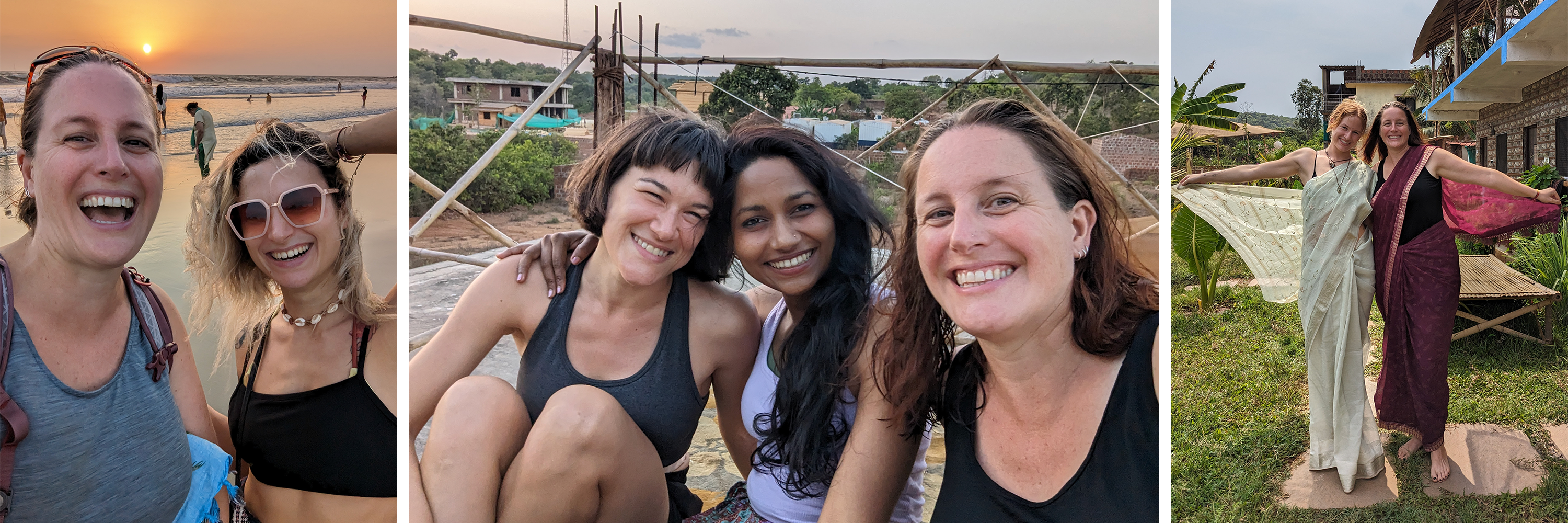
me & Gabi at the beach; Susanna, Pradnya, and me on the shala roof; roommate Mila and me
The training started and ended with ceremonies and Pradnya and I designed both of the mandalas that we gathered around. The rest of the students and staff were ripping the petals off all the flowers so we could fill in the outline. The training also offered a bunch of activities that were yoga-adjacent. In the heat, I was probably most excited for the ice bath experience in the middle of the day. Other folks struggled a bit more with the freezing water, but it felt a lot like jumping in alpine glacier lakes in the Sierras. Definitely cold, but tolerable.
beginning mandala, closing mandala, me in an ice bath in a barrel
Because of the heat, we had a lot of downtime in the middle of the day. I read quite a few novels while I was there, because even after a refreshingly cold shower, I didn’t want to do anything but hang out inside. I was perpetually washing my three yoga outfits since I would sweat through them every single practice. Our training was right at the beginning of monsoon season, so after big afternoon rain showers, the power would frequently go out for the rest of the night.
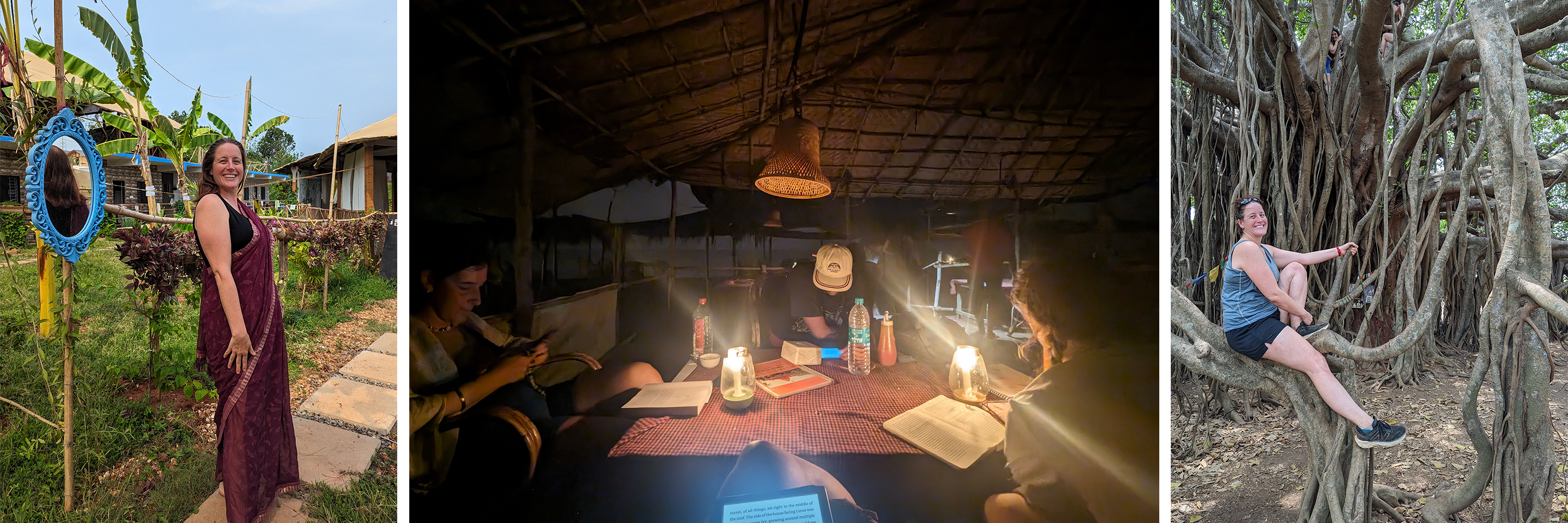
me in a sari at closing ceremony; Tina, Dheeraj, and Mila reading at a beachside restaurant when the lights went out, me in a ginormous banyan tree
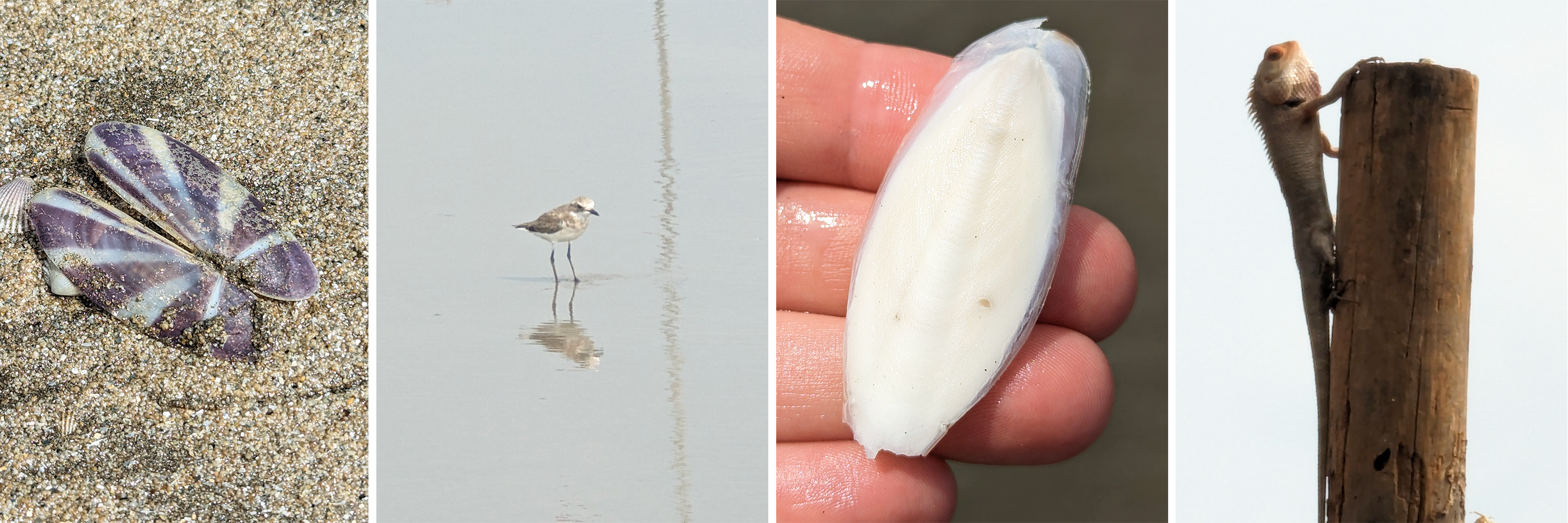
We spent a lot of weekends at the nearby beaches of the Arabian Sea. There were always a lot of stares from Indian men, but we eventually found some spots that were a bit more isolated without as many onlookers. Pradnya taught me the Hindi word tharki which roughly translates to pervert. It sounds a lot like the English word turkey and it became an inside joke about yet another “Uncle Tharki” whenever men came over to try and take photos of us. India is hard travel for women. We did find a bunch of cool shells and lots of cuttlefish bones washed up on the sand.
One of the perks of the shala was the random wildlife living around us. There were a couple of lizards that joined us for our morning breathwork. Sometimes we stopped in the middle of practice to watch the pack of langur monkeys that came scampering over the roof. Darkness and rain brought out frogs that lived around the stairwell. There were also some lovely large spiders and grasshoppers always hanging about.
friends at the shala: Indian tree frog, pantropical huntsman spider, grasshopper, Malabar gray langur
Yashwantgad Fort
The yoga place did arrange one really fascinating trip just over the state border into Maharashtra. On the way there, we got pulled over by the police and our driver didn’t have his identification on him, so they had to offer him some Gandhis (Indian rupee bills all have Gandhi on them) so we could keep going.
We spent the morning at the beach, but eventually went on a tour of Yashwantgad Fort near the town of Redi. In my ignorance, I figured it was a Portuguese colonial fort, but, no, it was built in the early 1700’s by the ruling Marathas. At that time, the Maratha Empire (aka as the Confederacy) covered most of the territory of present-day India. However, there was a lot of fighting between local groups and this fort was built to shore up their defenses along the coast. Eventually the British, starting on the east coast, started chipping away at the edges of the territory and eventually took over almost everything.
The fort itself has a storied history with the Portuguese eventually claiming it and the Marathas fighting to get it back. Regardless, the fort is still stunning today. The Indian government has done a huge amount of reconstruction work and it is in beautiful shape. The best part are the huge trees growing in and around the fort making intricate abstract patterns. It reminded me a lot of Ta Prohm, a temple in Angkor Wat, that also has trees growing out of its roof. This was definitely one of my favorite places on the Indian part of my trip.
beautiful archway, round parapet, tree roots slowly reclaiming the fort
views of the courtyard, more trees growing out of the fort, overlooking the beach where we swam
Panaji (also known as Panjim) is the capital city of the state of Goa. I arrived there on May first, which was Labour Day (labour spelled with a u because of the British). Almost everything was closed and the streets were relatively empty, so I just wandered around town.
There was a huge parade of workers walking from one side of town to a gathering in the central park. It was fascinating to see all the different groups coming together. I saw banners for brewers, concrete workers, and beach club employees. There is a small river that runs near the city and there’s a shaded boardwalk that meanders through the mangroves that grow on each side of the river.
Although India is often associated with British colonization, Goa was originally a colony of the Portuguese. Vasco de Gama and his crew were the first to arrive, and by the early 1500’s the Portuguese had established a significant stronghold in the area. This part of India remained part of Portugal until the 1950’s when they achieved their independence. They ultimately voted to become a part of the rest of India which had become independent in 1947. The signs of Portuguese influence are everywhere. For example, in the center of Panaji stands the Immaculate Conception Church, built in 1541 to serve Catholic Portuguese sailors.
Labour Day parade, Immaculate Conception Church, mosaic bridge over the Rio de Ourém
The parks of Panaji are decorated with some interesting sculptures. The one in all the tourist books is of Abbé Faria, a Goan Catholic priest who was a master of hypnotism. The central park contains a modern sculpture dedicated to Tristão de Bragança Cunha, an anti-colonial activist who called for Goan independence from Portugal. He was arrested for organizing against Portuguese rule and spent several years in prison. Once released, he continued his liberation work and published a newspaper dedicated to the cause. My favorite sculpture, though, was probably the awkwardly helmeted Indian gaur planted right next to the main road.
statue of Abbé Faria hypnotising a subject, sculpture dedicated to TB Cunha, Indian gaur
I stayed in the Fontainhas area of Panjim when I was there. It’s a UNESCO World Heritage site due to the colorful houses dating to the time of Portuguese rule. In addition to the white churches, there are also relatively recently built Hindu temples. There are more Hindus in Goa now, but there are still many practicing Christians.
One of my favorite parts of Panaji was the colorfully decorated stairs all over the Fontainhas area. It was probably over 100F and I was sweating profusely. Not much was open, so I just kept walking along abandoned streets, turning randomly at corners, and truly just stumbled upon these hidden gems.
bottom of stairway decorated with books, rainbow stairs, peacock stairs
Goan Food
The Portuguese influence is definitely reflected in the food. Xacuti was traditionally a coconut curry dish usually prepared with seafood, but is now offered in a variety of meat (and meatless) options. This is often served with poi, a small bread with a pocket, similar to a pita. On Labour Day, only a few restaurants were open, but I found the air-conditioned all-vegetarian Cafe Tato and it felt like I’d walked into paradise. I ate there probably 3 or 4 times and everything was delicious. It’s an iconic establishment that serves up awesome food all day long, but is known for its breakfast. That morning, I ate sukhi bhaji, a potato dish with a side of deep-fried puffed puri and a perfectly sweetened cup of masala chai. On another trip, I had batata wada, basically fried potato fritters. I have some more Indian food to share, but I’m going to leave the rest for another post.
xacuti with poi, suki bhaji with puri and masala chai, batata wada
Cashew Festival
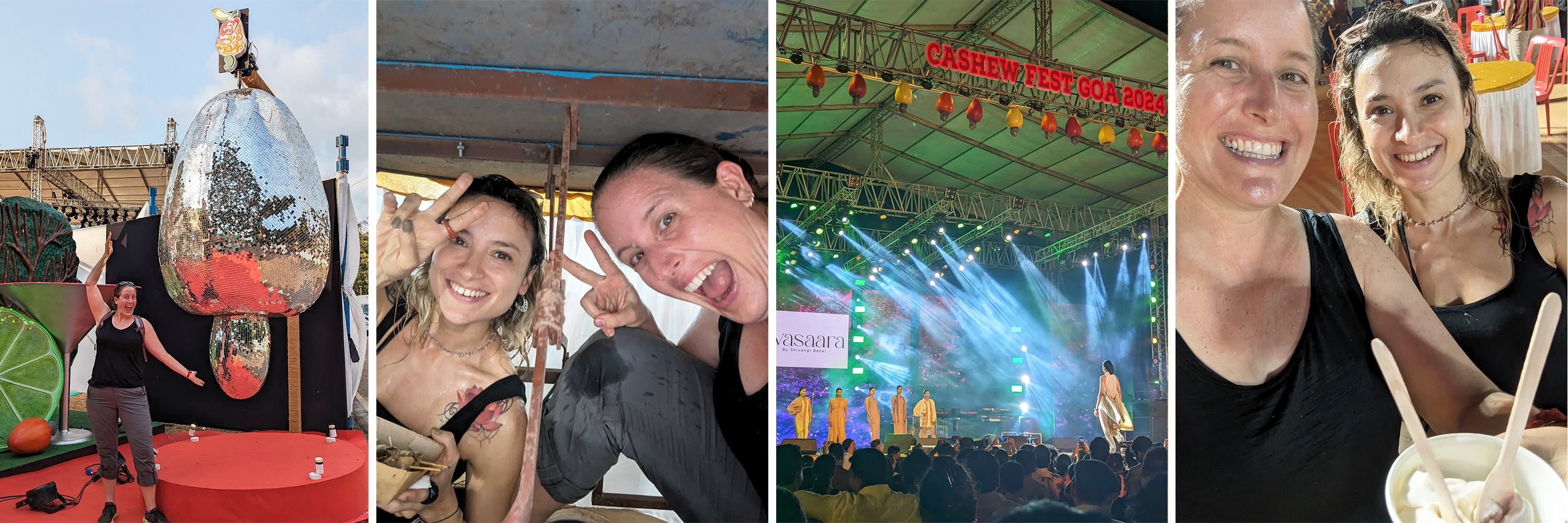
I ended up in Panaji a few times during my month in Goa, but I want to highlight one special day. At the time, I was doing a yoga teacher training about an hour away, but another student Gabi and I taxied in for the Goa Cashew Festival. Cashews grown in Goa are sold all over the city and many local and foreign tourists return home with bags of these nuts. The festival was held in a big open space with a glittering disco ball cashew welcoming us to the festivals. In case you don’t know, the nut of the cashew actually hangs out from the bottom of the fruit. The fruit itself is very astringent, and to be honest, I’m not a big fan.
All around the festival square were local restaurants selling cashew-based dishes and a few agricultural initiatives showing off different cashew varieties. There was a huge stage set up for a cashew-inspired fashion show and tons of little booths selling cashews with lots of different flavors. (My favorite was the Sriracha.) We got hit with an unexpected downpour and ended up hiding under a table to eat our cashew dinner. The rain finally stopped long enough for us to grab some cashew ice cream before we had to head back to the shala.
me and the disco ball cashew, Gabi and I hiding under a table, fashion show, enjoying our cashew ice cream
From Jaldapara, it’s about a 4 hour drive to Darjeeling. I didn’t have a lot of time, so I hired a taxi and off we drove through the turning, winding backcountry roads of West Bengal. This part of India is near the border and there are many signs of the historical movement between India and neighboring countries. There are Buddhist temples, prayer flags, and restaurants advertising momos in most small towns we passed through. In the case of the Gurkhas, the border crossed them. Gurkhas (or Gorkhas) are Nepali-speaking Indians who I had heard about before in a military context. They first fought against the British East Indian Company in the Anglo-Nepalese War. The British lost many battles before they finally won enough to force a peace treaty which gave them access to land outside of India. Later, the Gurkhas fought in the British Indian Army during World War II. Even today, they are still heavily recruited for many armies around the world. Because they speak a different language and have different customs than other Indians, they have experienced ethnic discrimination and violence. In response, they started a movement to establish a Gorkhaland state (carved out of West Bengal) in an effort to attain more political and social power.
In addition to the Gurkhas, there are Tibetan refugees who fled their home, starting after the 1959 uprising which caused the Dalai Lama to move to India. That immigration pattern has continued through subsequent Tibet-China disputes. There are also Bhutanese who left their country in political protest before the democratic reforms were instituted in the last twenty years.
During British colonization times, Darjeeling was set up as a summer retreat for British officials. It’s known as a “hill station” because it was a station in the hills, much cooler than the lowlands. That is still true today and I met a Bengali couple who had come to Darjeeling to escape the super hot temperatures (45 C/113 F) in Kolkata. The British started growing tea in the countryside, and there are still tea plantations sprawling out from the town in just about every direction. Because I only had a couple days, I didn’t actually make it to out to any of them, but I did buy a bunch of tea to see if I could taste the difference between leaves from the first flush (spring harvest) and those from the second flush (summer harvest) once I get home.
en route to Darjeeling: motorcycle moving mattresses, funny faced Assam Macaque, tea at the very British establishment Glenary’s
Toy Train
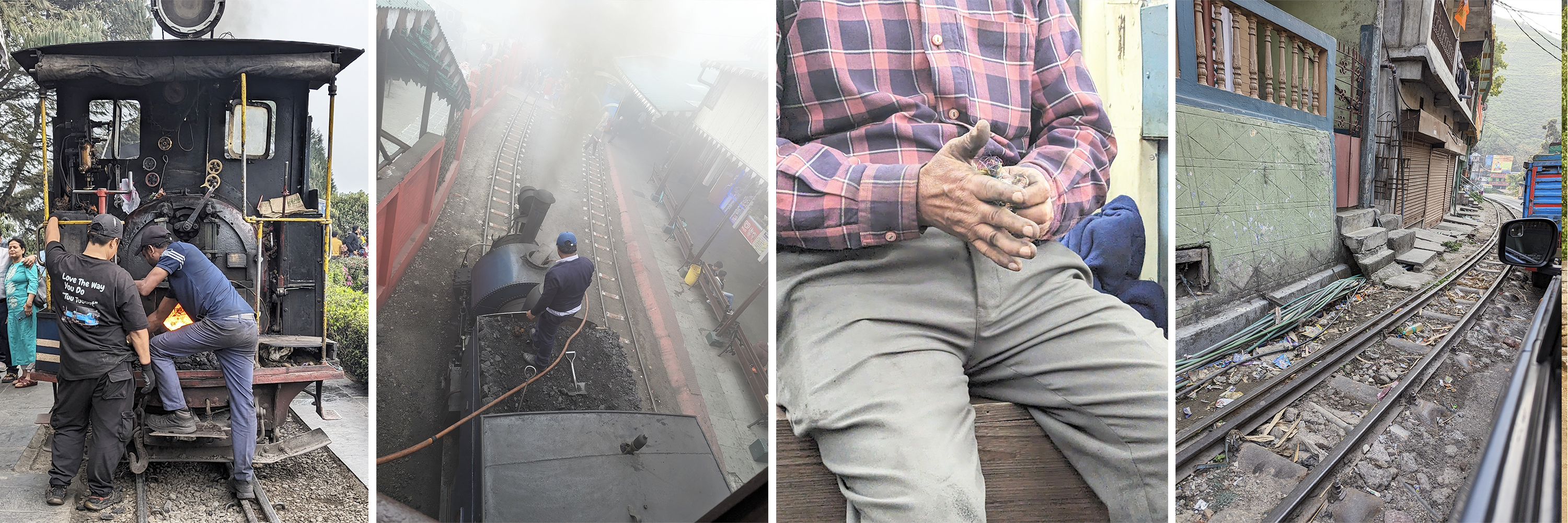
The Darjeeling Toy Train gets its name from the fact that it operates on tiny engines and narrow gauge rails (2 ft). I managed to, once again, wade through the bureaucracy of opening an online account for an Indian government agency and reserved a spot on one of the sightseeing trips that goes to the nearby town of Ghum and then returns. There was a choice of authentic steam engines (running on coal) or diesel engines and I went for the original coal that included an extra fee. In retrospect, I might have chosen diesel, because the coal-powered train produced a lot of smelly smoke that entered into the passenger cars while the train chugged up the hills.
stoking the coals, lots of steam, train worker’s hands, tracks alongside buildings
The trains don’t move very fast along and there’s a stop at the Batasia Loop which is how they used to get the trains to change directions within a small amount of space while keeping the train on the tracks. The loops basically function the same way freeway on-ramps work today. On a different section of the track, the train has zig-zag switchbacks to climb altitude quickly. Imagine a zig-zag track going up the side of a mountain. The train goes from one section to the next by first climbing forward, pulling into a level area, switching the track, and then reversing backwards up the next section. There’s a little train in Northern California that does this and it’s quite an experience.
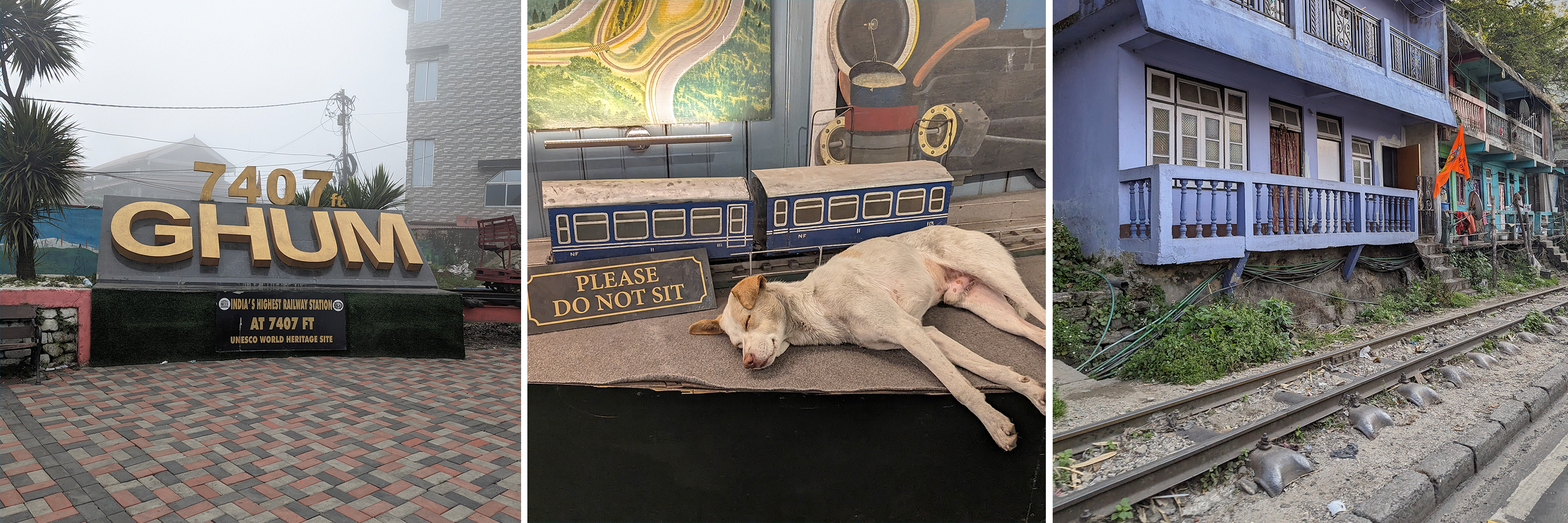
One of the best parts of the ride is seeing all the nearby buildings. The tracks are right in the middle of these small towns and the walls of these houses shake every time a train comes through. Because the train is moving so slowly, it’s easy to people watch and enjoy the scenery. Upon arrival at Ghum station, the train stopped for the workers to fill up on coal and for the tourists to get a bite to eat and visit a small museum. Inside was an article about Mark Twain (a fellow native Missourian) riding the railway in 1896. Although there are many quotes associated to the man that are not actually true, apparently he wrote that the day riding the Darjeeling Toy Train was “the most enjoyable day I have spent on Earth.” This is probably because he rode down from the Ghum station to Darjeeling in a hand-car at whatever speed gravity propelled them and that surely must’ve felt like an extended roller coaster ride moving rather quickly around the loops and turns.
Ghum station, dog following rules in the train station (the sign says nothing about lying down), more buildings close to tracks
After the museum, I opted for some warm masala chai in a clay cup since it was quite a bit chillier at the higher elevation. Darjeeling is surrounded on all sides by the Himalayas, and its known to have spectacular view of the third-highest mountain in the world, Mt. Kangchenjunga. Unfortunately for me, it was foggy and cloudy every single day I was there, so my views were not very breathtaking.
When traveling, I’m a big fan of trying all the candies and treats that I can’t get in the United States. Although I am not a huge fan of Snickers, the kesar pista (saffron pistachio) version was actually pretty tasty. Cadbury Gems are basically M&M’s and the Cadbury Fuse is basically peanuts, creme and caramel.
chai from Ghum station, view of Kangchenjunga, Indian treats
Himalayan Mountain Institute
One of the ongoing jokes from my trip to Bhutan was my desire to see a red panda. My guide kept telling me we might see one on our Merak-Sakteng trek or along the drive back to Paro, but eventually we were at lower elevations and it was clear that it wasn’t going to happen. Once he found out I was going to Darjeeling, he assured me I would see one there and he was right. The Darjeeling Zoo has a few of these adorable creatures on display. These are not closely related genetically to the giant panda at all, and are much closer to raccoons and skunks. Scientists have placed them into their own family branch that belongs to only them and their now extinct ancestors.
Inside the zoo is also the Himalayan Mountaineering Institute whose first Field Director was Sherpa Tenzing Norgay. Along with Edmund Hillary, they were the first people to reach the top of Mount Everest in 1953. The Institute was set up shortly thereafter to encourage others to participate in the sport. The museum includes clothing and equipment that was used in the early days of mountaineering.
red panda, quote from Tenzing Norgay, statue of the famous Sherpa
Many weeks have passed, but I wrote this the day I left Bhutan: One of the things travel does for me is that it reawakes my sensitivities to the world around me. I arrived in Bhutan, jet-lagged and tired from two days of long travel and I remember looking out the window from the car from the airport. Everything was new to my eyes. Prayer flags everywhere. Intricate wooden construction of houses, painted in meticulous detail. I remember thinking everything was beautiful, but also everything was so different from everything I know and understand.
Although it has only been two weeks, I’m leaving and the leaving is also tainted with sadness. The buildings no longer look strange. The prayer flags blend into the background of every scene. The things that once stirred me to wonder are just a part of the world I’m in. And I think that’s what brings the sadness – the leaving of comfort, the leaving of familiarity, the leaving of kindness and friendship of people who I still barely know.
It’s always a weird feeling to be going off on my own again.
Entering India
It was immediately apparent that I was no longer in Bhutan. That atmosphere had changed completely. Calm, chill, peaceful, green. Chaos, trash, noise, city. I was joking with our driver that he hadn’t used the horn in four hours of driving in Bhutan, but had used it three times just getting from the border to our parking spot in India. He definitely possessed bicultural driving skills.
My guide Tenzin got me through all the border shenanigans of stamped paperwork. He had gone to school in Darjeeling and was chatting away in Hindi with all the border guards. In addition to Dzongkha, he speaks a local dialect of the language used in his village near Trongsa, Hindi, and English.
Before finding me a taxi to my next stop, we all went out to get lunch. On the way, a bunch of cattle came sauntering down the street. Tenzin practically tackled me to make sure I didn’t get run over. Another few cattle came by and although they weren’t moving so fast, one of them swung their poop-covered tail in my direction leaving a giant brown mark across my shirt and my right hand. Our driver was similarly splattered. Welcome to India.
I cleaned myself up at the restaurant and had a lovely meal of masala dosa before being packaged into a taxi and sent on my way to Jaldapara National Park, located a mere hour away from the border crossing. Once out of the border city of Jaigaon, the honking and general noise gave way to acres of tea plantations and relative calm.
Jaldapara National Park
Even a couple weeks before we started the trip, my post-Bhutan plans kept changing. Originally, we were going to leave through the border on the eastern side of Bhutan into India. Our tour agency thought that border might open up by the time we got there, but it was still closed. This meant we needed to do a massive reroute ending up back in Paro at the end of our trip. I had a week of free time and had originally planned on going to see Indian rhinoceroses in Assam province. Trying to formulate I new plan, I pulled up Google Maps and just started looking around to see what was near the western border crossing with India. Lo and behold, there was a national park nearby that also had rhinoceroses!
And that is how I ended up in Jaldapara National Park. This is definitely a local tourist destination for families. People drive in from nearby cities to get a taste of nature. The park itself has a couple of lodges, so I was able to stay right inside the front gate after negotiating what can only be described as Indian government technological bureaucracy. There were so many online hoops to jump through for no reason at all. Regardless, I made it to the park and the nice guy at the front desk helped me book a safari for that evening with another family.
me and Tenzin and our dosas, Indian peafowl, gaur
The safaris are touted as gypsy safaris, which was super confusing to me at first, especially because that’s a term that is now considered a racial slur of the Roma people. Although Romani are often associated with living nomadically in Europe, according to genetic research, they were most likely originally from Northern India and left about 1000 years ago. Their original caste name in Sanksrit was Doma, which referred to a people who made their living by singing and playing music. That made them dalits, low-caste untouchables without many rights and privileges afforded to members of higher castes. Although many of the laws segregating Indian society into castes have gone away, socially the caste system and discrimination caused by it is still very real.
With some more research, I found out that the term gypsy refers to the Maruti Suzuki Gypsy, which was a four-wheel drive vehicle that was very popular with the Indian army and police. They are no longer manufactured for the general public, but Suzuki still continues to make them for the army. I tried to find out why Suzuki named the cars gypsies, but there wasn’t much about their origin story online.
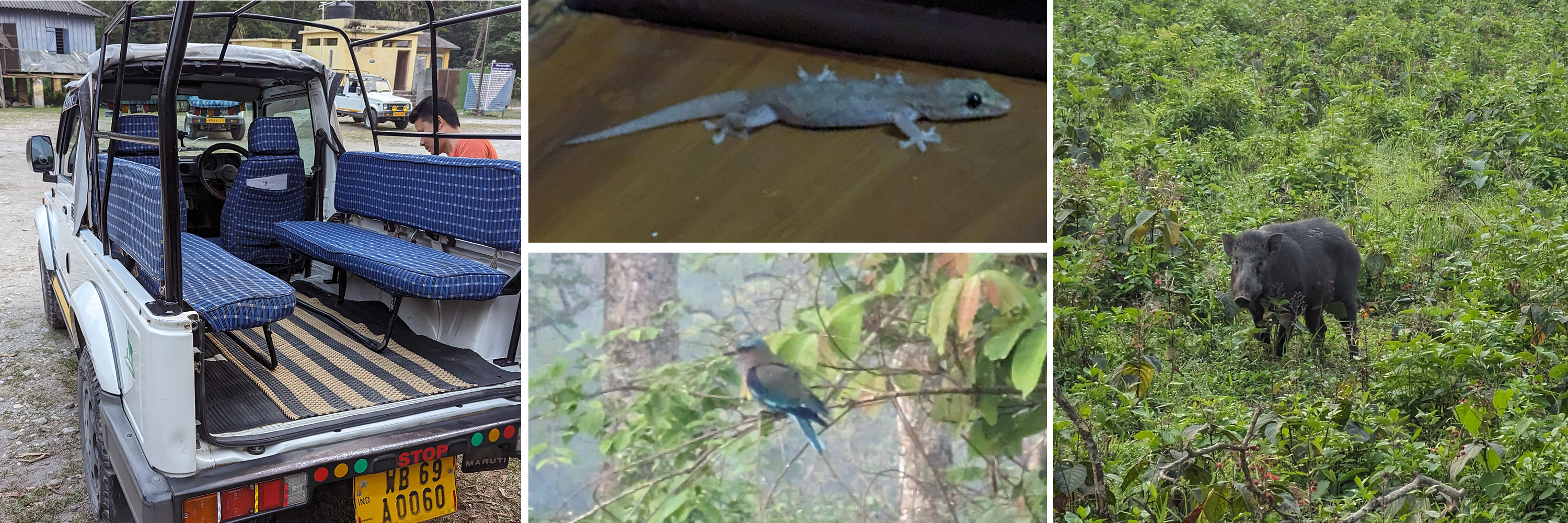
The cars can hold up to six people in the back and have a driver and guide in the front pointing out different flora and fauna along the way. I went on one tour at sunset and another one at sunrise, and ended up seeing a lot more during the evening tour. We did see one Indian rhinoceros from very far away. My phone has 30x zoom on it, or all I would’ve see was a blurry gray blob. I did manage to see an Indochinese roller, which reminded me so much of the lilac-breasted roller that I saw on safari in Tanzania and Zimbabwe. All of the rollers have such magnificent colored feathers. I think if you wanted to turn someone into a birder, you should get them watching rollers in the wild. Just stunning. I’m also a fan of the hornbill, with its fun calls and strange looking beak.
gypsy vehicle, Asian house gecko in my room (top middle), Indochinese roller (bottom middle), wild boar
Indian rhinoceros, planted fields, Oriental pied hornbill
Probably one of the most amazing moments was when we went to the Hollong Tourist Lodge. In front of this place, they’ve set up salt licks, which are basically giant blocks of salt that the animals come and lick. During the evening tour, a giant herd of elephants came to visit through the trees and we stayed for a long time just watching their slow and steady movements.
sambar, Asian elephants, Eastern cattle egrets
As part of the evening tour, young women of the Bodo (or Boro) tribes performed some traditional dances. The Boro people are traditionally from Meghalaya and Assam province and were originally part of a large number of different tribes that slowly merged into one larger identity. From my very brief research, the early Boro leaders and elites seemed to have created an existence for themselves outside of the Hindu caste system, by defining their caste as Boro on census reports. They still have control of the autonomous region of Bodoland in Assam to this day. Because of our elephant watching our group actually arrived a bit late, but I did get to capture this catchy music and dance performance that highlights their fishing traditions.
We stopped on the way back to Paro to see the Tachogang Lhakhang Bridge which was built over 600 years ago. Now it has an additional support structure, but this was forged from iron with wooden supports by Thangtong Gyalpo in the late 1300’s. This guy made over 100 bridges all over Bhutan and Tibet and this was the first ever bridge built in Bhutan.
view of bridge, up close of chain link, last jumping picture of the four of us
Paro
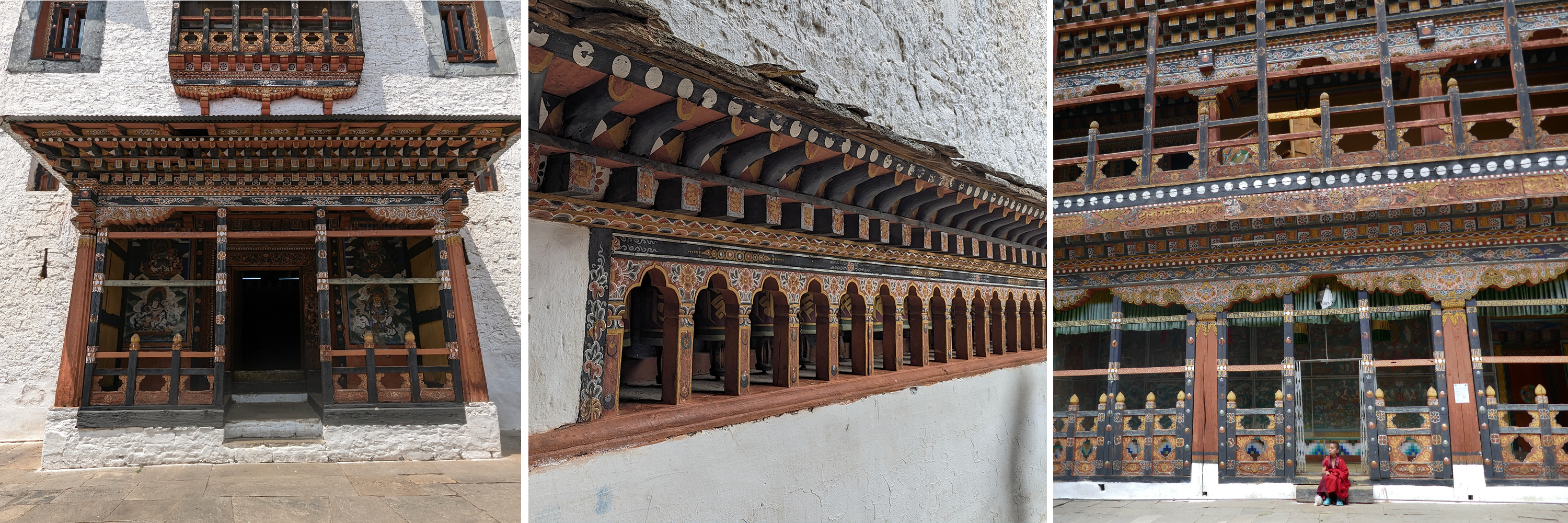
Angela and I actually did almost all of our Paro sightseeing at the beginning of the trip, but I got too excited to blog about our Eastern Bhutan adventures to write about it then. Our very first stop in the city was the National Museum of Bhutan set inside a watchtower overlooking the town. I remember feeling completely overwhelmed with all the information. There were so many Buddhist deities and Bhutanese historical figures to wrap my head around, while still dealing with jet lag from just arriving that morning. After the museum tour, we headed out to the Paro Dzong.
watchtower, Angela and the Paro Dzong, inside the Paro Dzong
This was the first dzong we visited and it functions the same way as the others we saw: part is for governmental administrative purposes and part is for monastic religious purposes.
decorations inside Paro Dzong, row of prayer wheels, monk-in-training
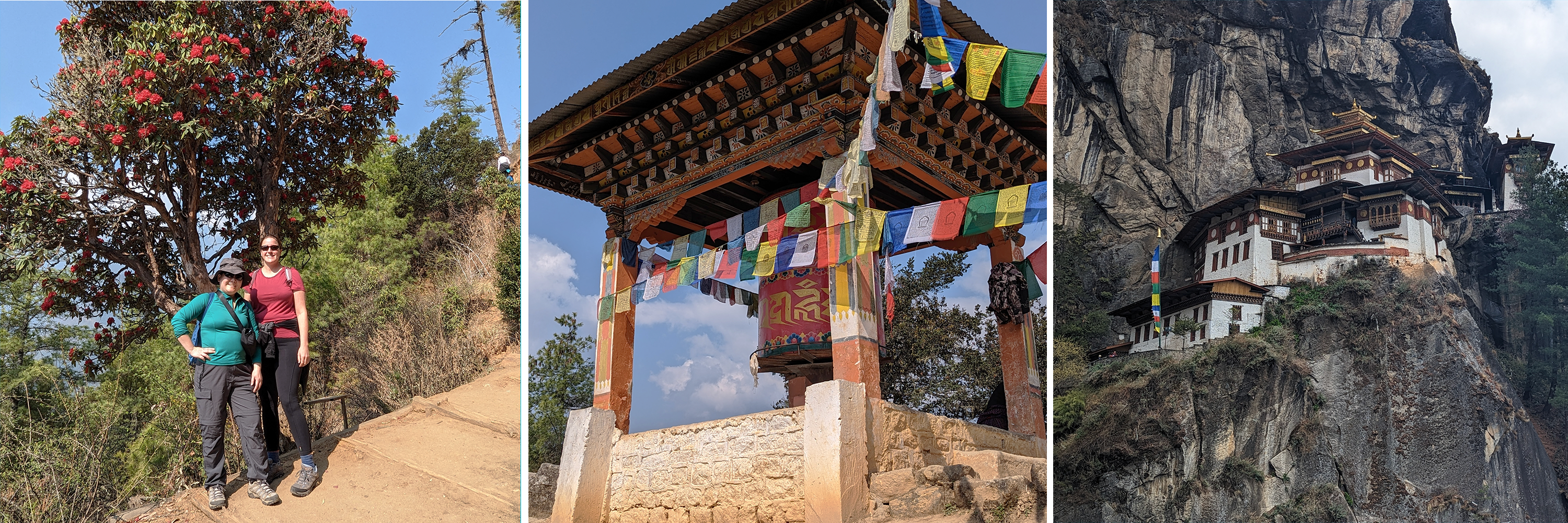
Our second day in Bhutan, we set out for one of the most notable sights in Bhutan: Tiger’s Nest Monastery. It’s built into the side of a mountain and is probably the most picturesque structure in all of Bhutan. It’s not that long of a trail (only 3-4 miles), but the elevation gain is 1500 ft and Paro is way over a mile above sea level (7200 ft). We took it real slow and huffed and puffed our way to the top. I was moving a bit faster than Angela on the way up, so I asked Tenzin to start teaching me the numbers in Dzongkha. It seemed pretty easy at first, and I got through 1 through 5 without too many problems (chee, nyi, zhi, sum, nga). My brain kept screwing up the order of the higher numbers though, but we both managed to learn up to ten by the time the day was over.
Once we got to the top, Tenzin told us the story behind the monastery, which stars our old friend Guru Rinpoche. He came to this location standing upright (think surfing) on the back of a flying tiger. This tiger was another form of his Tibetan consort Yeshe Tsogyal. Once he arrived at this spot in the mountain, he subdued a local demon and then meditated for three years, three months, three days, and three hours in a cave, thus, the name Tiger’s Nest. The whole monastery actually burned down in 1998 (probably from an overturned butter lamp) and was carefully rebuilt to match the original.
Angela & I and our first rhododendron, giant prayer wheel en route, Tiger’s Nest Monastery
I’m including the photo below so you can really revel in its dramatic beauty. And, yes, I took that photo on my phone.
Side Note on Stupas
Stupas are everywhere in Bhutan and there are often eight of them in a row and each of them are slightly different. They represent different stages of the life of Buddha. When there is a singular stupa, it is often connected to a specific individual or a specific event that a group of people are trying to commemorate. These stupas were all new to me, so when I had wi-fi one evening, I downloaded a cheat sheet of the 8 types of stupas and then it became a game to see if we could figure out the types of stupas we saw on the road.
The easiest one to identify is Nirvana, because it has a totally unique shape than the rest, more of a bell shape. The rest are a bit more subtle, but over time, I could see the differences a bit easier. At some point I made the comment that all these versions were “stupa-fying.” I have to admit to being rather proud of my dad joke. The stupas in these photos are fancier than most and I took them on the last day’s drive near a town called Gedu in the south. Note: In Bhutan, these are also called chortens which is the Tibetan word for a stupa.
Lotus Blossom Stupa (characterized by lotus flower carvings on four circular steps) – This represents Buddha’s birth. When he was born, he came out of the side of his mother’s body and then immediately stood and walked seven steps, and a lotus flower bloomed in each stop he had walked.
Enlightenment Stupa (characterized by four levels of steps) – This represents Buddha attaining enlightenment under the bodhi tree at the age of 35.
Many Doors Stupa (characterized by many openings that look like gates or doors) – This represents his first teachings to his five disciples in the deer park in Sarnath, which is located close to modern-day Varanasi in India. These ideas were entrances and pathways to understanding dharma.
Great Miracles Stupa (characterized by a center section that sticks out further than the surrounding steps) – This represents the miracles he performed in Shravasti, where he made flames come out of his shoulders and water come out of his feet. He then made the flames and water switch positions several times.
Lotus Blossom, Enlightenment, Many Doors, Great Miracles (click on the image to enlarge)
Descent from Heaven Stupa (characterized by three ladders in the center of the steps) – This represents Buddha’s return from his trip to heaven. He went there to teach the dharma to his mother who had already passed away.
Reconciliation Stupa (characterized by four steps with equal sides) – This represents the resolution of a schism between some of Buddha’s monks. His cousin Devadatta had tried to lead a breakaway group of monks, but Buddha sent two of his disciples and the situation was reconciled peacefully with the monks rejoining the main group.
Complete Victory Stupa (characterized by three circular steps) – This represents Buddha, at the age of 80, agreeing to live for three months after being asked to do so by one of his followers).
Nirvana Stupa (characterized by the bell shaped dome) – This represents Buddha entering nirvana into a state of true peace, beyond death.
Descent from Heaven, Reconciliation, Total Victory, Nirvana (click on the image to enlarge)
Archery is definitely Bhutan’s national sport. Even small villages have an archery range and the distance is way further than I’ve ever seen someone shoot, approximately 145 meters (476 ft), longer than an American football field. Olympic distance is 70 meters (230 ft), which is less than half of a typical Bhutanese setup. The targets are set on the ground and are only about 3 ft tall by 1 ft wide. When we visiting the Trongsa Dzong, there was a competition going on and the opposing team members just hung out on either side of the target when the other team is shooting. They have be to be remarkably accurate archers to be standing so close to an active shooting area. In this competition, they were all using fancy compound bows.
I kept teasing Tenzin that I would be a better shot than he was since I did archery at Girl Scout camp many years ago. When we were in Bumthang, we stumbled upon a tiny setup in the back of the place we had lunch. The target was only 20 meters or so away and we were using simple wooden bows. Tenzin went first and landed an arrow on the target in the first round. My arrows soared right over the top of the target. All four of us kept shooting and not a single other arrow from any of us hit the target. We, nevertheless, had a lovely time mocking each other’s terrible shots and I had to concede that Tenzin was, indeed, a slightly better archer.
We also played a round or two of khuru, basically lawn darts with a similarly small target. Tenzin managed to land a couple darts within the rings, but the rest of struggled with this sport as well.
Angela & Aja Pema, me & Aja Pema, lawn darts & target
Traditional Arts School
While in Thimphu, we took a tour around one of the country’s traditional arts trade schools. Students pick from one of eight pathways they are most interested in studying: mural painting, house painting, sculpture, tailoring, embroidery, woodcarving, mask carving, and metalworking (silver & gold). There are different accomplishments and time commitments based on the course. Mural painting is a six year course ending in a diploma, whereas house painting can be completed in one year ending in a certificate.
The school allows tourists to visit as long as they don’t disturb classes. Many of the students were already quite proficient in their art.
mask carving, stone carving, advanced ceramics
The work of the beginning ceramics class reminded me very much of a typical first-year high school class.
beginning ceramics pieces
One of my favorite parts was seeing all the math and patterns that were used to teach students proportions. The art in one monastery is very similar to the art in another monastery and this resemblance is possible because of the training received at schools like these. These complex rules and regulations don’t allow for a lot of individuality. On another day, we did visit VAST Bhutan, which is a group that exhibits more modern art by individual artists.
precision art: thangka mandala pattern, wrathful god mouth, Buddha proportions
Jungshi Handmade Paper Factory
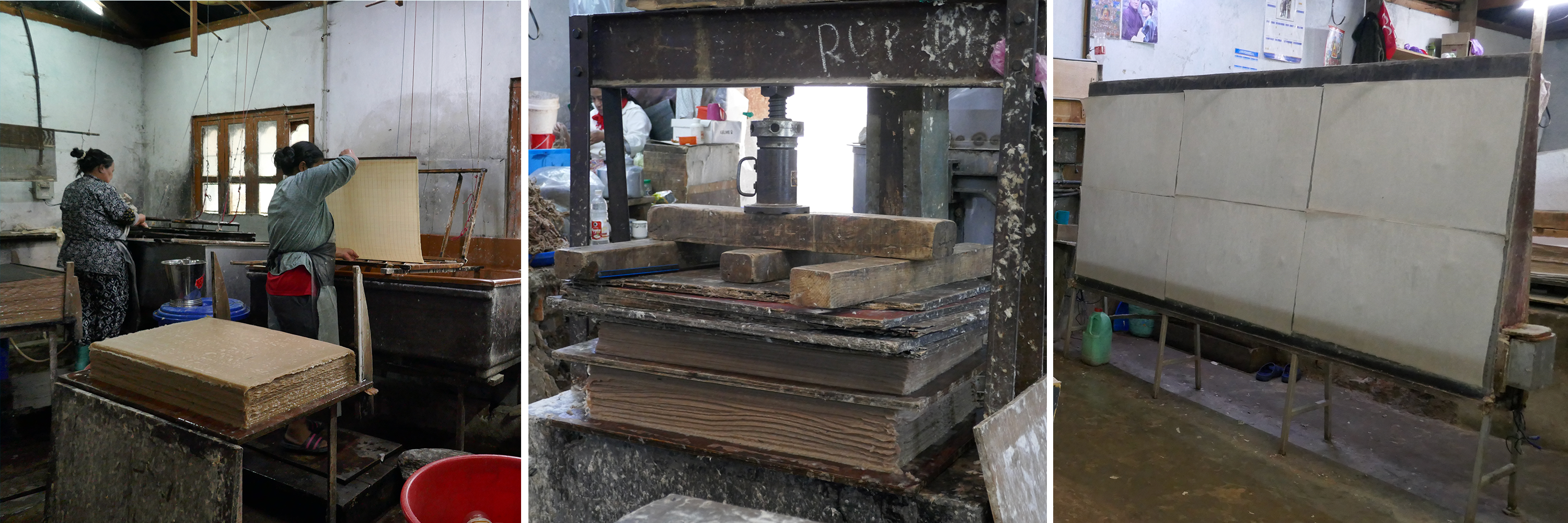
This was not my first paper factory tour, but it was my first daphne paper factory tour. The paper from this factory is made from a shrub with white, fragrant flowers. The first step is to remove the bark from the daphne plant and soak it in a giant tub. Afterwards, it is boiled and a crowd of workers tediously removes the unacceptable fibers. They then crush it and make a watery, pulpy mixture. That pulp is piled onto large, rectangular frames and the water drains out. This wet sheet is then transferred to a stack of paper and, somehow, they miraculously don’t stick together. They use a large press to squeeze all of the water out of the entire stack. In the end, one person meticulously moves each sheet of paper over to giant heated easels that speed up the drying process. After about fifteen minutes, the paper is dry. Some paper is sold as is, but the factory also produces books, stationary, and art as well.
removing the paper for, pressing the paper, drying the paper on specially heated boards
Nado Poizokhang Incense Factory
On the other hand, I have never visited an incense factory, so I was super excited to visit one. On the day we went, they weren’t making the dough itself, so we didn’t get to watch that part of the process. The recipe is a secret that has been modified from the original one that is 350 years old that came from a monastery in India. Their regular incense has over thirty ingredients, including juniper, saffron, sandalwood, agarwood, clove, cinnamon, and more. All the ingredients are organic and most are collected by yak herders.
After the dough is mixed, it is extruded through a machine into long coils. Those coils are set on tables and workers cut the coils to size and roll them out evenly. Afterwards, the incense is left to dry on racks, where it is separated into bundles and packaged for sale.
top (l to r): bags of smelly ingredients, rolls of incense dough, dough after it has been extruded bottom (l to r): rolling and cutting to size, drying incense on racks, bundles of incense
Before we left Punakha, we hiked up to see the Khamsum Yulley Namgyal Chorten. The terraced fields were stunning, and the monument itself is an impressive four-story affair, with a rooftop deck looking out over the surrounding area. It was built by the Queen Mother to help her son defeat any potential obstacles that he faces. Inside the monument, there are many paintings and statues of the wrathful god Vajrakilaya. This is a protector god who is usually depicted with three heads, six arms, and four legs. In two of his arms, he is holding a vajra, which is a Buddhist ritual object that represents a thunderbolt. (The Divine Madman, you might recall, named his phallus the Thunderbolt of Flaming Wisdom.) There are a lot of deities in Buddhism, and this is one of the gods I think I can now actually identify in a painting.
terraced fields of different crops, chorten, rows of stupas on surrounding wall
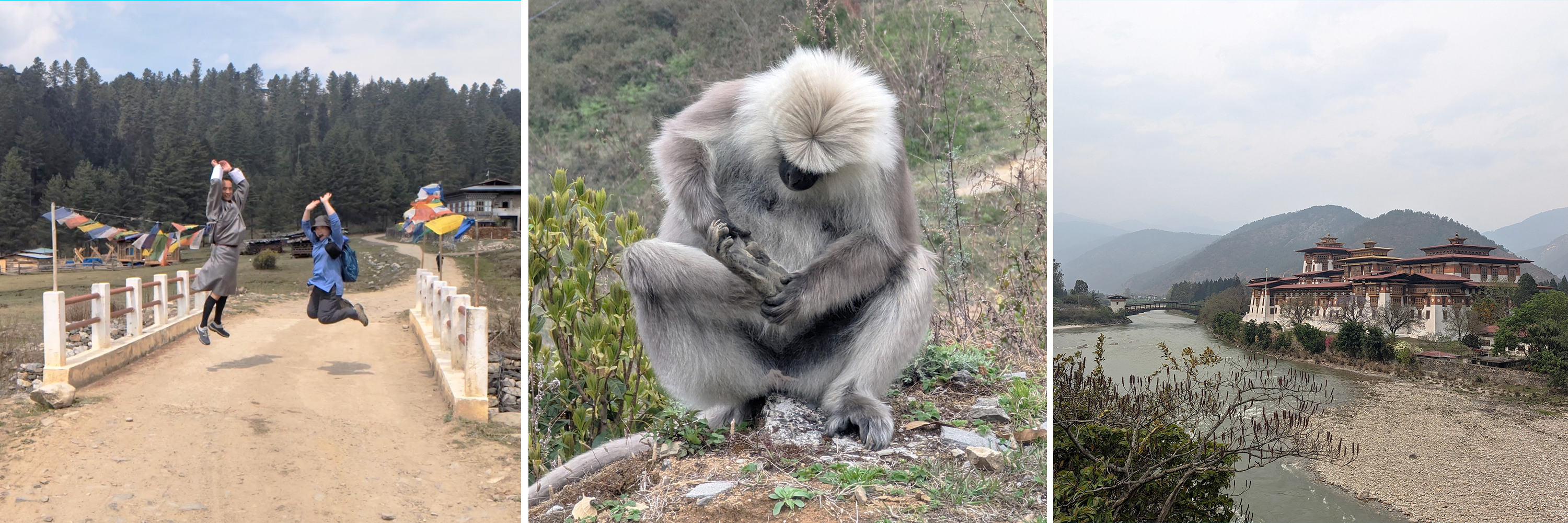
On the drive from eastern Bhutan, we started taking jumping photos with our guides. The first one was in front of a large monument, but then we took some on a bridge next to the Trongsa Dzong. Slowly, it became a ritual to take jumping photos whenever we found a bridge. Obviously, when we walked over the longest suspension bridge in Bhutan, we had to take some photos. We were pretty proud of these because it looks like we jumped way higher than we actually did.
Tenzin and me, Angela & Aja Pema
Onwards to Thimphu
The capital city of Thimphu looks and feels completely different than the rest of Bhutan. It was built in a meandering river valley, surrounded by hilly terrain. Unlike the quaint houses in small towns, Thimphu is full of government-subsidized multi-storied apartment complexes. Thimphu is the center of commerce and where most jobs are located. Many people who grew up in rural areas move into Thimphu to make more money than they can in their village. There are also a substantial number of Bhutanese moving abroad for educational and career opportunities. Many go to university in India or Australia and find ways to live overseas and send money home. Brain drain, the massive outward flow of educated citizens to other countries, is a real issue for modern Bhutan.
view of Thimphu driving into the city
I think one of the first times I ever heard about Bhutan was when the fourth king introduced the concept of measuring progress through Gross National Happiness. Basically, the idea is that non-economic aspects of life are as important as economic impacts (sometimes measured in Gross Domestic Product). The Gross National Happiness Index was developed to look at these other nine domains: psychological well-being, health, education, time use, cultural diversity and resilience, good governance, community vitality, ecological diversity and resilience, and living standards. Each of these domains has specific indicators and citizens are polled on their responses.
The fourth king brought the idea of Gross National Happiness to the United Nations and because of his work, the United Nations now produces an annual World Happiness Report. The Bhutanese version includes items specific to Bhutanese culture, including spiritual measures such as meditation and prayer. The UN version leaves much of this out, but basically asks people to answer how happy they are on a scale of 1-10. There is much discussion about whether there are better ways to determine happiness. However, using these metrics, Finland has been rated the world’s happiest country for several years. Out of 150+ countries, Bhutan usually ends up somewhere in the 90’s.
According to this one survey, Bhutan may not be the world’s happiest country. However, on their own index, they do continue to see positive progress from year to year, even after the pandemic. The fourth king was also responsible for overseeing the introduction of democracy. The king still serves as head of state, but in 2008, the new constitution established an elected Parliament. The country is slowly changing and opening up to outsiders and business, but the idea is to do this at a pace that allows the country to hold on to its identity and culture.
Thimphu is the center of all this change, where new and old come together. In spite of being the most populous city in Bhutan, there are still no traffic lights. At the busiest intersection in the city, a policeman directs the flow of traffic. Apparently a few were installed in 1995 but drivers ignored them, so they were removed after 24 hours.
The capital city is also home to a takin preserve. Takins are Bhutan’s national animal. The local story is that they were created by the Divine Madmen when locals asked him to perform a miracle in front of them. He said he would if he was given a whole cow and a whole goat for lunch. He devoured both of them, leaving only the bones. He then took the skull of the goat and attached it to the rest of the cow’s skeleton and then brought this creature to life. In case you’re wondering, mitochondrial DNA suggests they are closely related to mountain goats.
takin, biggest Buddha statue in Bhutan, cop directing traffic in Thimphu
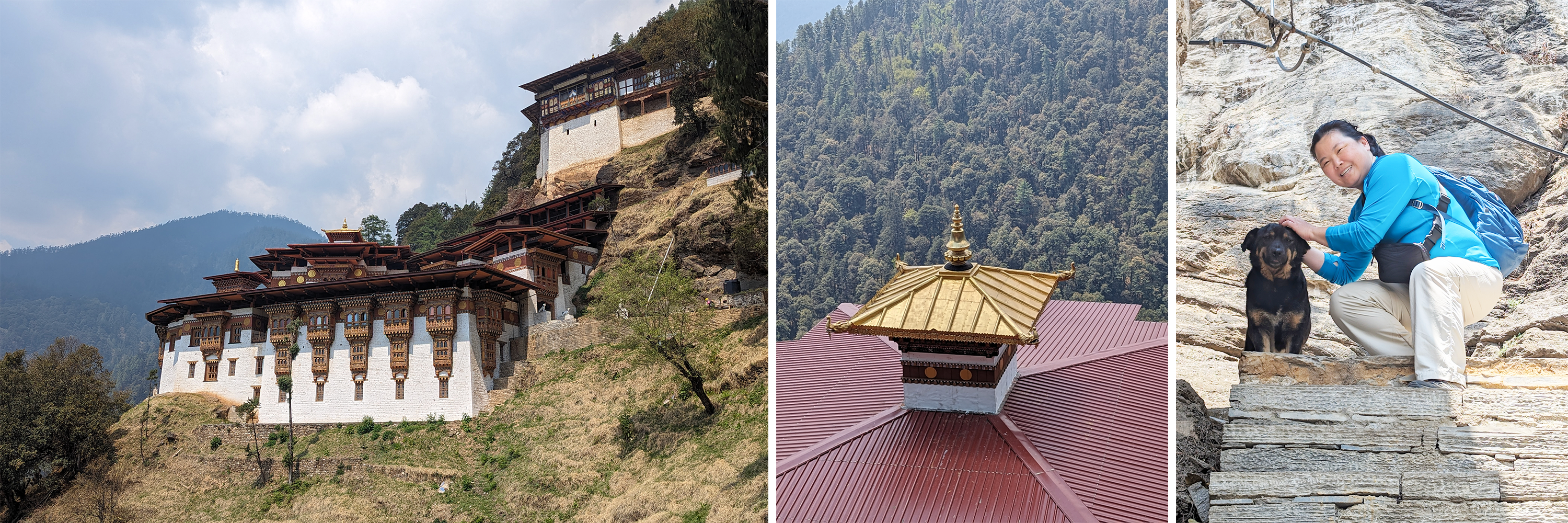
Thimphu is also home to one of the first monasteries established by Zhabdrung Rinpoche, the man responsible for uniting the eastern and western parts of Bhutan. He set up the Bhutanese government system of having both a spiritual leader (Je Khenpo) who runs the monasteries and an administrative leader (Druk Desi) who runs the government. Cheri Monastery was built into the side of a hill and it’s a pretty steep climb to the top. It recently went through a picturesque renovation, with new decorations both outside and inside.
view of Cheri Monastery, temple roof (notice the garudas on the four corners), Angela and her new friend
At the start of the hike there is a bridge. Of course, we took more jumping photos.
bridge jumps – me, Tenzin, Angela & Aja Pema
This bridge crosses the Thimphu River and there is a sign at this spot that recalls a local story. Apparently an enlightened master had seven children with his consort. In order to test the dharma of his children, he threw them into the river. Only four of them survived and were considered worthy to continue living. Regardless of that gruesome story, the view off the bridge was jaw-droppingly gorgeous. This is probably one of my favorite photos that I took in all of Bhutan.
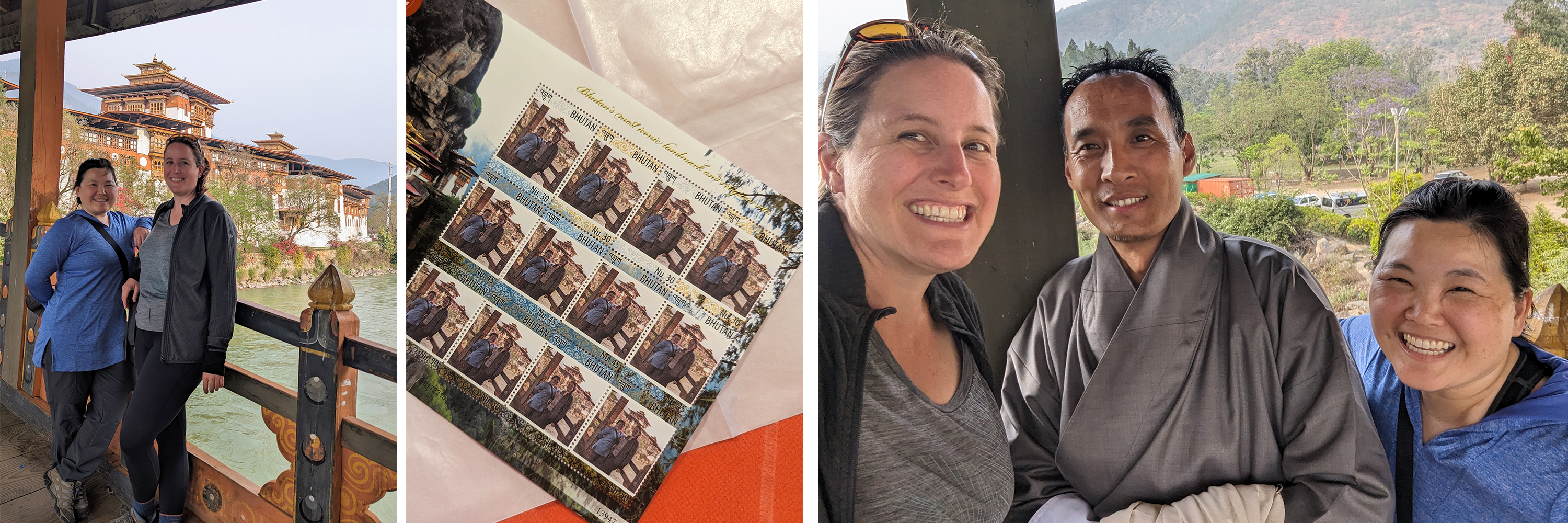
The last time I wrote, we were in Phobjikha Valley. After a lovely nature walk, we started our drive and our guides spotted a lively bunch of langur monkeys hanging out on the side of the road. They didn’t hang out for long, but one of them stopped to examine something stuck in its toes. It pulled out whatever was bothering it and put this toe treasure in its mouth. Apparently, tasty morsels can be found everywhere, if you’re a monkey. Eventually, we arrived in Punakha and we stopped to see the dzong, which was built on the scenic convergence of two rivers: Pho Chu (Male River) and Mo Chu (Female River).
Angela and Tenzin jumping in Phobjikha, en route we ran into some langur monkeys picking things out of their feet and eating them, the stunning Punakha Dzong
Although I think the Trongsa Dzong might actually still be more beautiful on the inside, the riverside setting of the Punakha Dzong makes its exterior more photogenic. The main temple inside the Punakha Dzong is quite large. This temple is where many ceremonies involving the royal family take place since it’s the only one large enough to accommodate all the invited guests. The outside of the temple is filled with intricate carvings and the inside is covered in paintings depicting Buddha’s life. Photography is prohibited inside all religious buildings.
beautiful wooden carvings on the main temple inside the dzong that is used for official purposes, Punakha Dzong lit up at night
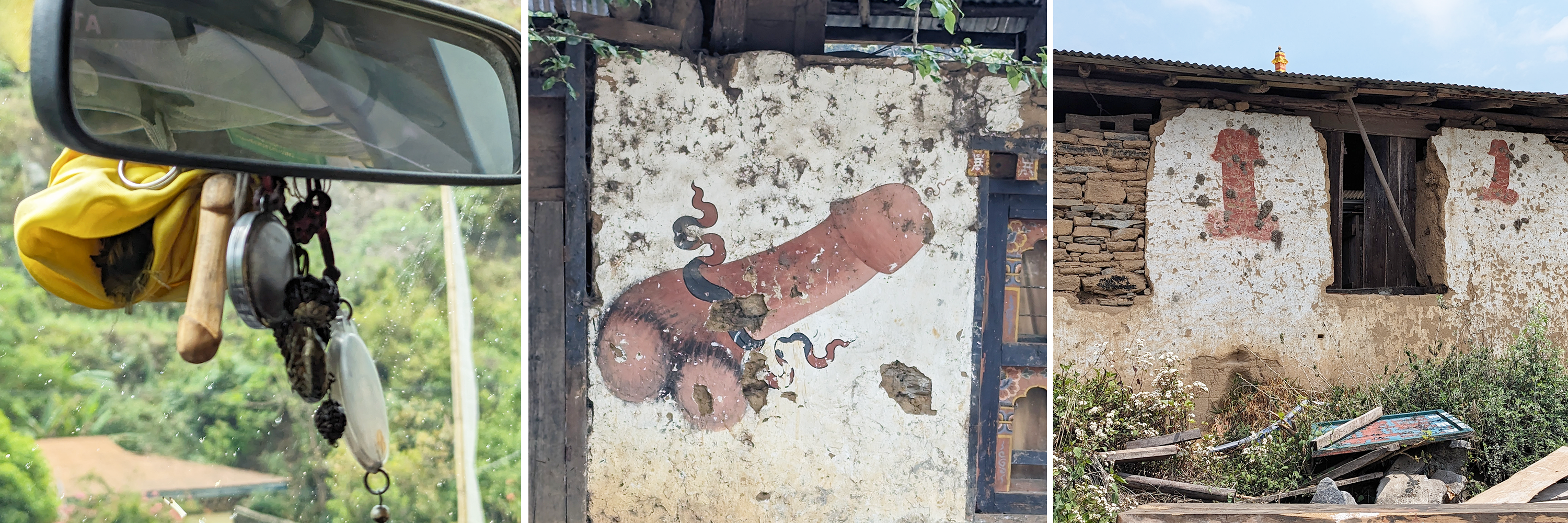
In order to get to the dzong, everyone crosses over a very scenic bridge over the river. Although we contemplated jumping on the bridge, there were a lot of people around and we didn’t want to seem disrespectful. Instead, we all posed for very tasteful photos with the dzong in the background. In the capital city of Thimphu, it is possible to have stamps made with a photo of your choice. We thought they just took a photo, but instead, we were asked to transfer a photo over from a phone. This was one of the most recent and cutest photos we had taken, so we purchased a couple sheets of stamps and a pile of postcards to send to family and friends. If you got one, consider yourself lucky, because those stamps had an extremely limited run of only 24.
outside of Punakha dzong; same photo made into stamps we sent home with our faces on them; me, Tenzin & Angela on the bridge
Divine Madman
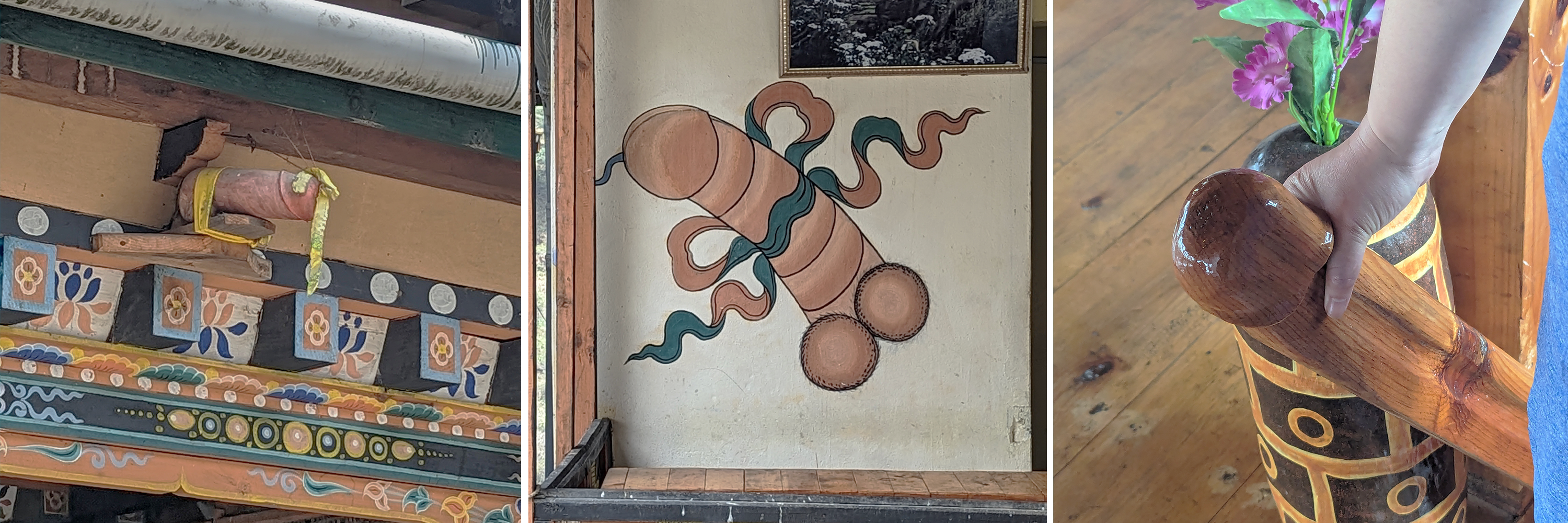
It doesn’t take long to notice that there are a lot of phalluses in Bhutan. They’re hanging from rooftops, painted on buildings, and used to bless tourists at festivals. Of course, there’s a story behind this, and it features a notorious monk named Drukpa Kunley, also known as the Divine Madman. He is usually depicted in paintings as having long hair, a bow and arrow, huge rings in his ears, and a hunting dog nearby. He was born in 1455 int Tibet and trained in a monastery before he later renounced his vows and took a wife.
The Divine Madman was a wandering Buddhist teacher, who started lecturing about different ways to reach enlightenment that included a lot of alcohol and sex. He used his Thunderbolt of Flaming Wisdom (a.k.a. his phallus) to subdue demons, in some cases by sticking it in their mouths. There are many stories about him seducing married women, and then their jealous husbands are converted to his ways and become an ardent follower of his teachings.
There are also stories of a Buddhist nun getting pregnant and having his child. However, the other nuns are jealous, but about a year later, there are a bunch of babies in the monastery, presumably from a very busy Drukpa Kunley. It’s easy to see why he’s associated with fertility in today’s Bhutan. Many people flock to Punakha to visit his temple, known as Chimi Lhakhang, to receive blessings and pray to have a child. There is an entire album of photographs inside the temple of people with their children they conceived after they visited. Those children are often given the name Kunley (after the monk) or Chimi (after the monastery).
good luck phallus in the car, intricate phallus painting on a storefront, double phallus decorations in a village
Today, the phalluses all over the county are meant to ward off evil spirits and malicious gossip. They are often hung from the eaves of the roof once a home is built. The paintings often depict phalluses with a string wrapped around the middle. Apparently, someone gave the Divine Madman a sacred thread to wear around his neck. However, he instead tied it around his phallus and said he hoped it would bring him luck with the ladies.
two crossed phalluses hanging from the corner of a house, painted phallus, handrail phallus carving
Although this phallic obsession is attributed to the Divine Madman, there’s been some research that shows that phalluses played a central role in the Bon religion, the animistic religion practiced in Bhutan before Buddhism became so widespread. Regardless of their origin, they continue to be a vital part of Bhutan’s cultural traditions today.
The most important part of every Bhutanese meal is a small dish of chilies, known as eezay. There are many different varieties of eezay. Some are nothing more than piles of red chilies; others are mixed with cilantro and other herbs. Often, the restaurant food caters to Western tourists that prefer their food on the blander side. I, however, prefer my food with a little more spice and by the last week of the trip, I just asked for a dish of eezay at every meal.
bag of chillies at the Paro market, old school giant mortar and pestle used for crushing chilies, side dish of eezay
Food in Eastern Bhutan
The food from our homestay in Merak was delicious. Every morning, we got thueb, red rice porridge with little cubes of paneer (homemade cheese). We also got a pile of fried red rice, a hard-boiled egg, and a cup of butter tea.
On our day-long Merak-Sakteng trek, our porters carried lunch for us and I got my first taste of my favorite Bhutanese food, nakay datshi. This is a dish made of fiddleheads, the fronds of the fern before they unravel in the spring. I’ve definitely eaten fiddleheads in the United States, but they’re pretty rare and often just sauteed in a simple butter sauce. These were cooked in a cheese sauce with chilies; something about this flavor combination is extremely satisfying. Datshi means cheese in Dzongkha and is featured in many dishes in Bhutan. For example, kewa datshi is potatoes with cheese (kewa means potato) and shamu datshi is mushrooms with cheese (shamu means mushroom). The amount of chillies in each dish depends on the preference of the chef.
Merak trek food (clockwise from left): eggs, mixed vegetables, eezay (chillies), rice, and nakay datsay; Angela getting her daily portion of thueb; drinking butter tea
Food in Central Bhutan
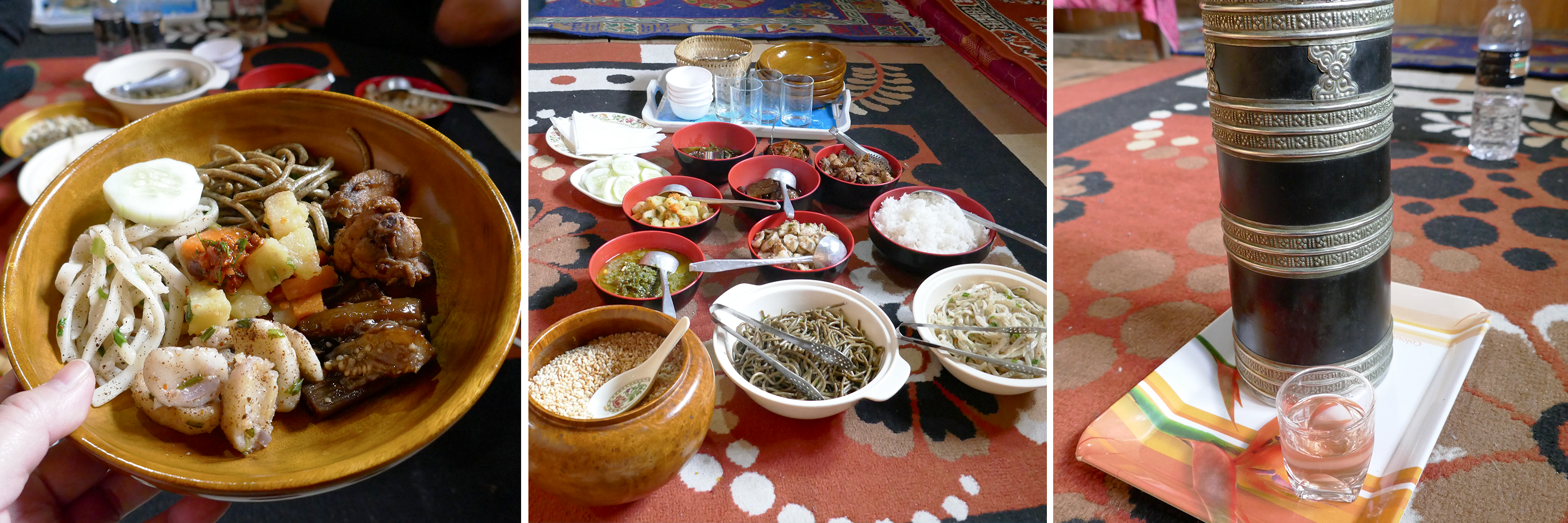
For lunch on our temple tour day, Tenzin took us to a local homestay that served a huge spread of food. We started with milk tea and then we tossed in some puffed rice (think Rice Krispies) for some added texture. Bumthang is known for buckwheat, so we got to sample long, skinny buckwheat noodles as well as two kind of wheat noodles: long, flat ones and short, fat pinched ones. We also drank some ara, the local moonshine which in this area had been brewed with sandalwood, giving it a slight pinkish tint.
Angela’s lunch plate full of noodles, the whole spread, and a traditional ara serving vessel with a glass of ara in front
In Bumthang, we also ate some delicious buckwheat pancakes for breakfast, smothered in local honey. Somewhere along the way, Tenzin figured out that Angela loves dumplings, so for a few dinners we ate a bunch of vegetable and potato dumplings. While we were in Phobjikha Valley, we ate kapchi, roasted wheat flour egg drop soup. Apparently this is a common soup to eat when you’re feeling sick and it was a surprisingly satisfying first course.
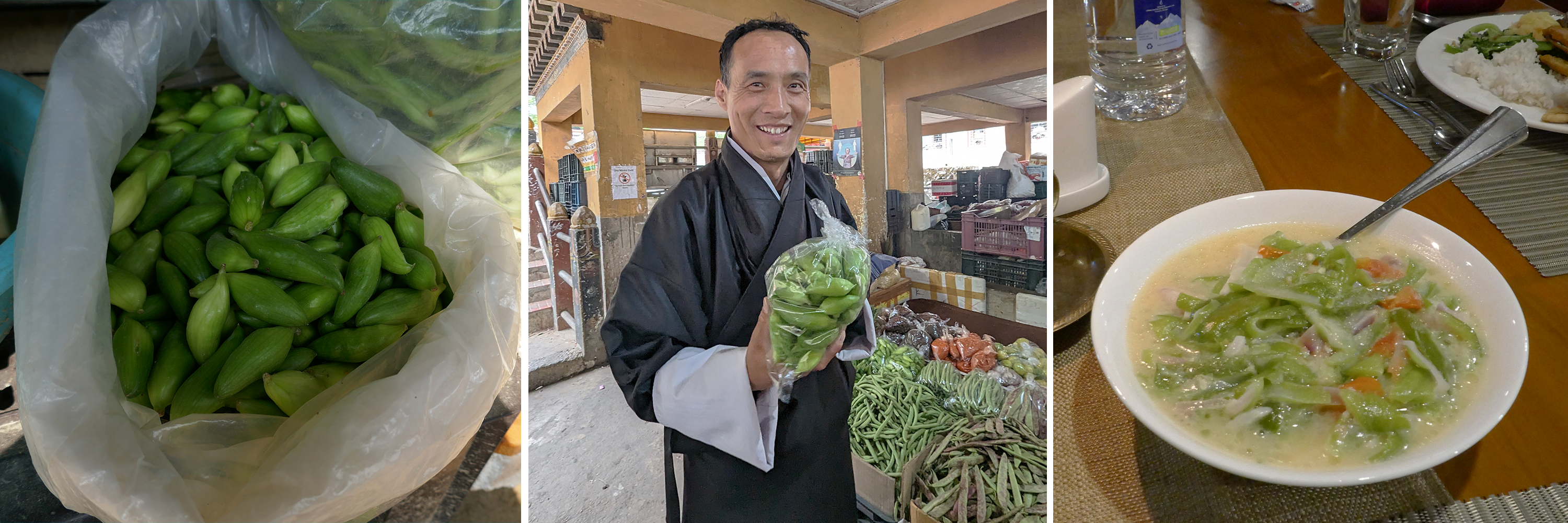
I had never seen this vegetable before in my life. Locally, it’s known as crow’s beak due to its shape. Tenzin showed it to us when we started our trip in Paro and both Angela and I had lots of questions about how people prepare it. She went down an internet rabbit hole and found out that there is a related variety that grows in Peru and Bolivia known as achocha.
We were walking through the Trongsa market and when we saw it again and we both started talking about how we wanted to try it, but it had to be cooked. Tenzin overheard us and was like, I’ll buy you some olo choto and I’ll have the hotel make it for dinner. In the car, we started discussing having an olo choto party and we were all laughing so hard. The hotel staff were kind enough to prepare the olo choto with cheese and chili. It was a delicious dinner and our guide and driver got to share in the olo choto fun as well.
pile of olo choto, Tenzin proudly showing off his purchase, prepared olo choto datshi
Best Meal of the Trip
For me, one of the best meals we had on our trip was on our way out of Thimphu. I kept asking Tenzin to find a place with some nakay datshi and he totally hooked us up. We started with a cup of milk tea (butter tea was also an option) with puffed rice (zao in Dzongkha). Then we were served a simple pumpkin soup before a bunch of different dishes arrived.
First up was ema datshi, which is practically the national dish of Bhutan. Ema means chilli in Dzongkha and this is a dish made of chilies and cheese, with different amounts of soupiness depending on the part of the country (I personally think the less soupy version is a bit better). This time of year, green chillies are the main ingredient. Next came my favorite nakay datshi, made with the seasonal fiddleheads mentioned earlier. There were also scrambled eggs, kewa datshi (potatoes and cheese), and the ever-present dish of eezay. We also were served Bhutanese red rice, which still has part of the bran left on the outside of each kernel. It has a slight nutty flavor and has quite a bit more nutrients than white rice. Interestingly, red rice is the only food item that the United States imports from Bhutan.
fiddleheads (nakay) at the market, one of the best meals we had in Thimphu (clockwise): red rice, eezay, nakay datshi, kewa datshi, eggs, ema datshi
Special thanks to Angela for providing most of the photos in this post!






















 Meandering Marbles