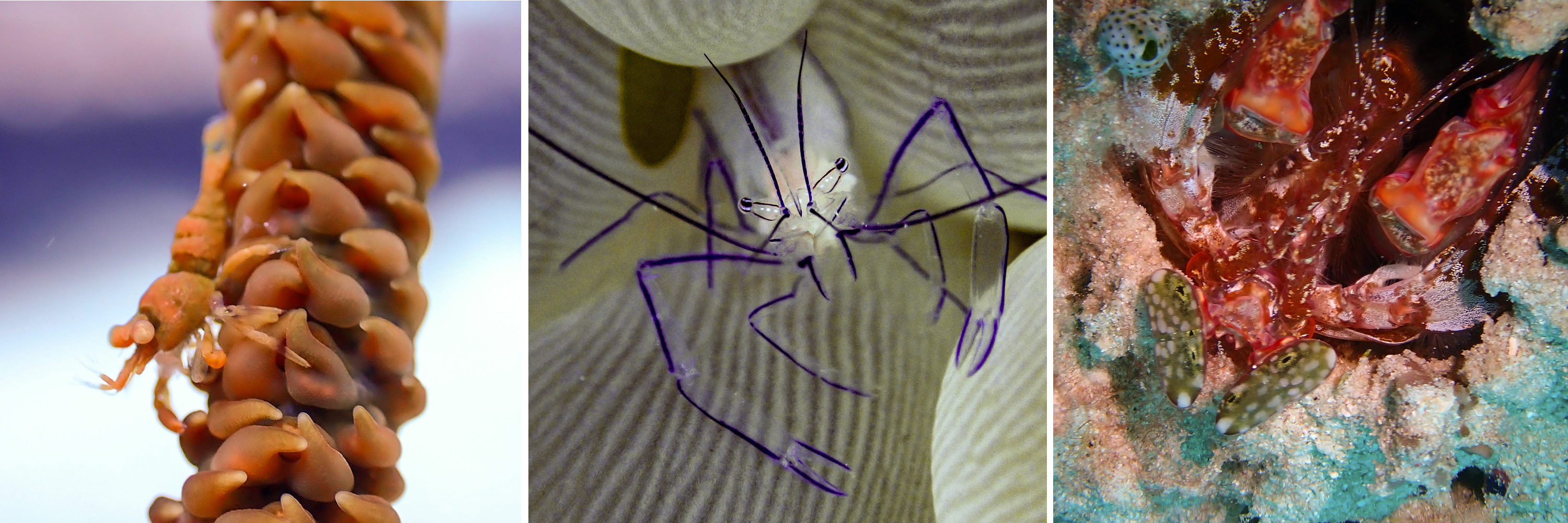
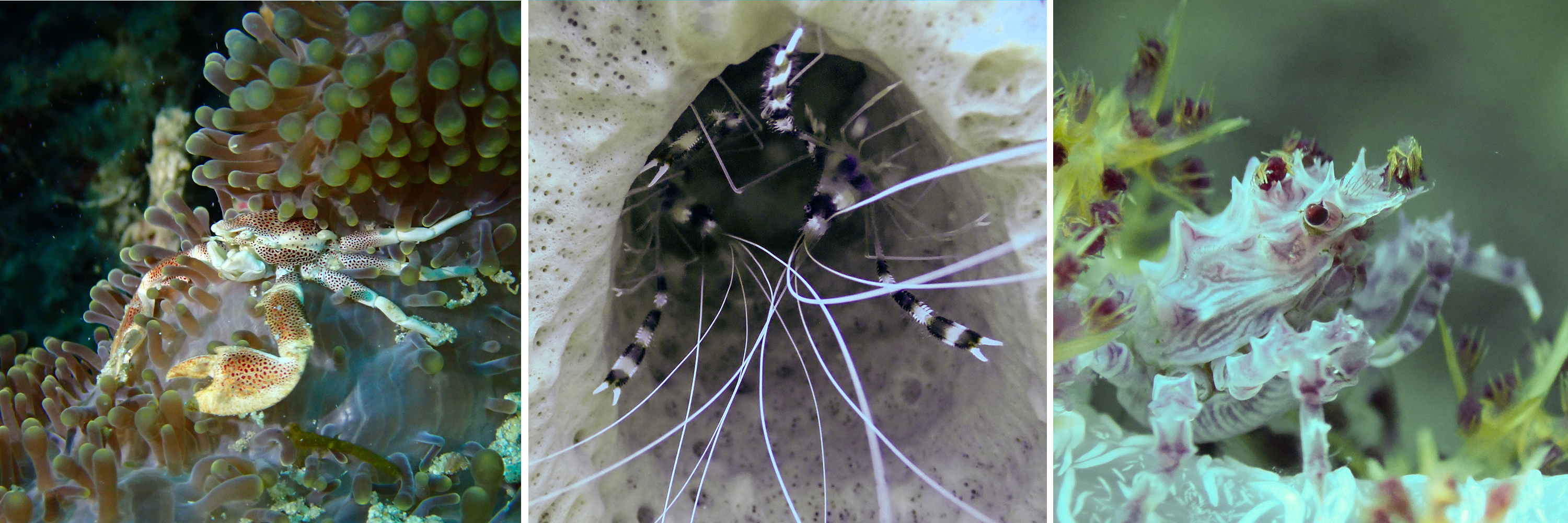
Here’s the second blog post filled with marine creatures from Indonesia. Remember you can click on an any image if you want to see it in more detail. First up are the arthropods – lots of crabs, shrimp, and lobsters.
Followed by some cuttlefish and a turtle. Most cuttlefish I’ve seen in aquariums are quite small, but these are a couple feet in length. They are incredibly still and you could swim right by one and not even notice. In fact, on my first dive I saw one and grabbed my guide’s leg to get his attention. He thought I was in some kind of distress, but quickly calmed down when he saw the cuttlefish I was fangirling over.
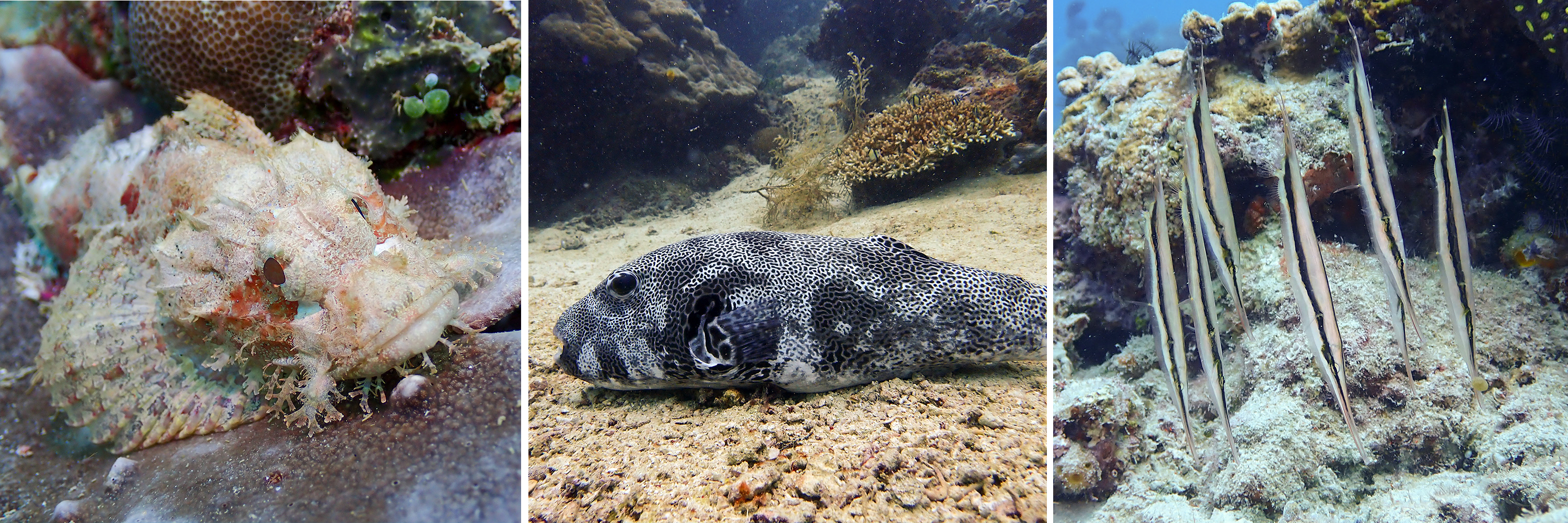
The crocodile flathead was a new one for me and I have so many questions about how the flap of skin over its eyes help or harm its vision. The harlequin sweetlips swims like a bat out of hell (see video below). My guide Maja took the photo of it where it looks so calm and I still have no idea how he did it, because it almost never stops moving.
Crocodile Flathead, close-up of its eye, Harlequin Sweetlips
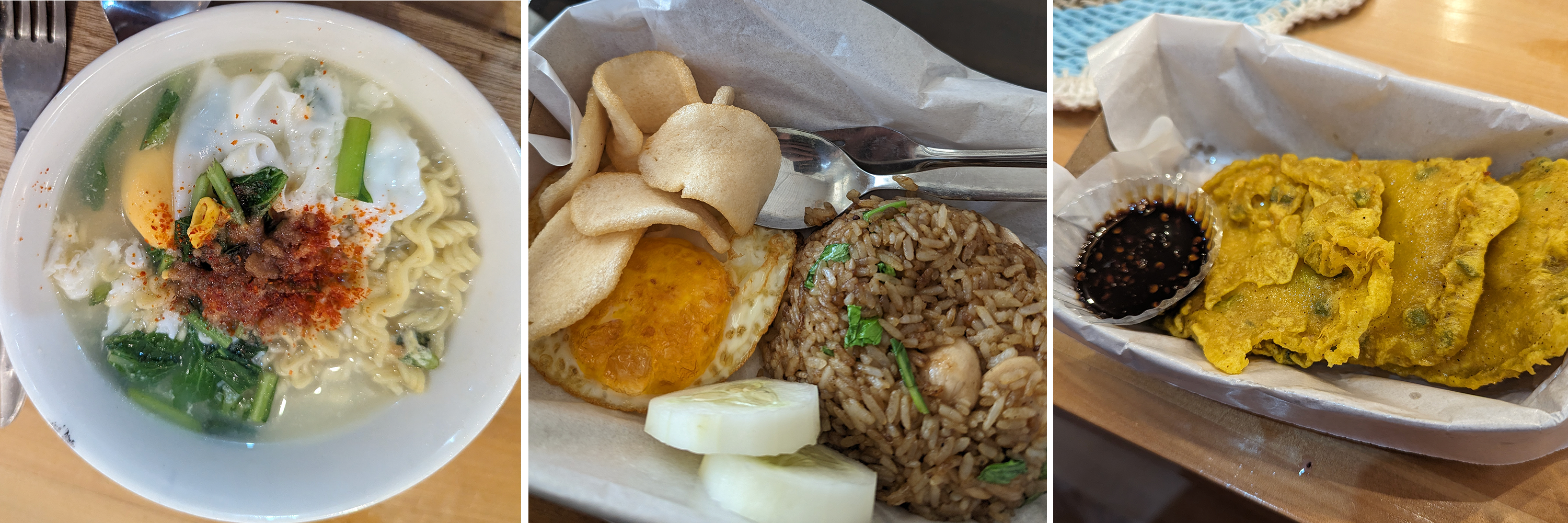
In Jakarta, there were always plenty of vegetarian options, but on Derawan Island, there was a lot less choice in general because the island was so tiny. However, I found a few places that offered up rice and noodle dishes that were meat-free. I ate a lot of tempeh while I was there for protein.
After getting my scuba certification while I was still in graduate school, I never went diving again. I did my certification dives in cold Monterey, California and when they had me clear my mask, it freaked me out to have my nose in such freezing water unable to breathe. I kept popping up to the surface because my weights were off and, at the time, I decided it was an expensive sport that I couldn’t really afford anyways.
However, when I was planning this trip, I realized I probably was just hiding behind my fears and I should try and tackle them. I booked a five-night stay on Derawan Island with scuba dives planned for three times a day with a private refresher lesson on the first day. I definitely was nervous and uncomfortable and right before we were supposed to go down, I had a very clear moment of “oh, hell no, I’m not doing this.” However, I was able to take a bunch of deep breaths and calm down and my very patient scuba dive instructor Maja helped me get through my initial moment of panic. Funnily enough, as soon as I was underwater, I was fine. I’ve been snorkeling for years and have all the underwater practices of clearing my mask and breathing through my mouth.
Fear is a lurking ghost that hides inside us, haunting our actions, until one day, we push through it and it’s just gone. As soon as I realized I could do it, and how beautiful it was down below, the fear vanished and instead, I was able to just enjoy all the beautiful scenery and marine life. I still struggled to adjust the air in my BCD and it was hard for me to stay still. But those are skills that come with practice and I was already improving in my few days of diving.
view from my above-water bungalow
The next couple of blog posts are just lots and lots of pictures of cool marine life. Remember you can click on an any image if you want to see it in more detail. This post is mostly sea slugs, which is why I ended up in Indonesia in the first place. The Indo-Pacific Ocean has some of the most colorful and diverse varieties of nudibranchs in the world, and I’m positively obsessed with them. Some of these photos are mine, some of them are from Maja.
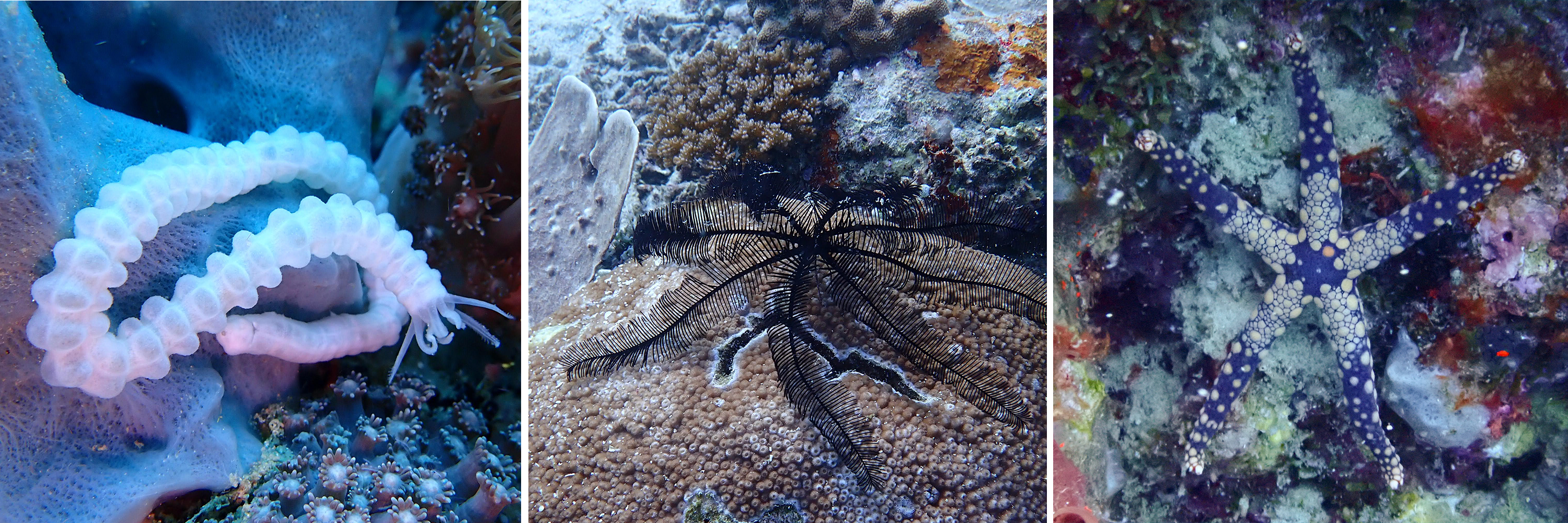
First up are some lovely tunicates. These are all invertebrates, but they are in the Phylum Chordata because they all have the beginnings of a rudimentary spinal cord called a notochord. They are the invertebrates that are most closely related to humans and these in particular were very colorful.
Golden Sea Squirt, Green Barrel Sea Squirt, Rhopalaea fusca
Next up are some lovely echinoderms: one sea cucumber and five sea stars. The variation in shape, size, color, and texture in sea stars is incredible.
Lampert’s Sea Cucumber, Spinose Feather Star, Pebbled Sea Star
Granulated Sea Star, Blue Linckia, Genus Nardoa Sea Star
This is what a sea cucumber looks like when it’s feeding. It uses its mouth parts to bring sand and the detritus it eats into its mouth. Eventually most of the sand comes out the other end and scientists think that at least half the world’s sand has traveled through the digestive tracts of sea cucumbers.
I’m a big fan of giant clams. They are huge, always a surprise, super colorful and patterned on the inside flesh.
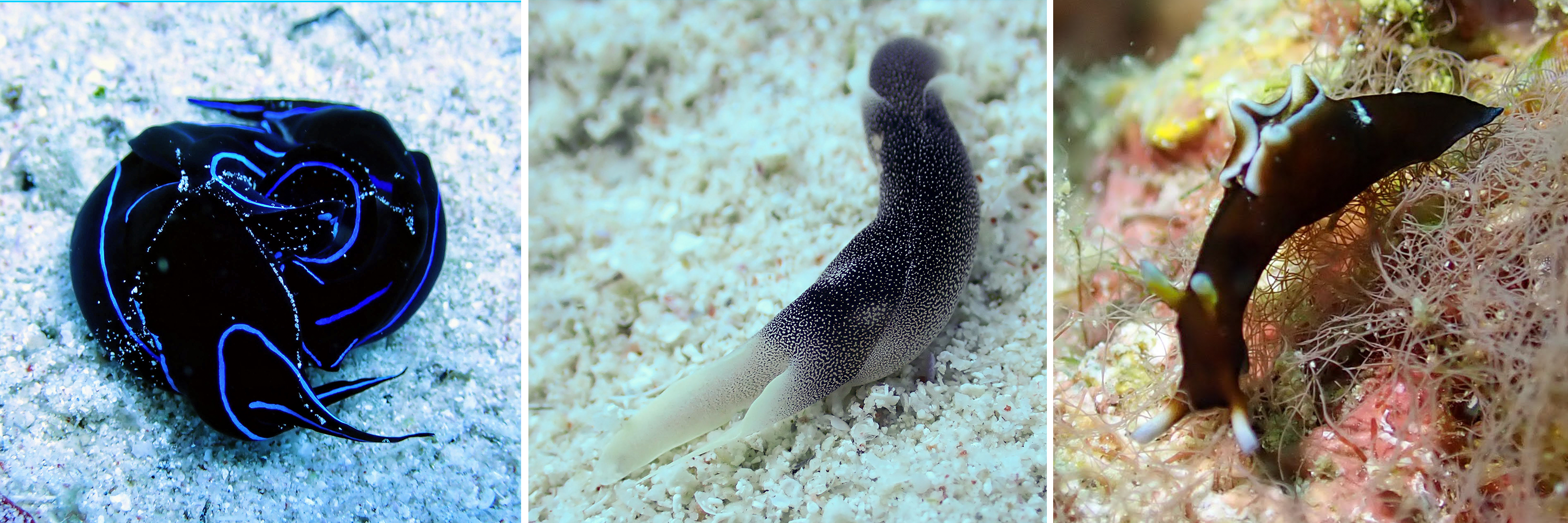
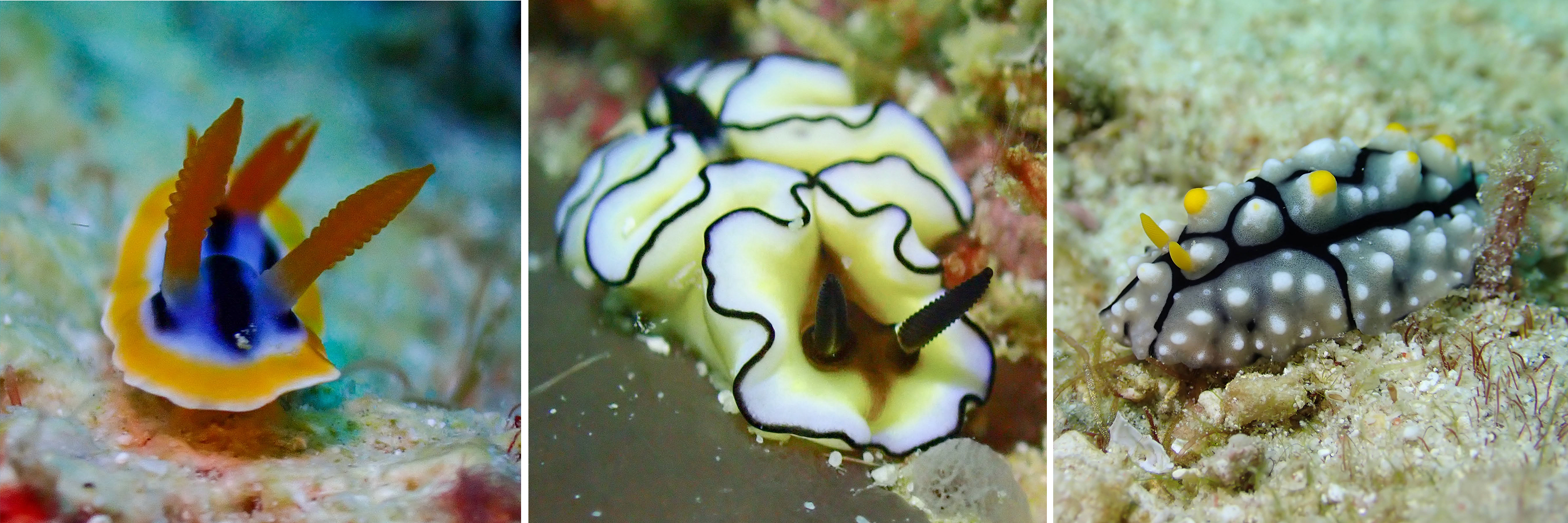
And now, for the stars of the show: the nudibranchs! These are different from other sea slugs because of the two rhinophores they have on their forehead. They use them for sensing the world around them.
Generally speaking, travelers aren’t very fond of Jakarta. The airport is a long way from the city and there is one road that goes to the city that gets backed up. Between all the cars and motorcycles and pedestrians, the traffic is overwhelming. Although there is public transportation, it isn’t easy to navigate at first and usually tourists just jump in a taxi, but then they are sitting for an hour in bumper-to-bumper traffic to get to their location. It’s hot and humid year-round. Everyone I told that I was going to Jakarta responded with horror stories.
And yet, I kind of fell in love with Jakarta (a.k.a. the Big Durian) and there was a clear moment for me when it happened. I was walking out of a big mall and there was a bunch of xylophones set up outside. A group of older ladies, carrying mallets and wearing matching blue hijabs, denim shirts, and stylish batik bottoms took the stage. They started playing “Bohemian Rhapsody” by Queen and I just marveled at the whole experience. Muslim women performing music by the very queer Freddie Mercury as a huge crowd sang along. It was so heartwarming to see the interweaving of cultures in a way that brought everybody joy. I just couldn’t stop smiling. Even now, months later, when I watch this clip, it makes me happy.
For fun, here’s a clip of the men of PINKAN Indonesia playing “Have you Ever Seen the Rain?” Watch the constant stream of scooter and car traffic in the background.
Sightseeing
I did a fair share of the normal tourist stuff in Jakarta, starting with the National Monument (also known as Monas) which celebrates Indonesian independence. Its design was inspired by a rice mortar and pestle. If you’ve been reading this blog for a while, garudas are a running theme on this trip. I found garudas on every temple in Bhutan and in church pulpits in India, and they were here on this monument in Indonesia. They feature prominently on the official emblem of Indonesia. However, the politicized version is a bit more like an eagle, than how garudas are traditionally depicted in Buddhism and Hinduism.
National Monument (Monas), golden garuda decoration outside Monas, official emblem of Indonesia
While waiting to go to the top, I visited a museum dedicated to the history of Indonesian independence underneath the monument with giant dioramas of important events in the country’s history. After my number was called, I followed a bunch of school kids in matching blue uniforms on to the elevator and up to the observation deck.
view of Jakarta from the top of the National Monument
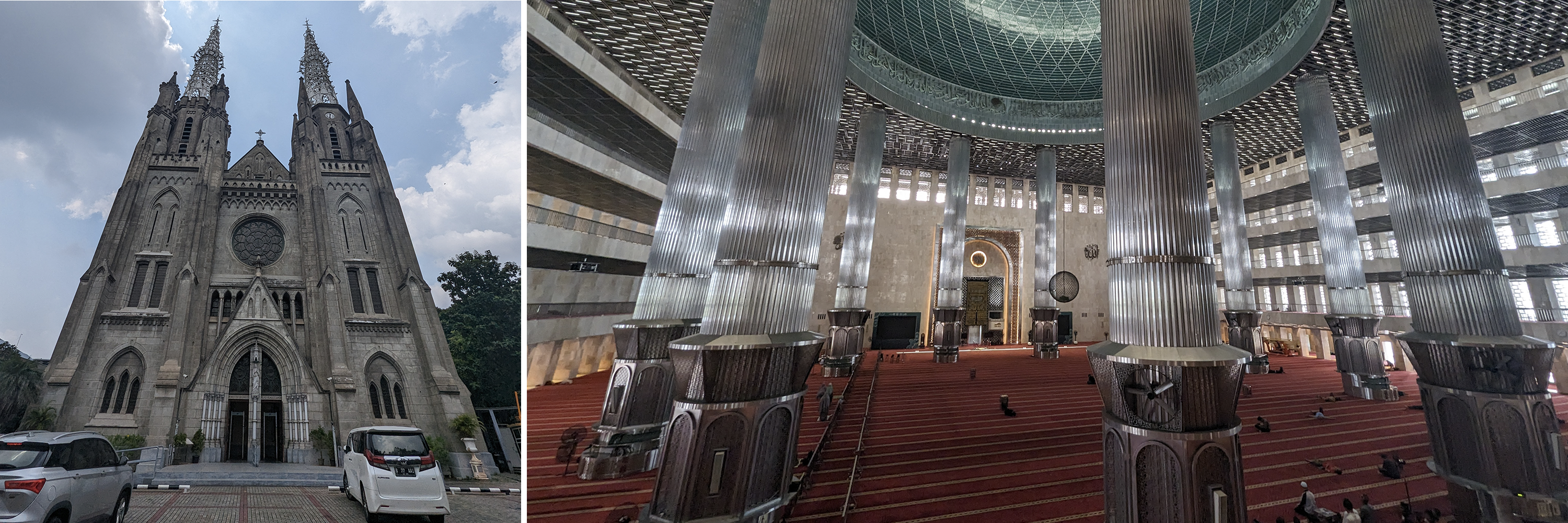
I then walked over to the Jakarta Cathedral which has two giant spires adorning either side of the entrance. Interestingly, the Istiqlal Mosque is right across the street. The mosque is named after the Arabic word for freedom. From the outside, the mosque looks like typical 1960’s concrete block office architecture. It barely resembles a mosque, except for the pointy minaret that sticks up on one side. There are seven entrances to the sprawling complex, which allow as many as 200,000 people to worship at once. The main room for prayers was exquisitely decorated and reminded me a lot of the main worship room in the mosque in Kampala, Uganda.
exterior view of Jakarta Cathedral, interior view of Istiqlal Mosque
Museums
My favorite museum was probably the Jakarta Textile Museum. The museum holds rows and rows of beautiful batik fabrics and weavings. At the very back of the museum in a separate building, they offer visitors a chance to make their own batik. Batik is a way of dyeing fabric by first applying wax to areas that will not be dyed. Then the fabric is dipped in color dye and removed, and then its dipped in hot water and the wax is removed. Through multiple steps of waxing and dying, very elaborate patterns can be produced.
Most complicated and large pieces are done with large stamps. However, applying the wax can also be done by hand using a batik pen called a canting. It has a small reservoir on top for holding the wax and then the artist must work quickly to apply the wax at the right angle as it flows from the pen tip.
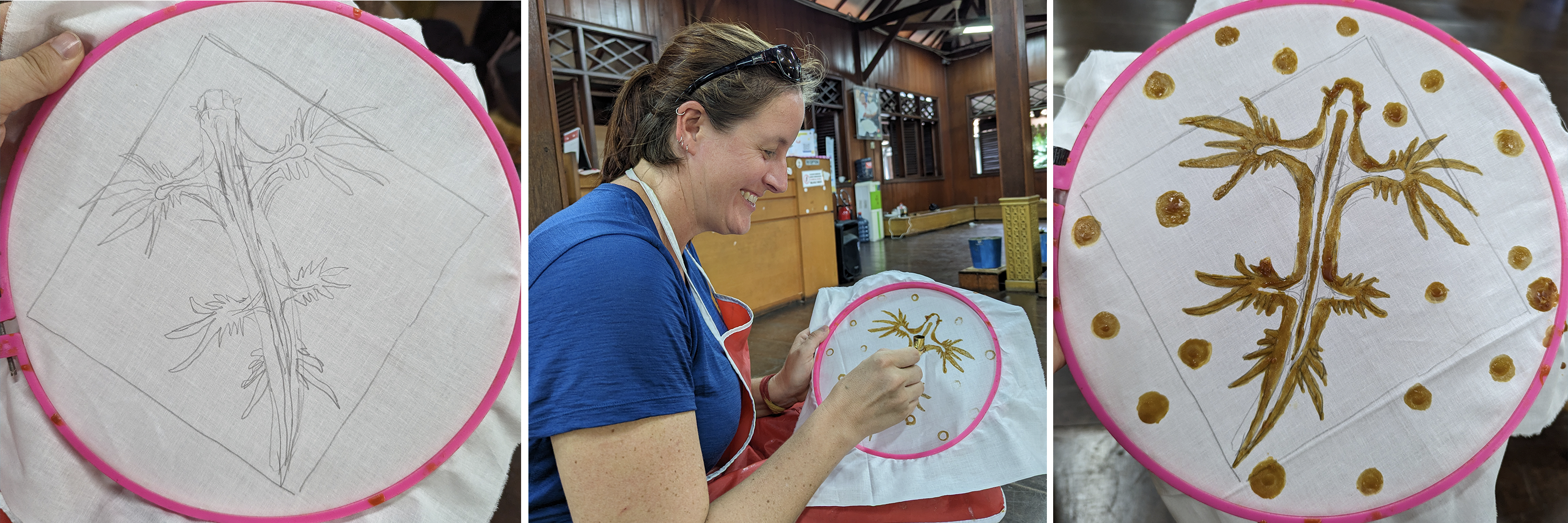
They gave me several very simple patterns to try, but instead I, of course, picked something much more difficult and decided to draw a blue dragon nudibranch. Applying the wax was challenging since it was hard to hold the pen at the proper angle without spilling it. My original design did not have all those big dots. I added them to cover up a bunch of wax dropping in the wrong place. I think they actually enhanced my final creation. What is it Bob Ross said? “We don’t make mistakes, we have happy accidents.” This process took a long time, because I had to apply wax to both the front and back sides so the dye didn’t go through.
original design, me applying wax, finished wax design
After I was done, one of the artists brushed on a light coat of wax along the edges to give it that textured border. Then he stuck my fabric in the dye, then into the hot water bath, and then on a clothesline to dry. That whole process took no more than ten minutes.
dipping design in blue dye, finished design waiting to dry, sculpture of the tool used to apply wax
The other museum I enjoyed a lot was the Kite Museum. This one is a bit outside of the center, so I hired a driver for a few hours from an app and off we went. I paid for him to visit the museum too since he’d never been there and he’d grown up in Jakarta. Kites are a part of the culture of many Indonesia islands, but especially Bali where there’s a huge festival held every year where people compete for best launch, longest flight, and best design. This museum had quite a collection of rare and special kites and at the end of the tour, they taught me how to make my own.
kite with elaborate characters, dengung kite, tour guide with elaborate life-sized kite
intricate kite with black design, owl kite, the kite I made at the end of my tour
Food
Indonesian food is definitely meat heavy, but Jakarta had a wide selection of vegetarian options. I found a vegan spot pretty close to the mall where the xylophone performance was held that served a meatless marangi satay. These are skewers marinated in sweet soy sauce and other spices before being grilled.
The Istiqlal Mosque had a whole food court in the complex and while waiting for the tour, I ate ketoprak which is basically tofu, veggies, rice cake, and rice vermicelli served in peanut sauce. The lady who made this for me and I communicated entirely through gestures, but we worked it out. It’s amazing what nonverbal communication can accomplish. I also ate some roti bakar at a fancy coffee shop, which is basically just grilled toast with some kind of filling, like coconut jam and butter.
vegan marangi satay, ketoprak, roti bakar
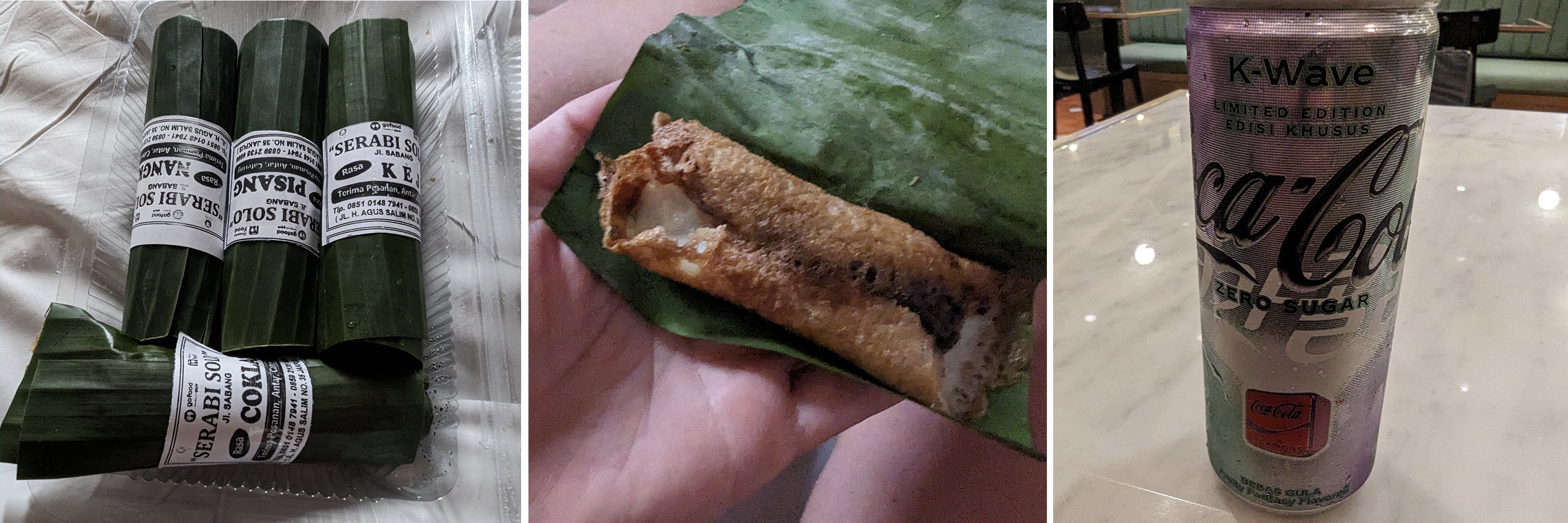
Serabi are pancakes that originally came from Java, the island Jakarta is on. Traditional ones are made from rice flour, coconut milk, and coconut sugar. I bought these from a guy on the street who wrapped them in leaves for easy transport. They were delicious.
serabi pancakes (one each of chocolate, cheese, jackfruit and banana), unrolled pancake, random Coca-Cola flavor K-Wave
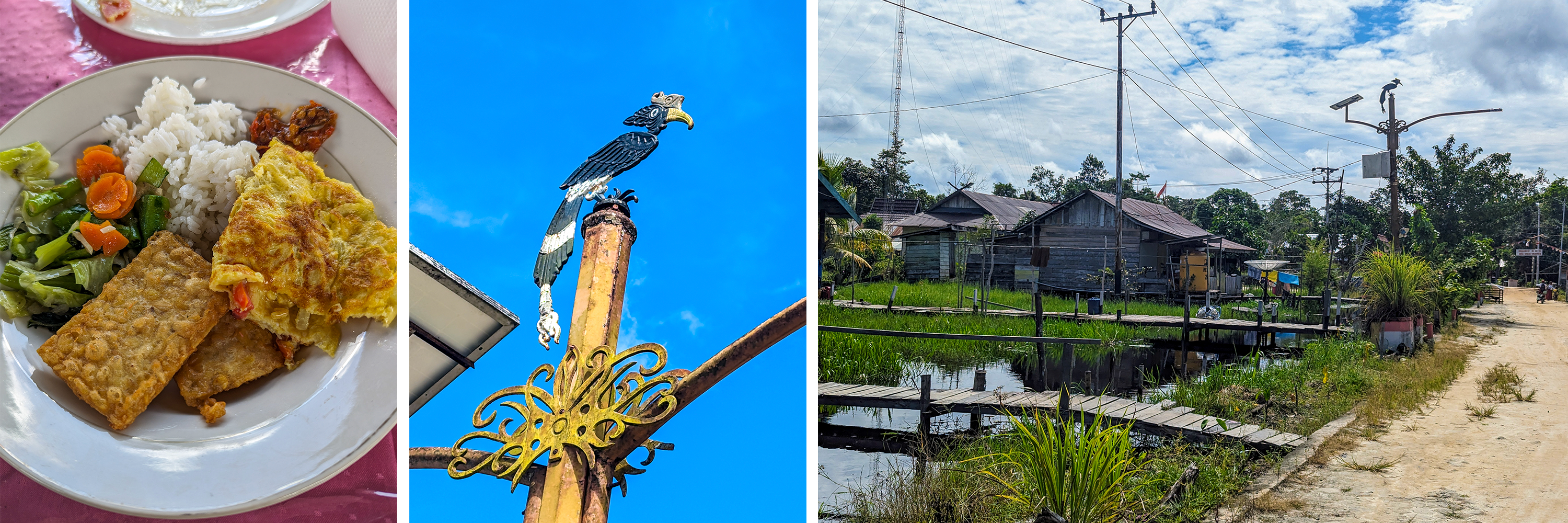
Kalimantan is the Indonesian side of Borneo where I went to see orangutans. Also, included in my 3 day liveaboard experience were some day and night hikes through the rainforest and a stop in a nearby village. Most members of the communities along the river work in one of two industries: orangutan tourism or palm oil. Although seemingly at odds with each other, people here see the need for both as a means to put food on the table. Palm oil can be grown sustainably on plantations, but many corporations continue to expand their production of palm oil, which frequently mean slash-and-burn of existing rainforests, rich ecosystems which are home to orangutans and other endangered organisms.
vegetarian meal on board with tempeh and scrambled eggs, hornbill details on lamp posts, village built right in the wetlands surrounding the river
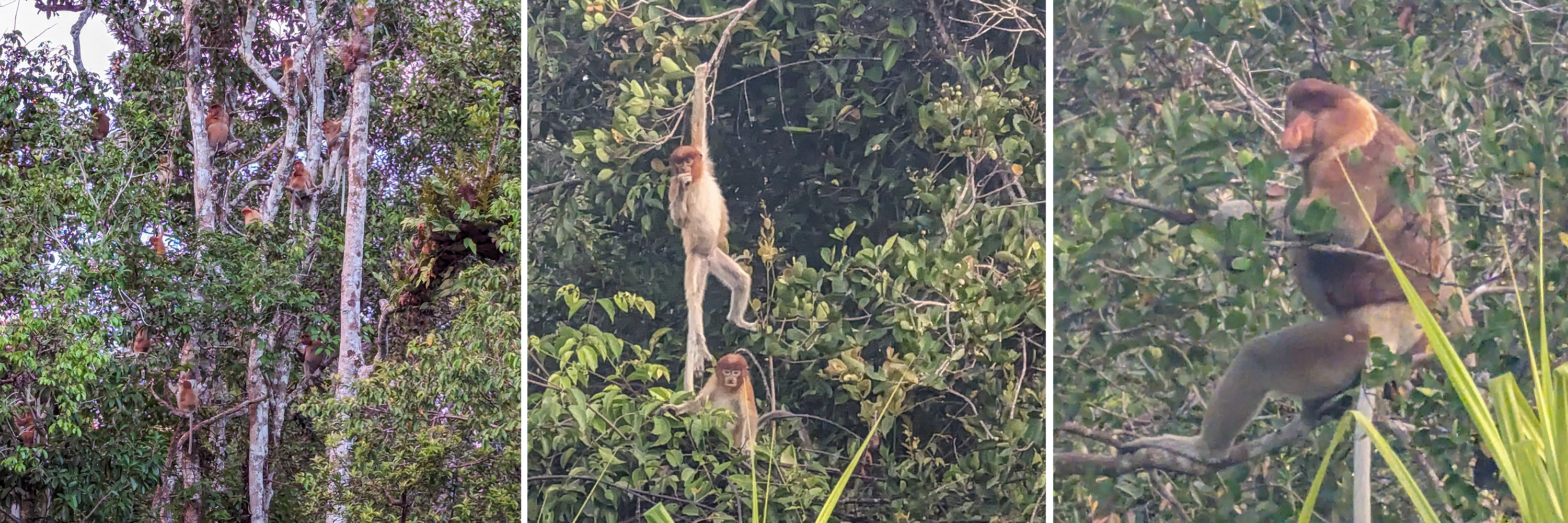
In addition to orangutans, our guide pointed out the proboscis monkeys that also live in the area. They were given this name because the males have absolutely enormous noses. Their fleshy noses are used to make loud mating calls to females. We saw a few different troops of these monkeys when we transiting between orangutan feeding stations and our boat captain would always pull over so we could watch the commotion. Normally, there would just be one adult male in a tree full of females.
tree full of females, monkey hanging from branch, adult male proboscis monkey casually hanging out
As part of our day hikes to find the orangutans, our guide would show us various fauna and flora. I really enjoyed the giant pillbugs that rolled up in little balls to protect themselves from predators. Also, the Sunda frogmouth bird has to be one of the funniest looking birds I’ve seen.
Gymnostoma seed with lovely geometrical symmetry, Sunda frogmouth, pitcher plants, Southeast Asian pill millipede
The night hike was surreal on so many levels. Walking through the rainforest at night, there were are many animals resting, but also so many awake and moving. My guide found a bunch of interesting insects, including a few assassin bugs which eat their prey by injecting them with a toxic set of enzymes that liquifies the insides, which the bugs then suck out. We also got to see giant forest ants that have big enough mandibles that they can actually pinch human skin to stay attached. The extremely well camouflaged mantises that look just like dead leaves were also lovely.
assassin bug, giant forest ant, damselfly, Asian dead leaf mantis,
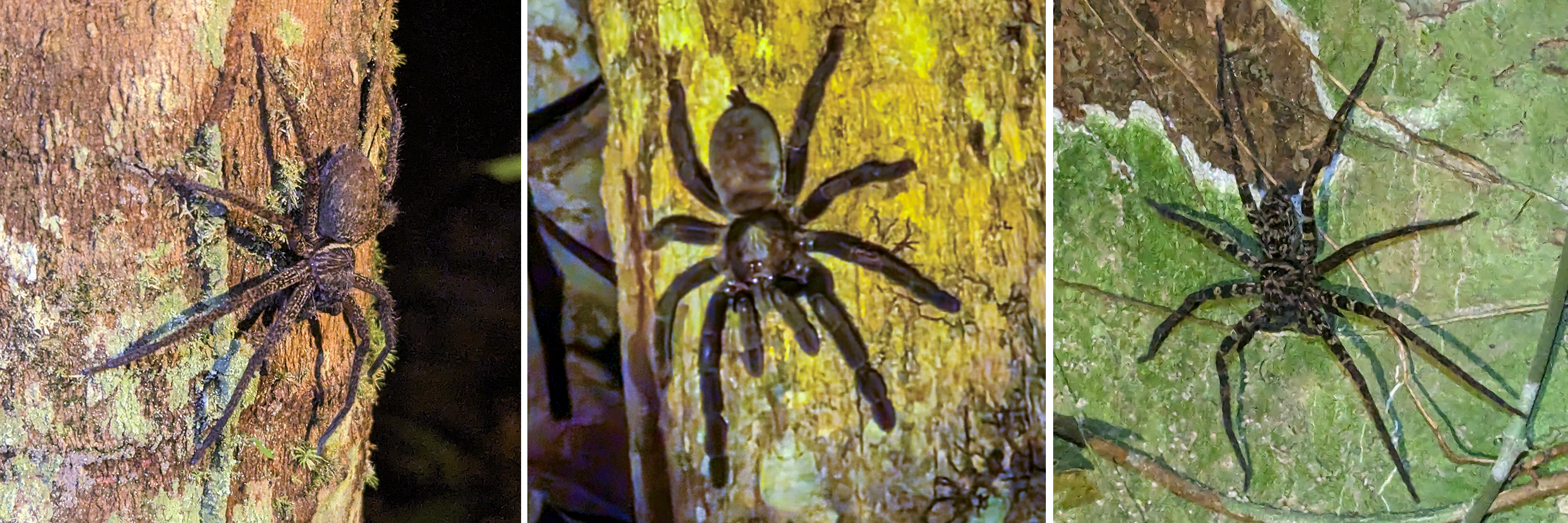
There were also quite a few different spiders. Most of them were variations of huntsman spiders, but I did get to see a giant black tarantula which was way bigger than the size of my hand, probably around 8 inches across. As they get larger, they eat even bigger prey including frogs, fish and lizards.
huntsman spider, Borneo black tarantula, another species of huntsman spider
I even got to hold a giant relative of Daddy Long Legs. One of the most shocking moments was when my guide turned his flashlight towards the tree canopy and right above us was a pit viper hanging out.
Cyclosa spider web, Gagrella harvestmen, North Philippine temple pit viper
There were also a few birds sleeping in the branches, colorful kingfishers and barbets. Earlier in the day, we also had caught sight of a crested serpent eagle, which get their name from all the snakes they eat.
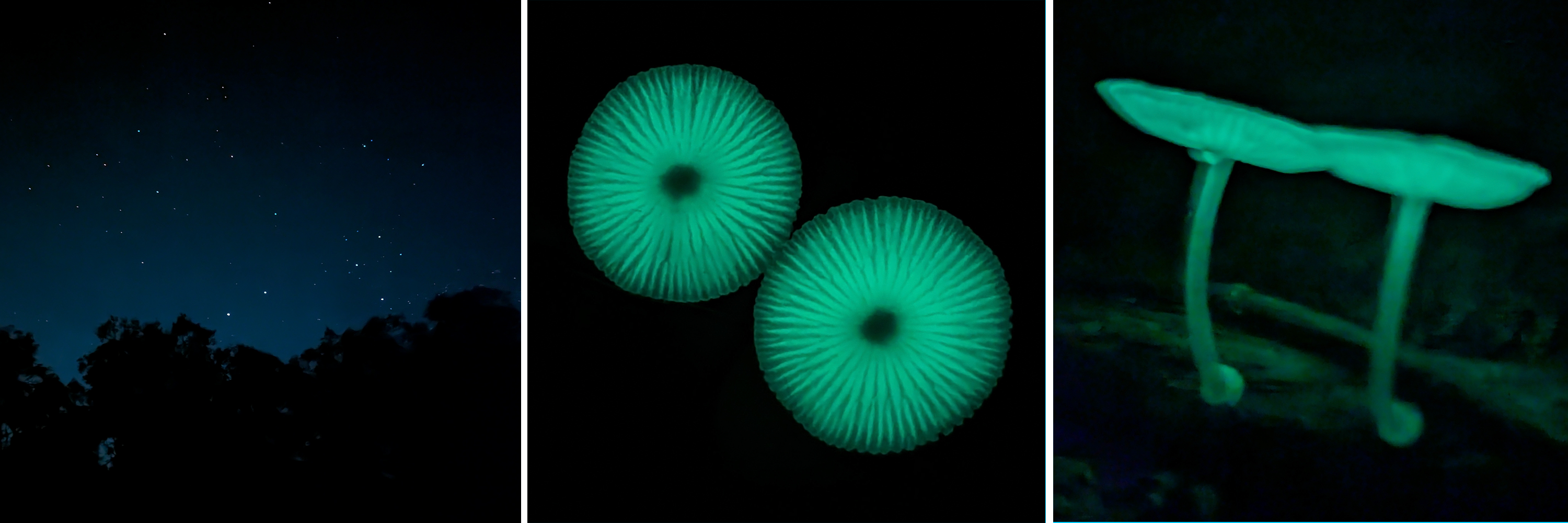
Perhaps my absolute favorite night hike find were these stunning bioluminescent mushrooms. I teach marine biology, so bioluminescence is a common feature in deep water organisms that I discuss with students every year. However, it is found much less frequently in terrestrial creatures, with the notable exception of fireflies. There are not that many species of fungi that bioluminesce, so I was super excited to see these.
Southern Cross just above the trees, glow in the dark bonnet mushrooms from top, and side
Going to see orangutans has been on my Wish List for a long time. Since I was already in the eastern hemisphere doing my yoga training, it made sense to hop over to see them. They are found on only two islands in the world, Borneo and Sumatra, and all three species are critically endangered. Populations have suffered over the past few decades because of an increase in palm oil production. As native rainforests are cut down to make room for palm tree plantations, this results in huge numbers of orangutans losing their homes.
The island of Borneo is divided in two, the north side belonging to Malaysia and the south side to Indonesia (known as Kalimantan). For this trip, I took an early, early morning flight to Pangkalan Bun and was driven to a spot on the Java Sea that connects to the river that goes through Tanjung Puting National Park. My guide ushered me on board our klotok, a houseboat that would be my home for the next couple of nights. While I was waiting for the boat to get moving, I lay down on my full-sized mattress on the top deck and promptly fell asleep. An hour or so later, I woke up to this gorgeous scene:
view from the klotok
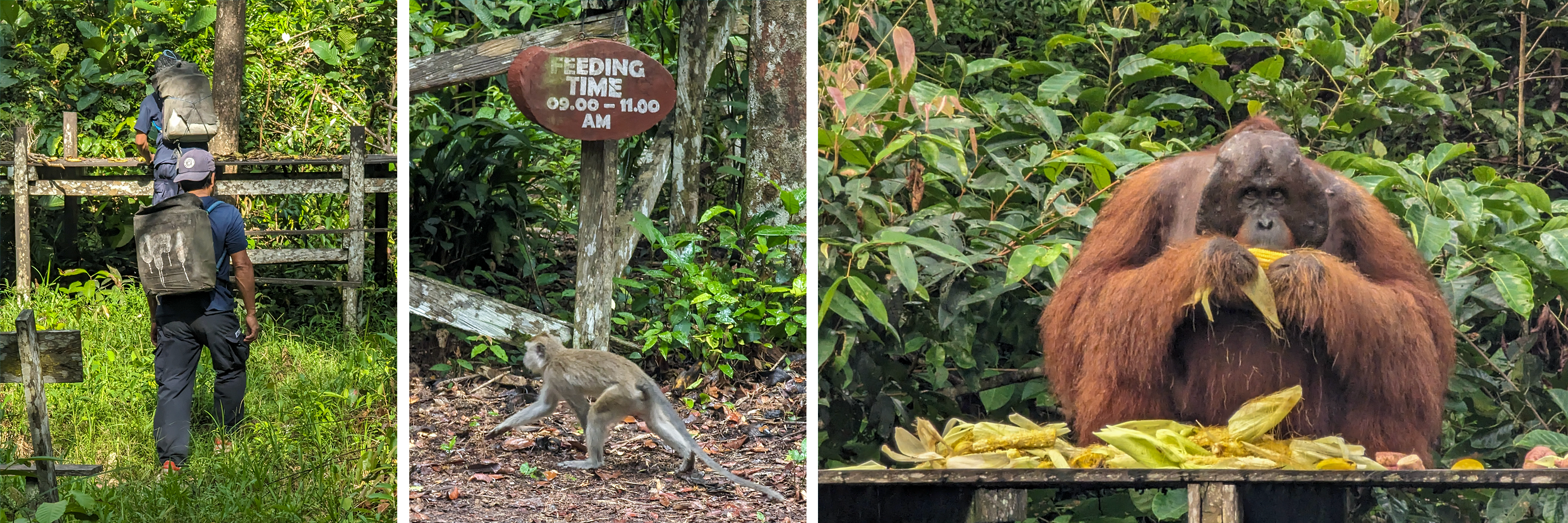
The park set up feeding stations for the orangutans and the rangers bring an assortment of bananas, corn, and sweet potatoes which they lay out on large wooden platforms. When fruit is in plentiful in the rainforest, the orangutans rarely come to the platforms for food, but when the food starts to become scarce in the wild, they show up like clockwork. The dominant males have impressive facial pads that distinguish them from the females. The toddlers and young ones are extremely playful and it is easy to see so many shared traits between orangutans and humans. During one feeding, two siblings were play fighting and their tired mother gentle scolded them to stop fighting.
rangers, a macaque trying to get in on the action, male orangutan enjoying corn
There is a clear order of food preference for the orangutans. The bananas disappear first, then the corn, and then the sweet potatoes. Female orangutans also often don’t want to stay on the platform if there is a male sitting on it. They approach tentatively, and then load up as much food as they can carry in their mouth and hands and scurry up a nearby tree to sit and consume their bounty. Their mouth is a great option because it leaves their hands and feet free for climbing.
hoarding sweet potatoes
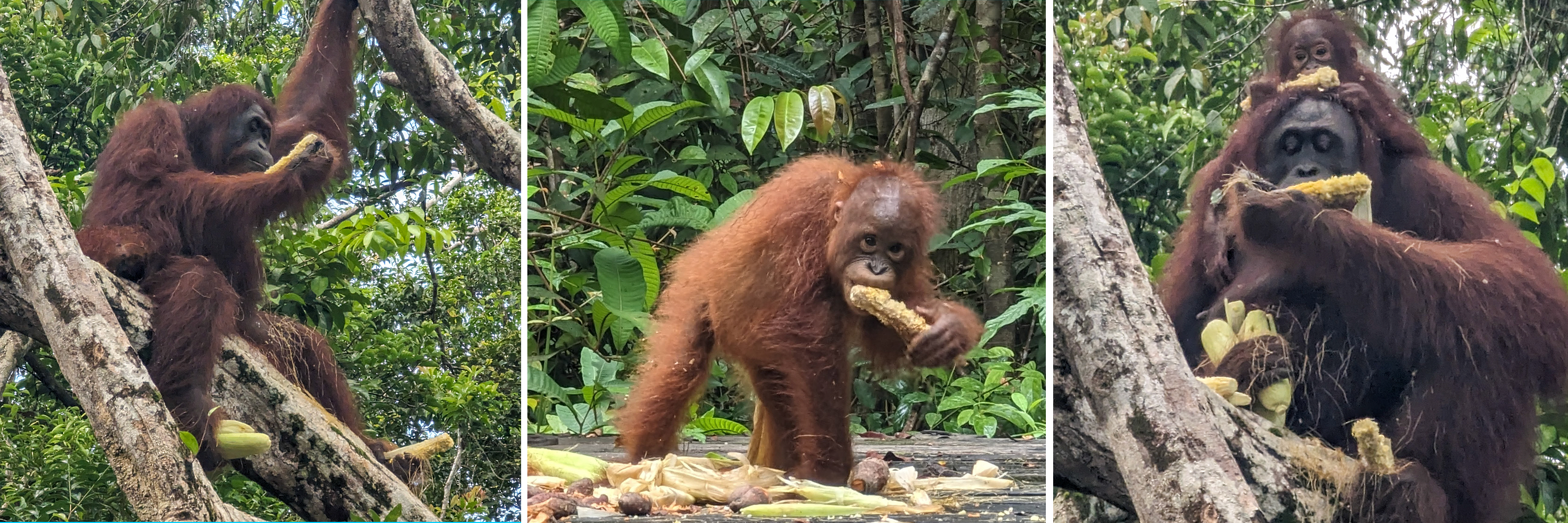
Corn was a preferred food and often the orangutans would take as many ears with them as they could to a nearby tree, safely away from where another animals could take their food. They tended to climb with a few ears of corns in their hands, but once they started eating, they held onto the extra ones with their toes.
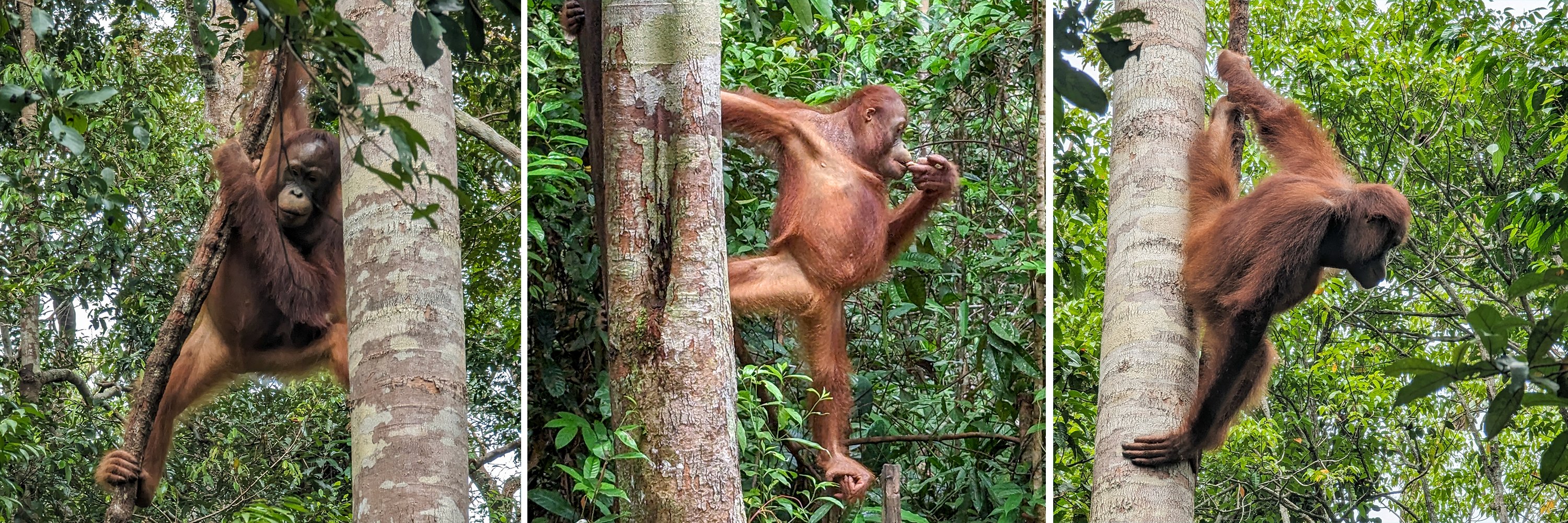
Orangutans have incredibly long arms that are generally used for climbing, but sometimes I think they just liked posing for the tourists.
climbing trees, posing, climbing trees (mom & baby)
Many of the female orangutans arrived with babies and toddlers in tow. The younger ones were still learning how to move through the trees and it was fun to watch their moms reach out and grab them when they got stuck.
mama and baby, toddler playing around, mother and baby in the same eating posture
orangutan children in the trees
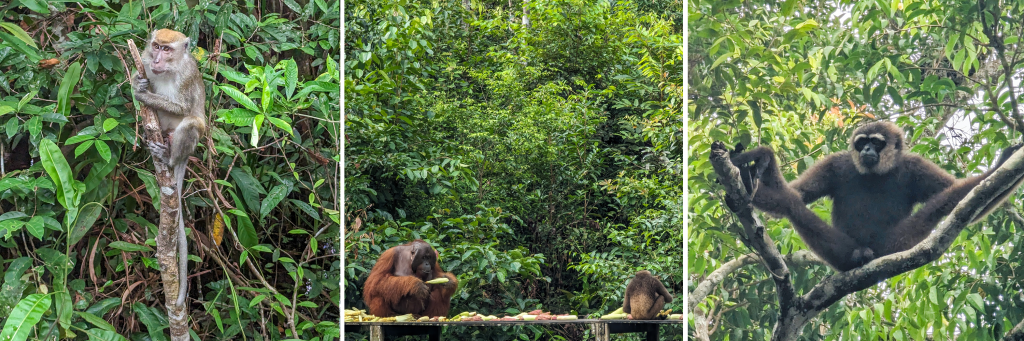
And, of course, some of the other animals wanted in on the action. The long-tailed macaques were good at rushing in and making off with a banana or two and eating them elsewhere. At one of the feeding stations, a Bornean white-bearded gibbon was actively waiting for the food to arrive. Eventually it did, and he scampered down and tentatively hung out on the platform for a minute, gathering his food before he took off.
long-tailed macaque, orangutan & gibbon, gibbon waiting in a tree
One of my favorite moments that I filmed was a baby orangutan scaring away a long-tailed macaque that was getting too close to the food.
The orangutans, the macques, and the gibbons are all endangered in the wild. Their homeland is threatened by humans and these national parks and the revenue from tourists are one of the few things keeping these animals from extinction. This next embedded video is a playlist of the best orangutan videos. Most of them are relatively short clips and the whole list will take only 6 minutes to watch.























 Meandering Marbles