Going to see orangutans has been on my Wish List for a long time. Since I was already in the eastern hemisphere doing my yoga training, it made sense to hop over to see them. They are found on only two islands in the world, Borneo and Sumatra, and all three species are critically endangered. Populations have suffered over the past few decades because of an increase in palm oil production. As native rainforests are cut down to make room for palm tree plantations, this results in huge numbers of orangutans losing their homes.
The island of Borneo is divided in two, the north side belonging to Malaysia and the south side to Indonesia (known as Kalimantan). For this trip, I took an early, early morning flight to Pangkalan Bun and was driven to a spot on the Java Sea that connects to the river that goes through Tanjung Puting National Park. My guide ushered me on board our klotok, a houseboat that would be my home for the next couple of nights. While I was waiting for the boat to get moving, I lay down on my full-sized mattress on the top deck and promptly fell asleep. An hour or so later, I woke up to this gorgeous scene:

view from the klotok
The park set up feeding stations for the orangutans and the rangers bring an assortment of bananas, corn, and sweet potatoes which they lay out on large wooden platforms. When fruit is in plentiful in the rainforest, the orangutans rarely come to the platforms for food, but when the food starts to become scarce in the wild, they show up like clockwork. The dominant males have impressive facial pads that distinguish them from the females. The toddlers and young ones are extremely playful and it is easy to see so many shared traits between orangutans and humans. During one feeding, two siblings were play fighting and their tired mother gentle scolded them to stop fighting.
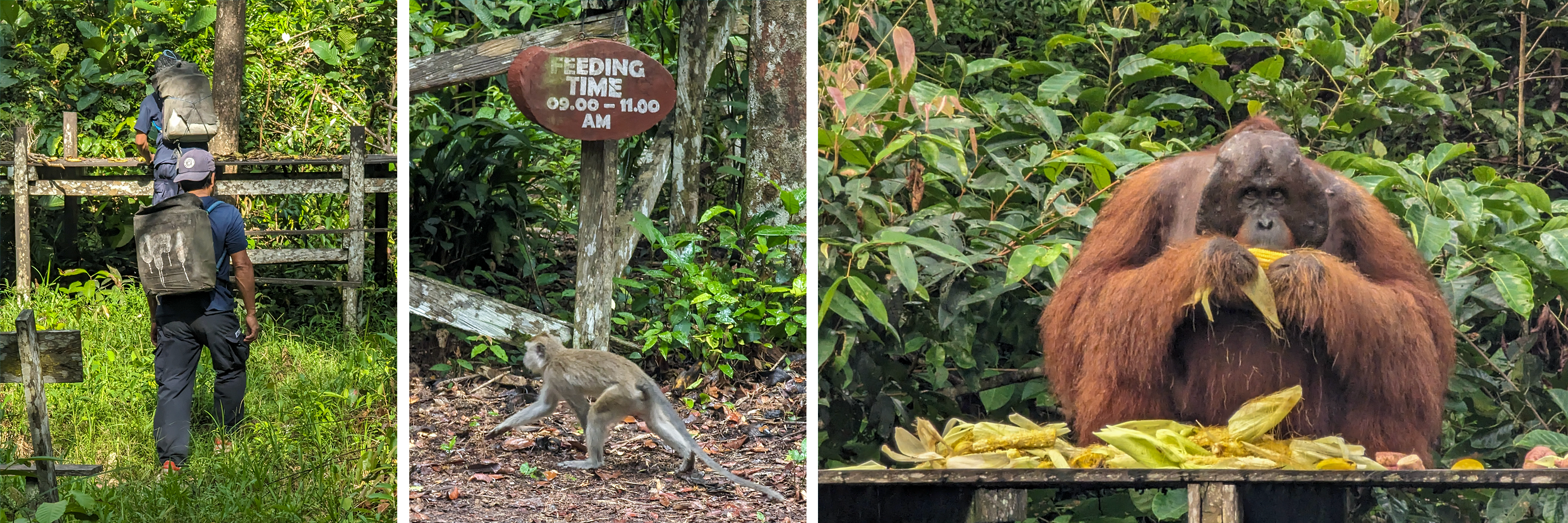
rangers, a macaque trying to get in on the action, male orangutan enjoying corn
There is a clear order of food preference for the orangutans. The bananas disappear first, then the corn, and then the sweet potatoes. Female orangutans also often don’t want to stay on the platform if there is a male sitting on it. They approach tentatively, and then load up as much food as they can carry in their mouth and hands and scurry up a nearby tree to sit and consume their bounty. Their mouth is a great option because it leaves their hands and feet free for climbing.

hoarding sweet potatoes
Corn was a preferred food and often the orangutans would take as many ears with them as they could to a nearby tree, safely away from where another animals could take their food. They tended to climb with a few ears of corns in their hands, but once they started eating, they held onto the extra ones with their toes.
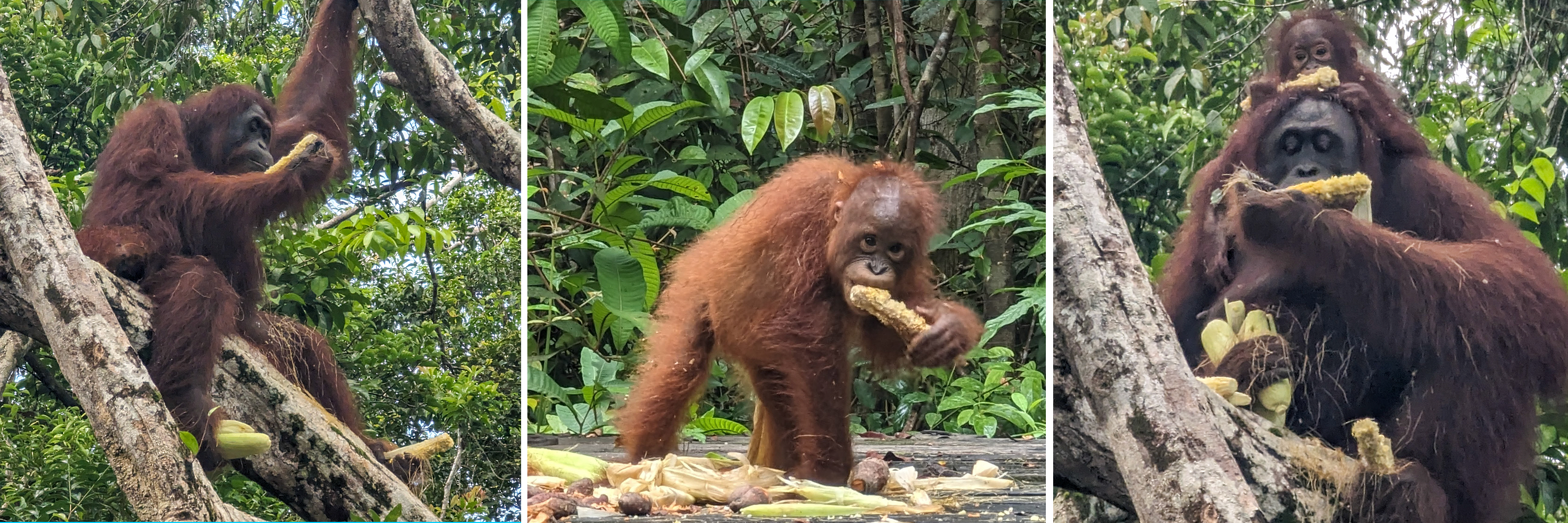
toes grasping corn, baby eating corn, mama & baby eating corn
Orangutans have incredibly long arms that are generally used for climbing, but sometimes I think they just liked posing for the tourists.

climbing trees, posing, climbing trees (mom & baby)
Many of the female orangutans arrived with babies and toddlers in tow. The younger ones were still learning how to move through the trees and it was fun to watch their moms reach out and grab them when they got stuck.

mama and baby, toddler playing around, mother and baby in the same eating posture
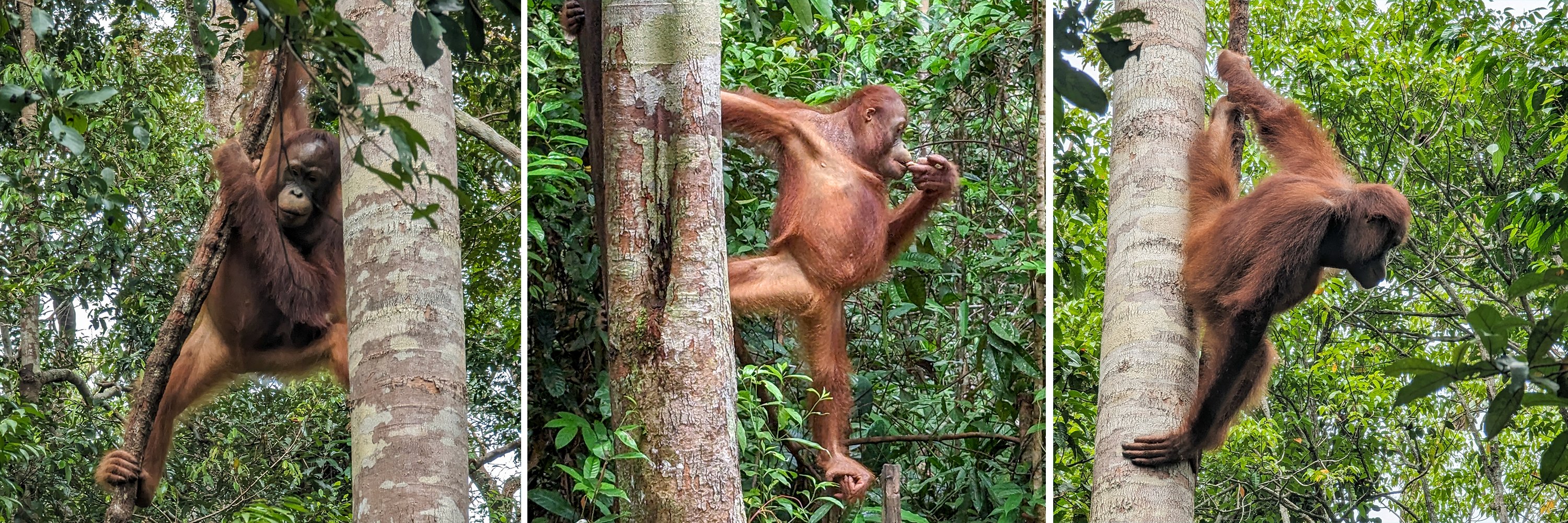
orangutan children in the trees
And, of course, some of the other animals wanted in on the action. The long-tailed macaques were good at rushing in and making off with a banana or two and eating them elsewhere. At one of the feeding stations, a Bornean white-bearded gibbon was actively waiting for the food to arrive. Eventually it did, and he scampered down and tentatively hung out on the platform for a minute, gathering his food before he took off.
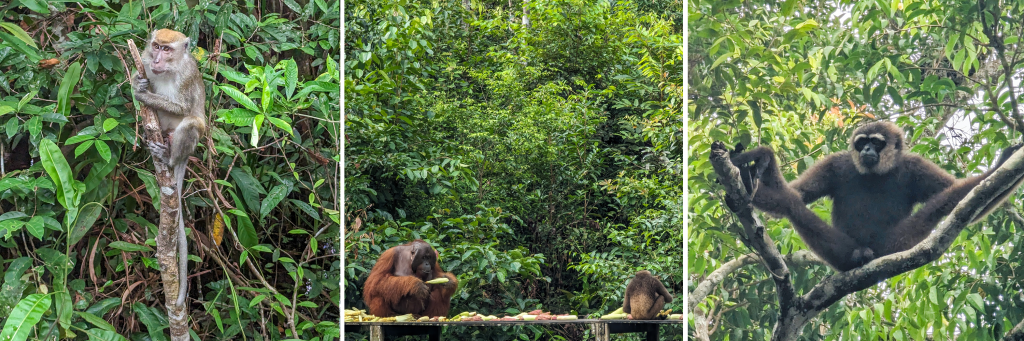
long-tailed macaque, orangutan & gibbon, gibbon waiting in a tree
One of my favorite moments that I filmed was a baby orangutan scaring away a long-tailed macaque that was getting too close to the food.
The orangutans, the macques, and the gibbons are all endangered in the wild. Their homeland is threatened by humans and these national parks and the revenue from tourists are one of the few things keeping these animals from extinction. This next embedded video is a playlist of the best orangutan videos. Most of them are relatively short clips and the whole list will take only 6 minutes to watch.
 Meandering Marbles
One thought on “Orangutans of Kalimantan”