Panaji City
Panaji (also known as Panjim) is the capital city of the state of Goa. I arrived there on May first, which was Labour Day (labour spelled with a u because of the British). Almost everything was closed and the streets were relatively empty, so I just wandered around town.
There was a huge parade of workers walking from one side of town to a gathering in the central park. It was fascinating to see all the different groups coming together. I saw banners for brewers, concrete workers, and beach club employees. There is a small river that runs near the city and there’s a shaded boardwalk that meanders through the mangroves that grow on each side of the river.
Although India is often associated with British colonization, Goa was originally a colony of the Portuguese. Vasco de Gama and his crew were the first to arrive, and by the early 1500’s the Portuguese had established a significant stronghold in the area. This part of India remained part of Portugal until the 1950’s when they achieved their independence. They ultimately voted to become a part of the rest of India which had become independent in 1947. The signs of Portuguese influence are everywhere. For example, in the center of Panaji stands the Immaculate Conception Church, built in 1541 to serve Catholic Portuguese sailors.

Labour Day parade, Immaculate Conception Church, mosaic bridge over the Rio de Ourém
The parks of Panaji are decorated with some interesting sculptures. The one in all the tourist books is of Abbé Faria, a Goan Catholic priest who was a master of hypnotism. The central park contains a modern sculpture dedicated to Tristão de Bragança Cunha, an anti-colonial activist who called for Goan independence from Portugal. He was arrested for organizing against Portuguese rule and spent several years in prison. Once released, he continued his liberation work and published a newspaper dedicated to the cause. My favorite sculpture, though, was probably the awkwardly helmeted Indian gaur planted right next to the main road.

statue of Abbé Faria hypnotising a subject, sculpture dedicated to TB Cunha, Indian gaur
I stayed in the Fontainhas area of Panjim when I was there. It’s a UNESCO World Heritage site due to the colorful houses dating to the time of Portuguese rule. In addition to the white churches, there are also relatively recently built Hindu temples. There are more Hindus in Goa now, but there are still many practicing Christians.

colorful Fontainhas house, Shri Hanuman Temple, Shri Vithal Rakhumai Mandir
One of my favorite parts of Panaji was the colorfully decorated stairs all over the Fontainhas area. It was probably over 100F and I was sweating profusely. Not much was open, so I just kept walking along abandoned streets, turning randomly at corners, and truly just stumbled upon these hidden gems.

bottom of stairway decorated with books, rainbow stairs, peacock stairs
Goan Food
The Portuguese influence is definitely reflected in the food. Xacuti was traditionally a coconut curry dish usually prepared with seafood, but is now offered in a variety of meat (and meatless) options. This is often served with poi, a small bread with a pocket, similar to a pita. On Labour Day, only a few restaurants were open, but I found the air-conditioned all-vegetarian Cafe Tato and it felt like I’d walked into paradise. I ate there probably 3 or 4 times and everything was delicious. It’s an iconic establishment that serves up awesome food all day long, but is known for its breakfast. That morning, I ate sukhi bhaji, a potato dish with a side of deep-fried puffed puri and a perfectly sweetened cup of masala chai. On another trip, I had batata wada, basically fried potato fritters. I have some more Indian food to share, but I’m going to leave the rest for another post.

xacuti with poi, suki bhaji with puri and masala chai, batata wada
Cashew Festival
I ended up in Panaji a few times during my month in Goa, but I want to highlight one special day. At the time, I was doing a yoga teacher training about an hour away, but another student Gabi and I taxied in for the Goa Cashew Festival. Cashews grown in Goa are sold all over the city and many local and foreign tourists return home with bags of these nuts. The festival was held in a big open space with a glittering disco ball cashew welcoming us to the festivals. In case you don’t know, the nut of the cashew actually hangs out from the bottom of the fruit. The fruit itself is very astringent, and to be honest, I’m not a big fan.
All around the festival square were local restaurants selling cashew-based dishes and a few agricultural initiatives showing off different cashew varieties. There was a huge stage set up for a cashew-inspired fashion show and tons of little booths selling cashews with lots of different flavors. (My favorite was the Sriracha.) We got hit with an unexpected downpour and ended up hiding under a table to eat our cashew dinner. The rain finally stopped long enough for us to grab some cashew ice cream before we had to head back to the shala.
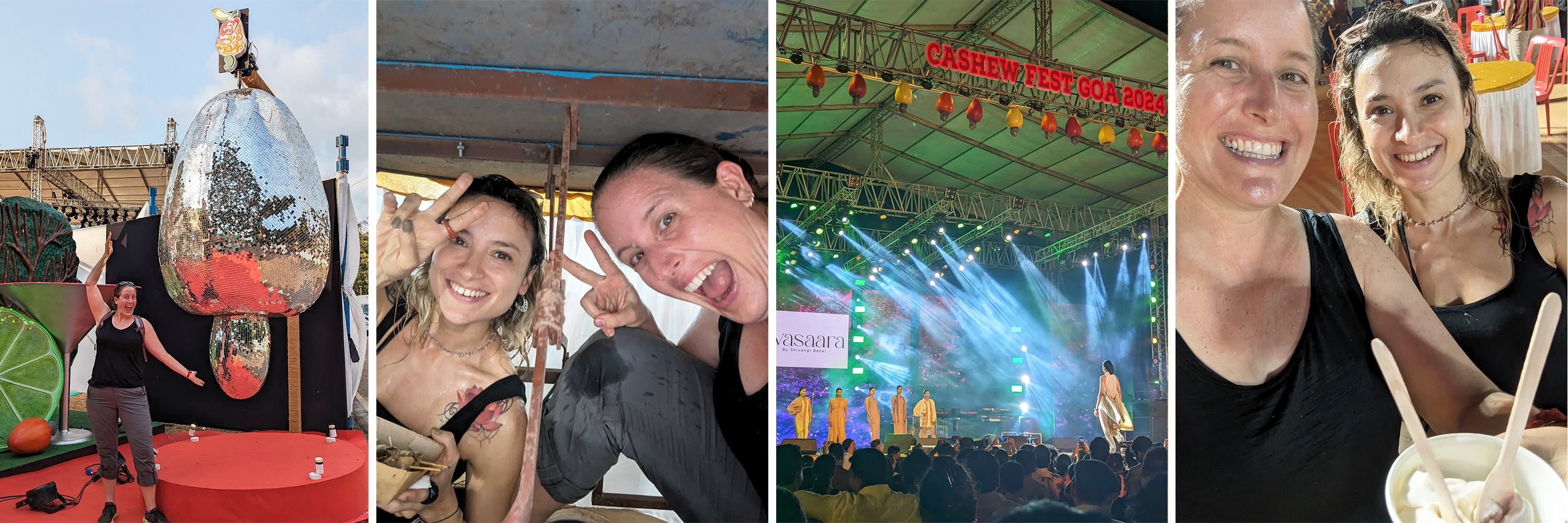
me and the disco ball cashew, Gabi and I hiding under a table, fashion show, enjoying our cashew ice cream
 Meandering Marbles
The description of Panaji is detailed and excellent. I have been to Goa several times and it is a relaxed town to chill out
LikeLike