Bit of History
From Jaldapara, it’s about a 4 hour drive to Darjeeling. I didn’t have a lot of time, so I hired a taxi and off we drove through the turning, winding backcountry roads of West Bengal. This part of India is near the border and there are many signs of the historical movement between India and neighboring countries. There are Buddhist temples, prayer flags, and restaurants advertising momos in most small towns we passed through. In the case of the Gurkhas, the border crossed them. Gurkhas (or Gorkhas) are Nepali-speaking Indians who I had heard about before in a military context. They first fought against the British East Indian Company in the Anglo-Nepalese War. The British lost many battles before they finally won enough to force a peace treaty which gave them access to land outside of India. Later, the Gurkhas fought in the British Indian Army during World War II. Even today, they are still heavily recruited for many armies around the world. Because they speak a different language and have different customs than other Indians, they have experienced ethnic discrimination and violence. In response, they started a movement to establish a Gorkhaland state (carved out of West Bengal) in an effort to attain more political and social power.
In addition to the Gurkhas, there are Tibetan refugees who fled their home, starting after the 1959 uprising which caused the Dalai Lama to move to India. That immigration pattern has continued through subsequent Tibet-China disputes. There are also Bhutanese who left their country in political protest before the democratic reforms were instituted in the last twenty years.
During British colonization times, Darjeeling was set up as a summer retreat for British officials. It’s known as a “hill station” because it was a station in the hills, much cooler than the lowlands. That is still true today and I met a Bengali couple who had come to Darjeeling to escape the super hot temperatures (45 C/113 F) in Kolkata. The British started growing tea in the countryside, and there are still tea plantations sprawling out from the town in just about every direction. Because I only had a couple days, I didn’t actually make it to out to any of them, but I did buy a bunch of tea to see if I could taste the difference between leaves from the first flush (spring harvest) and those from the second flush (summer harvest) once I get home.

en route to Darjeeling: motorcycle moving mattresses, funny faced Assam Macaque, tea at the very British establishment Glenary’s
Toy Train
The Darjeeling Toy Train gets its name from the fact that it operates on tiny engines and narrow gauge rails (2 ft). I managed to, once again, wade through the bureaucracy of opening an online account for an Indian government agency and reserved a spot on one of the sightseeing trips that goes to the nearby town of Ghum and then returns. There was a choice of authentic steam engines (running on coal) or diesel engines and I went for the original coal that included an extra fee. In retrospect, I might have chosen diesel, because the coal-powered train produced a lot of smelly smoke that entered into the passenger cars while the train chugged up the hills.
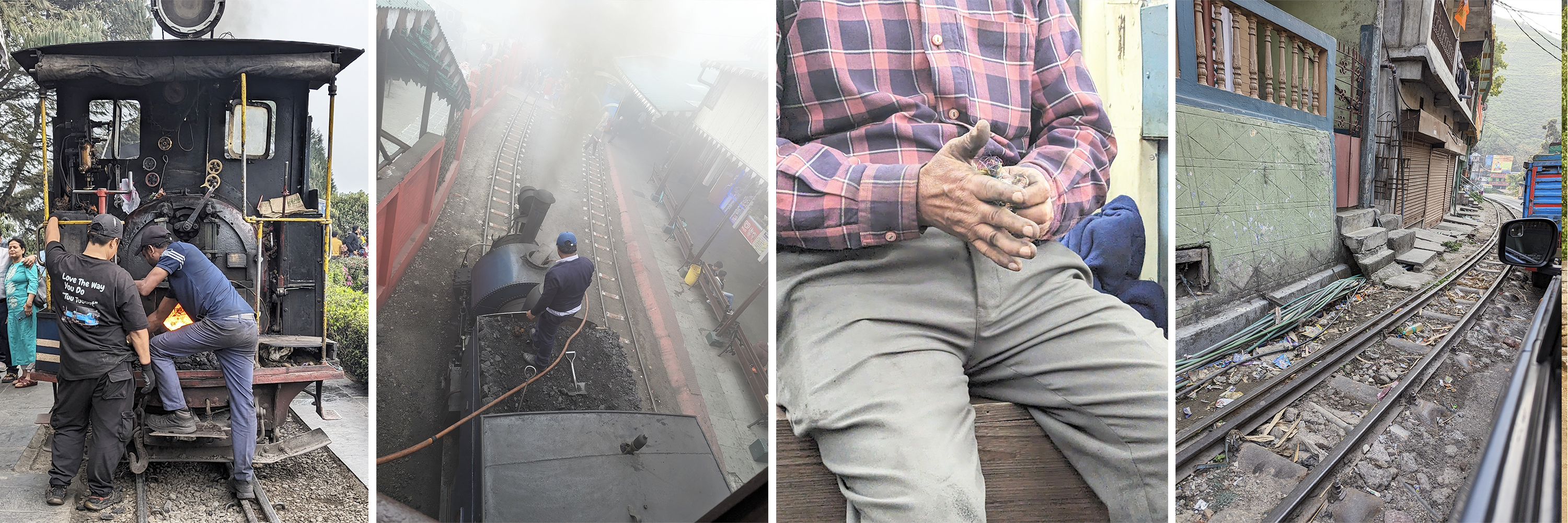
stoking the coals, lots of steam, train worker’s hands, tracks alongside buildings
The trains don’t move very fast along and there’s a stop at the Batasia Loop which is how they used to get the trains to change directions within a small amount of space while keeping the train on the tracks. The loops basically function the same way freeway on-ramps work today. On a different section of the track, the train has zig-zag switchbacks to climb altitude quickly. Imagine a zig-zag track going up the side of a mountain. The train goes from one section to the next by first climbing forward, pulling into a level area, switching the track, and then reversing backwards up the next section. There’s a little train in Northern California that does this and it’s quite an experience.
One of the best parts of the ride is seeing all the nearby buildings. The tracks are right in the middle of these small towns and the walls of these houses shake every time a train comes through. Because the train is moving so slowly, it’s easy to people watch and enjoy the scenery. Upon arrival at Ghum station, the train stopped for the workers to fill up on coal and for the tourists to get a bite to eat and visit a small museum. Inside was an article about Mark Twain (a fellow native Missourian) riding the railway in 1896. Although there are many quotes associated to the man that are not actually true, apparently he wrote that the day riding the Darjeeling Toy Train was “the most enjoyable day I have spent on Earth.” This is probably because he rode down from the Ghum station to Darjeeling in a hand-car at whatever speed gravity propelled them and that surely must’ve felt like an extended roller coaster ride moving rather quickly around the loops and turns.
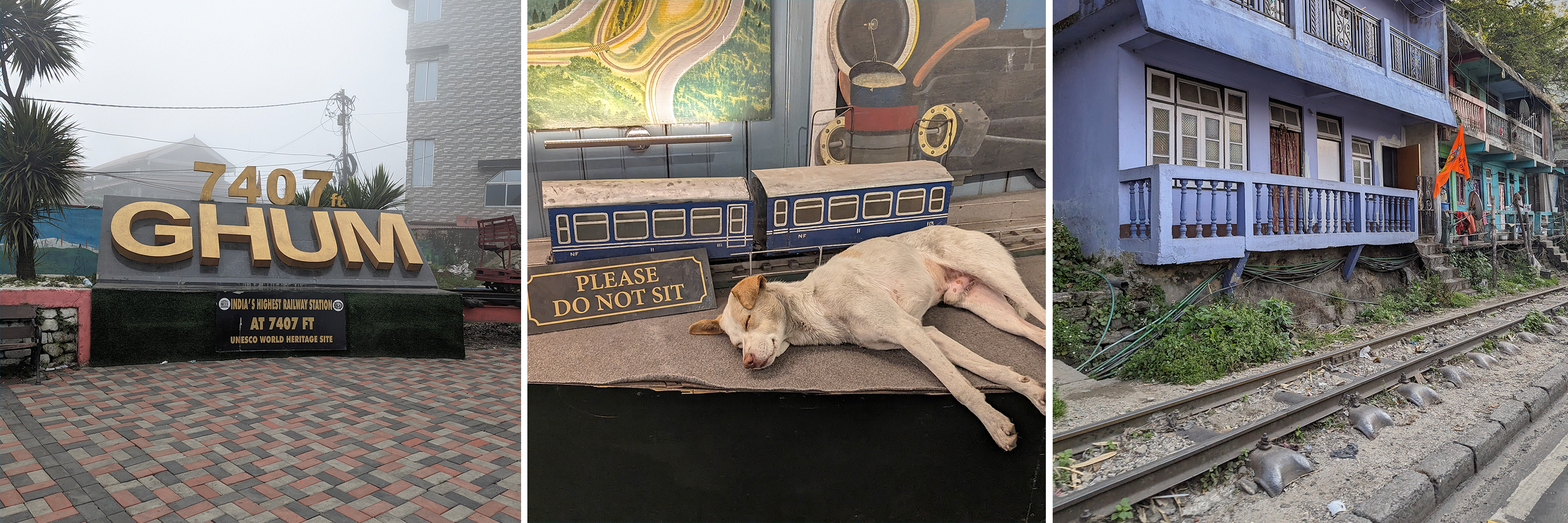
Ghum station, dog following rules in the train station (the sign says nothing about lying down), more buildings close to tracks
After the museum, I opted for some warm masala chai in a clay cup since it was quite a bit chillier at the higher elevation. Darjeeling is surrounded on all sides by the Himalayas, and its known to have spectacular view of the third-highest mountain in the world, Mt. Kangchenjunga. Unfortunately for me, it was foggy and cloudy every single day I was there, so my views were not very breathtaking.
When traveling, I’m a big fan of trying all the candies and treats that I can’t get in the United States. Although I am not a huge fan of Snickers, the kesar pista (saffron pistachio) version was actually pretty tasty. Cadbury Gems are basically M&M’s and the Cadbury Fuse is basically peanuts, creme and caramel.

chai from Ghum station, view of Kangchenjunga, Indian treats
Himalayan Mountain Institute
One of the ongoing jokes from my trip to Bhutan was my desire to see a red panda. My guide kept telling me we might see one on our Merak-Sakteng trek or along the drive back to Paro, but eventually we were at lower elevations and it was clear that it wasn’t going to happen. Once he found out I was going to Darjeeling, he assured me I would see one there and he was right. The Darjeeling Zoo has a few of these adorable creatures on display. These are not closely related genetically to the giant panda at all, and are much closer to raccoons and skunks. Scientists have placed them into their own family branch that belongs to only them and their now extinct ancestors.
Inside the zoo is also the Himalayan Mountaineering Institute whose first Field Director was Sherpa Tenzing Norgay. Along with Edmund Hillary, they were the first people to reach the top of Mount Everest in 1953. The Institute was set up shortly thereafter to encourage others to participate in the sport. The museum includes clothing and equipment that was used in the early days of mountaineering.

red panda, quote from Tenzing Norgay, statue of the famous Sherpa
 Meandering Marbles