En Route to Paro
We stopped on the way back to Paro to see the Tachogang Lhakhang Bridge which was built over 600 years ago. Now it has an additional support structure, but this was forged from iron with wooden supports by Thangtong Gyalpo in the late 1300’s. This guy made over 100 bridges all over Bhutan and Tibet and this was the first ever bridge built in Bhutan.

view of bridge, up close of chain link, last jumping picture of the four of us
Paro
Angela and I actually did almost all of our Paro sightseeing at the beginning of the trip, but I got too excited to blog about our Eastern Bhutan adventures to write about it then. Our very first stop in the city was the National Museum of Bhutan set inside a watchtower overlooking the town. I remember feeling completely overwhelmed with all the information. There were so many Buddhist deities and Bhutanese historical figures to wrap my head around, while still dealing with jet lag from just arriving that morning. After the museum tour, we headed out to the Paro Dzong.

watchtower, Angela and the Paro Dzong, inside the Paro Dzong
This was the first dzong we visited and it functions the same way as the others we saw: part is for governmental administrative purposes and part is for monastic religious purposes.
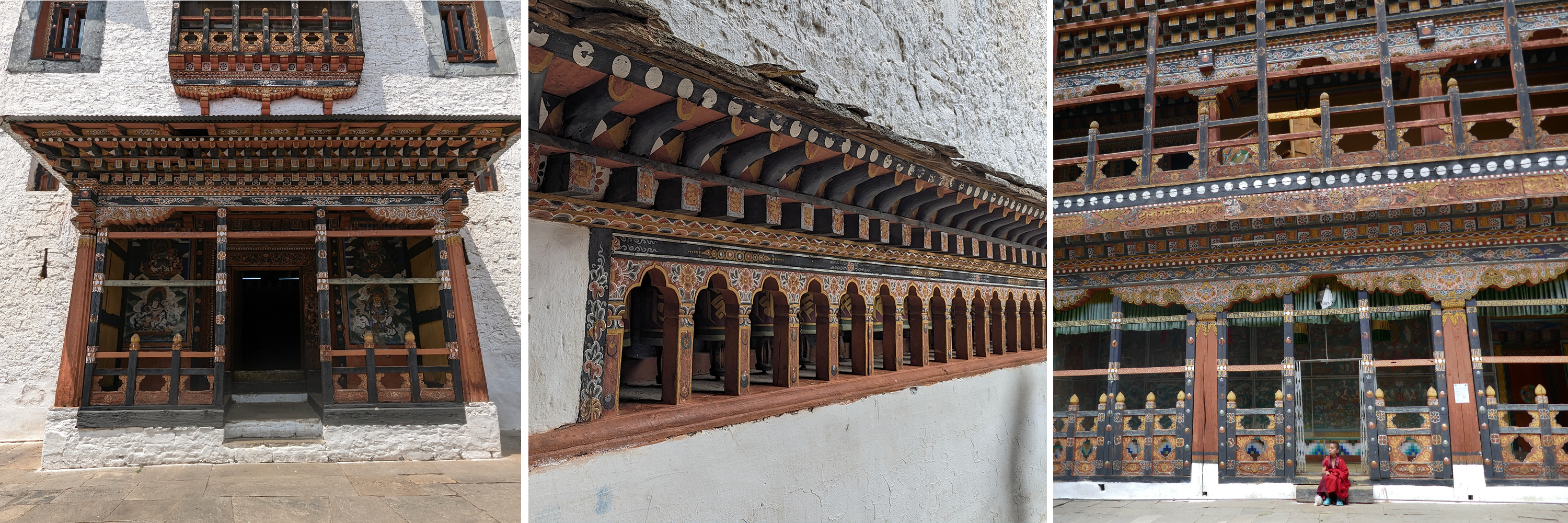
decorations inside Paro Dzong, row of prayer wheels, monk-in-training
Our second day in Bhutan, we set out for one of the most notable sights in Bhutan: Tiger’s Nest Monastery. It’s built into the side of a mountain and is probably the most picturesque structure in all of Bhutan. It’s not that long of a trail (only 3-4 miles), but the elevation gain is 1500 ft and Paro is way over a mile above sea level (7200 ft). We took it real slow and huffed and puffed our way to the top. I was moving a bit faster than Angela on the way up, so I asked Tenzin to start teaching me the numbers in Dzongkha. It seemed pretty easy at first, and I got through 1 through 5 without too many problems (chee, nyi, zhi, sum, nga). My brain kept screwing up the order of the higher numbers though, but we both managed to learn up to ten by the time the day was over.
Once we got to the top, Tenzin told us the story behind the monastery, which stars our old friend Guru Rinpoche. He came to this location standing upright (think surfing) on the back of a flying tiger. This tiger was another form of his Tibetan consort Yeshe Tsogyal. Once he arrived at this spot in the mountain, he subdued a local demon and then meditated for three years, three months, three days, and three hours in a cave, thus, the name Tiger’s Nest. The whole monastery actually burned down in 1998 (probably from an overturned butter lamp) and was carefully rebuilt to match the original.
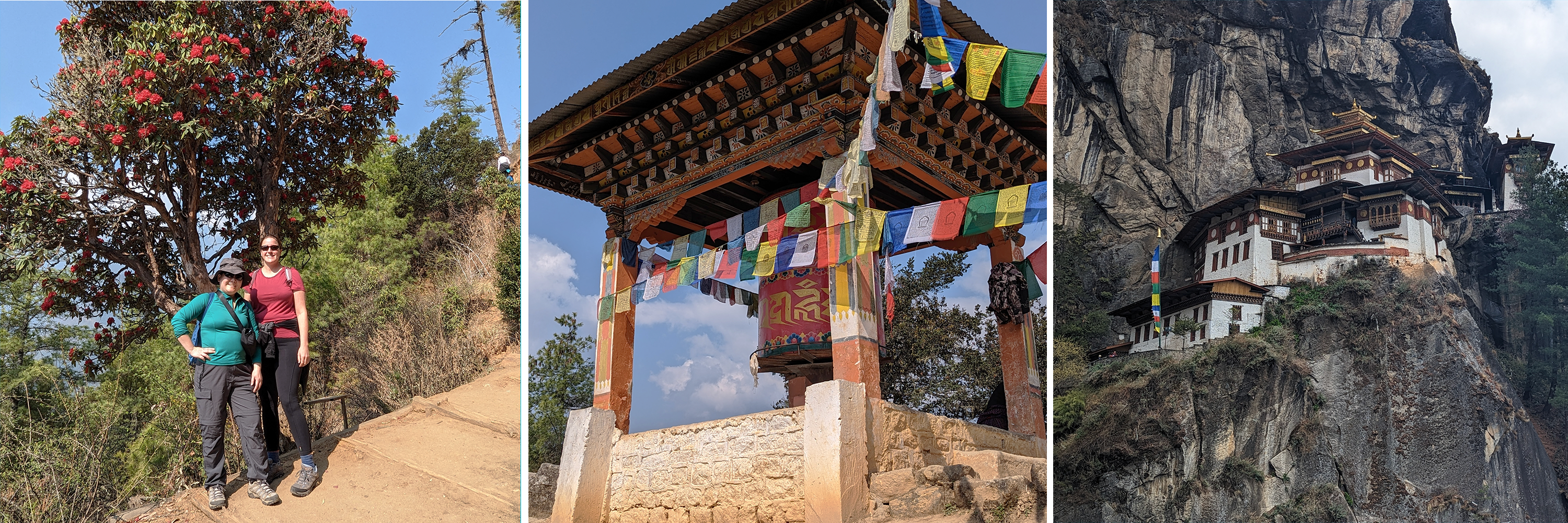
Angela & I and our first rhododendron, giant prayer wheel en route, Tiger’s Nest Monastery
I’m including the photo below so you can really revel in its dramatic beauty. And, yes, I took that photo on my phone.

Side Note on Stupas
Stupas are everywhere in Bhutan and there are often eight of them in a row and each of them are slightly different. They represent different stages of the life of Buddha. When there is a singular stupa, it is often connected to a specific individual or a specific event that a group of people are trying to commemorate. These stupas were all new to me, so when I had wi-fi one evening, I downloaded a cheat sheet of the 8 types of stupas and then it became a game to see if we could figure out the types of stupas we saw on the road.
The easiest one to identify is Nirvana, because it has a totally unique shape than the rest, more of a bell shape. The rest are a bit more subtle, but over time, I could see the differences a bit easier. At some point I made the comment that all these versions were “stupa-fying.” I have to admit to being rather proud of my dad joke. The stupas in these photos are fancier than most and I took them on the last day’s drive near a town called Gedu in the south. Note: In Bhutan, these are also called chortens which is the Tibetan word for a stupa.
- Lotus Blossom Stupa (characterized by lotus flower carvings on four circular steps) – This represents Buddha’s birth. When he was born, he came out of the side of his mother’s body and then immediately stood and walked seven steps, and a lotus flower bloomed in each stop he had walked.
- Enlightenment Stupa (characterized by four levels of steps) – This represents Buddha attaining enlightenment under the bodhi tree at the age of 35.
- Many Doors Stupa (characterized by many openings that look like gates or doors) – This represents his first teachings to his five disciples in the deer park in Sarnath, which is located close to modern-day Varanasi in India. These ideas were entrances and pathways to understanding dharma.
- Great Miracles Stupa (characterized by a center section that sticks out further than the surrounding steps) – This represents the miracles he performed in Shravasti, where he made flames come out of his shoulders and water come out of his feet. He then made the flames and water switch positions several times.

Lotus Blossom, Enlightenment, Many Doors, Great Miracles (click on the image to enlarge)
- Descent from Heaven Stupa (characterized by three ladders in the center of the steps) – This represents Buddha’s return from his trip to heaven. He went there to teach the dharma to his mother who had already passed away.
- Reconciliation Stupa (characterized by four steps with equal sides) – This represents the resolution of a schism between some of Buddha’s monks. His cousin Devadatta had tried to lead a breakaway group of monks, but Buddha sent two of his disciples and the situation was reconciled peacefully with the monks rejoining the main group.
- Complete Victory Stupa (characterized by three circular steps) – This represents Buddha, at the age of 80, agreeing to live for three months after being asked to do so by one of his followers).
- Nirvana Stupa (characterized by the bell shaped dome) – This represents Buddha entering nirvana into a state of true peace, beyond death.

Descent from Heaven, Reconciliation, Total Victory, Nirvana (click on the image to enlarge)
 Meandering Marbles