Eezay
The most important part of every Bhutanese meal is a small dish of chilies, known as eezay. There are many different varieties of eezay. Some are nothing more than piles of red chilies; others are mixed with cilantro and other herbs. Often, the restaurant food caters to Western tourists that prefer their food on the blander side. I, however, prefer my food with a little more spice and by the last week of the trip, I just asked for a dish of eezay at every meal.

bag of chillies at the Paro market, old school giant mortar and pestle used for crushing chilies, side dish of eezay
Food in Eastern Bhutan
The food from our homestay in Merak was delicious. Every morning, we got thueb, red rice porridge with little cubes of paneer (homemade cheese). We also got a pile of fried red rice, a hard-boiled egg, and a cup of butter tea.
On our day-long Merak-Sakteng trek, our porters carried lunch for us and I got my first taste of my favorite Bhutanese food, nakay datshi. This is a dish made of fiddleheads, the fronds of the fern before they unravel in the spring. I’ve definitely eaten fiddleheads in the United States, but they’re pretty rare and often just sauteed in a simple butter sauce. These were cooked in a cheese sauce with chilies; something about this flavor combination is extremely satisfying. Datshi means cheese in Dzongkha and is featured in many dishes in Bhutan. For example, kewa datshi is potatoes with cheese (kewa means potato) and shamu datshi is mushrooms with cheese (shamu means mushroom). The amount of chillies in each dish depends on the preference of the chef.

Merak trek food (clockwise from left): eggs, mixed vegetables, eezay (chillies), rice, and nakay datsay; Angela getting her daily portion of thueb; drinking butter tea
Food in Central Bhutan
For lunch on our temple tour day, Tenzin took us to a local homestay that served a huge spread of food. We started with milk tea and then we tossed in some puffed rice (think Rice Krispies) for some added texture. Bumthang is known for buckwheat, so we got to sample long, skinny buckwheat noodles as well as two kind of wheat noodles: long, flat ones and short, fat pinched ones. We also drank some ara, the local moonshine which in this area had been brewed with sandalwood, giving it a slight pinkish tint.
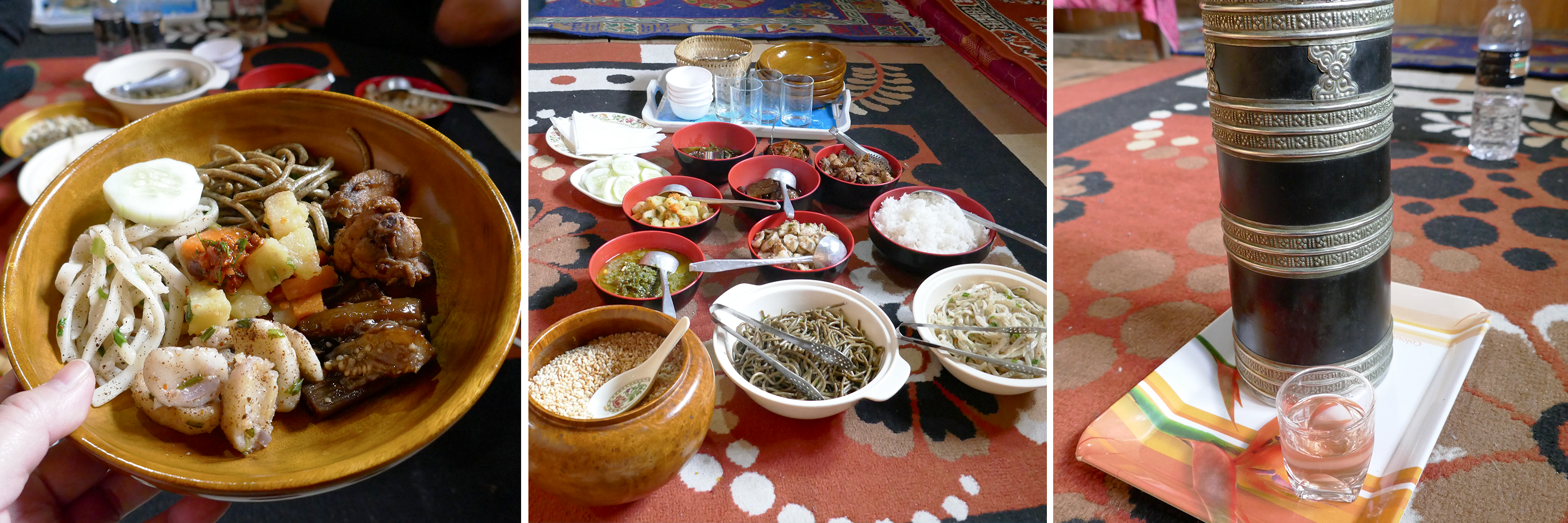
Angela’s lunch plate full of noodles, the whole spread, and a traditional ara serving vessel with a glass of ara in front
In Bumthang, we also ate some delicious buckwheat pancakes for breakfast, smothered in local honey. Somewhere along the way, Tenzin figured out that Angela loves dumplings, so for a few dinners we ate a bunch of vegetable and potato dumplings. While we were in Phobjikha Valley, we ate kapchi, roasted wheat flour egg drop soup. Apparently this is a common soup to eat when you’re feeling sick and it was a surprisingly satisfying first course.

delicious buckwheat pancake, momo (dumplings), kapchi (toasted wheat soup)
Olo Choto
I had never seen this vegetable before in my life. Locally, it’s known as crow’s beak due to its shape. Tenzin showed it to us when we started our trip in Paro and both Angela and I had lots of questions about how people prepare it. She went down an internet rabbit hole and found out that there is a related variety that grows in Peru and Bolivia known as achocha.
We were walking through the Trongsa market and when we saw it again and we both started talking about how we wanted to try it, but it had to be cooked. Tenzin overheard us and was like, I’ll buy you some olo choto and I’ll have the hotel make it for dinner. In the car, we started discussing having an olo choto party and we were all laughing so hard. The hotel staff were kind enough to prepare the olo choto with cheese and chili. It was a delicious dinner and our guide and driver got to share in the olo choto fun as well.
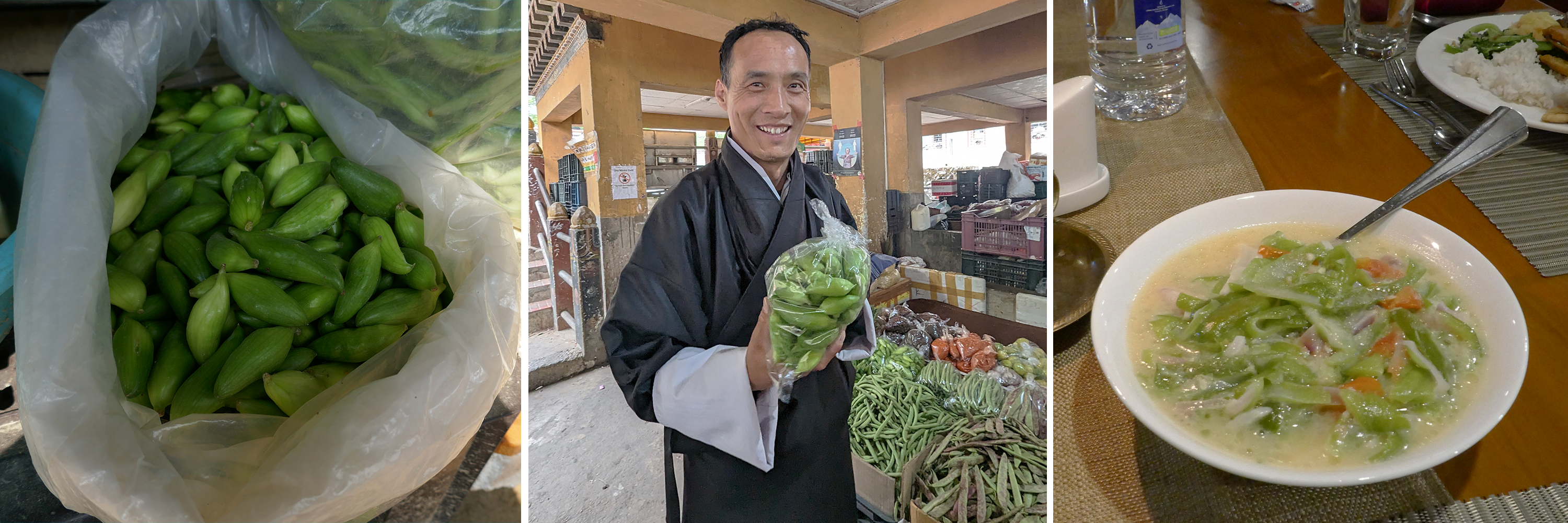
pile of olo choto, Tenzin proudly showing off his purchase, prepared olo choto datshi
Best Meal of the Trip
For me, one of the best meals we had on our trip was on our way out of Thimphu. I kept asking Tenzin to find a place with some nakay datshi and he totally hooked us up. We started with a cup of milk tea (butter tea was also an option) with puffed rice (zao in Dzongkha). Then we were served a simple pumpkin soup before a bunch of different dishes arrived.
First up was ema datshi, which is practically the national dish of Bhutan. Ema means chilli in Dzongkha and this is a dish made of chilies and cheese, with different amounts of soupiness depending on the part of the country (I personally think the less soupy version is a bit better). This time of year, green chillies are the main ingredient. Next came my favorite nakay datshi, made with the seasonal fiddleheads mentioned earlier. There were also scrambled eggs, kewa datshi (potatoes and cheese), and the ever-present dish of eezay. We also were served Bhutanese red rice, which still has part of the bran left on the outside of each kernel. It has a slight nutty flavor and has quite a bit more nutrients than white rice. Interestingly, red rice is the only food item that the United States imports from Bhutan.

fiddleheads (nakay) at the market, one of the best meals we had in Thimphu (clockwise): red rice, eezay, nakay datshi, kewa datshi, eggs, ema datshi
Special thanks to Angela for providing most of the photos in this post!
 Meandering Marbles